




 IJOPRS Home



SHH Pathway: A New Therapeutic Target for COPD
Nabeela Khanam1*, Mohammad Shameem1, Naveed Nazir Shah2 and Santosh Kumar3
1 Department of TB & Respiratory Disease, JN Medical College, Aligarh Muslim University, India
2 Department of Pulmonary Medicine, Government Medical College, India
3 Department of TB and Chest Disease, SN Medical College, India
Submission: May 21, 2026; Published: June 02, 2026
*Corresponding author: Nabeela Khanam, Department of TB & Respiratory Disease, JN Medical College, Aligarh Muslim University, Aligarh-202002, India
How to cite this article: Nabeela K, Mohammad S, Naveed Nazir S, Santosh K. SHH Pathway: A New Therapeutic Target for COPD. Int J Pul & Res Sci. 2026; 8(4): 555743.DOI: 10.19080/IJOPRS.2026.08.555743
Abstract
Chronic Obstructive Pulmonary Disease (COPD) is a major cause of morbidity and mortality worldwide. Although historically regarded as a disease predominantly associated with cigarette smoking, COPD is now recognized as a complex and heterogeneous disorder influenced by early life events, environmental exposures, genetic susceptibility and impaired tissue repair mechanisms. Among the molecular pathways regulating lung development and regeneration, the Hedgehog (HH) signaling pathway particularly Sonic Hedgehog (SHH) and Hedgehog-interacting protein (HHIP) has attracted considerable scientific interest. Emerging evidence from developmental biology, genome-wide association studies and pathophysiological research suggests that dysregulation of HH signaling plays a critical role in shaping airway architecture, modulating immune responses, regulating epithelial cell differentiation and influencing susceptibility to COPD. This review synthesizes current advances to highlight how SHH signaling may serve as a mechanistic bridge linking early-life determinants with adult COPD pathogenesis, thereby identifying potential targets for future disease-modifying therapeutic strategies.
Keywords:COPD; Sonic Hedgehog; Hedgehog signaling; Lung development; Airway remodeling
Abbreviations:(COPD): Chronic Obstructive Pulmonary Disease; (HH): Hedgehog; (SHH): Sonic Hedgehog; (HHIP): Hedgehog-Interacting Protein; (FVC): Forced Vital Capacity; LLN: Lower Limit of Normal; DHH): Desert Hedgehog; (SMO): Smoothened; (PKA): Protein Kinase A; (SUFU): Suppressor of Fused; (FGF): Fibroblast Growth Factor; Genome Wide Association Studies (GWAS)
Introduction
In 2019, the World Health Organization ranked chronic obstructive pulmonary disease (COPD) as the third leading cause of death worldwide, following ischemic heart disease and stroke. Despite this substantial and growing burden, COPD remains relatively under-recognized by the general public. It is often perceived as a smoking-related bronchial disorder affecting older individuals. Clinically, COPD is characterized by persistent dyspnea that leads to progressive disability, as well as acute exacerbations that can be life-threatening and are frequently triggered by respiratory infections, although the underlying mechanisms are not always fully understood [1].
The diagnosis of COPD relies on spirometric assessment, particularly forced expiratory volume in one second (FEV₁) and forced vital capacity (FVC). COPD is defined by persistent airflow limitation after bronchodilation, reflected by an FEV₁/FVC ratio below the lower limit of normal (LLN), along with a progressive decline in lung function severity assessed by FEV₁ [2]. Historically, COPD was viewed as the result of an accelerated decline in FEV₁ following a peak attained in early adulthood. This concept was challenged by Lange and colleagues, who demonstrated substantial heterogeneity in lung function trajectories across the lifespan [3]. Importantly, lung growth continues beyond birth and extends into adolescence, typically until 14-18 years of age [4]. Insults occurring during critical windows of lung development may therefore reduce maximal lung function, predisposing individuals to lower pulmonary reserve and increasing susceptibility to COPD later in life [5].
COPD develops through the interaction of multiple environmental and genetic factors, with cigarette smoke exposure representing the most prominent risk factor. However, only approximately 20% of smokers develop COPD, and epidemiological studies indicate that 25-45% of affected individuals have never smoked [6]. Occupational exposures, particularly in agricultural and mining settings, were among the earliest non-smoking risk factors identified. More recently, exposure to biomass fuels and ambient air pollution has been strongly associated with COPD prevalence, independent of tobacco use [7]. In addition, epigenetic mechanisms including DNA methylation, histone modifications, and dysregulated microRNA expression are increasingly recognized as key contributors to disease pathogenesis, providing a mechanistic link between environmental exposures and genetic susceptibility [8,9].
Despite extensive research, the molecular and cellular processes responsible for irreversible lung damage in COPD remain incompletely understood. Pathologically, COPD is characterized by remodeling of small airways, increased airway wall thickness, mucus luminal obstruction, peribronchial fibrosis, and chronic immune cell infiltration [10]. The bronchial epithelium comprises several specialized cell types, with ciliated epithelial cells being the most abundant in healthy airways and playing a crucial role in mucociliary clearance [11].
Currently, no disease-modifying therapies are available for COPD, particularly in patients with early-onset or severe disease. Existing pharmacological treatments primarily target airway smooth muscle, including long-acting β₂-agonists and long-acting muscarinic antagonists and mainly provide symptomatic relief without significantly altering disease progression [12]. In advanced stages, lung transplantation remains the only curative option [13]. There is therefore a critical need to develop therapeutic strategies aimed at restoring lung homeostasis and correcting the underlying biological mechanisms driving COPD. Identification of key signaling pathways involved in disease initiation and progression may open new avenues for targeted intervention.
Among these pathways, the Hedgehog signaling cascade particularly its principal ligand, Sonic Hedgehog (SHH) is a fundamental developmental pathway with essential roles in lung morphogenesis, in addition to its functions in central nervous system and limb development [14]. SHH signaling is tightly regulated by Hedgehog-interacting protein (HHIP), a major inhibitory component of the pathway. In this review, we focus on early and severe COPD phenotypes, which are thought to reflect enhanced genetic susceptibility, and examine the contribution of the Hedgehog signaling pathway to disease pathogenesis. Accumulating evidence suggests that dysregulation of this pathway contributes to COPD through multiple mechanisms and may represent a promising target for future therapeutic development.
Methods
This narrative review was conducted using literature searches in PubMed, Scopus, and Web of Science. Search terms included combinations of ‘COPD’, ‘Sonic Hedgehog’, ‘Hedgehog signaling’, ‘HHIP’, ‘lung development’, and ‘airway remodeling’. Articles published in English up to 2025 were considered. Both experimental and clinical studies examining Hedgehog signaling in lung biology or COPD were included. Priority was given to peer reviewed original research articles, genome wide association studies, and major review papers. Studies not directly related to lung biology or COPD pathogenesis were excluded.
a) Inclusion Criteria: (1) Original research studies (in vitro, in vivo, and GWAS), (2) Meta-analyses and systemic reviews regarding the Hhip locus, and (3) Studies investigating the role of HH signaling in airway remodeling and emphysema.
b) Exclusion Criteria: (1) Studies focusing solely on lung cancer without relevance to COPD pathology.
Hedgehog Signaling Pathway
The Hedgehog gene family was first identified in 1980 by Wieschaus and Nüsslein-Volhard during studies of embryonic development in Drosophila melanogaster. Mutations in the hedgehog gene resulted in larvae with a spiky cuticle, giving rise to the pathway’s name. In humans, three Hedgehog ligands have been described: Sonic Hedgehog (SHH), Indian Hedgehog (IHH), and Desert Hedgehog (DHH), with SHH being the predominant ligand expressed in the lung [15]. Hedgehog signaling is unique among developmental pathways due to its reliance on a series of inhibitory regulatory steps and its signal transduction mechanisms are not fully conserved across species [16]. Signal transduction is mediated by GLI transcription factors, members of the Kruppel family of zinc finger proteins originally identified as oncogenes in gliomas [17]. These transcription factors function as context-dependent regulators capable of either activating or repressing target gene expression.
The primary receptor for HH ligands is Patched (PTCH1), a 12-pass transmembrane protein that indirectly suppresses the activity of Smoothened (SMO), a G protein–coupled receptor–like protein [18-20]. In the absence of ligand binding, SMO inhibition allows protein kinase A (PKA) and suppressor of fused (SUFU) to restrain GLI activity, leading to the generation of transcriptionally repressive GLI forms. Upon SHH binding, PTCH1-mediated inhibition of SMO is relieved, enabling SMO activation and its localization to the primary cilium, where full-length, transcriptionally active GLI proteins are generated.
Activated GLI proteins translocate to the nucleus and regulate genes involved in cell proliferation, differentiation, survival, migration, epithelial-mesenchymal transition, and stem cell maintenance, including MYC, FOXO, and cyclins D and E [21]. HHIP and PTCH1 are direct transcriptional targets of GLI activation, forming a negative feedback loop that limits excessive pathway activity [22-24]. Additional modulators of HH signaling include CDO, BOC, and GAS1, which enhance pathway activity through cooperative ligand binding or modulation of HHIP interactions [25]. Evidence also supports the existence of non-canonical HH signaling mechanisms, as well as HH activity in cells lacking primary cilia, including immune cell populations (Figure 1) [26,27].
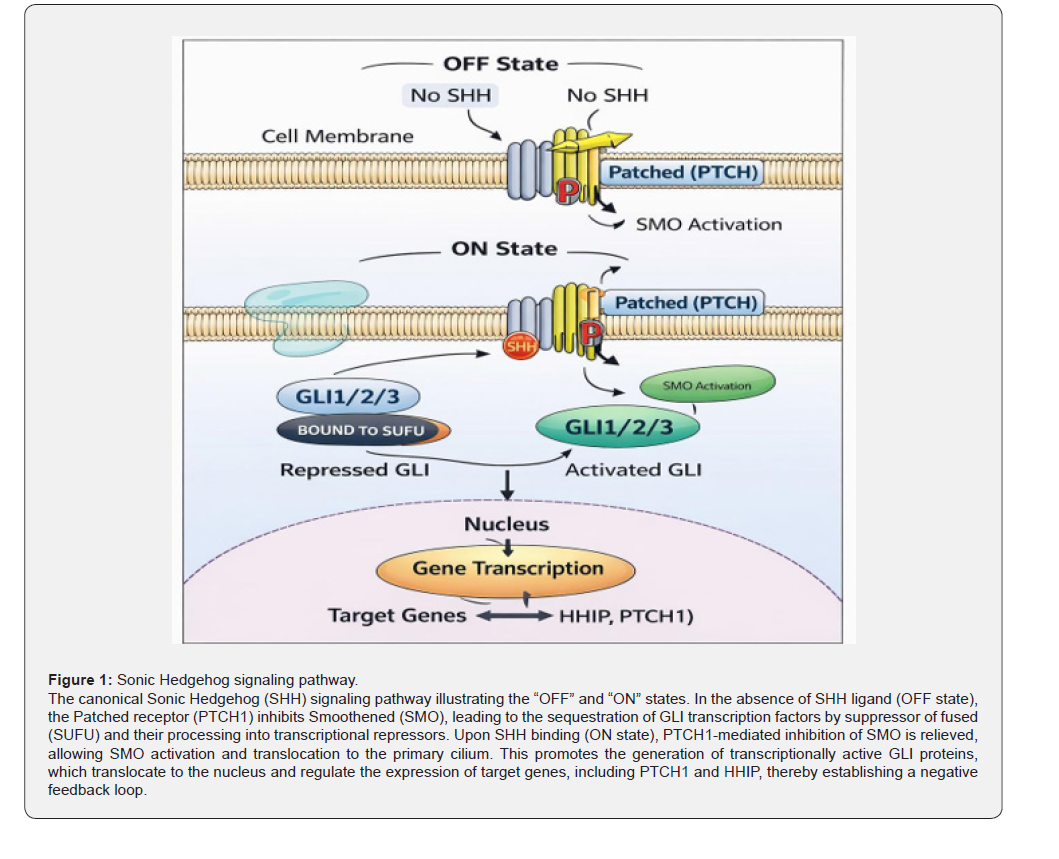
Role of HH Signaling in Lung Development
During embryonic lung development, Hedgehog signaling plays a crucial role in regulating branching morphogenesis and epithelial-mesenchymal interactions. Sonic Hedgehog (SHH), secreted by airway epithelial cells, acts on adjacent mesenchymal cells to coordinate lung patterning and airway formation [28, 29]. Experimental studies in mouse models have demonstrated that SHH signaling regulates fibroblast growth factor (FGF) signaling, particularly FGF10, which is essential for airway branching and proper lung morphogenesis [30]. Disruption of Hedgehog signaling results in severe abnormalities in lung structure, including impaired airway branching and defective lung development [31].
Role of SHH Signaling in Airway Disease
SHH signaling is active throughout lung development and persists into adulthood, where it contributes to airway maintenance and repair. Its involvement in lung biology across the lifespan, including COPD, has been previously reviewed [32]. Here, we emphasize the role of SHH signaling in bridging two major concepts in COPD pathogenesis: impaired lung growth and accelerated lung function decline. Both HHIP mRNA and protein levels are reduced in COPD lung tissue compared with healthy controls [33]. This observation may reflect reduced pathway activation or, alternatively, excessive SHH signaling due to loss of inhibitory feedback. Importantly, SHH does not act in isolation but interacts extensively with other key developmental pathways, including Wnt and Notch signaling, which collectively regulate airway epithelial differentiation and repair [34].
SHH Dysregulation in COPD
A growing body of evidence indicates that Hedgehog signaling is significantly altered in COPD. Reduced HHIP expression represents one of the most consistently reported molecular abnormalities and has been identified as a genetic susceptibility locus in multiple genome-wide association studies [35-37]. Disruption of HHIP-mediated negative feedback may lead to either insufficient or excessive SHH signaling, both of which are likely detrimental to airway homeostasis.
In the adult lung, tightly regulated SHH activity is essential for epithelial regeneration following injury. In COPD, dysregulated HH signaling impairs basal cell differentiation and limits recovery of ciliated epithelial cells, resulting in defective mucociliary clearance and prolonged exposure to inhaled toxins and pathogens [38,39]. At the same time, aberrant SHH signaling promotes mucous cell hyperplasia and goblet cell metaplasia, contributing to mucus overproduction and airway obstruction [40,41]. SHH dysregulation also contributes to airway remodeling and fibrosis through its effects on mesenchymal cells. Activation of the pathway in fibroblasts and airway smooth muscle cells enhances extracellular matrix deposition, cellular proliferation, and airway wall thickening, leading to progressive airway narrowing and fixed airflow limitation [42,43].
In addition, HH signaling interacts with inflammatory pathways, including NF-κB and cytokine-mediated signaling, potentially amplifying immune activation and sustaining chronic inflammation in COPD [44,45]. Crosstalk between HH, Wnt, and Notch pathways influences basal cell fate decisions, favouring secretory over ciliated epithelial lineages and further contributing to airway remodeling and functional decline.
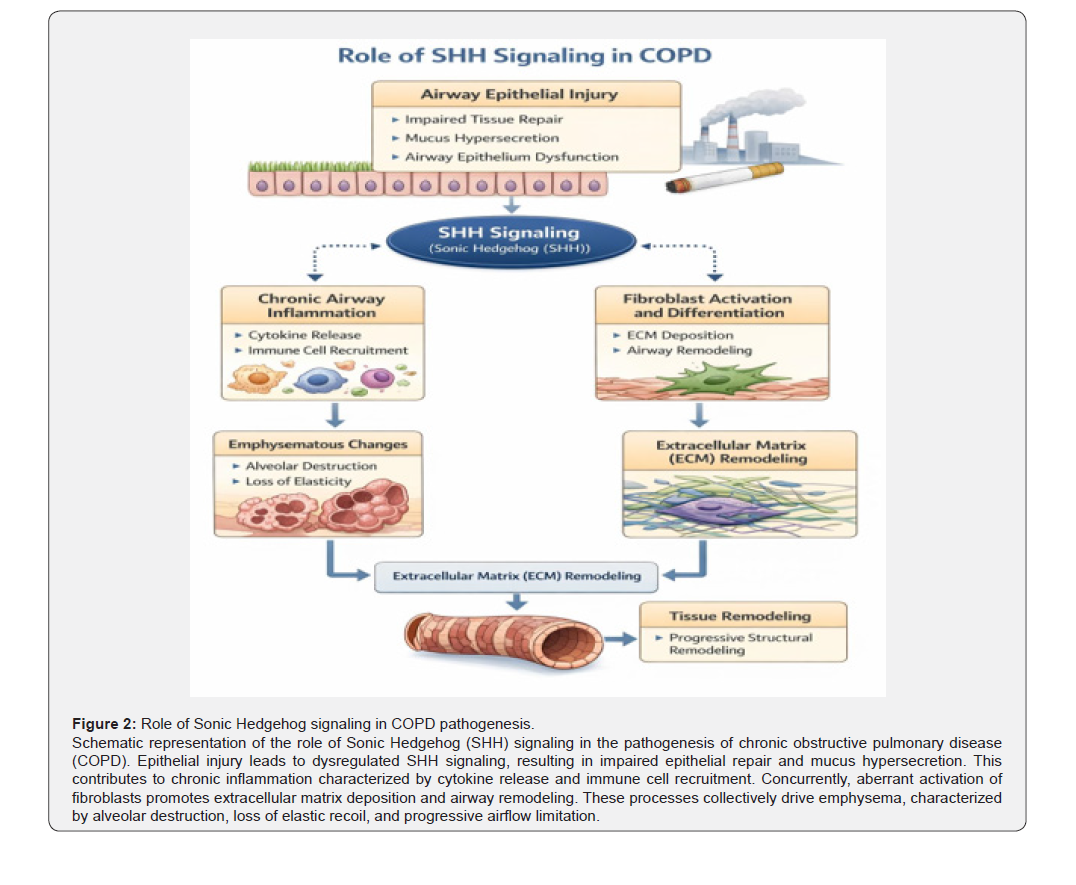
Expression of SHH Pathway Components in COPD
Studies examining lung tissue from COPD patients demonstrate altered expression of several components of the Hedgehog signaling pathway. Reduced expression of HHIP mRNA and protein has been reported in lung tissue from individuals with COPD, suggesting that decreased HHIP function may contribute to disease susceptibility [46]. Altered expression of SHH and Smoothened (SMO) has also been observed in airway epithelial cells and other pulmonary cell types, indicating dysregulation of Hedgehog signaling in the diseased lung (Figure 2) [47].
Dysregulation of this pathway, particularly the downregulation of HHIP (a decoy receptor and negative regulator), leads to aberrant signaling in several cell types:
• Fibroblasts: Increased activation and extracellular matrix deposition.
• Airway Smooth Muscle: Hyperplasia and increased contractility.
• Alveolar Epithelium: Impaired repair mechanisms leading to airspace enlargement (emphysema).
Genetic Evidence Linking HHIP to COPD
Genome wide association studies (GWAS) have consistently identified genetic variants near the Hedgehog interacting protein (HHIP) locus as significant determinants of lung function and susceptibility to chronic obstructive pulmonary disease (COPD) [48] Several large population-based studies have reported that polymorphisms in HHIP are associated with reduced forced expiratory volume in one second, increased risk of airflow obstruction, and susceptibility to emphysema [49]. These findings highlight HHIP as one of the most consistently replicated genetic loci associated with COPD and lung function decline [50].
Expanded GWAS Evidence Linking HHIP to COPD
A large meta-analysis conducted by Hobbs et al. (2017) identified several loci associated with COPD risk and lung function decline across diverse populations [51]. Among these, variants located near the HHIP gene on chromosome 4q31 showed one of the strongest and most reproducible associations with reduced lung function and airflow limitation. These variants are thought to influence regulatory elements (enhancers) controlling HHIP expression in lung tissue [52]. Reduced HHIP expression has been linked to impaired epithelial repair, abnormal airway remodeling, and increased susceptibility to emphysema. These findings suggest that genetic variation affecting HHIP may disrupt normal Hedgehog signaling and contribute to the development and progression of COPD [53].
Experimental Evidence from Mouse Models
Experimental studies using murine models have further strengthened the link between HHIP and COPD pathogenesis. Mice with heterozygous deletion of the HHIP gene show increased susceptibility to cigarette smoke–induced emphysema compared with wild type mice [54]. These animals develop enhanced inflammatory responses, alveolar destruction, and abnormal extracellular matrix remodeling following chronic smoke exposure. The pathological changes observed in mice closely resemble those seen in human COPD, including emphysematous airspace enlargement and airway remodeling [55]. Mechanistically, reduced HHIP expression results in dysregulated Hedgehog signaling, promoting fibroblast activation and impaired epithelial repair [56].
Mechanistic Contributions to COPD Pathogenesis
Experimental and translational studies suggest that dysregulated Hedgehog signaling may contribute to several processes central to COPD pathogenesis. These include impaired epithelial repair, mucus hypersecretion, airway remodeling, and persistent inflammation [57]. In addition, Hedgehog signaling has been shown to influence fibroblast activation and extracellular matrix deposition, which contribute to structural remodeling and fibrosis of the airway wall [58]. Alterations in HHIP expression in murine models have also been associated with increased susceptibility to smoke induced emphysema and abnormal epithelial cell function [59,60].
Therapeutic Targeting of Hedgehog Signaling
Given the role of Hedgehog signaling in tissue repair and airway remodeling, this pathway has been proposed as a potential therapeutic target in COPD. Pharmacological inhibitors of Smoothened and other pathway components have already been developed for cancer therapy [61] However, targeting Hedgehog signaling in chronic lung diseases remains challenging because of its critical roles in tissue homeostasis and regeneration [62]. Further experimental and clinical studies are required to determine whether selective modulation of this pathway could safely and effectively influence COPD progression.
Conclusion
The Sonic Hedgehog signaling pathway represents a critical link between lung development, genetic susceptibility, and pathological airway remodeling in chronic obstructive pulmonary disease. While indispensable for normal lung morphogenesis, dysregulated SHH signaling in the adult lung appears to promote persistent inflammation, impaired epithelial repair, and progressive structural damage. By sustaining a self-perpetuating cycle of inflammation and remodeling, aberrant SHH activity may accelerate disease progression, particularly in smoking-related COPD. Further translational and clinical studies are required to identify patient subgroups most likely to benefit from SHH-targeted interventions and to determine whether modulation of this pathway can safely and effectively alter the natural history of COPD.
Funding Statement: We are indebted to Department of Health and research (DHR) for financial assistance.
References
- Barnes PJ (2000) Chronic obstructive pulmonary disease. N Engl J Med 343(4): 269-280.
- Vogelmeier CF, Criner GJ, Martinez FJ, Antonio A, Peter JB, et al. (2017) Global strategy for the diagnosis, management, and prevention of chronic obstructive lung disease 2017 report. Am J Respir Crit Care Med 195(5): 557-582.
- Peter L, Bartolome C, Alvar A, Gorm BJ, Miguel D, et al. (2015) Lung-function trajectories leading to chronic obstructive pulmonary disease. N Engl J Med 373(2): 111-122.
- Whitsett JA, Weaver TE (2015) Alveolar development and disease. Am J Respir Cell Mol Biol 53(1): 1-7.
- James PA, Rebecca H, Gavin CD, Seif OS, Diana K, et al. (2017) Combined impact of smoking and early-life exposures on adult lung function trajectories. Am J Respir Crit Care Med 196(8): 1021-1030.
- Salvi SS, Barnes PJ (2009) Chronic obstructive pulmonary disease in non-smokers. Lancet 374(9691): 733-743.
- Postma DS, Bush A, van den Berge M (2015) Risk factors and early origins of chronic obstructive pulmonary disease. Lancet 385(9971): 899-909.
- Zhang L, Fang X, Liu H, Wang J, Cheng Z (2020) Epigenetic regulation in chronic obstructive pulmonary disease. Int J Chron Obstruct Pulmon Dis 15: 2419-2432.
- Probert K, Stewart CE, Bateman ED, et al. (2015) Epigenetic mechanisms in chronic obstructive pulmonary disease. Eur Respir J 45(3): 806-825.
- Hogg JC, Chu F, Utokaparch S, Ryan W, WM Elliott, et al. (2004) The nature of small-airway obstruction in chronic obstructive pulmonary disease. N Engl J Med 350(26): 2645-2653.
- Verra F, Escudier E, Lebargy F, JF Bernaudin, H De Crémoux, et al. (1995) Ciliary abnormalities in bronchial epithelium of smokers, ex-smokers, and nonsmokers Am J Respir Crit Care Med 151(2 Pt 1): 630-634.
- Stavem K, Bjørtuft Ø, Bøe J (2006) Health-related quality of life after lung transplantation. Eur Respir J 28(3): 540-546.
- Thabut G, Philippe R, Jason DC, Castier Y, Michel F, et al. (2008) Determinants of the survival benefit of lung transplantation in patients with chronic obstructive pulmonary disease. Am J Respir Crit Care Med 177(10): 1156-1163.
- Litingtung Y, Lei L, Westphal H, Chiang C (1998) Sonic hedgehog is essential for lung morphogenesis. Nat Genet 20(1): 58-61.
- Beachy PA, Hymowitz SG, Lazarus RA, Leahy DJ, Siebold C (2010) Interactions between Hedgehog proteins and their binding partners. Genes Dev 24(18): 2001-2012.
- Kinzler KW, Ruppert JM, Bigner SH, Vogelstein B (1987) The GLI gene is amplified in human gliomas. Science 236(4797): 70-73.
- Briscoe J, Thérond PP (2013) The mechanisms of Hedgehog signalling and its roles in development and disease. Nat Rev Mol Cell Biol 14(7): 416-429.
- Kalderon D (2000) Transducing the Hedgehog signal. Cell 103(3): 371-374.
- Varjosalo M, Taipale J (2008) Hedgehog signaling. J Cell Sci 121(Pt 1): 3-6.
- Chuang PT, McMahon AP (1999) Vertebrate Hedgehog signalling modulated by induction of a Hedgehog-binding protein. Nature 397(6720): 617-621.
- Griffiths SC, et al. (2021) Glycosaminoglycan-mediated regulation of Hedgehog signaling. Development 148(9): dev199525.
- Benjamin B, AR Aricescu, Karl H, CA O'Callaghan, EY Jones, et al. (2009) Structural insights into Hedgehog ligand sequestration by HHIP. Nat Struct Mol Biol 16(7): 698-703.
- Robbins DJ, Fei DL, Riobo NA (2012) The Hedgehog signal transduction network. Sci Signal 5(246): re6.
- Eunice YL, Hongkai J, Zhengqing O, Baiyu Z, Wenxiu M, et al. (2010) Hedgehog pathway-regulated gene networks. Proc Natl Acad Sci U S A 107(22): 9736-9741.
- Vokes SA, Ji H, Wong WH, McMahon AP (2008) A genome-scale analysis of the cis-regulatory circuitry underlying sonic hedgehog-mediated patterning of the mammalian limb. Genes Dev 22(19): 2651-2663.
- Vokes SA, et al. (2008) Direct regulation of Patched by Hedgehog signaling. Genes Dev 22(23): 3284-3293.
- Akhshi TK, et al. (2022) Canonical and non-canonical Hedgehog signaling pathways. Cell Mol Life Sci 79(3): 142.
- Regan JL, et al. (2017) Non-canonical Hedgehog signaling. Development 144(6): 961-973.
- Litingtung Y, et al. (1998) Sonic hedgehog is essential for proximal airway patterning. Development 125(10): 1809-1815.
- CV Pepicelli, PM Lewis, AP McMahon (1998) Sonic hedgehog regulates branching morphogenesis in the mammalian lung. Curr Biol 8(19): 1083-1086.
- S Bellusci, Y Furuta, MG Rush, R Henderson, G Winnier, et al. (1997) Involvement of Sonic hedgehog (Shh) in mouse embryonic lung growth and differentiation. Development 124(1): 53-63.
- De la Roche M, et al. (2013) Hedgehog signaling in T cells. Nat Immunol 14(9): 911-918.
- Kugler MC, Alexandra LJ, Cynthia AL, John SM (2015) Sonic Hedgehog signaling in lung development and disease. Am J Respir Cell Mol Biol 52(1): 1-13.
- Zhou X, et al. (2012) Decreased HHIP expression in chronic obstructive pulmonary disease lungs. Am J Respir Crit Care Med 185(4): 392-400.
- Watkins DN, et al. (2003) Hedgehog signaling in lung repair. Proc Natl Acad Sci U S A 100(20): 11356-11361.
- Peng T, et al. (2015) Hedgehog signaling regulates airway epithelial repair. Am J Physiol Lung Cell Mol Physiol 309(7): L812-L824.
- Guseh JS, et al. (2009) Notch signaling regulates airway mucous metaplasia. Proc Natl Acad Sci U S A 106(41): 17513-17518.
- Rock JR, et al. (2011) Basal cells as stem cells of the airway epithelium. Proc Natl Acad Sci U S A 108(12): 4935-4940.
- Stewart GA, et al. (2014) Hedgehog signaling promotes pulmonary fibrosis. Am J Respir Cell Mol Biol 50(1): 87-97.
- Belgacemi R, et al. (2019) Hedgehog signaling in airway smooth muscle remodeling. Eur Respir J 54(3): 1802448.
- Chen Y, et al. (2017) Hedgehog signaling and inflammation. Cell Death Dis 8(4): e2766.
- Shi Y, et al. (2109) Crosstalk between Hedgehog and NF-κB pathways. J Immunol 202(10): 2927-2937.
- Zuo W, et al. (2015) Wnt/Notch signaling in airway epithelial cell fate determination. Cell 162(5): 1107-1121.
- Tata PR, et al. (2018) Dedifferentiation of secretory cells during airway repair. Nature 560(7718): 218-223.
- Grubbs BH, et al. (2015) Cilia. Cilia (1): 7.
- Pillai SG, et al. (2009) A genome-wide association study in chronic obstructive pulmonary disease (COPD) identifies novel susceptibility loci. Am J Respir Crit Care Med 179(12): 1112-1120.
- Jemma BW, Ting-Hsu C, Daniel JG, Robert EW, Michael WN, et al. (2009) A genome-wide association study of pulmonary function measures in the Framingham Heart Study. PLoS Genet 5(3): e1000429.
- Emmanouela R, Ian S, Louise VW, Paul RB, Toby J, et al. (2010) Genome-wide association study identifies five loci associated with lung function. Nat Genet 42(1): 36-44.
- Brian DH, Kim de J, Maxime L, Yohan B, Nick S, et al. (2017) Genetic loci associated with chronic obstructive pulmonary disease overlap with loci for lung function and pulmonary fibrosis. Nat Genet 49(3): 426-432.
- Zhou X, et al. (2012) Functional variants at the 4q31 locus, a susceptibility region for chronic obstructive pulmonary disease. Hum Mol Genet 21(13): 3025-3035.
- Lao T, et al. (2015) HHIP-AS1, a novel long noncoding RNA, regulates HHIP expression in airway epithelial cells. Am J Respir Cell Mol Biol 53(5): 712-721.
- Lao T, et al. (2016) Haploinsufficiency of Hedgehog interacting protein causes increased emphysema induced by cigarette smoke. Hum Mol Genet 25(24): 5398-5407.
- Siedlinski M, et al. (2012) Genetics of COPD: the first 10 years of the 21st century. Eur Respir Rev 21(124): 142-151.
- Vyas-Read S, et al. (2014) Hyperoxia inhibits sonic hedgehog signaling in the lung. Am J Physiol Lung Cell Mol Physiol 306(4): L312-321.
- Van Tuyl M, et al. (2007) Sonic hedgehog is required for maintenance of the airway epithelium. Am J Physiol Lung Cell Mol Physiol 292(5): L1151-1161.
- Wang C, et al. (2018) Decreased expressions of Sonic hedgehog and Gli1 in the lungs of patients with COPD. Int J Chron Obstruct Pulmon Dis 13: 3553-3562.
- Tojo F, et al. (2012) Hedgehog signaling pathway in the lung: its role in pulmonary development and repair. Am J Physiol Lung Cell Mol Physiol 302(6): L535-545.
- Cigna N, et al. (2012) The Hedgehog system exacerbates lung inflammation and fibrosis. Am J Respir Cell Mol Biol 47(1): 61-68.
- A Ortega-Martínez, G Pérez-Rubio, A Ramírez-Venegas, ME Ramírez-Díaz, F Cruz-Vicente, et al. (2014) Interaction of smoking and HHIP variants in COPD. Hum Mol Genet 23(24): 6506-6515.
- Amakye D, et al. (2013) Hedgehog pathway inhibitors in cancer. Nat Med 19(11): 1410-1420.
- Petrova R, Joyner AL (2014) Roles for Hedgehog signaling in adult organ homeostasis and repair. Development 141(18): 3445-3457.
- Bolanos V, et al. (2012) Hedgehog signaling in lung development and disease. Transl Res 160(2): 137-150.

























