




 IJOPRS Home



Intra-Breath Oscillometry: An Early Marker of Pediatric Respiratory Disease
Alberto Vidal Grell*
Division of Pediatric Pulmonology, Department of Pediatrics, Clínica MEDS, Chile
Submission: April 26, 2026; Published: May 08, 2026
*Corresponding author: Alberto Vidal Grell, MD, Avenida José Alcalde Délano 10581, Lo Barnechea, Santiago, Chile
How to cite this article: Alberto Vidal Grell. Intra-Breath Oscillometry: An Early Marker of Pediatric Respiratory Disease. Int J Pul & Res Sci. 2026; 8(4): 002 555741.DOI: 10.19080/IJOPRS.2026.08.555741
Abstract
The incorporation of oscillometry into the diagnosis and monitoring of pediatric respiratory disease has allowed for the exploration of new ways to analyze its results. Measuring intra-breath impedance changes is an innovative oscillometric technique that could provide valuable information regarding the pathophysiological characteristics and phenotypes of wheezing, asthma, and chronic lung disease in premature infants.
Keywords:Intra-breath oscillometry; Children; Respiratory Illness; Airway; Premature infants
Abbreviations:IOS: Impulse oscillometry; FOT: Forced Oscillation technique; Zrs: Impedance; Rrs: Resistance; Xrs: Reactance; RI: Reactance inversion
Introduction
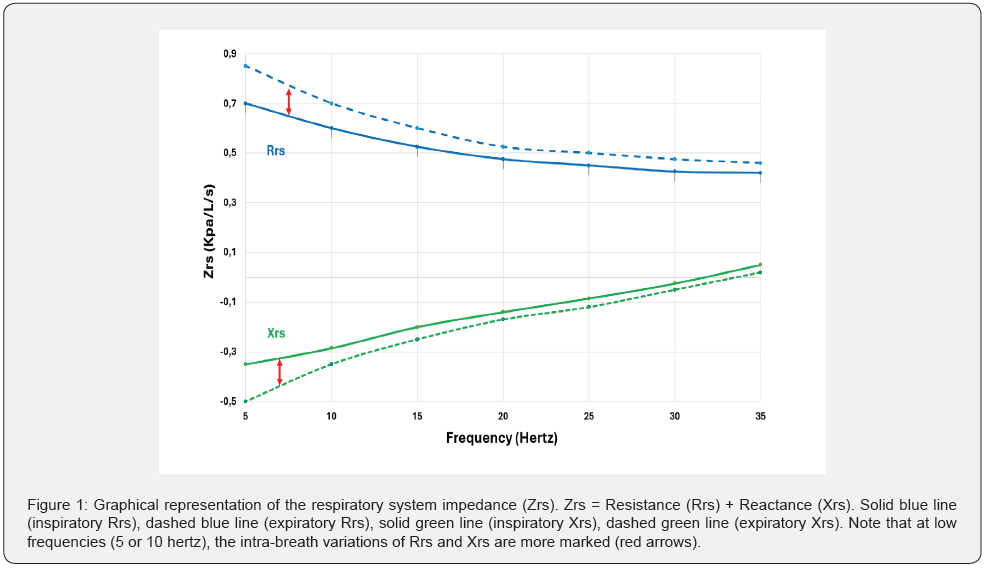
Impulse oscillometry (IOS) has undergone significant development in recent decades, enabling advancements in the understanding of the pathophysiology of chronic respiratory diseases such as asthma, bronchopulmonary dysplasia, and bronchiolitis obliterans, as well as measuring the impact of prematurity or pollution on respiratory health [1]. The IOS analyzes the respiratory system impedance (Zrs), which is the sum of the resistive component, known as Resistance (Rrs), and the reactive component, also called Reactance (Xrs), and which are projected onto different frequency waves [2]. At high frequencies (above 20 Hertz), Rrs and Xrs better reflect alterations occurring in the proximal airway, while at lower frequencies (below 15 Hertz), distal airway alterations are better represented [3]. The data obtained from the IOS are interpreted using spectral analysis, which is currently the most widely used method, but Rrs and Xrs can also be measured during the respiratory cycle. Inspiratory analysis reflects the intrinsic behavior of the airway or lung tissue, while expiratory analysis measures the dynamic compromise of the airway or alterations in the elastic recoil of the respiratory system [4]. This analysis could be useful for the early characterization of the phenotype of children with pediatric obstructive respiratory diseases. (Figure 1) shows a graphical representation of the variation of Rrs and Xrs during the respiratory cycle at different frequency waves.
Discussion
A study showed that preschoolers who went to the emergency department with acute wheezing had a significant increase in intra-breath Rrs in forced oscillation technique (FOT), compared to healthy controls [5]. In a cohort of healthy infants who underwent FOT at 6 weeks of age, the group with greater intra-breath differences in Rrs and Xrs was associated with a higher frequency and severity of acute lower respiratory infections during the first year of life [6]. A significant association has also been reported between increased intra-breath Rrs in IOS at 3 years of age and parental reports of asthma or wheezing during the first years of life [7]. In children with asthma, it became apparent that the differences in the intra-breath analysis of some IOS parameters, such as Rrs, Xrs, and reactance area, were greater than those found in healthy controls [8]. Another study conducted in children and adolescents with respiratory symptoms during exercise showed that those with exerciseinduced asthma had greater intra-breath differences in Xrs than those without it [9].
In near-term premature infants, it was shown that those presenting with Reactance Inversion (RI) had more marked intra-breath differences in Rrs and Xrs at low frequencies (10 Hertz) than premature infants without RI [10,11]. RI is a pathophysiological finding also described more frequently in the IOS of asthmatic children with lower weight and gestational age [12]. Inferring from these results, one could speculate that intra-breath changes in Zrs and RI could be useful parameters for identifying and differentiating, early in life, children with obstructive diseases, associated or not with prematurity. A study conducted on schoolchildren aged 7 to 12 years showed that those with a history of being premature with a gestational age ≤34 weeks and obstructive pulmonary disease confirmed by spirometry had greater differences in intra-breath Rrs and Xrs than healthy premature controls or full-term newborns [13]. It was also shown that adolescents between 11 and 14 years of age with a history of having been born at a gestational age of less than 37 weeks had significant intra-breath changes in Rrs and Xrs, compared with controls born at term [14]. Finally, in children and adolescents with cystic fibrosis, it was shown that those who had greater Intra-breath changes in the Xrs were associated with a greater degree of airway obstruction measured by spirometry and air trapping on plethysmography [15].
Conclusion
Intra-breath oscillometric changes have proven useful in differentiating infants or preschoolers with wheezing and increased respiratory morbidity from healthy individuals. These changes are also more pronounced in children with asthma or premature infants with chronic lung disease than in healthy or full-term children. Early classification and differentiation of clinical phenotypes of obstructive lung disease based on intrabreath oscillometry would allow for appropriate monitoring of pulmonary function trajectories with the aim of preserving pulmonary function in the medium and long term.
References
- Kaminsky DA, Simpson SJ, Berger KI, Calverley P, de Melo PL, et al. (2022) Clinical significance and applications of oscillometry. Eur Respir Rev 31(163): 210208.
- King GG, Bates J, Berger KI, Calverley P, de Melo PL, et al. (2020) Technical standards for respiratory oscillometry. Eur Respir J 55(2): 1900753.
- Bednarek M, Grabicki M, Piorunek T, Batura-Gabryel H (2020) Current place of impulse oscillometry in the assessment of pulmonary diseases. Respir Med 170: 105952.
- Farah CS, Seccombe LM (2025) Oscillometry. Clin Chest Med 46(3): 499-508.
- Czövek D, Shackleton C, Hantos Z, Taylor K, Kumar A, et al. (2016) Tidal changes in respiratory resistance are sensitive indicators of airway obstruction in children. Thorax 71(10): 907-915.
- Gray DM, Czovek D, McMillan L, Turkovic L, Stadler JAM, et al. (2019) Intra-breath measures of respiratory mechanics in healthy African infants detect risk of respiratory illness in early life. Eur Respir J 53(2): 1800998.
- Siroux V, Boudier A, Lyon-Caen S, Quentin J, Gioria Y, et al. (2024) Intra-breath changes in respiratory mechanics are sensitive to history of respiratory illness in preschool children: the SEPAGES cohort. Respir Res 25(1): 99.
- Sol IS, Kim YH, Kim S, Kim JD, Choi SH, et al. (2019) Assessment of within-breath impulse oscillometry parameters in children with asthma. Pediatr Pulmonol 2019 54(2): 117-124.
- Barreto M, Veneroni C, Caiulo M, Evangelisti M, Pompilio PP, et al. (2024) Within-breath oscillometry for identifying exercise-induced bronchoconstriction in pediatric patients reporting symptoms with exercise. Front Pediatr 11: 1324413.
- Allen JL, McDonough J, Ren CL, Clem C, DeMauro S, et al. (2020) Ain’t misbehavin’: “reactance inversion” at low frequencies during lung function measurement by impulse Oscillometry (iOS) in former preterm children. Am J Respirat Critic Care Med 201: A4673.
- Tsukahara K, Scully T, McDonough J, Boas H, DeMauro SB, et al. (2023) Reactance inversion in a cohort of former preterms: Physiology or artifact? Pediatr Pulmonol 58(9): 2681-2684.
- González Vera R, Vidal Grell A, Castro-Rodríguez JA, Palomino Montenegro MA, Méndez Yarur A (2024) Reactance inversion in moderate to severe persistent asthma: low birth weight, prematurity effect, and bronchodilator response. J Asthma 61(9): 1076-1082.
- Cousins M, Hart K, Radics B, Henderson AJ, Hantos Z, et al. (2025) Intra-breath respiratory mechanics of prematurity-associated lung disease phenotypes in school-aged children. ERJ Open Res 11(2): 00840-2024.
- Accorsi BF, Friedrich FO, Corso AL, Rosa JPD, Jones MH (2022) Intra-breath oscillometry for the evaluation of lung function in children and adolescents with a history of preterm birth. J Bras Pneumol 48(1): e20210290.
- Zannin E, Nyilas S, Ramsey KA, Latzin P, Dellaca' RL (2019) Within-breath changes in respiratory system impedance in children with cystic fibrosis. Pediatr Pulmonol 54(6): 737-742.

























