




 IJOPRS Home



Aspiration of a Three-Unit Dental Bridge
Rodrigo Garzón M*, Díaz Soriano S, Giannozzi L, Ruiz Tarbet CE, Pulido Hernández I, and Manzano Ramos C
Pneumology Service, Insular University Hospital, Avenida Marítima s/n, Spain
Submission: March 01, 2026; Published: March 13, 2026
*Corresponding author: Manuel Rodrigo Garzón, Avenida Marítima s/n, 35016, Las Palmas GC, Spain
How to cite this article: Rodrigo Garzón M, Díaz Soriano S, Giannozzi L, Ruiz Tarbet CE, Pulido H, et al. Aspiration of a Three-Unit Dental Bridge. Int J Pul & Res Sci. 2025; 8(3): 555739.DOI: 10.19080/IJOPRS.2026.08.555739
Abstract
Foreign body aspiration remains a common problem and potentially serious complication and can result in acute or chronic disease. Bronchoscopy is the standard for the diagnosis and treatment of these patients. A high index of suspicion is necessary to act quickly and avoid fatal consequences.
Keywords:Bronchoscopy; Foreign body Aspiration; Pneumonia; Dental bridge; Chest X-ray
Introduction
We present a case of a solid foreign body aspiration that we find interesting due to its nature and size.
Case Presentation
This is the case of a 50-year-old male with a history of ischaemic heart disease, hypertension, and pneumonia eight years ago. He is a long-term smoker (38-pack-year), allergic to penicillin and is on treatment with aspirin, losartan, and hydrochlorothiazide. The patient presented with intermittent coughing fits for three weeks, at the beginning dry cough, and later accompanied with dark sputum, without any other associated symptoms. During this period, he noticed the loss of his threepiece dental bridge. Laboratory tests, including complete blood count, biochemistry analysis, and coagulation tests, came back normal. His electrocardiogram was anodyne, and basal pulse oximetry showed a saturation of 97%.
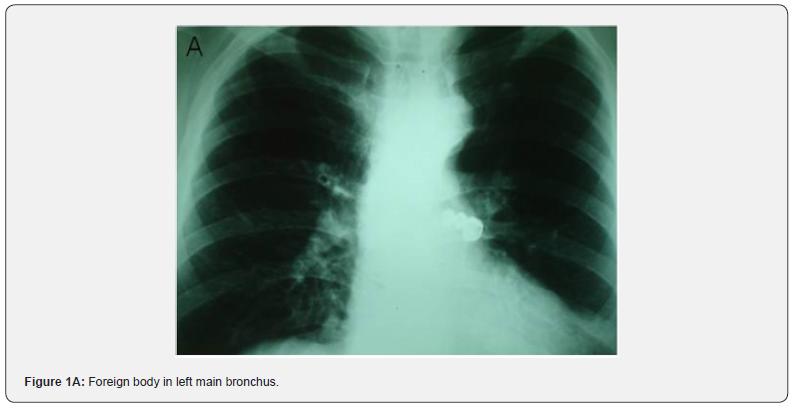
A chest X-ray revealed a foreign body (a three-unit dental bridge) lodged in the left main bronchus (Figure 1A). The patient has no history of dysphagia, dental issues, except for the loss of three teeth and the need to wear a dental bridge, nor had he experienced any choking episodes. Flexible bronchoscopy was performed, visualizing the foreign body in the distal third of the left main bronchus. It was successfully removed without complications using a grasping basket on the first try. After extraction, the patient was asymptomatic, and his cough resolved. If we had not been able to extract it with the flexible bronchoscope, we would have done so in the operating theatre with a rigid bronchoscope.
Results and Discussion
The aspiration of foreign bodies into the airway presents a wide clinical spectrum, ranging from asymptomatic patients with incidental findings on radiography or bronchoscopy performed for other reasons, to life-threatening medical emergencies requiring immediate intervention [1]. It is more common in children and adults over 70 years-old and is more frequently located on the right side. Most foreign bodies are not visible on chest X-ray, and a history of aspiration is not always identifiable, making diagnosis challenging and needing a high level of clinical suspicion especially in paediatric patients. If there is a suspicion of a radiolucent foreign body aspiration, a chest CT scan may be performed and bronchoscopy should be considered in all cases [2]. In adults, foreign body aspiration is often associated with underlying conditions that impair airway protection, such as neurological diseases or clinical states involving decreased consciousness due to trauma, alcohol, and/or drug use [3].
Traditionally, foreign bodies have been classified into organic and inorganic types [4]. In the past, they were commonly removed using a rigid bronchoscope, but nowadays, most can be extracted with flexible bronchoscopy and tools such as special forceps, grasping baskets, balloon catheters, and more recently, cryoprobes [5]. Today, the rigid bronchoscope is reserved for extracting foreign bodies from children, when it is not possible to do so with a flexible bronchoscope, or when the foreign body is considered dangerous due to its size or special characteristics such as sharp or pointed edges. Rigid bronchoscopy provides improved airway control and greater patient safety in the event of complications during extraction such as bleeding, airway rupture, pneumothorax and respiratory failure.
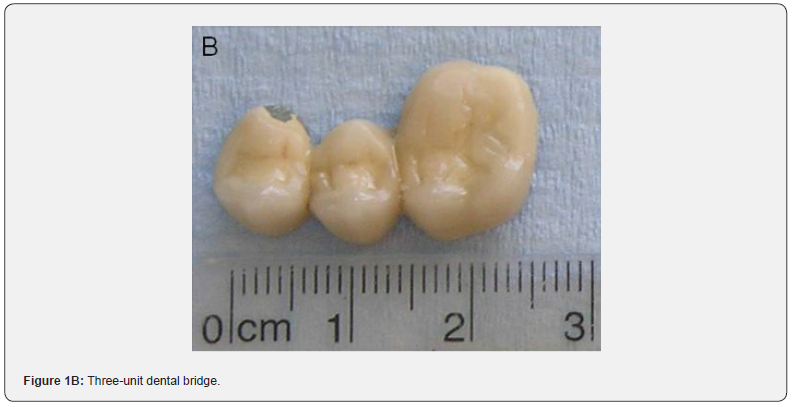
In our case, the patient denied any history of substance abuse, episodes of decreased consciousness, or any conditions predisposing him to aspiration. He only became aware of the loss of his dental bridge after the onset of the coughing fits but did not seek medical attention until three weeks later. He was unable to recall the circumstances or timing of the aspiration. Following the removal of the foreign body, it was confirmed to be a dental bridge consisting of three teeth bonded with cement, measuring slightly over 2.5cm in length and 1.5cm at its widest (Figure 1B).
Conclusion
Bronchoscopy remains the best method for the diagnosis and treatment of these patients. You should always attempt to remove the foreign body to prevent complications and improve patient`s symptoms and situation. If this cannot be achieved using a flexible bronchoscopy and accessory instruments, a rigid bronchoscopy should be used instead.
References
- Bajaj D, Sachdeva A, Deepak D (2021) Foreign body aspiration. J Thorac Dis 13(8): 5159-5175.
- Ulas AB, Aydin Y, Eroglu A (2022) Foreign body aspirations in children and adults. Am J Surg 224(4): 1168-1173.
- Syed Rizwan A, Metha AC (2017) Alive in the airways: Live Endobronchial Foreign Bodies. Chest 151(2): 481-491.
- Metha AC, Khemasuwan D (2014) A foreign body of a different kind: pill aspiration. An Thorac Med 9(1): 1-2.
- Feller-Kopman D, Shojaee S (2023) Broncoscopia Terapéutica: técnicas intervencionistas. Murray and Nadel editors. In: Tratado de Medicina Respiratoria. Editorial Elsevier, seventh edition Pp: 387-397.

























