




 IJCSMB Home




Biocontainment Strategies to Prevent Transgene Escape in Plants and Animals – A Mini-Review
Krishnaswamy VKD1* and Ladha G1
1Institute of Fisheries Biotechnology, Dr. J. Jayalalithaa Fisheries University, OMR, Chennai, India
Submission:October 12, 2026; Published:October 21, 2026
*Corresponding author:Krishnaswamy VKD, Institute of Fisheries Biotechnology, Dr. J. Jayalalithaa Fisheries University, OMR, Chennai, India
How to cite this article: Krishnaswamy VKD, Ladha G. Biocontainment Strategies to Prevent Transgene Escape in Plants and Animals – A Mini-Review. Int J Cell Sci & Mol Biol. 2026; 8(3): 555737. DOI: 10.19080/IJCSMB.2026.08.555737
Abstract
modern agriculture and aquaculture involve molecular techniques like genetic engineering and precision genome editing, yet transgene escape into wild populations poses serious ecological risks, such as loss of biodiversity and the "Trojan gene effect". To mitigate these hazards, robust biological containment (biocontainment) safeguards are essential. This mini review synthesizes key genetic, physiological, and molecular biocontainment strategies established across plant and animal domains. In agricultural botany, gene flow via pollen or seeds is managed through transplastomics, Genetic Use Restriction Technologies (GURTs), cytoplasmic male sterility, and cleistogamy. In animal systems, particularly aquaculture where net-pen breaches threaten endemic stocks, reproductive containment relies on induced triploidy (3n), CRISPR/Cas9-mediated targeted germ-cell ablation (e.g., dnd1 gene knockout), and synthetic auxotrophy. While physical containment remains vulnerable to environmental extremes and human error, multi-tiered biological fail-safes operate directly at cellular and genetic levels. Integrating these complementary genetic mechanisms will be pivotal for regulatory approval and sustainable biotechnology deployment.
Keywords: Trojan Gene Effect; Transplastomics; Cleistogamy; Triploidy
Abbreviations: GURTs: Genetic Use Restriction Technologies; GMOs: Genetically Modified Organisms; CMS: Cytoplasmic Male Sterility; PGC: Primordial Germ Cell
Introduction
Genetic engineering and precision genome editing have revolutionized modern agriculture and aquaculture by enabling the development of transgenic organisms with enhanced growth kinetics, pest resistance, and climate resilience. However, the commercial release of genetically modified organisms (GMOs) introduces significant environmental concerns regarding the potential escape of transgenes into wild relatives or non-target ecosystems. Transgene introgression can trigger ecological disruptions, including the loss of native biodiversity and the hypothetical 'Trojan gene effect' in animal populations. Consequently, robust biological containment (biocontainment) strategies- incorporating genetic, physiological, and molecular safeguards- are critical prerequisites for sustainable biotechnology deployment across both plant and animal kingdoms.
Plant Biocontainment Strategies
In agricultural botany, transgene escape occurs primarily via gene flow through wind- or insect-borne pollen dispersion, seed spillage during harvesting/transport, or volunteer persistence in soil seed banks. Several innovative genetic containment architectures have been established:
Plastid transformation (transplastomics)
Engineered transgenes are integrated directly into the chloroplast genome (plastome) rather than the nuclear genome. Because chloroplasts are maternally inherited in the vast majority of angiosperm species, transgenes are absent from mature pollen grains Daniell [1], Gressel [2]. This maternal inheritance mechanism provides a formidable biological barrier against pollen-mediated gene flow into wild sexually compatible relatives.
Genetic Use Restriction Technologies (GURTs)
GURTs employ inducible genetic switches to regulate seed fertility or gene expression Hills [3]. In V-GURTs (Variety-level GURTs), the second-generation (F1) seeds produced by farmers yield sterile (non-viable) F2 seeds due to the late-stage activation of a lethal toxin (e.g., cell-disrupting ribonuclease or diphtheria toxin) controlled by a germline-specific promoter. T-GURTs (Trait-level GURTs) restrict expression of the beneficial transgene unless an exogenous chemical inducer (e.g., ethanol, dexamethasone, or tetracycline) is applied.
Male Sterility & Cleistogamy
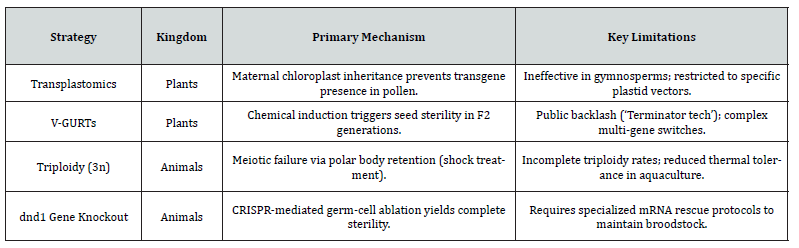
Cytoplasmic Male Sterility (CMS) and nuclear gene knockouts (e.g., targeting the MS1 or MS8 genes via CRISPR/Cas9) prevent functional pollen formation. Alternatively, engineering cleistogamy wherein flower opening is suppressed, and self-pollination occurs strictly within closed buds. This effectively eliminates pollen release into open environments; Transplastomics involves transformation in Chloroplast that prevents transgene transmission in angiosperm pollen; V-GURTs / Terminator Tech: Inducible embryonic lethality ensures second-generation seed sterility.
Animal Biocontainment Strategies
In livestock and aquaculture, biocontainment focuses on preventing escaping individuals from interbreeding with endemic wild populations. Aquaculture organisms (e.g., Atlantic salmon, tilapia, catfish) present high escape risks due to environmental disasters, net-pen breaches, or flooding.
Induced triploidy
Triploid induction (3n) remains the standard commercial method for reproductive containment in teleost fish Benfey [4]. Freshly fertilized zygotes are subjected to hydrostatic pressure or thermal shocks, preventing the extrusion of the second polar body. Triploid females undergo complete meiotic failure and gonadal arrest, rendering them sterile. While highly effective, triploid males can occasionally undergo partial spermatogenesis, producing aneuploid sperm that may disrupt natural spawning grounds.
Targeted germ-cell ablation (CRISPR/Cas9)
Modern precision biocontainment targets essential primordial germ cell (PGC) developmental pathways Gutierrez [5]. Knockout of the Dead end (dnd1) gene via CRISPR/Cas9 prevents PGC survival, yielding completely sterile adult fish that retain normal somatic growth and endocrine profiles Wargelius [6]. To maintain commercial broodstock, fertile lines are rescued via exogenous dnd1 mRNA microinjection into embryos, enabling homozygous sterile commercial production.
Synthetic auxotrophy and conditional lethality
Synthetic biology approaches engineer essential metabolic dependencies. By knocking out metabolic enzymes required for synthesizing critical amino acids or lipids, transgenic animals rely entirely on custom dietary supplements supplied in commercial feed. Escaped individuals die rapidly due to nutrient deficiency in natural ecosystems.
Comparative Analysis of Biocontainment Approaches
(Table 1)
Conclusion & Regulatory Outlook
Preventing transgene escape requires a multi-tiered defense strategy combining physical containment with robust biological safeguards. While physical barriers remain vulnerable to human error and environmental extreme events, biological containment provides fail-safe mechanisms at the cellular and genetic levels. Emerging gene-editing platforms like CRISPR/Cas9 offer unprecedented precision for generating non-replicating or sterile GM populations. Regulatory approval by agencies such as the USDA, FDA, and EFSA increasingly favors stackable biocontainment layers to balance technological innovation with ecological integrity.
References
- Daniell H (2002) Molecular strategies for gene containment in transgenic crops. Nature Biotechnology 20(6): 581-586.
- Gressel J (2015) Molecular biology approaches in plant biocontainment. Plant Science 241: 10-19.
- Hills MJ, Hall L, Arnison PG, Good AG (2007) Genetic use restriction technologies (GURTs): technological overview and implications for biosafety. Environmental Biosafety Research 6(4): 211-220.
- Benfey TJ (1999) The physiology and behavior of triploid fishes. Reviews in Fisheries Science 7(1): 39-67.
- Gutierrez AP, Yáñez JM, Davidson WS (2018) Applications of gene editing in aquaculture: Structural, technical, and regulatory aspects. Marine Biotechnology 20(5): 621-637.
- Wargelius A, Leininger S, Skaftnesmo KO, Kleppe L, Schulz RW, et al. (2016) Dnd knockout in Atlantic salmon (Salmo salar) leads to sterility, revealing that germ cells are indispensable for gonad differentiation. Scientific Reports 6: 23284.