




 IJCSMB Home



T-cell Acute Lymphoblastic Leukemia in the Second Trimester of Pregnancy: A Case Report with Review of Literature
Saumya Pandey1*, Ila Singh2, Vatsala Kishore3 and Sangeeta Rai4
1 Assistant Professor, Department of Pathology, Heritage Institute of Medical Sciences, Varanasi, India
2 Associate Professor, Department of Pathology, Heritage Institute of Medical Sciences, Varanasi, India
3 Professor, Department of Pathology, Heritage Institute of Medical Sciences, Varanasi, India
4 Professor, Department of Obstetrics and Gynecology, Varanasi, India
Submission: April 23, 2026; Published:May 08, 2026
*Corresponding author:Saumya Pandey, Assistant Professor, Department of Pathology, Heritage Institute of Medical Sciences, Varanasi, India
How to cite this article:Saumya P, Ila S, Vatsala K, Sangeeta R. T-cell Acute Lymphoblastic Leukemia in the Second Trimester of Pregnancy: A Case Report with Review of Literature. Int J Cell Sci & Mol Biol. 2026; 8(2): 555732.DOI: 10.19080/IJCSMB.2026.08.555732
Abstract
Acute lymphoblastic leukemia (ALL) during pregnancy is exceptionally rare and presents one of the most complex clinical dilemmas in medicine balancing maternal survival against fetal safety. Among its subtypes, T-cell ALL is particularly uncommon and notoriously aggressive, with very limited published data to guide management. We report the case of a 26-year-old primigravida with 16 weeks of gestation presented with progressive lymphadenopathy, fever, and anorexia. Laboratory evaluation revealed marked leukocytosis (114.2 ×10³/μL), profound lymphocytosis (84%), and thrombocytopenia (65×10³/μL). Peripheral smear demonstrated numerous medium-to-large lymphoid blasts, and flow cytometry confirmed T-cell ALL. Given the urgency of initiating intensive chemotherapy, medical termination of pregnancy was undertaken. Despite induction therapy and transient improvement, the patient experienced early relapse and succumbed to disease within five months of diagnosis. This case highlights the devastating course of T-ALL in pregnancy, where therapeutic decisions are constrained by gestational age and drug toxicity. It underscores the necessity of early recognition through vigilant antenatal screening, rapid multidisciplinary decision-making, and the urgent need for safer, targeted therapies that can protect both maternal and fetal outcomes.
Keywords:T-Cell Acute Lymphoblastic leukemia; Pregnancy; Hematological malignancy; Maternal prognosis; Case report
Abbreviations:ALL: Acute Lymphoblastic Leukemia; MPO: Myeloperoxidase
Introduction
The coexistence of pregnancy and hematological malignancy is rare, estimated at roughly 1 in 1,000 pregnancies, with acute leukemias representing only a small fraction. Within this already uncommon scenario, acute lymphoblastic leukemia (ALL) constitutes less than one-third of cases, and its T-cell subtype is even more infrequent1. Unlike B-cell ALL, T-cell ALL often presents with high tumor burden, rapid progression, and poorer outcomes—making management particularly challenging when maternal and fetal health must be considered simultaneously2. Treatment decisions are further complicated by the teratogenicity of chemotherapy, gestational age at diagnosis, and the urgency to control aggressive disease. While chemotherapy after the first trimester is considered relatively safer for fetal development, maternal prognosis remains guarded, especially in T-ALL where intensive, multi-agent regimens are standard 3. Published evidence to guide treatment is scarce, mostly limited to isolated case reports and small series.
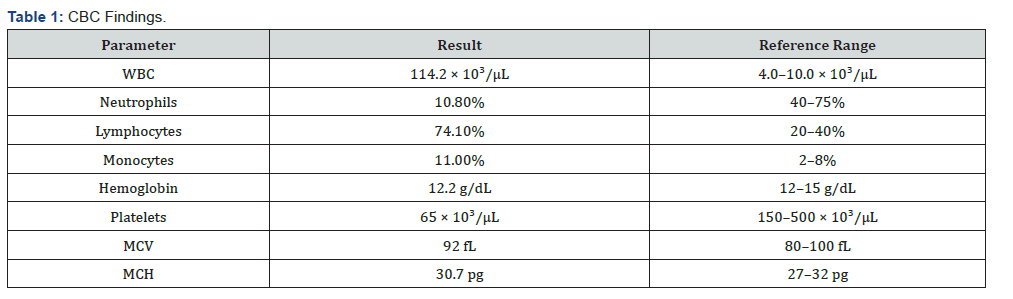
Case: A 26-year-old primigravida at 16 weeks of gestation presented with progressive lymphadenopathy, fever, and anorexia. Laboratory evaluation revealed marked leukocytosis (114.2×10³/ μL), profound lymphocytosis (84%), and thrombocytopenia (65×10³/μL) Table 1.
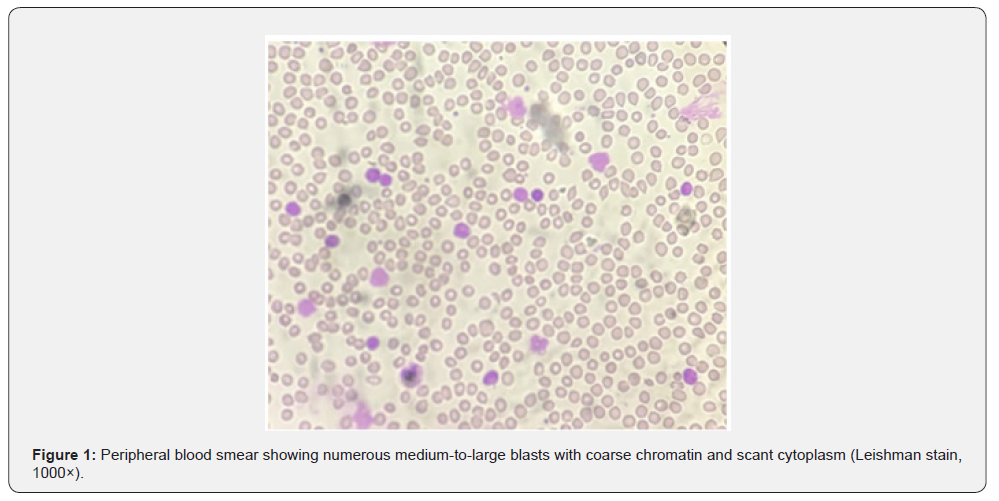
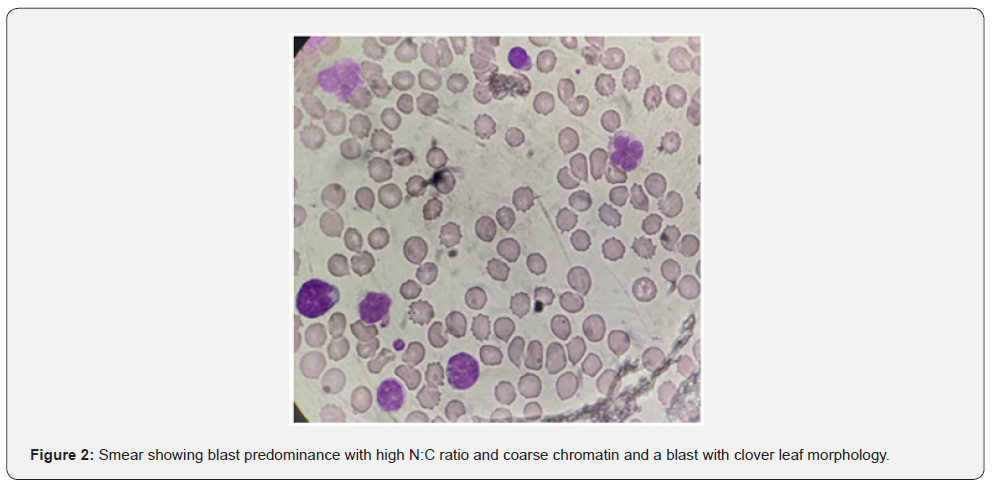
Peripheral smear demonstrated numerous medium-tolarge lymphoid blasts with coarse chromatin, folded nuclear membranes, inconspicuous nucleoli and scant cytoplasm, high N:C ratio, few blast with clover leaf morphology (Figure 1 & 2).
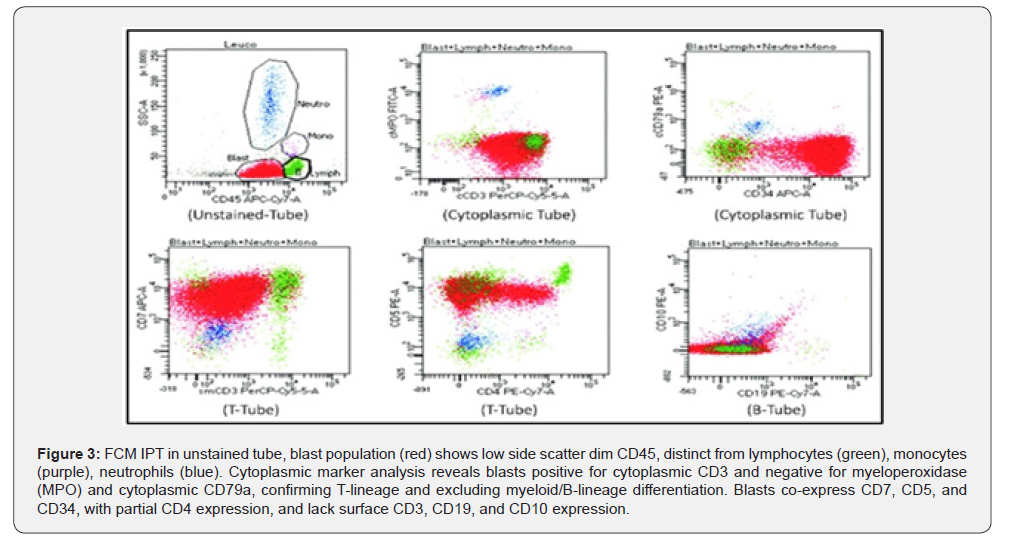
Flow cytometry immunophenotyping revealed CD45 dim blast population (80%) Cytoplasmic marker analysis reveals blasts positive for cytoplasmic CD3 and negative for myeloperoxidase (MPO) and cytoplasmic CD79a, confirming T-lineage and excluding myeloid/B-lineage differentiation. Blasts co-express CD7, CD5, and CD34, with partial CD4 expression, and lack surface CD3, CD19, and CD10 expression consistent with T-cell ALL (Figure 3).
Given the urgency of initiating intensive chemotherapy, due to aggressive clinical course of the disease, medical termination of pregnancy was undertaken followed by chemotherapy. However, despite induction therapy and transient improvement, patients experienced early relapses and succumbed to disease within five months of diagnosis. This case illustrates not only biological aggressiveness of disease but also ethical and clinical dilemmas in balancing maternal survival and fetal preservation and serves as a reminder of the pressing need for earlier detection and novel therapeutic strategies in such high-stakes scenarios.
Discussion and Review of Literature
Acute leukemia during pregnancy is an uncommon but devastating diagnosis, with an estimated incidence of approximately 1 in 75,000 pregnancies. Among hematological malignancies, it accounts for a small fraction, yet it remains a major cause of maternal and fetal morbidity. Clinical presentation often mirrors non-pregnant cases and includes anemia, leukocytosis, thrombocytopenia, constitutional symptoms, and lymphadenopathy. However, physiological changes of pregnancy may delay recognition, further complicating timely diagnosis. Therapeutic strategies are largely dictated by gestational age. Chemotherapy is generally avoided in the first trimester due to the high risk of teratogenicity during organogenesis, whereas its administration in the second and third trimesters is considered relatively safer. Even then, treatment carries risks such as prematurity, intrauterine growth restriction, or transient neonatal cytopenias. For T-cell acute lymphoblastic leukemia, management requires aggressive multi-agent regimens such as Hyper-CVAD, which are associated with considerable maternal toxicity. The inherent aggressiveness of T-ALL adds another layer of complexity, as even minor delays in therapy can compromise maternal prognosis. Available literature underscores these challenges. [1], in a review of 17 cases of ALL diagnosed during pregnancy, it was reported that nearly half of mothers achieved remission.
Nevertheless, relapses and maternal mortality remained frequent, underscoring the fragile nature of remission in this context. Fetal outcomes in these cases varied widely, ranging from preterm birth and transient hematologic abnormalities to neonatal death, highlighting the dual vulnerability of mother and child. Other reports, such as those by [2-4] similarly emphasize both the possibility of administering chemotherapy during gestation and the sobering reality of its limitations in altering maternal outcomes. Taken together, the literature portrays T-ALL in pregnancy as a condition with limited protocols that have improved survival in the general population, pregnant patients with T-ALL continue to face dismal outcomes 4. These reports collectively reinforce the importance of early recognition, multidisciplinary care, and the urgent need for pregnancy-compatible targeted therapies to bridge the gap between maternal survival and fetal safety.
Conclusion
T-cell ALL in pregnancy, though rare, exemplifies one of the most formidable challenges in oncology and obstetric care. Its aggressive course limited therapeutic window, and paucity of safe treatment options often translate into dismal outcomes despite best efforts. Our case emphasizes the critical importance of maintaining a high index of suspicion for hematological malignancy in antenatal care. Prompt hematologic work up like CBC and smear evaluation can unmask hematologic malignancies. Early recognition and timely intervention may offer the only chance at extending survival. The central dilemma remains the balance between maternal treatment urgency and fetal safety—a decision that requires close coordination among hematologists and obstetricians. Our case emphasizes urgent need for standardized pregnancy specific management protocols for leukemia, as well as the value of reporting rare cases to build collective clinical experience in guiding future care.
References
- Ticku J, Jain R, Shastri S (2013) Therapeutic advances in hematology. Ther Adv Hematol 4(5): 313-319.
- Terek MC, Ozsaran AA, Sarica K, Erhan Y, Cagirgan S, et al. (2003) Acute leukemia in pregnancy: a case report and review of the literature. Int J Gynecol Cancer 13: 904-908.
- Pye SM, Keidan AJ, Mufti GJ (2008) Management of acute leukemia in pregnancy. Blood 111: 5505-5508.
- Avilés A, Neri N (2001) Hematological malignancies and pregnancy: clinical outcomes. Clin Lymphoma 2(3): 173-177.

























