




 IJCSMB Home



Data-Driven and Physics-Inspired Modeling Approaches: Emerging Parallels Between Structural Materials Engineering and Cellular Mechanics
Meisam Mahboubi Niazmandi1* and Roya Sedaeesoula2
1Department of Civil and Environmental Engineering, Shiraz University of Technology, Shiraz, Iran
2GOLDBECK West GmbH, Alte Wittener, Straße 72, 44803 Bochum, Germany
Submission:January 27, 2026; Published:February 24, 2026
*Corresponding author:Meisam Mahboubi Niazmandi, Department of Civil and Environmental Engineering, Shiraz University of Technology, Shiraz, Iran
How to cite this article:Meisam Mahboubi N, Roya S. Data-Driven and Physics-Inspired Modeling Approaches: Emerging Parallels Between Structural Materials Engineering and Cellular Mechanics. Int J Cell Sci & Mol Biol. 2026; 8(2): 555731.DOI: 10.19080/IJCSMB.2026.08.555731
Abstract
Recent advances in data-driven modeling and physics-inspired machine learning have significantly transformed predictive analysis across engineering and biomedical sciences. While these approaches are extensively applied in structural and material engineering, their conceptual parallels with cellular mechanics and biological material behavior are increasingly evident. This mini-review highlights emerging similarities between modeling strategies used in structural materials engineering and cell-scale biomechanical analysis, emphasizing the role of hybrid physics-data frameworks. The discussion underscores how methodologies developed for predicting complex material behavior can offer valuable insights for cellular and molecular biomechanics research.
Keywords:Data-driven modeling; Physics-informed learning; Cellular mechanics; Structural materials; Machine learning
Overview
Understanding complex nonlinear behavior is a central challenge shared by both structural materials engineering and cellular biomechanics. In recent years, Machine Learning (ML) and hybrid physics-data approaches have been increasingly employed to predict mechanical responses of materials subjected to complex loading and environmental conditions [1-8]. Similar challenges arise in cell science, where mechanical behavior at cellular and subcellular scales is governed by multiscale interactions and nonlinear responses.
Research in geotechnical engineering has demonstrated the effectiveness of ML-based regression, ensemble learning, and physics-guided models in predicting material strength, durability, and deformation behavior [2,3]. These approaches provide a transferable conceptual framework for modeling biomechanical phenomena in cellular systems.
Data-Driven Modeling in Structural Materials Engineering
Advanced ML techniques such as ensemble learning, boosting, and hybrid regression models have shown high predictive accuracy in estimating mechanical performance of construction materials, including concrete, fiber-reinforced composites, and geopolymer systems. Recent studies emphasize the superiority of combining data-driven learning with physical constraints to improve generalization and reliability of predictions [3-8].
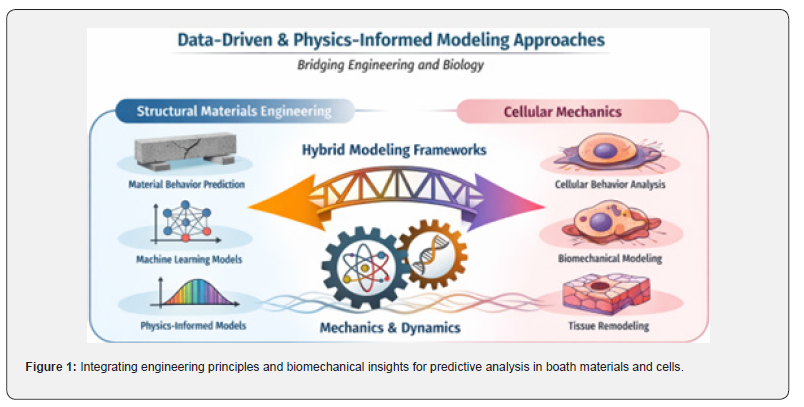
Such approaches have been successfully applied to predict strength, ductility, and failure mechanisms in complex material systems, highlighting their robustness in handling uncertainty, heterogeneity, and nonlinear relationships [5,6]. As illustrated in (Figure 1), hybrid data-driven and physics-informed modeling approaches provide a unified framework for predicting complex nonlinear behavior in both structural materials and cellular systems, highlighting strong methodological parallels between engineering and biological sciences [9-14].
Parallels with Cellular and Molecular Mechanics
Cells and biological tissues exhibit mechanical behaviors analogous to engineered materials, including viscoelasticity, anisotropy, damage accumulation, and adaptive remodeling. Recent studies in cell science increasingly adopt ML-based and multiscale modeling techniques to capture these behaviors. The integration of Physics-Informed Machine Learning (PIML) offers a promising pathway to bridge experimental observations with theoretical models in cellular mechanics, similar to its successful application in structural engineering problems [12-15].
Future Perspectives
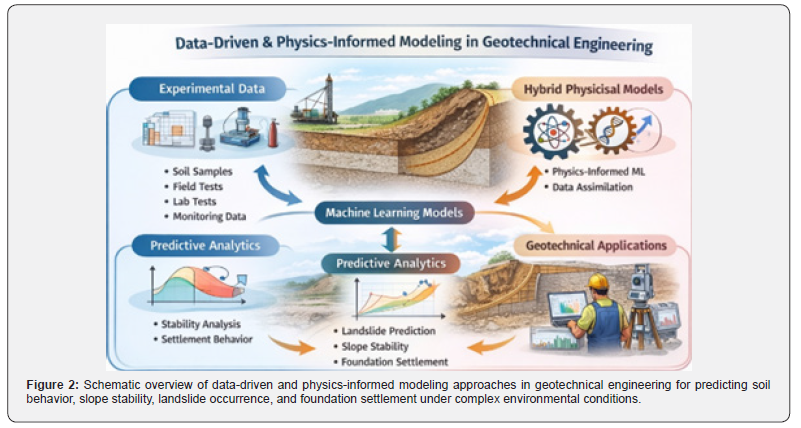
Figure 2 demonstrates how data-driven and physics-informed modeling techniques, widely used in geotechnical engineering, can serve as transferable methodologies for predictive analysis in other complex systems, including biological and cellular environments.
The convergence of modeling strategies across engineering materials and cellular biomechanics suggests strong interdisciplinary potential. Techniques developed in structural materials research—particularly hybrid physics-data approaches—can accelerate predictive modeling in cell science, enabling improved understanding of mechanotransduction, tissue remodeling, and disease progression. Future research should focus on cross-disciplinary knowledge transfer, leveraging engineering-scale modeling frameworks to enhance predictive accuracy in biological systems [16-18].
Conclusion
This mini-review highlights conceptual and methodological parallels between structural materials engineering and cellular mechanics. Data-driven and physics-inspired modeling approaches provide a common language that can foster interdisciplinary innovation, benefiting both engineering and biomedical research communities.
References
- Karniadakis GE, Kevrekidis IG, Lu L, Perdikaris P, Wang S, et al. (2021) Physics-informed machine learning. Nat Rev Phys 3(6): 422-440.
- Hosseini M, Gaff M, Niazmandi MM, Konvalinka P, Li H, et al. (2024) Study of the behavior of eccentrically-loaded fiber-reinforced polymer (FRP) confined RC columns using a novel approach based on probabilistic gene expression programming. Mechanics of Advanced Materials and Structures 1-31.
- Mahboubi Niazmandi M, Moussavi P, Ahmadi Bonakdar Z, Shakiba A, Sedaeesoula R, et al. (2025) Synergistic effects of building information modelling and lean construction: a conceptual model for enhancing productivity in construction projects. Int J Constr Manag 25(4): 1-18.
- Mahboubi Niazmandi M, Gholizadeh M (2023) Experimental study of the effect of different types of industrial steel fibers on the mechanical properties of reactive powder concrete. J Struct Constr Eng 10(11): 5-28.
- Niazmandi MM, Sedaeesoula R, Lari S, Moussavi P (2024) An integrated risk and productivity assessment model for public–private partnership projects using fuzzy inference system. Decision Analytics J 10(4): 100376.
- Kalukula Y, Ciccone G, Mohammed D, Procès A, Versaevel M, et al. (2025) Unlocking the therapeutic potential of cellular mechanobiology. Sci Adv 11(44): eaea6817.
- Hyun J, Kim HW (2022) Leveraging cellular mechano-responsiveness for cancer therapy. Trends Mol Med 28(2): 155-169.
- Pakshir P, Hinz B (2018) The big five in fibrosis: Macrophages, myofibroblasts, matrix, mechanics, and miscommunication. Matrix Biol 68-69: 81-93.
- Niazmandi MM, Mirasi S, Jokar MH, and Momeni M (2023) The effect of combined loading on the bearing capacity of strip footings located on two-layered clayey soils adjacent to geogrid-reinforced slopes. Amirkabir Journal of Civil Engineering 55(9): 1825-1844.
- Niazmandi MM (2023) Estimation of the undrained bearing capacity of strip foundations on two-layer clay soils adjacent to the geogrid-stabilized slope under the effect of combined loading. J Struct Constr Eng 11(3): 109-130.
- Wu C, Xu Y, Fang J, and Li Q (2024) Machine learning in biomaterials, biomechanics/mechanobiology, and biofabrication: State of the art and perspective. Arch Comput Methods Eng 31(7): 3699-3765.
- Niazmandi MM, Sedaeesoula R, Lari S, and Yousefi M (2024) Integrated project delivery (IPD) capabilities on reducing claims in urban underground projects: A hybrid FAHP-FTOPSIS approach. Sustainable Futures 7: 100175.
- Siddique N, and Adeli H (2013) Computational intelligence: synergies of fuzzy logic, neural networks and evolutionary computing. John Wiley & Sons.
- Shahin A, Fahimian M, Niazmandi MM, Soltaninejad M, and Wood LC (2026). The Green Building Policy Puzzle: A Stakeholder-Informed Multistage Fuzzy Framework for Incentive Evaluation. Journal of construction engineering and management 152(2): 04025246.
- Karniadakis GE, Kevrekidis IG, Lu L, Perdikaris P, Wang S (2021) Physics-informed machine learning. Nat Rev Phys 3(6): 422-440.
- Wang G, Sun D, Liu Q, Chen Y (2022) Machine learning in biomechanics: data-driven modeling of mechanical behavior in biological tissues. J Biomech 128: 110799.
- Lari S, Niazmandi MM, Dezdarani VH, and Gholipour S (2025) A practical performance level-based design method for seismic retrofitting of high-rise flexural concrete structures equipped with steel shear walls. J Struct. Constr. Eng 12(05): 68-93.
- Mousavi S, Noorzad A, Niazmandi MM, Majidi F, and Ciancimino A (2026) Advanced GEP-probabilistic-based modeling for predicting tunneling-induced groundwater drawdown: A case study of the Uma Oya Multipurpose development project. Tunn Undergr Space Technol 168: 107176.

























