




 IJCSMB Home



Reducing Cost and Enhancing Testing Capacity Of RT-PCR For SARS-Cov-2 Detection Using Half Reaction Volume Assay
Shakeel Ahmed1*, Zakir Hossain1, Mamunur Rashid1, Istiak Ahmad1, Farzana Begum1, Meherab Hossain1, Hasan Rabbi1 and Zahirul Islam2
1Bangladesh Institute of Tropical and Infectious Diseases (BITID), Bangladesh
2Institute for Developing Science and Health Initiatives (ideSHi), Bangladesh
Submission: August 7, 2023; Published:August 22, 2023
*Corresponding author:Md. Shakeel Ahmed, Professor (Microbiology & Immunology), Bangladesh Institute of Tropical & Infectious Diseases (BITID), Chittagong-4317, Bangladesh
How to cite this article:Shakeel A, Zakir H, Mamunur R, Istiak A, Farzana B, et al. Reducing Cost and Enhancing Testing Capacity Of RT-PCR For SARS-Cov-2 Detection Using Half Reaction Volume Assay. Int J Cell Sci & Mol Biol. 2023; 7(4): 555718. DOI: 10.19080/IJCSMB.2023.07.555718
Abstract
The gold standard method for detecting SARS-CoV-2 is reverse transcriptase-polymerase chain reaction (RT-qPCR). Despite its effectiveness, the COVID-19 pandemic presents challenges due to the high cost and limited availability of testing reagents. Therefore, there is an increasing need for alternative methodologies that can reduce costs, preserve testing reagents, and improve the testing capacity of RT-qPCR. This study focuses on evaluating the efficacy of RT-qPCR in detecting SARS-CoV-2 using only half of the total reaction volume. This study was conducted in the Rodolphe Merieux Laboratory (RML) at the Bangladesh Institute of Tropical and Infectious Diseases (BITID) from December 2020 to December 2021. Nasopharyngeal swab samples were collected from 80 suspected and close contact COVID-19 patients. RNA extraction was performed using the Sansure Biotech kit, and both standard and half reaction RT-qPCR assays were conducted using the 2019-nCoV nucleic acid diagnostic kit (PCR-Fluorescence Probing from Sansure Biotech, China). Among the 80 samples, 39 (48.75%) tested positive in both the standard and half-reaction assays, while none of the 41(51.25%) samples that tested negative in the standard reaction showed positive results in the half-reaction. We found 100% concordant results between the two assays. Ct values were similar between the two assays, with a slight decrease observed in the half-reaction. The average drop in Ct values for the N and ORF-1ab targets was 1.4 and 1.5, respectively. The use of the RT-qPCR half-reaction would be economically advantageous for molecular diagnostic laboratories to handle the COVID-19 pandemic more effectively especially in resource-poor settings without compromising the accuracy of the results.
Keywords: Coronavirus; RT-Qpcr, COVID-19; SARS-Cov-2; RT-Qpcr Half-reaction
Abbreviations: RML: Rodolphe Merieux Laboratory; BITID: Bangladesh Institute of Tropical and Infectious Diseases; WHO: World Health Organization; IEDCR: Institute Of Epidemiology, Disease Control, And Research; NPS: Nasopharyngeal Swabs; IRB: Institutional Review Board
Introduction
The severe acute respiratory syndrome coronavirus 2 (SARS-CoV-2) that causes coronavirus disease 2019 (COVID-19) was first identified in Wuhan, China, in December 2019 [1]. COVID-19 was officially recognized as a worldwide public health emergency by the World Health Organization (WHO) on January 30, 2020, and later declared a pandemic on March 11, 2020 [2]. Currently, there are more than 766.44 million confirmed cases of COVID-19, including 6.93 million deaths globally [3]. The first case of COVID-19 in Bangladesh was confirmed on 8th March 2020 by the Institute of Epidemiology, Disease Control, and Research (IEDCR). Onwards, the total number of confirmed COVID-19 cases exceeds 2.04 million, with a staggering death toll of 29,457 [4]. The gold standard for diagnosis of COVID-19 from respiratory tract specimens is reverse transcriptase-polymerase chain reaction (RT-qPCR) assay. It is an accurate and sensitive molecular method that quantitively detects viral RNA from suspected clinical samples [5]. RT-qPCR is a time-consuming and costly procedure, requiring skilled manpower, advanced equipment, and special laboratory environments [6]. Given the high prevalence of SARS-CoV-2 and the need for widespread testing, it is crucial to increase the rate of RT-qPCR testing to enable rapid and accurate identification of infected individuals, thereby curbing the spread of the virus [7]. However, the cost and limited availability of testing reagents pose challenges. Therefore, there is a growing demand for alternative methodologies that can lower costs, conserve testing reagents, and enhance the testing capacity of RT-qPCR. This study aimed to evaluate the RT-qPCR using half of the total reaction volume to detect SARS-CoV-2 in respiratory samples by using the Sansure Biotech RT-qPCR Kit.
Methods
Study Design
It was a cross-sectional study conducted in the Rodolphe Merieux Laboratory (RML) at the Bangladesh Institute of Tropical and Infectious Diseases (BITID). A total of 80 nasopharyngeal swabs (NPS) samples were collected from suspected and close contact COVID-19 patients from December 2020 to December 2021. Ethical permission was approved by the Institutional Review Board (IRB) of the BITID.
Specimen Collection
Nasopharyngeal swab samples were collected in a 2mL sample storage buffer (Sansure Biotech, Changsha, China) for SARS-CoV-2 RT-qPCR. Collected specimens to be tested were immediately processed or stored at 40 C for testing within 24 hours of sample collection. All suspected specimens were treated in a biosafety cabinet with full personal protective equipment.
SARS-Cov-2 Viral RNA Extraction
A sample-release reagent kit (Sansure Biotech, Changsha, China) was used to extract total RNA from 20 μl of nasopharyngeal swab samples. The extraction of RNA was carried out as per the manufacturer’s instructions.
SARS-CoV-2 Viral RNA Detection via Real‑Time RT‑PCR
We conducted the RT-qPCR assays for the standard and halfreactions concurrently using the novel Coronavirus 2019-nCoV nucleic acid diagnostic kit (PCR-Fluorescence Probing from Sansure Biotech, China). Briefly, to perform the standard RT-qPCR reaction, 20 μl extracted RNA was added to 30 μl of 2019-nCoVPCR master mix (2019-nCoV-PCR Mix + 2019-nCoV-PCR-Enzyme Mix). For the half-reaction of RT-qPCR, half of the volumes of the reagents were utilized. Therefore, our proposed reaction comprised 15 μl of reagents and 10 μl of RNA, adding up to 25 μl in each well. We conducted both assays (standard and halfreactions) in 96-well plates using the CFX96Touch™ Real-time PCR Detection System (Bio-Rad Laboratories, Inc., Hercules, CA, USA). The manufacturer’s instructions were followed for conducting the reaction, amplification conditions, and interpretation of the results. RT-qPCR result was reported as positive when the cycle threshold (Ct) value for the N and ORF-1ab targets was less or equal to 40. If the Ct was greater than 40 or undetectable, the result was considered negative [8].
Statistical analysis
SPSS (Statistical Package for Social Science) for Windows version 23 software was used for the analyses. Continuous variables were given as means ± SD, whereas categorical variables were presented as percentages.
Results
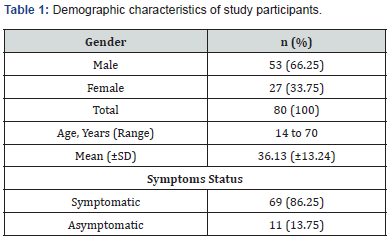
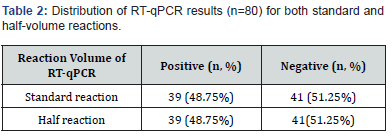
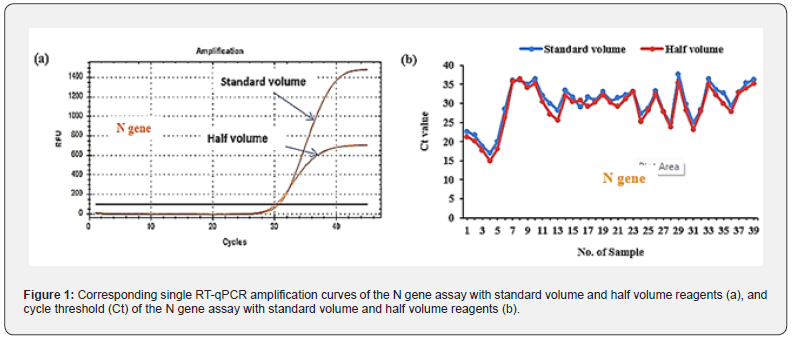
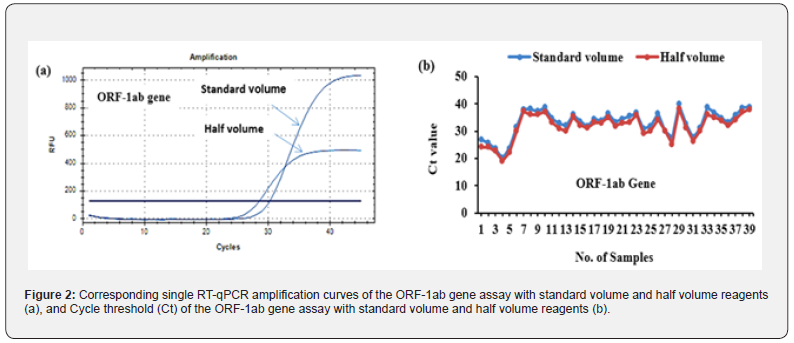
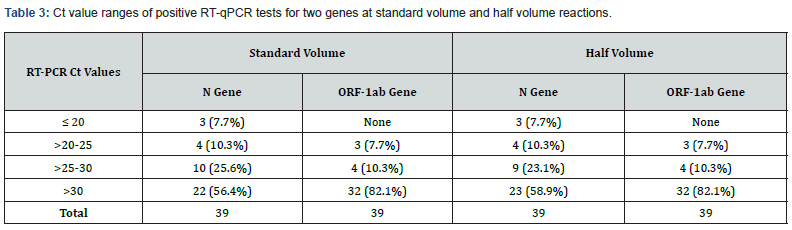
A total of 80 NPS samples were analyzed with RT-qPCR using both standard and half reaction assays, where 53 (66.25%) were male and 27 (33.75%) were female. The mean age of study individuals was 36.13 (±13.24). Regarding symptom status, 69 individuals (86.25%) reported experiencing symptoms, while 11 individuals (13.75%) were asymptomatic close contacts (Table 1). Among 80 samples, 39 (48.75%) tested positive for both standard and half reaction assays. In addition, none of the 41(51.25%) samples that yielded negative results in the standard reaction showed positive results in the half-reaction (Table 2). The Ct values of the SARS-CoV-2 N gene and the ORF-1ab gene obtained in the half-reaction and standard-reaction tests were compared (Figure 1 & 2). For the N gene target in the standard reaction assay, out of the 39 positive samples, 3 samples (7.7%) had Ct values ≤ 20, 4 samples (10.3%) had Ct values >20-25, 10 samples (25.6%) had Ct values >25-30, and 22 samples (56.4%) had Ct values > 30. Similarly, when the tests were conducted at half-reaction, the distribution of Ct values was similar, with 3 samples (7.7%) having Ct values ≤ 20, 4 samples (10.3%) having Ct values >20-25, 9 samples (23.1%) having Ct values >25-30, and 23 samples (58.9%) having Ct values > 30 (Table 3).
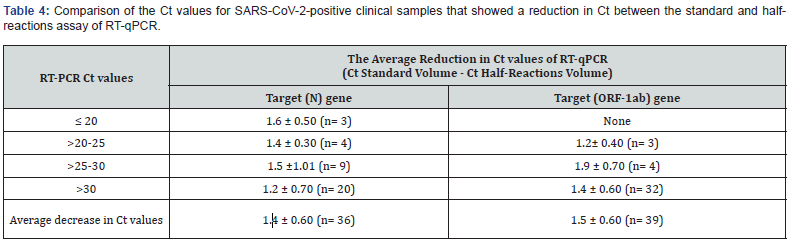
For the ORF-1ab gene, none of the samples had a Ct value ≤ 20 in either the standard or half-volume reactions. 3 samples (7.7%) had Ct values >20-25, 4 samples (10.3%) had Ct values >25 -30, and the majority of samples, 32 (82.1%), had Ct values > 30 (Table 3). Out of 39 positive samples, half reaction assay showed a decrease in Ct values of 36 samples for the N gene target and all 39 for the ORF-1ab gene target. In comparison to the standard reaction testing, the average drop in Ct values was 1.4 and 1.5 for both targets respectively (Table 4).
Discussion
RT-qPCR assays for SARS-CoV-2 RNA detection in clinical samples are widely used in COVID-19 diagnostic laboratories due to their high sensitivity and specificity [9]. To effectively address the widespread presence of SARS-CoV-2, enhancing the rate of RTPCR testing is crucial. Due to the expensive and limited availability of reagents, there is a pressing demand for a new methodology to lower costs, preserve testing reagents, and enhance the testing capacity of RT-qPCR. In this study, we evaluated the RT-qPCR using half of the total reaction volume to detect SARS-CoV-2 in respiratory samples collected from COVID-19 suspected and close contact patients at BITID. The gender distribution of the study participants revealed a higher proportion of males (66.25%) compared to females (33.75%). This finding aligns with previous studies that have shown a higher prevalence of COVID-19 in males [10,11]. Additionally, a significant majority (86.25%) of the individuals reported experiencing symptoms, highlighting the importance of timely and accurate testing to identify and isolate infected individuals.
We analyzed the cycle threshold (Ct) values of the clinical samples for SARS-CoV-2 using the standard and half reaction assays. We found 100% concordant results between the two assays. Among the positive SARS-CoV-2 specimens, we noticed a slight decline in the values of Ct for the majority of samples, either for the N (36 cases [92%] or ORF-1ab (39 cases [100%] targets in the half-reaction assay which was similar to the previous study [7,12]. This decrease in Ct values had no impact on the RT-qPCR result. So, according to the above-mentioned data, the halfreaction volume assay is a promising strategy for the detection of SARS-CoV-2, and it can help to reduce the cost of the test in resource-poor settings without compromising the accuracy of the results. The study possessed certain limitations such as a limited sample size and a single-center study design. Hence, additional investigations with larger sample sizes and multicenter designs using the same RT-qPCR test kit are necessary to validate the study’s results.
Conclusion
Due to a shortage of test reagents, each laboratory’s ability to conduct tests is still limited and the number of patients tested for COVID-19 is increasing globally, it would be economically advantageous for molecular diagnostic laboratories to implement the half-reaction methodology to handle the COVID-19 pandemic more effectively. However, further studies are needed to validate these findings in different settings and with different RT-PCR kits.
Author Contributions
Md. Shakeel Ahmed was the principal investigator responsible for the study conception, design, validation, review, and editing of the manuscript. Md. Zakir Hossain was responsible for the laboratory resources, investigation, and supervision of the laboratory staff. Md. Mamunur Rashid’s role was the laboratory research methodology, investigation, and validation. Istiak Ahmad’s role was COVID-19 case selection. Md. Zahirul Islam’s role was laboratory research methodology, study, validation, formal data analysis, original draft writing, and editing of the manuscript. Farzana Begum, Meherab Hossain, and Hasan Rabbi assisted in patient specimen collection and laboratory methodology.
Acknowledgments
The authors thank Rodolphe Merièux Laboratory, Fouzderhat, Chittagong, for providing laboratory facilities, reagents, and technical support throughout the study.
References
- Li Q, Guan X, Wu P, Wang X, Zhou L, et al. (2020) Early Transmission Dynamics in Wuhan, China, of Novel Coronavirus-infected pneumonia. N Engl J Med 382(13): 1199-207.
- https://www.who.int/docs/default-source/coronaviruse/situation-reports/20200313-sitrep-53-Covid-19.pdf?sfvrsn=adb3f72_2.
- World health statistics (2022) World Health Organization. Available from: https://www.who.int/news/item/20-05-2022-world-health-statistics-2022.
- Anwar S, Nasrullah M, Hosen MJ (2020) Covid-19 and Bangladesh: Challenges and how to address them. Frontiers in Public Health 8: 154.
- Munne K, Bhanothu V, Bhor V, Patel V, Mahale SD, et al. (2021) Detection of SARS-COV-2 infection by RT-PCR test: Factors influencing interpretation of results. Virus Disease 32(2): 187-189.
- Colton H, Ankcorn M, Yavuz M, Tovey L, Cope A, et al. (2021) Improved sensitivity using a dual target, E and RDRP assay for the diagnosis of SARS-COV-2 infection: Experience at a large NHS Foundation Trust in the UK. J Inf 82(1): 159-198.
- Wink PL, Volpato F, Lima-Morales D de, Paiva RM, Willig JB, et al. (2021) RT-qPCR half-reaction optimization for the detection of SARS-COV-2. Rev Soc Bras Med Trop 54: e0319.
- The Novel Coronavirus (2019-nCoV) Nucleic Acid Diagnostic Kit (PCR-Fluorescence Probing) is only for use under the Food and Drug Administration’s Emergency Use Authorization (EUA).
- Chaimayo C, Kaewnaphan B, Tanlieng N, Athipanyasilp N, Sirijatuphat R, et al. (2020) Rapid sars-COV-2 antigen detection assay in comparison with real-time RT-PCR assay for laboratory diagnosis of COVID-19 in Thailand. Virol J 17(1) :177.
- Fortunato F, Martinelli D, Lo Caputo S, Santantonio T, Dattoli V, et al. (2021) Sex and gender differences in COVID-19: An Italian local register-based study. BMJ Open 11(10): e051506.
- Jin JM, Bai P, He W, Wu F, Liu XF, et al. (2020) Gender differences in patients with COVID-19: Focus on severity and mortality. Front Public Health 8: 152.
- Chen CJ, Hsieh LL, Lin SK, Wang CF, Huang YH, et al. (2020) Optimization of the CDC protocol of molecular diagnosis of COVID-19 for timely diagnosis. Diagnostics 10(5): 333.

























