




 IJCSMB Home



Characterization of Dependent K+ Voltage Channels (Kv) in the Colon of Chagasic Patients with and without Megacolon
Cláudio Ferreira de Mendonça1, Michelle AR Freitas2, Enio C de Oliveira3, Axel Brehmer4 and Alexandre Barcelos Morais da Silveira5*
1Geral Surgery Service, HC-UFU, Universidade Federal de Uberlândia, Minas Gerais, Brazil
2Parasitology Sector, ICBIM, Universidade Federal de Uberlândia, Minas Gerais, Brazil
3Department of Surgery, Medical School, Universidade Federal de Goiás, Brazil
4Institute of Anatomy I, University of Erlangen-Nuremberg, Krankenhausstr 9 Erlangen D-91054, Germany
5Human Anatomy Sector, ICBIM, Universidade Federal de Uberlândia, Minas Gerais, Brazil
Submission: July 7, 2023; Published:August 15, 2023
*Corresponding author:Alexandre Barcelos Morais da Silveira, PhD, MD Neurosciences Laboratory, ICBIM, Campus Umuarama, Universidade Federal de Uberlândia, Uberlândia, Minas Gerais, Brazil
How to cite this article:Cláudio F d M, Michelle AR F, Enio C de O, Axel B, Alexandre B M d S. Characterization of Dependent K+ Voltage Channels (Kv) in the Colon of Chagasic Patients with and without Megacolon. Int J Cell Sci & Mol Biol. 2023; 7(4): 555717. DOI: 10.19080/IJCSMB.2023.07.555717
Abstract
Chagas’ disease is a chronic illness that can lead to a digestive form characterized by organ obstruction, resulting in significant morbidity and mortality. Patients with this form experience symptoms related to megacolon, where the affected organs exhibit enlarged lumens and muscle hypertrophy. Histological analysis reveals inflammatory lesions in the enteric nervous system (ENS) with a reduction in the number of neurons. Even individuals without megacolon show less intense denervation and inflammation processes. These findings offer new avenues for understanding the pathology of Chagasic megacolon. Voltage-dependent K+ (Kv) channels play a crucial role in regulating the electrical activity and smooth muscle responses in various body systems. They are involved in maintaining the resting membrane potential of cells and respond to excitatory and inhibitory neurotransmitters, affecting interstitial cells of Cajal and smooth muscle responses to neural stimuli. Thus, this study aimed to investigate the expression of voltage-dependent K+ channels (Kv channels) in Chagasic patients with and without megacolon. The results indicate abnormal expression of Kv7 channels in the dilated portion of chagasic patients with megacolon. Conversely, the expression of these channels in chagasic patients without megacolon may serve as a protective factor against megacolon development, potentially delaying or preventing its occurrence. Decreased Kv7 expression may contribute to the pathophysiology of this complex condition and the development of megacolon. Maintaining the expression of these channels could potentially serve as a preventive measure against megacolon development. Further research is necessary to explore the underlying mechanisms and develop targeted interventions.
Keywords: Chagas Disease; Enteric Nervous System; Ik Channels; Megacolon
Abbreviations: ENS: Enteric Nervous System; KV: Voltage-Dependent K+ Channels; KIR: Internal Rectified Potassium Channel; Kca: Calcium-Activated Potassium Channel; K2p: Pore Domain Potassium Channel; BSA: Bovine Serum Albumin
Introduction
Megaesophagus, megacólon and heart disease are causes of morbidity and mortality in the chronic phase of Chagas’ disease. Our laboratory has been especially interested in the study of the pathogenesis of the chagrined megaesophagus and megacolon. Epidemiological studies in endemic areas of Brazil have shown that 8-10% of chronic patients have the digestive form of the disease [1] Patients with the digestive form present a number of symptoms related to organ obstruction. Both in the megaesophagus and in the megacólon, the organs exhibit a large increase in lumen and hypertrophy of the muscular layer. Histological analyses of the affected organs have demonstrated inflammatory lesions of the enteric nervous system (ENS), associated with a large reduction in the number of neurons. According to Koberle, for the development of megaesophagus it is necessarily a reduction of approximately 85% in the number of neurons in the organ, while the disease in the colon is associated with a neuronal loss of at least 50% [2].
Although the mechanism of neuronal injury remains unclear, the frequent observation of ganglionitis and periganglionitis in patients with mega points to the participation of immune system cells in this pathological process. They found inflammatory infiltrates in the mucosal muscle, submucosa, and muscle layers [3]. The ENS presents about 10 to 100 million neurons, with a wide variety of neurotransmitters and/or neuropeptides. It controls various aspects of the intestine, such as glandular secretion, vascular tone, peristalsis, and still participates in regional neuroimmune relationships. It is possible that in patients with megaesophagus and megacolon, some categories of neurons and some particular systems of neurotransmitters are preferentially affected, and their functions are depressed or exacerbated. The performance of comparative studies aiming to clarify the nature of the inflammatory process and the identification of the neuropeptide systems generally affected in these populations will contribute to the understanding of the pathogenesis of the mega chagasic [4]. Until some time ago, the scarcity of knowledge hampered the investigation of pathological changes in enteric neurons about the functional classes of these neurons in normal individuals and by the lack of experimental models that mimic the gastrointestinal disorders that afflict humans. However, this fact has changed in recent years [5]. Due to the use of experimental models used in laboratories, there is currently relevant knowledge regarding the types of neurons regarding their morphology, neurochemistry, projections, and physiological properties [6,7]. The alterations suffered by neuroimmune integration have been the subject of research in several pathologies that affect the gastrointestinal tract. In Chagas´ disease, we believe that the study of the enteric nervous system, as well as its association with the inflammatory process, may provide support for understanding neuroimmune changes that may be somehow involved in the development of the mega.
The electrical activity existing in all organs of superior animals is essential for the physiological processes of mammals, such as the transmission of nervous excitability. And electrical signals cause all electrical activities generated through ionic channels. Ions pass through the channels distributed in the membranes to conduct electrical signals selectively and quickly, which can modulate the physiological and pathological activities of the cells [8]. Among all these ionic channels, potassium channels have the most extensive distribution. Potassium channels are the largest family of ionic channels involved in the governance of neural functions such as synaptic organization and neuronal signaling [9]. Neuronal K+ channels can modulate membrane excitability, for example, establishing resting potential, and maintaining brief and temporal intervals in action potentials. There are four types of K+ channels: internal rectified potassium channel (KIR), calcium-activated potassium channel (KCa), voltage-dependent potassium channel (KV) and pore domain potassium channel (K2p). Increased activity of plasma membrane voltage-dependent potassium (KV) channels will reduce the concentration of K+ in the cytoplasm and trigger the process of cell death. It has been described that some K+ channel blockers or increased extracellular K+ concentration K+ may inhibit K+ flow, which can totally prevent cell death [10]. The Kv family of K+ channels consist of 12 subfamilies, Kv1-Kv12, within which five members of the Kv7 family have already been identified. To date, most published data on the expression of these channels have focused on their location in the heart and brain [11,12]. The enteric nervous system is a complex network of neurons and enteroglial cells arranged within the walls of the gastrointestinal tract. It is the largest and most complex division of the peripheral nervous system, containing more neurons than the spinal cord, and has the unique characteristic of being able to perform its motility functions completely independent of the central nervous system [13].
The Chagas´ megacolon is a pathology characterized by the destruction of components of the enteric nervous system mediated by both the inflammatory process and the infection caused directly by T. cruzi. Surgical resection of the colon segments affected by the digestive form of Chagas´ disease is one of the few treatments available to these patients. We will conduct this study to test the hypothesis that Kv7 channels are present in the normal human colon and are reduced in Chagas’ disease, which may have an immediate effect on the process of constipation and the progression of this pathology.
Material and Methods
Patients
In this project, we used tissue samples from chagasic patients with megacolon, chagasic patients without megacolon and control individuals, collected by surgery or necropsy at the School Hospital of the Faculty of Medicine of the Federal University of Goiás, by Dr. Ênio Oliveira. Prior consent was obtained from all individuals, parents, or guardians for their inclusion in the research study. This project was approved by the Research Ethics Committee of UFU (Ethics 131/11) and the University of Erlangen-Numberg.
Our research group has a unique collection of samples from the gastrointestinal tract of Chagas´ disease patients who developed (15 patients) and did not develop the chagasic megacolon (15 patients), as well as samples from non-Chagas individuals (10 patients) (submitted to surgery due to intestinal pathologies, such as cancer). The presence of the disease was confirmed by clinical and laboratory tests [14]. The quality of these samples was evaluated by histological and immunohistochemistry techniques, which demonstrated the preservation of their immunoreactivity. Patients from the control group and chagasic patients without megacolon were submitted to surgical process due to intestinal neoplasms. In the group of chagasic patients not with megacolon, only one presented intestinal complaints or symptom of any involvement of the digestive system. Of the 15 patients analyzed in this group, 13 developed chronic Chagas heart disease. In this group of patients, samples were collected from the dilated region (megacolon) and from the non-dilated region upstream of the affected portion. In the group of chagasic patients with megacolon, 10 suffered from constipation several years ago and 7 had megaesophagus. These patients underwent the surgical process due to complications caused by the megacolon.
Immunohistochemistry
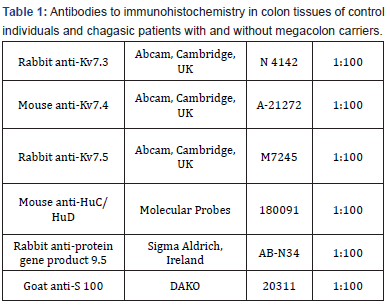
In this work, a triple marking was performed in our samples with the antibodies listed in Table 1. Samples were pre-incubated for 2 hours in PBS 0.05M containing 1% bovine serum albumin, Triton X-100 at 0.5%, Thimerosal at 0.05% and normal goat serum at 5%. After a bath in PBS for 10 minutes, the samples (pH 7.4) (BSA) were incubated in a solution containing BSA, Triton X-100, Thimerosal and primary antibodies for 72 hours. After this period, the samples (4°C) were submitted to a bath in PBS at 4 °C overnight. After this bath, the secondary antibodies were added in the same solution used with the primary antibodies followed by a bath in PBS. To reduce lipofuccine-induced self-fluorescence, the samples (4 hours in room temperature) (12 hours in 4°C) were incubated with acetate-ammonia buffer containing 1 mM CuSO4 (pH 5.0) for 60-90 minutes followed by a brief bath in distilled water. After this process, the samples were mounted on PBS-glycerol. For image acquisition and processing, a confocal laser scanning microscope attached to a Nikon Diaphot 300 and equipped with a Krypton-argon laser was used. The images (American Laser, Salt Lake City, USA) were generated using three different excitation waves using filters of 488nm, 594nm and 647nm. The images generated by this system (ALEXA Fluor 488), (ALEXA Fluor 594) and (ALEXA Fluor 647) were prepared using the Confocal Assistant 4.02, Adobe Photoshop 6.0 and Corel Draw 13 program. We made statistical analyses using spot software. The differences between the mean values of the marking areas (Version 3.5.6 for Windows, Diagnostic Instruments, USA) were analyzed with the one-way ANOVA for each patient (P<0.05).
Results
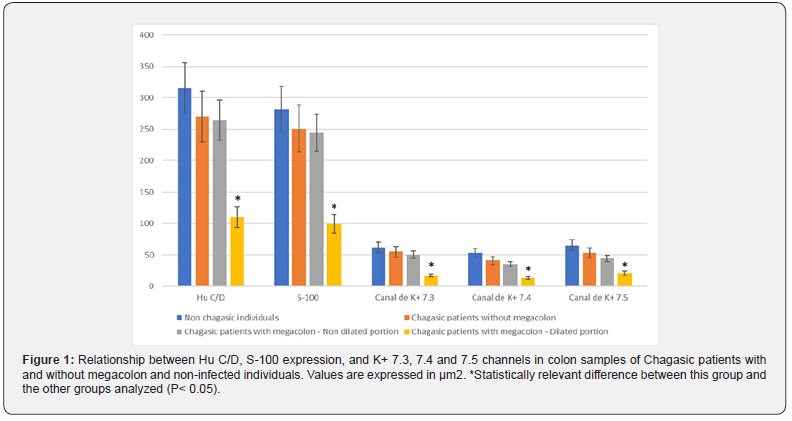
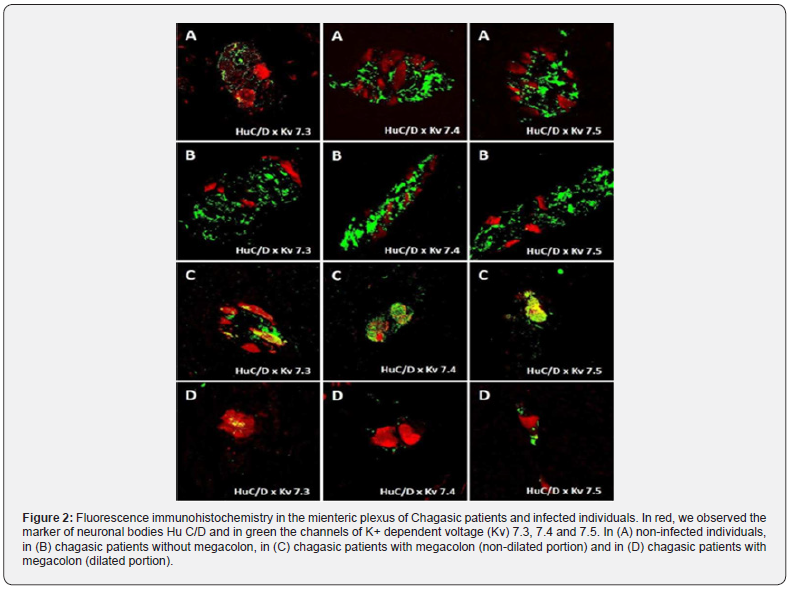
The expression of K+ voltage-dependent channels Kv7.3, Kv7.4 and Kv7.5 in the mienteric plexus and submucous plexus in colon samples from chagasic patients with and without megacolon carriers. For this, the co-expression of K+ channels and neuronal cells (through the expression of anti-HuC/HuD) and enteroglial cells (S-100 evaluated. Our results indicated that chagasic patients with megacolon have a statistically relevant decrease in K+ channels in relation to non-infected patients and in relation to chagasic patients without megacolon. However, the expression of K+ channels in chagasic patients without megacolon was similar to that presented by non-infected individuals. When comparing the expression of K+ channels in the dilated portion with the nondilated portion of samples of chagasic patients with megacolon, we noticed that the non-dilated portion of these samples does not present a decrease in the expression of K+ channels as sharply as that presented in the dilated portion, indicating that the alterations suffered in the colon are limited to the dilated portion of this organ. In addition, we observed that the immunoreactivity of K+ channels occurred mainly in neurons with Dogiel II morphology (large neuronal body, round or oval) in all analyzed groups. Enteroglial cells, on the other hand, practically did not present expression of the K+ channels analyzed, demonstrating that they restrict it to neurons.
We also observed that regarding the expression of neurons in the nerve plexus studied, chagasic patients without megacolon and non-infected patients present similar amount both in Hu C/D expression and in K+ channels, as observed. Chagasic patients with megacolon have an intense decrease in the number of neurons, reflected in the low expression of Hu C/D. In addition, this group of patients presents neuronal hypertrophy, characterized by the increase of the remaining neuronal bodies, both in the nondilated and dilated portions. On the other hand, the expression of K+ channels is statistically equivalent in the non-dilated portion of patients with megacolon, and greatly decreased in the dilated portion of these patients. These details can be seen in lines C and D.
Regarding enteroglial cells, we observed that all groups of noninfected individuals, chagasic patients without megacolon and chagasic patients with megacolon (non-dilated portion) present similar expression of the S-100 protein, marker of enteroglial cells. However, we observed a decrease in the expression of enteroglial cells in the dilated portion of chagasic patients with megacolon, as can be seen in Figure 1,2. Regarding the distribution of K+ channels, we observed that they do not exhibit great expression in enteroglial cells when compared with their expression in neurons. Among all the analyzed groups, the non-dilated portion of chagasic patients with megacolon was the one that most exhibited K+ channels next to enteroglial cells (Figure 3, line C), although this increase in expression in relation to the other groups was not statistically significant.
Discussion
Ionic channels are essential for basic cellular function, including sensory perception and intercellular communication. Dependent voltage K+ channels (Kv channels) participate in the rhythmicity and responses of smooth muscles by regulating membrane potential in various cell types throughout the body [15]. As the control of muscle motility is regulated by excitatory and inhibitory neurotransmitters, the channels also participate in the responses performed by neurons and enteroglial cells found in the enteric nervous system (ENS). The K+ channel family consists of 12 subfamilies, Kv1 to Kv12, in which five members of the Kv family have already been characterized at the molecular level and identified. These comprise Kv7.1-Kv7.5 and are encoded by KCNQ1-5 genes. To date, most published data on the expression of these channels have focused on their location in the heart and brain [16]. For some decades, it is an already consensus that the ENS is an intricate network of neurons and enteroglial cells between the walls of the gastrointestinal tract. It is the largest and most complex division of the peripheral nervous system, containing more neurons than the spinal cord, and possesses the unique characteristic of performing its motility functions completely independent of the central nervous system [6]. It is known that the digestive form of Chagas´ disease occurs from the destruction of the ENS and, um of the most important factors in the development of the mega chagasic would be a degenerative process, mainly of nerve ganglia of the gastrointestinal tract, which apparently begins in the acute phase, persisting until the chronic phase. However, there are still many aspects to be elucidated about its etiopathogenesis [2].
Megaesophagus and megacolon are the most common changes in the digestive tract in Chagas´ disease. The parasite’s high concentration in the tissue triggers neuronal destruction in Chagas´ disease in the acute phase, but the inflammatory process involved in this disease also plays a part in the chronic phase. The interrelation between the nervous, endocrine, and immunological systems is very important for the understanding of intestinal pathologies and may be definitive in the determination of clinical manifestations and for the development of inflammatory processes in the intestine [17]. A recent study identified the potassium channel Kv7.5 as having a role in excitability in the rat colon [18]. This data prompted us to design this study to test the hypothesis that the Kv7 channels present in the human colon could be altered in the digestive form of Chagas´ disease. K+ channels play important roles in excitable cells, neurons and enteroglial cells, directly involved in various physiological processes, such as triggering action potential, neurotransmitter release, and muscle contractility. The potential of the cell membrane hyperpolarizes whenever the K+ channels open, thus K+ flows out of the cell due to the large transmembrane electrochemical gradient, leading to decreased cellular excitability [11].
In addition, K+ channels also play a role in defining membrane potential at rest, resulting in different levels of basal muscle tone that vary depending on location within the gastrointestinal tract. Over the years, several research groups have investigated the expression of Kv7 channels in human tissues and experimental models. Previously, it was reported findings of their study of Kv channel expression in the murine gastrointestinal tract. Of all Kv7 channels studied, both Kv7.4 and Kv7.5 genes have been shown to be the most abundantly expressed in ENS cells. The results showed that Kv7.4 and Kv7.5 were expressed in the circular muscle of the colon, but not Kv7.1. In addition, their data showed that Kv7 channel blockers increase activity in different regions of the intestine [19]. Ipavec et al. investigated the expression of Kv7 channels in the gastric fundus rat. Ipavec et al. demonstrated that Kv7 channel blocker XE-991 induces concentration-dependent contractions. Transcriptions encoded by all KV7 genes were detected on the gastric background of rats, with Kv7.4 and Kv7.5 channels showing the highest levels of expression, with low levels of Kv7.1-3 also evident. The Kv7.4 and Kv7.5 channels were visualized by confocal immunofluorescence in the circular muscle and longitudinal layers [20]. More recently, the same group of researchers performed a very similar analysis, in which they analyzed the expression of Kv7 channels in human taenia coli and revealed similar results in this tissue as described above. These authors have suggested that Kv7 channels seem to contribute to the rest of muscle tone and that Kv7 channel activators may present therapeutic potential as a relaxant for gastrointestinal muscles [21]. A recent study by Jepps et al. discussed the therapeutic potential of Kv7 channel blockers in patients with gastrointestinal dismotility conditions such as chronic constipation and an incontinence study in animal models suggested that the Kv7 channel activator, Retigabin, provided an improvement in sphincter control in 5% of individuals compared to 1.4% who received placebo. This data suggests that Kv7 channels found in the colon may provide another therapeutic target for Kv7 channel activators and blockers [22]. In 2014, a study developed by Wright et al. indicated the expression of Kv7 channels in Cajal cells, evaluating the potential of these channels in regulating the excitability of ENS neurons. These authors found Cajal cells expressing Kv7.5 through immunohistochemistry. Kv7.5 channel expression has also been reported in enteric neurons of myenteric ganglia, as well as weak co-localization in smooth muscle cells [23]. This study revealed that Hu C/D positive neurons expressed Kv7.3, Kv7.4 and Kv7.5 in both submucous and myenteric plexuses of the normal human colon. The study revealed that the expression of Kv7.3, Kv7.4 and Kv7.5 decreased in colon samples of the dilated portion of chagasic patients with megacolon while in the non-dilated portion of these patients and in chagasic samples without megacolon, the expression was statistically equivalent to that of uninfected individuals [24-31].
The results of our current study suggest that the expression of ionic channels, in this case, they abnormally expressed Kv7 channels in the dilated portion of chagasic patients with megacolon. Similarly, its expression in the samples of chagasic patients without megacolon could mean a protective factor against the development of the mega, being responsible for avoiding or at least delaying it. We believe that the lack or decrease in Kv7 expression may play a role in the pathophysiology of this complex condition and consequently in the development of megacolon. Similarly, we believe that maintaining the expression of these channels could hinder the development of the mega. This data point that the destruction of Kv channels initiated by the parasite and the inflammatory process would initially lead to muscle dysmism and would accelerate this entire cycle of destruction described above. Our results agreed with previous studies that demonstrated the reduction of the expression of Kv channels in other gastrointestinal diseases, such as Crohn’s disease and ulcerative colitis accelerates the progression of the disease by leading to a greater degree of motor incoordination of the colon. Future studies evaluating the function of each Kv channel separately could better clarify the function of these channels in the development not only of the Chagas megacolon but also of other pathologies of the gastrointestinal tract.
Conclusion
The destruction of Kv channels initiated by the parasite and the inflammatory process would initially lead to muscular dysmotility and accelerate the cycle of megacolon destruction. Our findings are consistent with previous studies that have demonstrated reduced expression of Kv channels in other gastrointestinal diseases, such as Crohn’s disease and ulcerative colitis, which accelerates disease progression by causing a greater degree of colonic motor incoordination. Future studies investigating the function of each Kv channel separately could provide a better understanding of the role of these channels not only in the development of chagasic megacolon but also in other gastrointestinal pathologies.
Acknowledgements
This work was supported by funds from CNPq (Conselho Nacional de Desenvolvimento Científico e Tecnológico).
References
- Dias JC, Machado EM, Borges EC, Moreira EF, Gontijo C, et al. (2002) Chagas disease in Lassance, Minas Gerais State: Clinical-epidemiological re-evaluation ninety years after the discovery by Carlos Chagas. Rev Soc Bras Med Trop 35(2): 167-176.
- Koberle F (1961)Pathology and pathological anatomy of Chagas' disease. Bol Oficina Sanit Panam 51: 404-428.
- Adad SJ, Cancado CG, Etchebehere RM, Teixeira VP, Gomes UA, et al. (2001) Neuron count reevaluation in the myenteric plexus of chagasic megacolon after morphometric neuron analysis. Virchows Arch 438(3): 254-258.
- Furness JB, Costa M (1980) Types of nerves in the enteric nervous system. Neuroscience 5(1): 1-20.
- Schroedl F, De Stefano ME, Reese S, Brehmer A, Neuhuber WL (2004) Comparative anatomy of nitrergic intrinsic choroidal neurons (ICN) in various avian species. Exp eye res 78(2): 87-196.
- Brehmer A, Lindig TM, Schrodl F, Neuhuber W, Ditterich D, et al. (2005) Morphology of enkephalin-immunoreactive myenteric neurons in the human gut. Histochem cell biology 123(2): 131-138.
- Schrodl F, De Stefano ME, Minvielle F, Brehmer A, Neuhuber WL (2005) Somatostatin immunoreactivity in quail pterygopalatine ganglion. J Anat 206(3): 249-255.
- Brehmer A (2006) Structure of enteric neurons. Adv Anat Embryol cell biol 186:1-91.
- Brehmer A, Schrodl F, Neuhuber W (2006) Morphology of VIP/nNOS-immunoreactive myenteric neurons in the human gut. Histochem cell biol 125(5): 557-565.
- Ganns D, Schrodl F, Neuhuber W, Brehmer A (2006) Investigation of general and cytoskeletal markers to estimate numbers and proportions of neurons in human intestine. Histol Histopathol 21(1): 41-51.
- Jungbauer C, Lindig TM, Schrodl F, Neuhuber W, Brehmer A (2006) Chemical coding of myenteric neurons with different axonal projection patterns in the porcine ileum. J Anat 209(6): 733-743.
- Kapp S, Schrodl F, Neuhuber W, Brehmer A (2006) Chemical coding of submucosal type V neurons in porcine ileum. Cells tissues organs 184(1): 31-41.
- Schrodl F, Brehmer A, Neuhuber WL, Nickla D (2006) The autonomic facial nerve pathway in birds: a tracing study in chickens. Invest Ophthal vis sci 47(8): 3225-3233.
- Furness JB (2006) Novel gut afferents: Intrinsic afferent neurons and intestinofugal neurons. Auton Neurosci 125(1-2): 81- 85.
- Furness P, Garrud P, Faulder A, Swift J (2006) Coming to terms: a grounded theory of adaptation to facial surgery in adulthood. J Health psychol 11(3): 453-466.
- Chen W, Lee RC (1994) Evidence for electrical shock-induced conformational damage of voltage-gated ionic channels. Ann N Y Acad Sci 720: 124-135.
- Sands ZA, Sansom MS (2007) How does a voltage sensor interact with a lipid bilayer? Simulations of a potassium channel domain. Structure 15(2): 235-244.
- Edmonds CJ (2010) Apical potassium (BK) channels and enhanced potassium secretion in human colon. QJM 103(7): 539-540.
- Perry MD, Rajendran VM, MacLennan KA, Sandle GI (2016) Segmental differences in upregulated apical potassium channels in mammalian colon during potassium adaptation. Am J Physiol Gastrointest Liver Physiol 311(5): G785- G793.
- Yin X, Xu G, Zhu H, Fu R, Li Y, et al. (2021) Effects of magnetic stimulation at different frequencies on neuronal excitability and voltage-gated potassium channels in vitro brain slices] Sheng wu yi xue gong cheng xue za zhi Journal of biomedical engineering 38(2): 224-231.
- Sancho M, Fletcher J, Welsh DG (2022) Inward Rectifier Potassium Channels: Membrane Lipid-Dependent Mechanosensitive Gates in Brain Vascular Cells. Front cardiovasc Med 9: 869481.
- Da Silveira ABM, Arantes RM, Vago AR, Lemos EM, Adad SJ, et al. (2005) Comparative study of the presence of Trypanosoma cruzi kDNA, inflammation and denervation in chagasic patients with and without megaesophagus. Parasitology 131(Pt 5): 627- 634.
- Abdul M, Hoosein N (2002) Voltage-gated potassium ion channels in colon cancer. Oncol reports 9(5): 961-964.
- Sandle GI, Butterfield I (1999) Potassium secretion in rat distal colon during dietary potassium loading: role of pH regulated apical potassium channels. Gut 44(1): 40-46.
- Da Silveira AB, D Avila Reis D, De Oliveira EC, Neto SG, Luquetti D, et al. (2007) Neurochemical coding of the enteric nervous system in chagasic patients with megacolon. Dig dis sci 52(10): 2877-2883.
- Li SY, Ou-Yang S (2005) Emodin blocks voltage dependent potassium channels in rat proximal colon smooth muscle cells. Yao xue bao Acta pharmaceutica Sinica 40(9): 804-809.
- Horst JVD, Greenwood IA, Jepps TA (2020) Cyclic AMP-Dependent Regulation of Kv7 Voltage-Gated Potassium Channels. Front physiol 11: 727.
- Ipavec V, Martire M, Barrese V, Taglialatela M, Curro D (2011) KV7 channels regulate muscle tone and noradrenergic noncholinergic relaxation of the rat gastric fundus. Pharmacol Res 64(4): 397-409.
- Adduci A, Martire M, Taglialatela M, Arena V, Rizzo G, et al. (2013) Expression and motor functional roles of voltage-dependent type 7 K(+) channels in the human taenia coli. Eur J pharmacol 721(1-3): 12-20.
- Jepps TA, Barrese V, Miceli F (2021) Editorial: Kv7 Channels: Structure, Physiology, and Pharmacology. Front physiol 12: 679317.
- Wrighton KH (2014) Ion channels: regulating cell volume. Nat rev Mol cell biol 15(6): 363.

























