




 GJPPS Home




Abstract
Rheumatoid Arthritis (RA) is a chronic autoimmune inflammatory disease. It symmetrically promotes swelling, discomfort, and inflammation in the joints and affects other body organs. Using currently available drugs to treat RA has a number of potential side effects. Therefore, there is a need for safe and effective new anti-inflammatory drugs for RA. Rheumatigo Capsule (RC) is a polyherbal capsule used by alternative medicine practitioners to treat inflammatory and arthritic diseases. The present investigation was performed to evaluate the antiarthritic activity of RC against Complete Freund’s Adjuvant (CFA) induced arthritis in rats. RC (50 and 100 mg/kg) and diclofenac sodium (15 mg/kg) were administered orally for 14 days. The antiarthritic activity was evaluated by measuring paw thickness at regular intervals of time, hematological parameters, biochemical parameters, and histopathology studies on paw skin tissue and liver were examined on day 21. In CFA-induced arthritic rats, there was a significant increase in paw thickness, whereas the drug-treated group showed a significant reduction in paw thickness. The altered hematological parameters (Hb, RBC, WBC and platelet) and biochemical parameters (ALT, AST and ALP) in the arthritic rats were significantly brought back to near normal by RC treatment. The histopathological studies revealed the anti-arthritic activity of RC by indicating fewer abnormalities in drug-treated groups when compared to the arthritic control group. Hence, RC can be a potential drug candidate for treating rheumatoid arthritis because it has a potential therapeutic action against CFA-induced rats.
Keywords: Rheumatoid arthritis; Polyherbal Capsule; Complete Freund’s adjuvant; Anti-inflammatory
Background
Rheumatoid Arthritis (RA) is a chronic autoimmune disorder, inflammatory joint condition that affects approximately 0.5- 1% of the adult population globally [1]. The disease most commonly occurs at the ages of 25 to 55 and women are three times more prone to developing the disease than men [2]. Numerous theories claim that RA is caused by a combination of genetic components and environmental factors [3]. The process of RA involves synovial cell proliferation, fibrosis, pannus formation, and cartilage and bone erosion. RA tends to affect the joints in a symmetric polyarticular manner that primarily affects the synovium of several parts of the joints including cartilage, synovium of tendons, and muscles. Continuous infiltration of inflammatory cells in the synovium of affected joints causes synovial hyperplasia also known as pannus formation. Pannus in synovium invades surrounding cartilage and subchondral bone, stimulating articular degeneration [4]. The pathophysiological characteristics of RA include severe joint pain and stiffness, swelling, and synovial tissue proliferation that contribute to joint damage and disability [5].
Drugs and lifestyle modifications are recommended for RA treatment. The purposes of RA treatment are to reduce symptoms and protect joints and internal organs. Several synthetic medications are used to treat RA such as glucocorticoids, Disease-Modifying Anti-Rheumatic Medications (DMARDs), and Non-Steroidal Anti-Inflammatory Medicines (NSAIDs) [6]. Even though synthetic medications manage pain and slow the progression of RA, these treatments are costly and have been linked to serious side effects such as muscle degeneration, bone marrow depression, gastrointestinal irritations, hypertension, ulcers, infections, and myocardial infarction [6]. The therapeutic approach demands cost-effective medicine with relatively minimal adverse effects. This emphasizes the need for effective alternative therapies.
Ayurveda is one of the most effective ancient medical systems, with a wide range of healing and therapeutic abilities. Ayurvedic literature emphasized the idea of polyherbal, which holds that mixed plant extracts are preferable and most effective rather than individual herbal medicine [7,8]. Rheumatigo Capsule (RC) is an ayurvedic polyherbal medicine that has been used by alternative medicine practitioners to treat inflammatory and arthritic conditions. This polyherbal formulation consists of specialized and proprietary extracts of eight different medicinal plants including Pavonia odorata, Withania somnifera, Plumbago zaylanica, Zingiber officnalis, Piper nigrum, Piper longum, Vitex negundo, Kantha chendhooram. These medical plants in RC have anti-inflammatory and anti-rheumatic properties to treat symptoms and reduce the progression of the disease [9-21]. Based on the traditional uses of these plants, the present study was carried out to evaluate the therapeutic efficacy of the RC as an anti-arthritic agent using Complete Freund’s Adjuvant (CFA)-induced arthritis in rats.
Materials and Method
Procurement of Drugs and Chemicals
The polyherbal formulation Rheumatigo Capsule (Aravindh Herbal Labs, Tamil Nadu, India), Diclofenac sodium, Complete Freund’s Adjuvant (Sigma Chemicals, USA).
Animals
A total of 30 male Sprague Dawley rats weighing 100-200g were used for this research. All the animals were kept at the Animal Holding Facility of the Faculty of Medicine, QIU. Rats were provided a regular pellet diet and water ad libitum. Animals were kept at 12 hr dark and light cycles and standard conditions of humidity and temperature (26°C ± 2°C) were maintained throughout the study. The animals were accustomed to the surroundings for a week before the beginning of the experiment. The experiments were approved by the ethical review committee of Quest international university.
Experimental Design
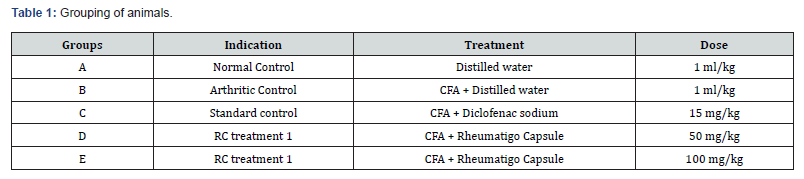
The rats were divided into five groups (n = 6); Group A (normal control), Group B (arthritis control), Group C (Standard drug control), Group D (RC treatment 1) and Group E (RC treatment 2). On day one, arthritis was induced through intradermal injection of CFA (0.1 mL) at the left hind footpad of all animal groups except Group A. Group C animals were orally administered diclofenac sodium (15 mg/kg). The animals of Group D and E were orally administered RC at doses of 50 mg/kg and 100 mg/kg respectively for 14 days. The left hind paw thickness was measured on day 1, 7, 14, and day 21 using a digital vernier caliper. On day 21, the animals were anesthetized to collect blood samples for hematological and biochemical analysis. Animals were sacrificed and paw skin and liver tissue were removed for histopathological analysis (Table 1).
Paw thickness
On the day prior to adjuvant injection, the left hind paw thickness of all rats was measured using a digital vernier caliper. the paw thickness on the left hind paw of the rats was measured on day 1, 7,14, and 21 after the CFA injection.
Formula:

Biochemical and Hematological analysis
Blood samples stored in EDTA tubes were measured RBC, WBC, Hb, and platelet using an automated hematology analyzer. Serum was separated by centrifuging blood samples at 3000 RPM for 15 at 4°C. The centrifuged serum was analyzed for AST, ALT, and ALP using an autoanalyzer.
Histopathological analysis
Left hind paw skin tissue and liver tissues were removed and fixed in 10% buffered formalin solution. Processed tissue was embedded with paraffin. Embedded tissue was sectioned to 4 µm and stained with Hematoxylin and Eosin (H&E). The sections were mounted with DPX solution and examined under a light microscope for histopathological changes.
Statistical analysis
All the values that are obtained from the hematological and biochemical analysis reading were calculated were presented as Mean ± S.E.M. The data were analyzed using one-way analysis of variance (ANOVA) followed by pos hoc Tukey test by using GraphPad Prism (version 5). This analysis was performed to determine the significant difference in mean between the control group and the arthritic control group as well as the drug-treated group. The consideration of statistical significance is observed at a P < 0.05.
Results
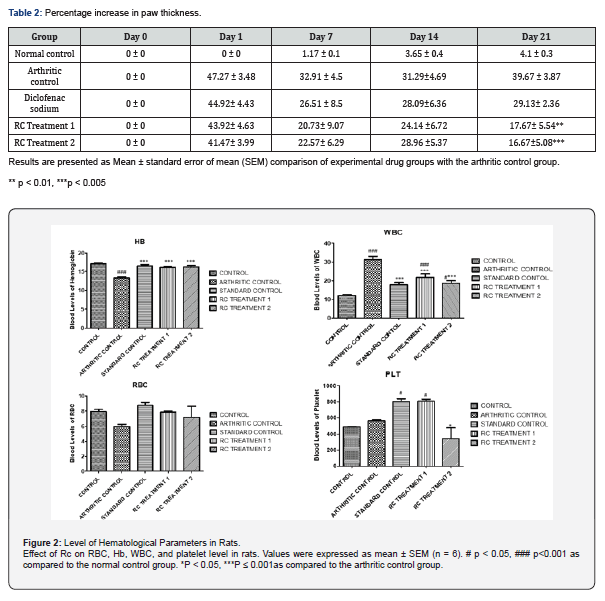
Effect of RC on paw thickness (Table 2)
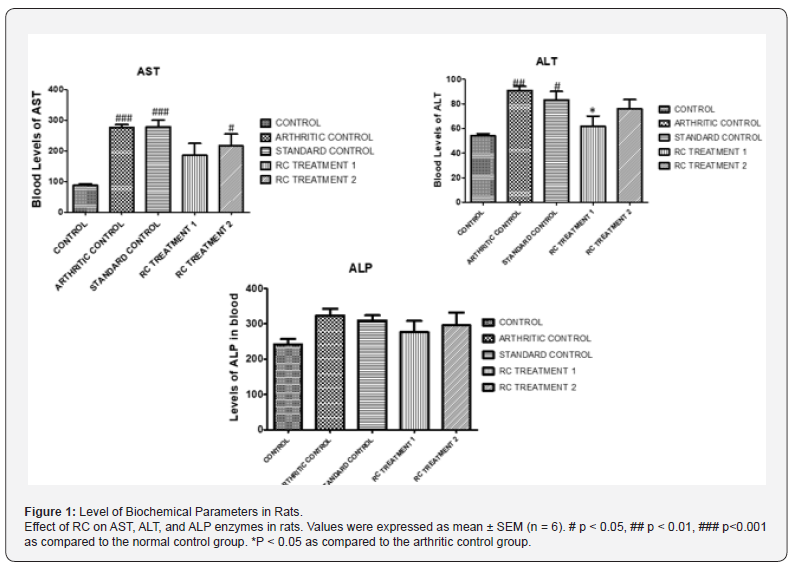
Effect of RC on biochemical parameters (Figure 1)
Effect of RC on hematological parameters (Figure 2)
Histopathological and Gross Analysis
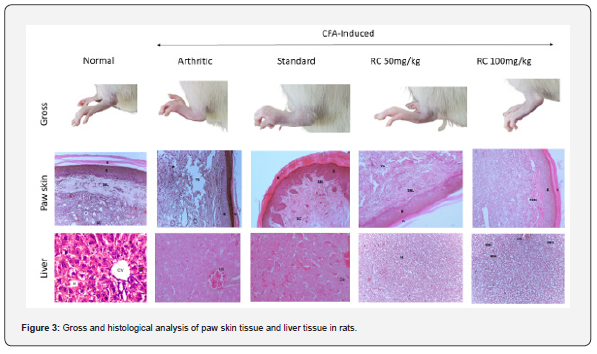
(Figure 3) Histopathology of the liver tissue of healthy control rats indicating normal Central Vein (CV) and Hepatocytes (H). Arthritic control shows Inflamed Hepatic Sinusoid (IHS) with accumulation of RBC, hepatocytes are poorly defined, central vein and portal triad have not been noticed in arthritic control. while the drug-treated group with Diclofenac sodium shows degenerated areas without Nuclei (DN). The liver section of arthritic rats treated with RC demonstrated markedly less histopathological alterations showing normal hepatic architecture with few Binucleated Hepatocytes (BNH) and hepatic sinusoid (HS). Histopathology of paw skin tissue of normal control showing normal histological structure of Keratin(K), Epidermis (E), Sub Epidermal Layer (SEL), Subcutaneous Layer (SC) and Fat Vacuoles (F). Arthritic control indicates Tissue Degradation (TD) along with edema and a significant Inflammatory Response (IR). The standard treatment showed an increase in the thickness of the epidermis layer. Arthritic rats treated with RC at 100 mg/kg showed fewer degenerative changes, as compared with rats treated with RC at 50 mg/kg.
Discussion
Rheumatoid arthritis is an inflammatory disease characterized by the degeneration of joint cartilage and bone. Despite the early discovery, existing treatment drugs are unsatisfactory due to their low effectiveness, serious side effects, and excessive cost 1.To provide better management of arthritic disorders, novel targeted therapies should be established. In the present study, anti-arthritic activities of polyherbal formulation RC were evaluated by using CFA-induced rat arthritic model. The immune-mediated CFA-induced arthritic model is considered the current best experimental model of rheumatoid arthritis for the evaluation of the pharmacological effects of anti-arthritic drugs [2]. In the current study, CFA-induced rats showed chronic inflammation on the 1st day after injecting with 0.1 ml on the left hind paw and the chronic inflammation remains for the next 21 days for the arthritic control group. There was a statistically significant decrease in paw thickness in the RC-treated groups on comparing with the arthritic control group.
Assessment of AST, ALT and ALP enzymes gives an excellent and easy method for assessing the anti-arthritic efficacy of the drug [22]. ALT and AST enzymes were significantly raised in arthritic rats indicate as markers of kidney and liver impairment, which are also considered the features of adjuvant arthritis [23]. ALP is characterized marker of bone resorption and suggests a positive correlation between the increased activity of serum ALP and RA [22]. In the present study, arthritic rats showed significantly higher values of serum AST, and ALT compared to the normal control group. A significant reduction in AST and ALT levels was observed in the treatment with RC at 50 mg/kg as compared with the standard drug-treated group. The decreased enzyme levels after treatments indicate the reduced bone loss and organ protective effects of RC in CFA-induced rats.
Effects of RC were evaluated on hematological parameters including WBC, RBC, platelet count and Hb level. WBC and platelet count were higher in the CFA-induced group. The level of WBC significantly increased in CFA-induced group and drug-treated group normalized increased WBC level. The platelet level was significantly reduced in RC treatment dose at 100mg/kg as compared to diclofenac sodium-treated group. Further observations of a significant increase in WBC and platelet count in the arthritic control group possibly due to the immune system being stimulated by the invading microbial antigen [24].
The most prevalent extracellular RA symptom is anemia which is characterized by a low level of RCB and Hb content in the blood. Our findings also revealed a significant decrease in Hb content and reduced RBC count indicating anemia in the arthritic control group. Abnormal iron storage in the synovial tissue and the reticuloendothelial system prevents bone marrow from producing enough red blood cells in an anemic state [25]. The Hb level was reduced due to the progression of the disease, which lead to premature RBCs destruction and a decrease in erythropoietin. A study found that low Hb levels were significantly correlated with RA disease duration, pain, clinical signs, joint destruction, impairment, and disability [13,26]. The current study reveals that treatment with RC altered RBC and Hb levels close to the normal level as compared with the standard drug-treated group. The reversal of RBC and Hb levels could be related to the protective effects on tissue repair and deceleration of disease progression.
A gross examination of paw thickness showed swelling and joint deformity in CFA-induced rats and the drug-treated group significantly reduced the paw swelling and symptoms. Histopathological analysis revealed that the CFA model induced inflammatory cell infiltration and significant tissue destruction, which separated the fibers of the dermal connective tissue. Diclofenac sodium-treated groups have prevented tissue destruction. Similarly, Treatment with RC at 100 mg/kg showed less degenerative changes when compared with rats treated with RC at 50 mg/kg.
The efficacy of hepatoprotective activity in the CFA-induced model has also been evaluated by the histological analysis of liver tissue. From the sections examined, Arthritic control shows severe damage to the liver tissue and abnormal hepatocyte architecture. Treatment with standard drug shows degenerated nuclei due to tissue necrosis. In contrast to pathological changes, the drug-treated group with RC showed significant protection against necrosis with minimal damage compared to the standard drug-treated group. In addition, the presence of binucleated cells is due to hepatocyte regeneration and it can be seen upon treatment with RC at 100mg/kg. The maximum effect was seen in RC (50mg/kg) treated group indicating the hepato-protective effect of RC. This was further confirmed by decreased elevation of serum ALT and AST levels.
Inhibition of inflammation in the CFA-induced rat model indicates the activity of components of RC on inflammatory mediators. According to the previous study, Withania somnifera has significantly reduced RANKL, NF-κB expression and proinflammatory cytokines including TNF-α, IL-1β, IL-6, IL-17a, and MMP that involved in pathogenesis of RA [1,4]. Similarly, Vitex negundo has anti-inflammatory properties as it suppresses proinflammatory cytokines and COX-2 expression [17]. Previous studies also support the action of Withania somnifera, Zingiber officinale, vitex negundo and Plumbagin zeylanica as it has ability to reduce T cells expression [4,27-29]. Moreover, Piprine active component in Piper nigrum and Piper longum has anti-inflammatory properties due to supressing effect on TNF-α and NF-κB expression [30]. The interaction with RC component and inflammatory mediators could be the mechanism of anti-inflammatory response observed in our experiment.
Conclusion
In summary, treatment with RC decreased paw thickness in CFA-induced rats. Histopathologic examination of the paw skin tissue and liver tissue shows severe damage and the inflammatory reaction seen in the arthritic control group compared with the RC treated group and diclofenac sodium treated group. The arthritic control group has elevated hematological and biochemical parameters compared with the normal control. The study observed that RC dose at 50mg/kg possesses a better toxicological profile as it shows normal liver histology and reduced AST, and ALT enzymes indicating a significant effect on the hepatoprotective activity of the drug. Furthermore, treatment with RC normalized all altered hematological parameters. These results justify the use of RC polyherbal formulation in arthritis treatment and it can be a better drug candidate for treating RA due to the potential therapeutic action against CFA-induced rats.
Acknowledgment
We would like to thank Dr. Jaya Balan A/L Valliappan Obstetrician and Gynecologist at Pantai Hospital Ipoh, Perak for providing a sophisticated lab facility for the successful completion of this work.
Authors’ contributions
a) Study planning: Pugazhandhi Bakthavatchalam, Ashok Gnanasekaran, Selvam P
b) Literature search: Asra Banu Shaik Alaudeen, Selvam, Sarah Stephenie, Mustafa Rehmatulla Batliwala,
c) Manuscript writing: Ashok Gnanasekaran, Asra Banu Shaik Alaudeen, Selvam, Sarah Stephenie, Mustafa Rehmatulla Batliwala, Pugazhandhi Bakthavatchalam
d) Manuscript revision: Ashok Gnanasekaran, Ashok Gnanasekaran, Asra Banu Shaik Alaudeen, Selvam, Sarah Stephenie, Mustafa Rehmatulla Batliwala
e) Final approval: Ashok Gnanasekaran, Asra Banu Shaik Alaudeen, Selvam, Sarah Stephenie, Chahat Antil, Pugazhandhi Bakthavatchalam
References
- Hussain A, Aslam B, Muhammad F, Faisal MN, Kousar S, et al. (2021) Anti-arthritic activity of Ricinus communis L. and Withania somnifera L. extracts in adjuvant-induced arthritic rats via modulating inflammatory mediators and subsiding oxidative stress. Iran J Basic Med Sci 24: 951.
- Srivastava, S, Singh P, Jha KK, Mishra G, Srivastava S, et al. (2012) Evaluation of anti-arthritic potential of the methanolic extract of the aerial parts of Costus speciosus. J Ayurveda Integr Med 3: 204-208.
- Choudhary M, Kumar V, Malhotra H, Singh S (2015) Medicinal plants with potential anti-arthritic activity. J Intercult Ethnopharmacol 4: 147.
- Khan MA, Ahmed RS, Chandra N, Arora VK, Ali A (2018) In vivo, Extract from Withania somnifera Root Ameliorates Arthritis via Regulation of Key Immune Mediators of Inflammation in Experimental Model of Arthritis. Antiinflamm Antiallergy Agents Med Chem 18: 55-70.
- Cui X, Wang R, Bian P, Wu Q, Devanatha V, et al. (2019) Artificial Cells, Nanomedicine, and Biotechnology Evaluation of antiarthritic activity of nimbolide against Freund’s adjuvant induced arthritis in rats Evaluation of antiarthritic activity of nimbolide against Freund’s adjuvant induced arthritis in rats. Nanomedicine, and Biotechnology 47: 3391-3398.
- Zaka M, Sehgal SA, Shafique S, Abbasi BH (2017) Comparative in silico analyses of Cannabis sativa, Prunella vulgaris and Withania somnifera compounds elucidating the medicinal properties against rheumatoid arthritis. J Mol Graph Model 74: 296-304.
- Dev SK, Choudhury PK, Srivastava R, Sharma M (2019) Antimicrobial, anti-inflammatory and wound healing activity of polyherbal formulation. Biomedicine & Pharmacotherapy 111: 555-567.
- Sheik SM, Bakhthavatchlam P, Shenoy RP, Hadapad BS, Nayak DM, et al. (2022) Anti-hyperglycemic, anti-hyperlipidemic, and anti-inflammatory effect of the drug Guggulutiktaka ghrita on high-fat diet-induced obese rats. J Ayurveda Integr Med 13, 100583.
- Kashima Y, Nakaya S, Miyazawa M (2014) Volatile composition and sensory properties of indian herbal medicine-Pavonia odorata-used in ayurveda. J Oleo Sci 63: 149-158.
- Rayar A, Aeganathan R, Ilayaraja S, Prabakaran K, Manivannan R (2015) Anti-microbial and Anti-Inflammatory Activity of Bioactive Components of Pavonia odorata Wild. American J Phytomed Clin Ther 3: 79-87.
- Dragos D, Gilca M, Gaman L, Vlad A, Losif L, et al. (2017) Phytomedicine in Joint Disorders. Nutrients 9(1): 70.
- Hegde HV, Ganguly K, Hedge HV, Patil PA, Roy S, et al. (2014) Activity of Plumbago zeylanica Linn. root and Holoptelea integrifolia Roxb. bark pastes in acute and chronic paw infl ammation in Wistar rats. J Ayurveda Integr Med 5: 33-37.
- Mutthuraj D, Vinutha T, Gopenath TS, Kaginelli B, Karthikeyan M, et al. (2020) Inhibition of pro-inflammatory molecules by ginger (zingiber officinale roscoe) and its anti-inflammatory effects on arthritis patients. Journal of Drug Delivery and Therapeutics 10: 125-139.
- Murugesan S, Venkateswaran MR, Jayabal S, Periyasamy S (2020) Evaluation of the antioxidant and anti-arthritic potential of Zingiber officinale Rosc. by in vitro and in silico analysis. South African Journal of Botany 130: 45-53.
- Damanhouri ZAA, Ahmad A (2014) Review on Therapeutic Potential of Piper nigrum L. (Black Pepper): The King of Spices. Med Aromat Plants (Los Angel) 3(3).
- Yende SR, Sannapuri VD, Vyawahare NS, Harle UN (2010) Antirheumatoid Activity of Aqueous Extract of Piper Longum on Freunds Adjuvant-Induced Arthritis in Rats. 1: 129-133.
- Jing, R, Ban Y, Xu W, Nian H, Guo Y, et al. (2019) Therapeutic effects of the total lignans from Vitex negundo seeds on collagen-induced arthritis in rats. Phytomedicine 58: 152825.
- Zheng CJ, Zhao XX, Ai HW, Lin B, Han T, et al. (2014) Therapeutic effects of standardized Vitex negundo seeds extract on complete Freund’s adjuvant induced arthritis in rats. Phytomedicine 21: 838-846.
- Sudheer G, Pingaley A, Brindha P, Ramanathan V (2015) What roles do herbs play in Kantacenturam: An iron oxide based herbo-mineral Siddha drug formulation? Indian Journal of Traditional Knowledge 14.
- Kannan M, Rajendran P, Vedha V, Ashok G, Anushka S, et al. (2012) HIV-1 reverse transcriptase inhibition by Vitex negundo L. leaf extract and quantification of flavonoids in relation to anti-HIV activity. Journal of Cell and Molecular Biology 10: 53-59.
- Anbalagan S (2017) The role of medicinal plants in the treatment of cancer. Cancer versus nutraceuticals 97.
- Li Y, Kakkar R, Wang J (2018) In vivo and in vitro approach to anti-arthritic and anti-inflammatory effect of crocetin by alteration of nuclear factor-E2-related factor 2/hem oxygenase (HO)-1 and NF-κB expression. Front Pharmacol 9: 1341.
- Mbiantcha M, Almas J, Shabana SU, Nida D, Aisha F (2017) Anti-arthritic property of crude extracts of Piptadeniastrum africanum (Mimosaceae) in complete Freund’s adjuvant-induced arthritis in rats. BMC Complement Altern Med 17: 1-16.
- Ekambaram S, Selvan PS, Subramanian V (2010) Evaluation of antiarthritic activity of Strychnos potatorum Linn seeds in Freund’s adjuvant induced arthritic rat model. BMC Complement Altern Med 13:10.
- Gautam RK, Sharma S, Sharma K, Gupta G (2018) Evaluation of antiarthritic activity of butanol fraction of Punica granatum Linn. Rind extract against Freund’s complete adjuvant-induced arthritis in rats. Journal of Environmental Pathology, Toxicology and Oncology 37(1): 53-62.
- Ganna S (2014) The relationship between hemoglobin level and disease activity in patients with rheumatoid arthritis. Revista Brasileira de Reumatologia (English Edition) 54: 437-440.
- Hwang JH, Jung HW, Oh SY, Kang SJ, Kim JP, et al. (2017) Effects of Zingiber officinale extract on collagen-induced arthritis in mice and IL-1β-induced inflammation in human synovial fibroblasts. Eur J Inflamm 15: 168-178.
- Poosarla A, Kumar BV, Kumar SP, Sreedevi K, Rao DN, et al. (2005) Induction of anti-inflammatory and altered T-cell proliferative responses by the ethanol root extract of Plumbago zeylanica in adjuvant-induced arthritic rats. Pharm Biol 43: 784-789.
- Nirmal P (2013) Influence of six medicinal herbs on collagenase-induced osteoarthritis in rats. Am J Chin Med (Gard City N Y) 41: 1407-1425.
- Mani A, Vasanthi C, Gopal V, Chellathai D (2016) Role of phyto-stabilised silver nanoparticles in suppressing adjuvant induced arthritis in rats. Int Immunopharmacol 41: 17–23.