




 GJPPS Home



Abstract
Background: Tobacco has killed an estimated 100 million people in the 20th century and continues to kill approximately 5.4 million people every year. Globally, nearly all tobacco use begins in childhood and adolescence.
Objective: The study narrative reviewed the extent of studies on tobacco use in Nigeria.
Methods: The study was a narrative review of the prevalence, prevention, management, and control of tobacco use in Nigeria, issues, and prospects from 1970 to 2023.
Results: Majority of the studies were carried out between 2011 -2020; 13.0 (76.5%). Most of the studies sited were observational studies, 13.0 (76.5%). An outstanding characteristic of the populations studied indicated the predominance of youth, particularly those aged between 10 and 30 years in the use of tobacco. Prevalence rates of tobacco use varied significantly among the studies, reflecting the complexity of the issue. Some studies reported very low rates of less than 5%, while others indicated that smoking prevalence could reach as high as 32.5%.
Conclusion: A notable characteristic of the populations studied is the predominance of youth, particularly those aged between 10 and 30 years. The study suggested a predominance of observational studies in this field, pointing to a need for more rigorous experimental studies and systematic reviews. Varying factors, including regional cultural norms, socioeconomic status, and exposure to tobacco marketing, played crucial roles in influencing smoking rates.
Keywords:Tobacco; Review; Utilization Studies; Nigeria
Introduction
Worldwide, cigarette smoking has been noted to contribute to higher morbidity and mortality.1 Cigarette smoking has been implicated in several diseases and is a risk factor for six of the eight leading causes of death in the world. This figure is expected to rise to 8 million deaths per year by 2030, 80% of which are expected to occur in the developing world [1].
Tobacco use is an important preventable cause of premature death and accounts for the deaths of up to half of its users [2]. In 2017, about 8 million deaths worldwide were attributable to tobacco, mostly from smoked tobacco. If optimal control measures are not implemented, these deaths are projected to reach 10 million by 2030, mostly in low- and middle-income countries where the high burden of tobacco use is due to an ongoing transition from tobacco production to tobacco consumption [3,4].
Africa has become attractive to multinational tobacco companies because of economic and personal income growth, an unsaturated market, weak tobacco-control policies, reduced awareness of the dangers of tobacco use, prioritization of control of infectious disease over noncommunicable diseases, and a young, growing population [4-7]. Tobacco companies have adopted aggressive and uncontrolled marketing and promotional activities on the continent [6]. Worldwide, nearly all tobacco use begins in childhood and adolescence. Globally, 43.8 million (12%) of adolescents aged 13 to 15 years use some form of tobacco [8]. Adolescents in this age group in low- and middle-income countries have average tobacco use prevalence rates that range from 11% to 13% [9,10]. The younger children are when they start smoking, the less likely they are to quit, with prolonged exposure leading to earlier and more pronounced health risks [11,12]. The short-term health consequences of smoking include respiratory effects, such as exacerbation of severe asthma, pneumonia, ear infections, addiction to nicotine, and the risk of other drug use [13,14]. In adults, the cumulative effects of tobacco use manifest as cardiovascular diseases, cancers, chronic respiratory diseases, type 2 diabetes, immune and autoimmune disorders, and eye disease [15]. Early signs of these diseases occur in adolescents who smoke. Early abdominal aortic atherosclerosis, which affects the flow of blood to vital organs, has been found among young smokers. This leads to consequences such as hypertension, ischemic heart disease, and chronic obstructive pulmonary disease later in life [8].
Like other sub-Saharan African countries, Nigeria’s young and growing population is attractive to the tobacco industry [16]. Nigeria hosts transnational tobacco companies, including British America Tobacco Nigeria and Japan Tobacco International. Every year, more than 16,100 of Nigeria’s population die from tobaccocaused disease; 748,800 Nigerians aged 15 years or older, and more than 25,000 aged 10 to 14 years use tobacco every day [17].
Tobacco use has become a rapidly growing problem worldwide as well as in many developing countries. It is projected that over the next 50 years close to 450 million deaths will be caused by tobacco use [18]. While it has been established that many smokers start before the age of 18 years, of serious concern, is the increasing trend in smoking prevalence among youths and the likelihood that many of these young people who begin to smoke at an early age, will continue to do so throughout adulthood [19,20]. Furthermore, the years of potential life lost attributable to tobacco-related diseases will continue to increase if we do not target interventions to prevent smoking initiation among youths.
Factors associated with increasing uptake of smoking behavior among youths include low self-esteem, stressful life events, friends who smoke, advertisements, and living with a smoker [21-23]. The patterns of tobacco use however vary from region to region and interventions for tobacco control also differ. In developed countries, systematic data collection procedures are available for documenting the prevalence and pattern of tobacco use but these procedures are sub-optimal in developing countries [24]. Hence, there is a lack of adequate research to guide policy and interventions. Although studies examining smoking among youths have been documented in Nigeria, these are skewed towards describing patterns of use amongst in-school youths in urban areas. However, many of the factors associated with adverse health behaviors which may include smoking initiation and persistence are known to be common amongst out-ofschool youth because of their aggregation in areas lacking adult supervision. The study narrative reviewed the extent of studies on tobacco use in Nigeria.
Study Methods
Study area
The study covered cases of tobacco use carried out in Nigeria.
Study population and types of studies included
All studies that passed the inclusion criteria and were published on MEDLINE, AJOL, and Google Scholar were utilized for the study. A manual search was also conducted for studies that met the inclusion criteria. This ensured the retrieval of relevant studies while focusing on the study objectives.
Eligibility Criteria Inclusion criteria
1. Peer-reviewed studies published in English Language
2. Studies conducted on the prevalence of tobacco use in
Nigeria irrespective of the region and setting between 1970 and
2023
3. Studies with no conflict of interest stated
4. Studies that provided other information that may help to
understand the subject of review
5. Studies with clearly stated and defined research
methods and design
6. Exclusion criteria
7. Studies conducted on the prevalence of tobacco use in
Nigeria irrespective of the region between 1970 and 2023 without
clearly defined period, duration, sample size, and location were excluded
8. Studies with methodological flaws
9. Studies with incomplete and inconclusive data or
information
Study Design
The study was a narrative review of the prevalence, prevention, management, and control of tobacco use in Nigeria, issues, and prospects from 1970 to 2023.
Search Strategy
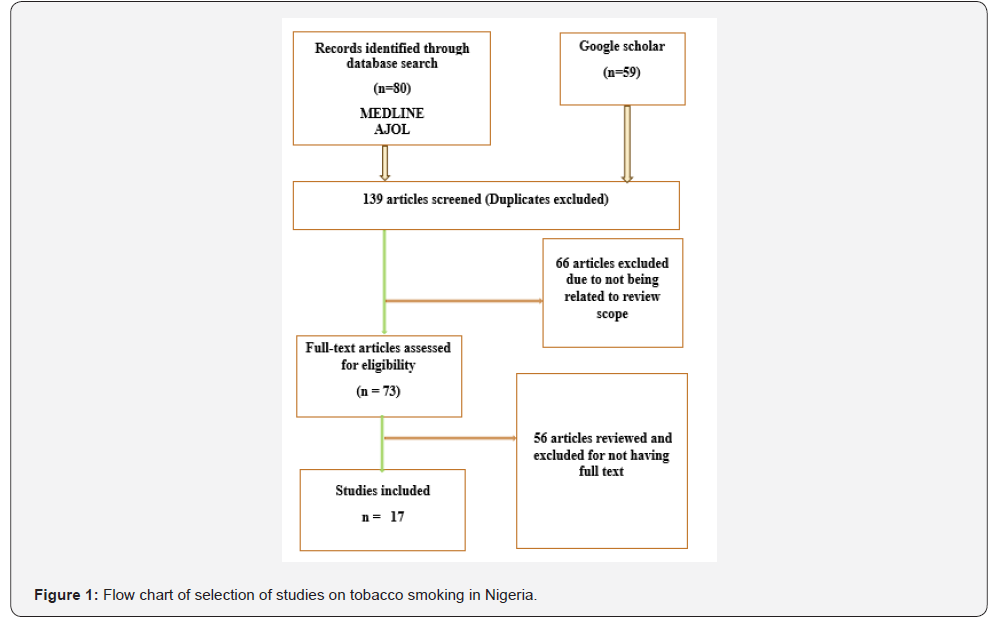
A comprehensive search was conducted for relevant articles, exploring three key databases: Google Scholar, MEDLINE, and the African Journals Online (AJOL) platform. The search began with Google Scholar, entering a combination of keywords pertinent to the review topic and applying Boolean operators to refine the search-using quotation marks for exact phrases and the minus sign to eliminate irrelevant terms. This approach yielded a wide array of scholarly articles. Furthermore, MEDLINE was utilized for further search, this was done by utilizing the PubMed interface. An advanced search with Medical Subject Headings (MeSH) to precisely locate peer-reviewed articles relevant to the study. Filters were applied for publication dates and article types to focus on the most relevant research. Finally, AJOL was accessed, which focuses on African academic research. The search was done using topic-specific keywords and filtered results by language and publication date. This multifaceted strategy across these three platforms enabled a compilation of a robust set of articles, providing a solid foundation for the research. (Figure 1) (Tables 1-3) [19-35].



Discussion
The studies outlined in the table provide valuable insights into the prevalence and factors influencing tobacco use across various populations in Nigeria. Most of these studies utilize descriptive cross-sectional designs, which are effective for capturing a snapshot of tobacco use patterns at a specific point in time. By conducting research in diverse locations spanning from Ibadan to Sokoto-these studies highlight the geographical variations in smoking behaviors, influenced by cultural and socio-economic factors.
A notable characteristic of the populations studied is the predominance of youth, particularly those aged between 10 and 30 years. This focus is critical, as tobacco use often begins in adolescence. The gender distribution across these studies consistently shows a higher prevalence among males, aligning with global trends where men are more likely to smoke than women. For example, one study reported that males accounted for a significant proportion of current smokers, further emphasizing the need for targeted interventions that address the specific dynamics of male smoking behaviors.
Prevalence rates of tobacco use varied significantly among the studies, reflecting the complexity of the issue. Some studies reported very low rates of less than 5%, while others indicated that smoking prevalence could reach as high as 32.5%. This discrepancy suggests that various factors, including regional cultural norms, socioeconomic status, and exposure to tobacco marketing, play crucial roles in influencing smoking rates. Additionally, a consistent finding across multiple studies is the strong influence of peer pressure on smoking initiation, with many respondents indicating that friends who smoke significantly impacted their decision to start.
Awareness of the health risks associated with smoking is generally high among respondents, yet gaps remain, particularly regarding the connection between smoking and certain diseases like hypertension and lung cancer. For instance, while many participants knew that smoking could lead to lung cancer, fewer were aware of its relationship with other serious health conditions. This highlights the importance of educational campaigns that inform and empower individuals with knowledge about the risks associated with tobacco use.
The findings underscore a pressing need for comprehensive anti-tobacco campaigns, especially targeted toward youth. Studies call for urgent interventions in university settings and among out-of-school adolescents, as these groups often underestimate the dangers of smoking. Peer-led initiatives may be particularly effective, as they can reshape social norms around smoking. Moreover, strengthening tobacco control policies, such as restricting advertising and implementing public smoking bans, is essential for reducing tobacco use and protecting public health.
Furthermore, the study provides a breakdown of various study types according to their hierarchy in research methods. It reflected the compositions of a set of 17 studies. A prominent finding is the overwhelming prevalence of observational studies, which constitute 76.5% of the total. This suggests that most of the research relies on descriptive or correlational data, which can provide valuable insights into trends and associations but may lack the rigor of experimental designs in establishing causal relationships.
Within the hierarchy, systematic reviews and meta-analyses, which synthesize findings from multiple studies to draw broader conclusions, are represented by only 2.0% of the total. This limited presence indicates a gap in comprehensive analyses that aggregate existing research, which could enhance the understanding of tobacco use dynamics and inform public health strategies more effectively. Additionally, the absence of randomized controlled trials (RCTs) and non-experimental studies highlights a lack of robust experimental evidence, which is critical for establishing causal links between interventions and outcomes. Non-randomize intervention studies also make up 11.8% of the total, suggesting some attempts to assess the effectiveness of interventions aimed at reducing tobacco use. However, the lack of RCTs limits the ability to draw definitive conclusions about the efficacy of these interventions, as RCTs are considered the gold standard for evaluating causal effects.
Overall, it underscored the predominance of observational studies in this field, pointing to a need for more rigorous experimental studies and systematic reviews. Expanding the variety of study designs employed could provide a more comprehensive understanding of tobacco use behaviors and facilitate the development of effective interventions in public health. This emphasis on diverse research methodologies is essential for advancing knowledge and improving strategies to combat tobacco use and its associated health risks.
Conclusion
The studies examined here illustrates the multifaceted nature of tobacco use in Nigeria, shaped by age, gender, and social influences. A notable characteristic of the populations studied is the predominance of youth, particularly those aged between 10 and 30 years. The study suggested a predominance of observational studies in this field, pointing to a need for more rigorous experimental studies and systematic reviews. Varying factors, including regional cultural norms, socioeconomic status, and exposure to tobacco marketing, played crucial roles in influencing smoking rates. Additionally, a consistent finding across multiple studies is the strong influence of peer pressure on smoking initiation. Addressing this public health challenge requires coordinated efforts that include education, policy reform, and community engagement to effectively reduce smoking rates and promote healthier lifestyles among vulnerable populations.
References
- World Health Organization (2008) World report on the global tobacco epidemic. The MPOWER package Geneva.
- Doll R, Peto R, Wheatley K, Gray R, Sutherland I, et al. (1994) Mortality in relation to smoking: 40 years’ observations on male British doctors. BMJ 309(6959): 901-911.
- Institute for Health Metrics and Evaluation (2018) GBD Compare Tool: findings from the Global Burden of Disease Study.
- Mathers CD, Loncar D (2006) Projections of global mortality and burden of disease from 2002 to 2030. PLoS Med 3(11): e442.
- Drope J (2011) Tobacco control in Africa: people, politics and policies. Anthem Press & International Development Research Centre.
- Sala IMX, Pinkovskiy M (2010) African poverty is falling…much faster than you think.
- Lee S, Ling PM, Glantz SA (2012) The vector of the tobacco epidemic: tobacco industry practices in low and middle-income countries. Cancer Causes Control 23 (suppl 1) 1: 117-129.
- Network of African Science Academies (2014) Preventing a tobacco epidemic in Africa: a call for effective action to support health, social, and economic development.
- S. Department of Health and Human Services (2012) Preventing tobacco use among youth and young adults: a report of the Surgeon General.
- Peto R, Lopez AD (2001) Future worldwide health effects of current smoking patterns. In: Koop CD, Pearson C, Schwarz MR, Critical issues in global health. New York, NY: Jossey-Bass.
- Secretary of State for Health and Secretaries of State for Scotland, Wales, and Northern Ireland: Smoking kills (1999) A White Paper on Tobacco London, HM Stationery Office.
- US Department of Health and Human Services: Preventing tobacco use among young people. A report of the Surgeon General, 1994 Atlanta, Georgia: Public Health Service, Centers for Disease Control and Prevention, Office on Smoking and Health.
- Odeyemi KA, Osibogun A, Akinsete AO, Sadiq L (2009) The Prevalence and Predictors of Cigarette Smoking among Secondary School Students in Nigeria. Niger Postgrad Med J 16(1): 40-45.
- Simantov E, Schoen C, Klein JD (2000) Health-compromising Behaviors: why do adolescents smoke or drink. Arch Pediatr Adolesc Med 154(10): 1025-1033.
- Osungbade KO, Oshiname FO (2008) Determinants of cigarette smoking among senior secondary school students in a rural community of southwest Nigeria. Niger J Med 17(1): 40-44.
- The Global Youth Tobacco Survey Collaborative Group (2002) Tobacco use among youth: a cross-country comparison. In Tob Control BMJ Publishing 11(3): 252-270.
- Omokhodion FO, Faseru BO (2007) Perception of cigarette smoking and advertisement among senior secondary school students in Ibadan, Southwestern Nigeria. West Afr J Med 26(3): 206-209.
- Ikenna O, Magbagbeola DD, Muhammad SB, Olufunmilayo F (2023) Preventing Chronic Disease Public Health Research, Practice, and Policy 20: E40.
- Hussain NAA, Akande TM, Adebayo O (2009) Prevalence of Cigarette Smoking and The Knowledge of its Health Implications Among Nigerian Soldiers. East African Journal of Public Health 6(2): 168-170.
- Adebiyi (2010) Tobacco use amongst out-of-school adolescents in a Local Government Area in Nigeria. Substance Abuse Treatment, Prevention, and Policy 5(24).
- Ebenezer GA, Samuel A, Olowookere NA, Adeleke OTA, Folakemi OO, et al. (2013) A Population-Based study on the prevalence of cigarette smoking and smokers’ characteristics at Osogbo, Nigeria. Tobacco Use Insights 6: 1-5.
- Abiola AO, Balogun OS, Odukoya OO, Olatona FA, Odugbemi TO, et al. (2016) Age of Initiation, Determinants and Prevalence of Cigarette Smoking among Teenagers in Lagos State. Asian Pac J Cancer Prev 17 (3): 1209-1214.
- Fawibe AE, Shittu AO (2011) Prevalence and characteristics of cigarette smokers among undergraduates of the University of Ilorin, Nigeria. Niger J Clin Pract 14(1): 201-205.
- Aghaji MN (2008) Cigarette Smoking and Quitting Adults in Enugu, Nigeria. Niger Med J 49(2).
- Godwin JG, Suleiman HI, Kabiru S, Mansur OO, Aisha AA, et al. (2018) Prevalence and perception of cigarette smoking among out-of-school adolescents in Birnin Kebbi, North-western Nigeria. Pan African Medical Journal 30(304).
- Oluwakemi OO, Kofoworola AO, Abisoye SO, Ravi PU (2013) Smoking Initiation and Susceptibility in Nigerian School-Going Determinants of smoking initiation and susceptibility to future smoking among school-going adolescents in Lagos State, Nigeria. Asian Pacific J Cancer Prev 14 (3): 1747-1753.
- Arute J, Oyita G, Eniojukan JF (2015) Substance Abuse among Adolescents: Prevalence and Patterns of Cigarette smoking among senior secondary school students in Abraka, Delta State. IOSR Journal of Pharmacy (e) 5(1).
- Raji MO, Muhammad H, Usman AM (2017) Cigarette Smoking among Out-of-School Adolescents in Sokoto Metropolis, North-West Nigeria. Health Sci J 11(3).
- Adeyeye OO (2011) Cigarette smoking habits among senior secondary school students in Lagos, southwest Nigeria. International Journal of Biological & Medical Research 2(4): 1047-1050.
- Olufemi OD, Adebowale OA, Adetokunbo OE, Adeolu D, Tolutope FK, et al. (2009) Knowledge of and practices related to smoking cessation among physicians in Nigeria. J Bras Pneumol 35(12): 1198-1203.
- Israel A, Adisa OA, Uyoyo TO (2012) Evaluation of factors influencing intention to quit smokeless and cigarette tobacco use among Nigerian adolescents. Nigerian Medical Journal 53(1): 31-36.
- Oyewole BK, Animasahun VJ, Chapman HJ (2018) Tobacco use in Nigerian youth: A systematic review. PLoS ONE 13(5): e0196362.
- Adekunle S, Omotosho Mu, Tanimola A, Oladimeji B (2011) Effects of Health Education on Cigarette Smoking Habits of Young Adults in Tertiary Institutions in a Northern Nigerian State. Health Science Journal 5(3): 216-228.
- Babatunde OA, Elegbede OE, Ayodele LM, Atoyebi OA, Ibirongbe DO, et al. (2012) Cigarette Smoking Practices and Its Determinants Among University Students in Southwest, Nigeria. Journal of Asian Scientific Research 2(2): 62-69.
- Adeloye D, Asa A, Ademola F, Muktar G, Nnenna E, et al. (2019) Current prevalence pattern of tobacco smoking in Nigeria: a systematic review and meta-analysis. BMC Public Health 19(1): 1719.

























