




 GJPPS Home



Abstract
Background
Poor reproductive, maternal, and child health care still pose a significant challenge in low and middle-income countries. Worldwide as of 2015, an estimated 6.55 million children die under the age of five while 250,000-280,000 women die during pregnancy and childbirth yearly. Nigeria currently contributes 10 percent of the global deaths for pregnant mothers with a maternal mortality ratio of 576 per 100,000 live births and an infant mortality rate of 69 per 1000 live births and 128 per 1000 live births as the infant mortality rate.
Objective
To narratively review studies on the evaluation of pharmacists and pharmacy students’ knowledge and skills in reproductive, maternal, and child care in Nigeria.
Methods
The study utilized a narrative review to describe its findings on the level of knowledge of pharmacists and pharmacy students in Nigeria. Literature was retrieved from the search of online databases. The studies inputted were only studies carried out in Nigeria and published in the English Language. The study lasted from June to August 2024.
Results
The overall articles selected and used for this study were 16. The Southwest had the highest distribution of studies; 10 (62.5%), followed by the Northwest; 6 (37.7%), the south-south; 5(31.25%), and the Southeast; 4 (25.0%) with no record of any study yet done in the Northeast. Many of the studies were cross-sectional studies; 10 (62.5%) followed by Quasi-experimental studies; 3 (18.75%), then 1(6.25%) each for longitudinal, mixed-method, and non-randomized controlled trial studies. All studies fell into the lower rung of the Oxford Centre for Evidence-based Medicine Scale (OCEMS) with 11 (68.75%) being case series studies and 5 (31.25%) being case-control studies. The study hierarchy fell within the 3rd and 4th stages of the Scottish Intercollegiate Guideline Network Scale (SIGNS) for the hierarchy of study types. The studies were majorly carried out in community pharmacies [8;50.0%] and hospitals [4;25.0%]. On the components of the studies, 9 (56.25%) were on reproductive health; 4 (25.0) assessed maternal health; 3(18.75%) assessed child health while only a study (6.25%) was found on neonatal health. No study was found on the overall components of RMNCH knowledge and skills.
Conclusion
Evaluation of RMNCH knowledge and skills of pharmacists has not been widely studied in Nigeria. The studies available fell within the lower rung of the major standard benchmarks for the hierarchy of study types. Recommendations are being made for studies on the overall core indicators and components in the nation. Also, studies with stronger evidence are being recommended to be carried out.
Keywords:Pharmacists; Reproductive Health; Public Health; Maternal Health; Child Health; Review; Nigeria
Abbreviations: RMNCH: Reproductive, Maternal, Newborn, and Child Health; MDGs: Millennium Development Goals; MMR: maternal mortality ratio; FP: Family Planning; SRH: Sexual and Reproductive Healthcare; KAP: Knowledge Attitude and Practices; PMTCT: Prevention of Mother to Child Therapy
Introduction
Poor reproductive, maternal, and child health care still pose a significant challenge in low and middle-income countries. Worldwide as of 2015, an estimated 6.55 million children die under the age of five while 250,000-280,000 women die during pregnancy and childbirth yearly. Nigeria currently contributes 25 percent of the global deaths for pregnant mothers with a maternal mortality ratio of 576 per 100,000 live births and an infant mortality rate of 69 per 1000 live births and 128 per 1000 live births as the infant mortality rate. [1-5]. Reproductive, maternal, neonatal, and child health care is an all-encompassing term that covers a range of clinical and social care provided from pre-pregnancy to pregnancy through delivery and for newborns for t3e first month of their lives and their childhood till the fifth year. It aims at providing this care in two phases where one phase recognizes the link between the mother to her child and all the necessary health services, they both require. The other phase aims to deliver both preventive and therapeutic health interventions through public health avenues like the hospital, the primary healthcare center, and the community at large. It has remained one of the top priorities of many low and middle-income countries’ governments as there has been a high incidence of maternal and child mortality in the past few decades [6-8]. This priority was agreed on by world leaders in the Millennium Development Goals (MDGs) which called for leadership of countries to aim at reducing the under-five mortality rate by two-thirds in goal four and reduce the mortality ratio of mothers by three-quarters between 1990 and 2015 as well as achieving universal access to reproductive health in goal five. It’s already past 2015 and progress has been made on these goals but few countries have been able to achieve them [9,10]. All over the world, an estimated 250,000 to 280,000 women die during pregnancy or childbirth yearly while about 6.55 million children die before the age of five. It has been observed that there is more frequency of children in low and middle-income countries dying than in the average high-income countries with the rate being as high as 14 times more as they account for 99% of global maternal death [1-5,11,12].
Maternal deaths are majorly recorded during or immediately after childbirth with obstetric hemorrhage being the chief medical cause of death followed by hypertensive disorders, obstructed labor, as well as abortion-related complications, and pregnancy-related infections. According to WHO, maternal and child mortality can be either of direct obstetric origin or indirect obstetric origin with the obstetric origins including these already mentioned. It can also be a result of unanticipated complications of management, coincidental causes, or unknown and undetermined causes. With the initiation of the MDGS, the global maternal mortality ratio (MMR) reduced by 44%. All the regions that the MDGs were initiated experienced this reduction with eastern Asia on the lead with a 72% decrease while Sub-Saharan Africa and western Asia had the least decrease with 45% and 42% decrease respectively. It is worthy of note that the regions with the lowest decline in MMR are the low and middle-income countries as they account for 99% of global maternal deaths. At the country level, it has been found that Nigeria and India account for at least 33% of all global maternal deaths as of 2015 [1,3,6,8,10,11].
Child mortality encompasses major child deaths from the 28th week of pregnancy to the age of five. The major causes of stillbirth which are child mortality before birth include placental pathologies, infections, maternal disorders, congenital abnormalities, and cord-related issues amongst others. Childhood mortality has also been found to be higher among children born to women of low literacy levels as compared to literate mothers. With these abysmal statistics, there is a great need to emphasize and propagate maternal, neonatal, and childcare goals. Maternal health covers the aspects of the career of a woman before pregnancy which aims at reducing the risk factors that might affect future pregnancies (pre-pregnancy care), during pregnancy (pregnancy care), during child delivery, and after child delivery (postnatal/postpartum care) [2-5]. It seeks to take care of a woman’s physical, mental, emotional (clinical), and social aspects of health (FIP, 2013). The pre-pregnancy care involves health promotion and prevention, patient education and counseling, screening, and interventions for women of childbearing age. Pregnancy care refers to a wide range of health services that a pregnant woman receives from the time of taking into child delivery. Post-partum care covers general care the mother receives immediately after childbirth, breastfeeding as well as the health status of the neonate. (FIP, 2013). The Continuum of Care for Maternal Care includes a well-rounded system that connects essential maternal, newborn, and child health (MNCH) services before pregnancy, during pregnancy, at childbirth, after childbirth, and during child care. Failure to adhere to this continuum has been implicated amongst other factors in the high maternal mortality ratio in sub-Saharan Africa with Nigeria topping with other three countries as the most affected countries [2-5,7,9,12-14].
Worldwide, annual unplanned pregnancies are a major cause of maternal and child mortality as they result in 25 million unsafe abortions,47,000 maternal deaths, 2.7 million neonatal deaths, and 2.6 million deaths in children below the age of five as these mothers are more reluctant to seek antenatal care as well as delivery assistance. Reproductive health care is a necessary aspect of the care of women. It involves addressing issues of unintended pregnancy. It involves addressing issues of unintended pregnancy and the subsequent unsafe abortion, sexual and non-sexually transmitted infections, violence against women, female genital mutilation, and infertility. Unintended pregnancy is usually found in younger women who are not ready to become mothers hence causing them to be more intent on abortions and in societies where abortions are mostly illegal, it draws these women to the practice of unsafe abortion which is the practice of termination unwanted pregnancies either by persons lacking in proper skills or carrying out the practice in a location that does not meet the necessary minimal medical standards or both. Unintended pregnancy can be reduced through the use of contraceptives, prolonged breastfeeding, and premarital sexual abstinence [12,13]. The use of contraceptives is the most effective way of reducing fertility as the majority of unintended pregnancies emanate from a lack of appropriate use of contraceptive methods among women. Promotion of effective family planning programs helps to reduce the population growth rate, avoid pregnancies that are unintended or mistimed, help couples achieve desired family size, and ensure proper spacing of children. Also, with the high attention received by sexually transmitted infections, non-sexually transmitted infections which are of equal importance seem to receive lesser attention despite their equally being important [12-14].
Due to the accessibility of the pharmacists in the healthcare system, they are readily available to mothers and children throughout this range of care for prescription filling, pharmaceutical care, and health promotion and education hence making them crucial agents in the provision of RMNCH care. They are also ranked as the most trusted healthcare professionals. Being primarily drug experts, they are responsible for the provision of necessary medications and devices required for reproductive health such as contraceptives, vaccines both for the mother and child and adolescent, pregnancy, labor, and delivery. The pharmacist should also be involved in every stage of family planning as well as in the provision of recommendations for medications for the pregnant woman such as prenatal vitamins and supplementations as well as aspirin for preeclampsia prevention [15-18]. They also help postpartum women with breastfeeding services. Pharmacy students are therefore required to be trained by pharmacy schools to meet these needs so that the pharmacists produced are fit to provide these services to the population. To access this, pharmacists should be evaluated on their knowledge of the key components of the RMNCH which are reproductive and sexual health, maternal and antenatal care, neonatal and child care, and skills assessment [19-21]. We narratively reviewed studies on the evaluation of pharmacists and pharmacy students’ knowledge and skills in reproductive, maternal, and child care in Nigeria.
Methodology
Study Area
This study covered all studies originally carried out in Nigeria on the evaluation of the knowledge and skills of pharmacists on RMNCH from 1980 to 2023
Study Design
The study was a narrative review of all studies already conducted on pharmacists’ knowledge and skills in RMNCH in Nigeria within the period under review.
Study Setting
Only studies pertaining to the topic carried out in Nigeria were used for this study.
Study Criteria
Published studies carried out in Nigeria from 1970 to 2023 pertaining to the study topic and published in English language.
Inclusion Criteria
Studies with incomplete information or data.
Risk of Bias
The risk of bias was minimized by choosing studies that were without subject, sampling, and selection bias.
Review Questions
1. How many studies have been carried out on the level of
pharmacists’ knowledge and skills in RMNCH?
2. What is the level of pharmacists’ knowledge and skills in
RMNCH in Nigeria from past studies?
Article Search Process
The keywords; pharmacists, reproduction Health, maternal health, child health, review, and Nigeria distilled from the title of the study were used to search for studies individually and in strings using Boolean operators of AND/OR. The results of papers published in the database of PubMed and Google Scholar from the computerized search were distilled and the abstracts of the rele vant papers highlighted were then screened. The choice of databases used was based on ease of access. The studies that met the review criteria of evaluating any key indicator in RMNCH in Nigeria within the period of the review were selected, and their full texts were obtained and used for the study. A total of 16 studies related to the study of focus were obtained and studied.
Article Selection Process
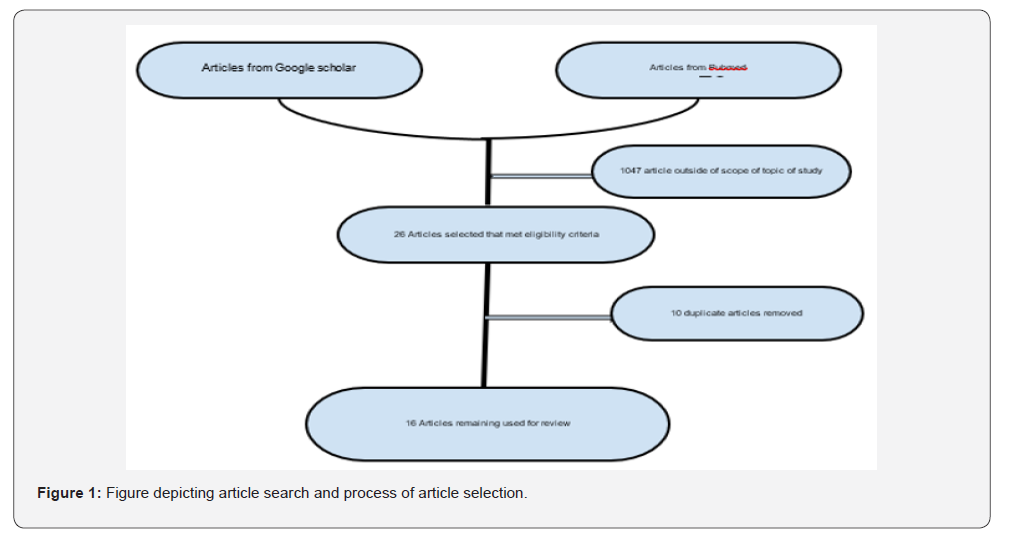
1073 articles were obtained relating to the keywords with 1000 from Google Scholar and 73 from PubMed. 26 of the articles met the eligibility criteria and upon removing duplicate articles, 16 articles remained and were used for the study. Figure 1 depicts the article search and selection process.
Ethical Approval
Ethical approval is not required for this study but it was ensured that only studies with ethical approval were included in the review.
Data Analysis
A simple descriptive analysis was used to summarize the data.
Results
(Tables 1-8)


Discussion
This study yielded insightful findings, revealing the high incidence of observational studies (68.75%) on the subject of RMNCh skills amongst pharmacists in Nigeria with the remainder being non-randomized intervention studies (31.25%).
Tables 1 & 8 reveal the overall studies with more than half (56.25) of the studies carried out on reproductive health indicators. Mostly on family planning and level of knowledge of STIs. The remaining half is distributed amongst maternal (25.0) and child health (18.75). Only one study was found on neonatal health (24).
This trend could be attributed to RMNCH being a relatively new treatise in the policy-making sector of Nigeria. The first technical working group on the strategy was established in 2018 to implement the RMNCAEH+N guide developed.
This yields a study gap that requires to be filled. As the pharmacist is the most accessible health professional, there is a need to verify their level of knowledge. Their level of skilled services could go a long way in improving the lives of the mothers and their children who come to them. According to the FIP, a pharmacist could prepare, obtain, store, secure, distribute, dispense, administer, and dispose of medical products to both the mother and her child; Provide effective medication therapy management for the mother for effective drug use amongst many others. For example, the pharmacist’s provision of education to children/their mothers on asthma medications, results in appropriate inhaler use and reduced asthmatic symptoms leading to better humanistic outcomes [22-43].
Many of the studies (81.25) were carried out from 2011 till date showing a surge in the study focus on RMNCH. Only 3(18.75) of the studies were carried out within the ten-year range of 2001- 2010. This could be associated with the increase in focus by policy and strategy makers from 2018.
The regional distribution of the studies showed the highest number came from the Southwest (10,62.5) with a focus on reproductive health, Maternal care, and child care. This is followed by the Northwest (6,37.5) with a focus on Maternal and child care and reproductive health. South follows with 5(31.25) studies encompassing Maternal and child health as well as reproductive health. Southeast and Northcentral follow with 4(25%) studies each covering Maternal and child care, reproductive health as well as the only neonatal care study registered. There is no study carried out in the Northeast region of the country.
Many of the studies (10;62.5) were cross-sectional studies carried out with the use of validated questionnaire instruments. With sprinkles of quasi-experimental studies, mixed method studies, and non-randomized Controlled Trials studies.
The assessment of the level of RMNCH knowledge and skills of pharmacists in Nigeria based on the Oxford Centre for Evidence- based Medicine level of evidence benchmark revealed the low Evidence level of the studies in the country. Gold standard studies such as systematic reviews of RCTs, and individual RCTs were not recorded with many of the studies ranking in individual case-control studies, case series, and poor-quality cohort and case-control studies.
This was also the observation made on the hierarchy of study type with the studies ranking number 3 & 4 on the Scottish intercollegiate guideline network benchmark. This implies that the available information is not strong enough to be used in policy formulation and decision-making. This provides a research gap that requires intervention.
The studies were mostly carried out in community pharmacies (8;50) with about 4 (25) carried out in hospital pharmacies. This is understandable as there is more advocacy for support task shifting and incorporation of community pharmacists. Though there is already a policy on task shifting in Nigeria, the pharmacists were significantly not included and this borders on a source of concern as the community pharmacy is the most accessible health-based outfit in Nigeria. This is because most community pharmacists do not charge extra for registration, documentation, or provision of pharmaceutical care and consultation. They also have longer opened hours and shorter waiting periods than many primary health care’s centers.
The majority of the studies were also noted to focus on the reproductive health arm of RMNCH, followed by the Maternal health arm. This could be explained by the heightened strategizing to achieve Family Planning (FP) goals to reduce barriers to access to FP by youths, lower income, and other marginalized groups.
From the studies covering reproductive health, it was noted that there was heightened willingness amongst CPs to provide Sexual and Reproductive Healthcare (SRH) with self-reported competence and knowledge in the provision of se to adolescents. Another study advocated for the training of community pharmacists in the provision of family planning services to be supported by job roles. It was also discovered in other studies that the Knowledge Attitude and Practices (KAP) of pharmacists for FPS were suboptimal and if interventions are initiated there could be better leverage of pharmacists for the provision of SERH services. The barriers majorly noted were lack of time for adequate attention and consultation with the target population; religious objections and lack of formal training and co-option of community pharmacists in the SRH management system for standardization of services.
The studies on maternal health were mostly on the Preven tion of Mother to Child Therapy (PMTCT) and malaria in pregnancy. A study reported a sub-optimal level of knowledge of current best practices for the treatment and chemoprophylaxis of malaria amongst hospital pharmacists especially in private hospitals. A substantial gap was also noticed amongst the community pharmacists in their knowledge of the management of malaria in pregnancy according to WHO treatment guidelines. The level of knowledge, attitude, and practice of health workers, pharmacists included, were also found to be suboptimal. These findings beg for special intervention as one of the findings found out that the baseline status of community pharmacists’ participation in MNCH showed a considerable client load of the target population with community pharmacists daily.
Studies on child health registered little KAP amongst community pharmacists toward pediatric pain in Nigeria which requires targeted education intervention. It was also noted in another study that the competence in the assessment of pediatric patients for determination of acute diarrhea was poor with inappropriate practices being observed in the management practices which go against the WHO guideline for the treatment of acute diarrhea in children.
Conclusion
There is a gaping niche for studies to determine the level of pharmacists’ knowledge and skills in reproductive, maternal, neonatal, and child health services in Nigeria. Many of the already carried out studies were non-experimental studies with low levels of evidence based on the benchmarks of the Oxford Center for Evidence-Based Medicine and Scottish Intercollegiate Guidelines Network. This implies that much of the available information is not of high-quality evidence level and may not be confidently adopted for policy and decision-making. Relatively there is limited incidence of studies on the evaluation of pharmacists’ knowledge and skills in RMNCH in Nigeria. None of the studies discovered carried out a comprehensive evaluation of all the key indicators at the same time with most of the studies covering the reproductive health aspect of the continuum of care only. No study was recorded for the Northeastern region of Nigeria that qualified for inclusion in this study. Studies evaluating the RMNCH knowledge and skills of pharmacists in Nigeria began in 2000. Since the studies fell short of the Oxford and Scottish benchmarks, it shows that the RMNCH knowledge and skills of pharmacists have not been determined effectively based on evidence-based studies.
References
- UNICEF Nigeria (2016) Situation of women and children in Nigeria; challenges faced by women and children in Nigeria.
- Lassi ZS, Salam RA, Das JK, Zulfiqar A, Bhutta ZA, et al. (2014). Essential interventions for maternal, newborn and child health: background and methodology. Reproductive Health Journal 11(1): S1.
- Kana MA, Doctor HV, Bárbara PB, Nuno LN, Barros H, et al. (2015) Maternal and child health interventions in Nigeria: a systematic review of published studies from 1990 to 2014. BMC Public Health 334(15).
- Doctor HV (2013) Variations in under-five mortality estimates in Nigeria: explanations and implications for program monitoring and evaluation. Maternal and Child Health Journal 17(8): 1355-1358.
- Ezeh OK, Agho KE, Dibley MJ, Hall J, Page AN, et al. (2014) Determinants of neonatal mortality in Nigeria: evidence from the 2008 demographic and health survey. BMC Public Health 521(14).
- World Health Organization (2024) Social Determinants of Health.
- Joe IN, Osuorah CDI, Nwankwo BE, Ngene W, Nwaneli EI (2020) Evaluation of the Social Determinants of Health (SDH) in Communities across the South-Eastern Region of Nigeria. Anatol J Family Med 3(1): 10-16.
- Oyedele OK, Fagbamigbe AF, Akinyemi OJ, Adebowale AS (2023) Coverage-level and predictors of maternity continuum of care in Nigeria: implications for maternal, newborn and child health programming. BMC Pregnancy and Childbirth 23(36).
- De Graft JJ, Kerber K, Tinker A, Otchere S, Narayanan I, et al. (2006) The continuum of care -reaching mothers and babies at the crucial time and place: Opportunities for Africa’s Newborns, p. 23-36.
- The Partnership for Maternal, Newborn & Child Health (2011) A Global Review of the Key Interventions Related to Reproductive, Maternal, Newborn and Child Health (Rmnch). Geneva, Switzerland: PMNCH.
- World Health Organization (2019) Trends in maternal mortality 2000 To 2017. Estimates by WHO, UNICEF, UNFPA, World Bank Group and United Nations Population Division (119).
- Black RE, Levin C, Walker N, Chou D, Liu L, et al. (2016) Reproductive, maternal, newborn, and child health: key messages from Disease Control Priorities 3rd Edition. The Lancet 388(10061): 2811-2824.
- World Health Organization (2016) Improving the Quality of Care for Reproductive, Maternal, Neonatal, Child and Adolescent Health in the European Region: A Regional Framework to Support the Implementation of Health 2020.
- World Health Organization (2011) Monitoring maternal, newborn and child health: understanding key progress indicators.
- FIP (2013) Fip statement of policy the effective utilization of pharmacists in improving maternal, newborn and child health (MNCH).
- Gandhi N, Cunningham S, Shipman AJ, Seignemartin B (2021) Maternal Health Services Set Toolkit for Pharmacists. American Journal of Pharmaceutical Education 85(9): 8908.
- Chandrasekhar D, Shaji A, Jose AM, Kareem AA, Thomas L, et al. (2018) Effectiveness of pharmacist intervention (SAHELI) on family planning, maternal care and child care among rural women. Journal of Young Pharmacists 10(1): 86-90.
- International Pharmaceutical Federation (FIP) (2018) Pharmacists supporting women and responsible use of medicines. The Hague, Netherlands: International Pharmaceutical Federation (FIP) p. 13-22.
- Egieyeh EO, Van Huyssteen M, Coetzee R, Bheekie A (2021) Evaluating pharmacy students’ knowledge and skills in reproductive, maternal, new-born and child health care at a South African university. BMC medical education 21(1): 34.
- Egieyeh EO, Bheekie A, Van HM, Coetzee R (2022) Comparative Evaluation of Pharmacy Students' Knowledge and Skills in Maternal and Child Health: Traditional versus Integrated Curriculum. Pharmacy (Basel, Switzerland) 10(3): 62.
- Egieyeh EO, Bheekie A, Van HM, Coetzee R (2021) Development and Implementation of an Integrated Framework for Undergraduate Pharmacy Training in Maternal and Child Health at a South African University. Pharmacy 9(4): 163.
- Kerber KJ, De Graft JJE, Bhutta ZA, Okong P, Starrs A, et al. (2007) Continuum of care for maternal, newborn, and child health: from slogan to service delivery. Lancet (London, England) 370(9595): 1358-1369.
- Bellizzi S, Mannava P, Nagai M, Sobel HL (2020) Reasons for discontinuation of contraception among women with a current unintended pregnancy in 36 low and middle-income countries. Contraception 101(1): 26-33.
- Faduyile T, Oparah AC, Oreagba IA (2012) Potentials of Community Pharmacists to Improve Maternal, Newborn and Child Health. West African Journal of Pharmacy 23(2): 76-86.
- Onwujekwe OC, Soremekun RO, Uzochukwu B (2012) Patterns of case management and chemoprevention for malaria-in-pregnancy by public and private sector health providers in Enugu state, Nigeria. BMC Res Notes 5: 211.
- Abdulmuminu I, Muhammed AM, Uchenna IN, Chijioke II, Sandra IC, et al. (2022) A Cross-Sectional Assessment of Pharmacists' Knowledge, Attitude and Practice of Prevention of Mother-to-Child Transmission of HIV in Two Nigerian Teaching Hospitals. African journal of infectious diseases 16(2 Suppl): 17-25.
- Okonkwo AD, Okonkwo UP (2010) Patent medicine vendors, community pharmacists and STI management in Abuja, Nigeria. African health sciences 10(3): 253-265.
- Akande SW, Ilesanmi OS, Ayanleke AS (2019) Treatment of Malaria in Pregnancy: Knowledge of Community Pharmacists in Ibadan, Nigeria. SSRN Electronic Journal.
- Alayande A, Bello GB, Nuhu IA, Somefun O (2018) Understanding Health-care Providers' Perspectives Toward Providing Contraceptives Services for Adolescents in Northern Nigeria. J Community Prev Med 1(2): 1-8.
- Folukemi BA, Kanayo PO, Romanus MI (2024) Evaluation of the participation of community pharmacists in family planning services: A nonrandomized controlled trial. Exploratory Research in Clinical and Social Pharmacy 14(100430): 2667-2766.
- Temitope AO, Antoinette J, Onakewhor AO (2017) Health Workers' Knowledge of Preventing Mother-To-Child Transmission of HIV in Benin City, Edo State, Nigeria. Journal of Community Medicine and Primary Health Care 29(1): 1-10.
- Baruwa S, Tobey E, Okafor E (2022) The role of job aids in supporting task sharing family planning services to community pharmacists and patent proprietary medicine vendors in Kaduna and Lagos, Nigeria. BMC Health Serv Res 22: 981.
- Corroon M, Kebede E, Spektor G, Speizer I (2016) Key Role of Drug Shops and Pharmacies for Family Planning in Urban Nigeria and Kenya. Global health, science and practice 4(4): 594-609.
- Ebuehi OM, Ebuehi OA, Inem V (2006) Health care providers' knowledge of, attitudes toward and provision of emergency contraceptives in Lagos, Nigeria. International family planning perspectives 32(2): 89-93.
- Adje D, Vivian CU (2023) An Assessment of Community Pharmacists' Competence and Involvement in Adolescent Sexuality Education and Reproductive Health Services. Innovations in pharmacy 14(1): 10.24926.
- Ihekoronye MR, Osemene KP (2022) Evaluation of the Participation of Community Pharmacists in Primary Healthcare Services in Nigeria: A Mixed-Method Survey. International journal of health policy and management 11(6): 829-839.
- Ogunyinka I, Yusuff K, Erah PO, Oshikoya K, Faponle F, et al. (2021) Community Pharmacists' Knowledge and Attitudes Towards Pediatric Pain Management in Nigeria. Risk management and healthcare policy 14: 4595-4607.
- Baruwa S, Tobey E, Okafor E, Afolabi K, Akomolafe TO, et al. (2022) The role of job aids in supporting task sharing family planning services to community pharmacists and patent proprietary medicine vendors in Kaduna and Lagos, Nigeria. BMC health services research 22(1): 981.
- Ogbo PU, Aina BA, Aderemi WRI (2014) Management of acute diarrhea in children by community pharmacists in Lagos, Nigeria. Pharmacy practice 12(1): 376.
- Patsopoulos NA (2005) Relative citation impact of various study designs in the health sciences. Journal of the American Medical Association 293(19): 2362-2366.
- Mann JJ (2005) Suicide prevention strategies: A systematic review. Journal of the American Medical Association 294(16): 2064-2074.
- Ranganathan P (2019) Understanding Research Study Designs. Indian journal of critical care medicine: peer-reviewed, official publication of Indian Society of Critical Care Medicine, 23(Suppl 4): S305-S307.
- Deborah OA, Melissa MN (2020) Community pharmacists as a resource in task-shifted interventions for depression, The Lancet Psychiatry 7(5): 2215-0366.

























