




 GJPPS Home



Analysis of Isotopic Abundance Ratio of Consciousness Energy Healing Treated Cholecalciferol Using LC-MS and GC-MS Spectrometry
Alice Branton1, Mahendra Kumar Trivedi1, Dahryn Trivedi1 and Snehasis Jana2*
1Trivedi Global, USA
2Trivedi Science Research Laboratory Pvt Ltd., India
Submission: December 7, 2019; Published: December 22, 2020
*Corresponding author: Snehasis Jana, Trivedi Science Research Laboratory Pvt Ltd, Bhopal, India
How to cite this article:Alice B, Mahendra K T, Dahryn T, Snehasis J. Analysis of Isotopic Abundance Ratio of Consciousness Energy Healing Treated Cholecalciferol Using LC-MS and GC-MS Spectrometry. Glob J Pharmaceu Sci. 2020; 8(1): 555730. DOI: 10.19080/GJPPS.2020.08.555730.
Abstract
Vitamin D3 (cholecalciferol) is a fat-soluble vitamin, which widely used for the prevention and treatment of vitamin D deficiency disorders. This study was designed to investigate the impact of The Trivedi Effect®-Biofield Energy Healing Treatment on the structural properties and the isotopic abundance ratio of cholecalciferol using LC-MS and GC-MS spectroscopy. Cholecalciferol sample was divided into two parts, one part of cholecalciferol was considered as a control sample (no Biofield Energy Treatment was provided), while the second part was treated with The Trivedi Effect®-Consciousness Energy Healing Treatment remotely by a renowned Biofield Energy Healer, Alice Branton and termed as the treated sample. The LC-MS spectra of both the samples at retention time (Rt) ~21.5 minutes exhibited the mass of the molecular ion peak at m/z 385.25 (calcd for C27H45O+, 385.35). The LC-MS based isotopic abundance ratio of PM+1/PM in the treated cholecalciferol was increased by 1.9% compared with the control sample. The control and treated cholecalciferol showed the presence of the chromatographic peak at the retention time of ~22.7min in the GC-MS chromatograms. The GC-MS based isotopic abundance ratio of PM+1/PM and PM+2/PM in the treated cholecalciferol was significantly increased by 1.99% and 15.69%, respectively compared with the control sample. Hence, 13C, 2H, 17O and 18O contributions from C27H44O+ to m/z 386 and 387 in the Biofield Energy Treated sample were significantly increased compared with the control sample. The isotopic abundance ratios of PM+1/PM (2H/1H or 13C/12C or 17O/16O) and PM+2/PM (18O/16O) in the Biofield Energy Treated cholecalciferol were significantly increased compared to the control sample. It can be assumed that the changes in isotopic abundance and mass peak intensities could be due to changes in nuclei possibly through the interference of neutrino particles via The Trivedi Effect® - Consciousness Energy Healing Treatment. The new form of cholecalciferol would be better designing novel pharmaceutical formulations that might offer better therapeutic response against rickets, osteoporosis, arthritis, multiple sclerosis, cancer, diabetes mellitus, mental disorders, cardiovascular diseases, infections, cognitive impairment in older adults, Parkinson’s and Alzheimer’s diseases, dementia, glucose intolerance, multiple sclerosis, etc.
Keywords:Cholecalciferol; The trivedi effect®; Biofield energy; Consciousness energy healing treatment; LC-MS; GC-MS
Introduction
Vitamin D3 (cholecalciferol) is majorly found in foods and consume as a dietary supplement to overcome the vitamin D3 deficiency and associated disease [1]. Vitamin D regulates various functions of muscles, brain, lungs, liver, kidneys, heart, pancreas, large and small intestines, and immune system. Vitamin D receptors are ubiquitously found in most of the body parts, i.e., brain, heart, lungs, kidney, liver, pancreas, large and small intestines, muscles, reproductive organs, nervous system, etc. Vitamin D receptor response elements with hundreds of genes directly or indirectly influence cell-to-cell communication, normal cell growth, cell cycling and proliferation, cell differentiation, maintenance of calcium and phosphorus balance, hormonal balance, neurotransmission, skin health, immune, and cardiovascular functions [1-3]. An insufficient dietary intake or those who fail to produce enough vitamin D3 in their skin from its precursor, 7-dehydrocholesterol, in response to exposure to ultraviolet light, intestinal malabsorption or chronic liver disease, familial hypophosphatemia, and for the hypocalcaemia that is associated with hypoparathyroidism leads to the vitamin D deficiency [2]. Vitamin D deficiency responsible for several diseases e.g., rickets, osteoporosis, arthritis, multiple sclerosis, cancer, diabetes mellitus, mental disorders, cardiovascular diseases, infections, cognitive impairment in older adults, Parkinson’s and Alzheimer’s diseases, dementia, glucose intolerance, multiple sclerosis, etc. [3,4-6]. As per the literature data, in the USA, 15μg/d (600IU per day) is required for all individuals (males, female, pregnant/lactating women) between the ages of 1 and 70 years old [7]. High dose of vitamin D supplementation may cause the toxicity like hypercalcemia, polyuria, polydipsia, weakness, mental retardation, and insomnia [8]. The stability of vitamin D is more concerned as it is more sensitive to heat and light [9,10]. Vitamin D3 bioavailability directly affected by various factors such as dietary fiber, genetic factors, and status of vitamin D3 [11].
In this scenario, several studies revealed that the bioavailability profile of several pharmaceutical compounds, i.e., 25-hydroxyvitamin D3 [25(OH)D3], resveratrol, berberine, etc. are significantly altered by means of The Trivedi Effect®-Energy of Consciousness Healing Treatment [12-14]. The Trivedi Effect® is a natural and only scientifically proven phenomenon in which a person can harness this inherently intelligent energy and transmit it anywhere on the planet through the possible mediation of neutrinos [15]. The Biofield Energy Healers can harness the energy from the “Universal Energy Field” and can transmit into any living or non-living object(s) [16]. Further, the object(s) respond to the useful way is known as the Biofield Energy Healing Treatment. There are several Biofield based Energy Healing Therapies that are used nowadays against various disease conditions [17,18]. Biofield Energy Healing therapy has been recognized worldwide as a Complementary and Alternative Medicine (CAM) health care approach by National Center of Complementary and Integrative Health (NCCIH) with other therapies, medicines and practices such as Ayurvedic medicine, traditional Chinese herbs and medicines, aromatherapy, yoga, Qi Gong, Tai Chi, chiropractic/ osteopathic manipulation, meditation, homeopathy, acupressure, acupuncture, healing touch, hypnotherapy, movement therapy, naturopathy, Reiki, cranial sacral therapy, etc. [19]. These therapies have been accepted by most of the U.S.A. population with several advantages [20]. The Trivedi Effect®- Energy of Consciousness Healing Treatment has the grate potential to transform the characteristic properties of organic compounds [21,22], metals and ceramic [23,24], nutraceuticals and pharmaceuticals [25,26], microorganisms [27,28], and improve the overall productivity of crops [29,30], alteration of the isotopic abundance ratio [31,32]. There are wide applications of study on the natural stable isotope ratio analysis in several fields of sciences to understand the isotope effects resulting from the alterations of the isotopic composition [33-35]. Gas chromatography – mass spectrometry (GC-MS) and liquid chromatography – mass spectrometry (LC-MS), are widely used for the analysis of isotope ratio with sufficient precision [34]. The Trivedi Effect®-Biofield Energy Healing Treatment could be an economical approach for designing better pharmaceuticals formulations. Therefore, in this study, special attention was taken to improve the physicochemical parameters of the pharmaceutical product, e.g., cholecalciferol. Hence, the LC-MS and GC-MS were used in this study to characterize the structural properties and to evaluate the isotopic abundance ratio of PM+1/PM (2H/1H or 13C/12C or 17O/16O) and PM+2/PM (18O/16O) in The Trivedi Effect® - Consciousness Energy Healing Treated cholecalciferol compared to the control sample.
Materials and Methods
Chemicals and reagents
Cholecalciferol (> 98%) was purchased from Sigma-Aldrich, India. All other chemicals used during the experiments were of analytical grade available in India.
Consciousness energy healing treatment strategies
The cholecalciferol powder was the test sample divided into two parts. One part of cholecalciferol powder sample was considered as a control sample (no Biofield Energy Treatment was provided). However, the other part of cholecalciferol was treated with The Trivedi Effect®-Consciousness Energy Healing Treatment remotely under standard laboratory conditions for 3 minutes and known as The Trivedi Effect® Treated (Biofield Energy Treated) cholecalciferol sample. The Biofield Energy Treatment was provided through the healer’s unique energy transmission process by the renowned Biofield Energy Healer, Alice Branton, USA, to the test sample. Further, the control sample was treated with “sham” healer for comparison purpose. The sham healer did not have any knowledge about the Biofield Energy Treatment. After that, the Biofield Energy Treated and untreated cholecalciferol samples were kept in sealed conditions and characterized using LC-MS and GC-MS, analytical techniques.
Characterization
Liquid chromatography-mass spectrometry (LC-MS) analysis and calculation of isotopic abundance ratio
The LC-MS analysis of the control and Biofield Energy Treated cholecalciferol was carried out with the help of LC-MS Thermo Fisher Scientific, the USA equipped with an iron trap detector connected with a triple-stage quadrupole mass spectrometer. The column used here was a reversed phase Thermo Scientific Synchronis C18 (Length-250mm X ID 4.6mm X 5micron), maintained at 25˚C. The diluent used for the sample preparation was methanol. 20μL of cholecalciferol solution was injected, and the analyte was eluted using acetonitrile + methanol (80:20) pumped at a constant flow rate of 1.5mL/min. Chromatographic separation was achieved using gradient condition and the total run time was 30min. Peaks were monitored at 300nm using the PDA detector. Mass spectrometric analysis was performed under atmospheric pressure chemical ionization (APCI) +ve ion mode. The total ion chromatogram, peak area% and mass spectrum of the individual peak which was appeared in LC along with the full scan (m/z 50-500) were recorded. The total ion chromatogram and mass spectrum of the individual peak (appeared in LC-MS) were recorded. The natural abundance of each isotope (H, C, and O) can be predicted from the comparison of the height of the isotope peak with respect to the base peak. The values of the natural isotopic abundance of the common elements are obtained from the literature [35-38]. The LC-MS based isotopic abundance ratios (PM+1/PM) for the control and Biofield Energy Treated cholecalciferol was calculated.
Percentage (%) change in isotopic abundance ratio = [(IARTreated – IARControl)/ IARControl) x 100]
Where IARTreated = isotopic abundance ratio in the treated sample and IARControl = isotopic abundance ratio in the control sample.
Gas chromatography-mass spectrometry (GC-MS) analysis
GC-MS of the control and Biofield Energy Treated sample of cholecalciferol were analyzed with the help of Perkin Elmer Gas chromatograph equipped with a PE-5MS (30M x 250micros x 0.250microns) capillary column and coupled to a single quadrupole mass detector was operated with electron impact (EI) ionization in positive mode. Oven temperature was programmed from 150°C (5min hold) to 280°C (17 min hold) @ 10°C /min (total run time 35min). The sample was prepared taking 50mg of the cholecalciferol in 2.5 ml methanol as a diluent. Mass spectra were scanned from m/z 20 to 400. The identification of analyte was done by GC retention times and by a comparison of the mass spectra of samples. The GC-MS based isotopic abundance ratios (PM+1/PM and PM+2/PM) for the control and Biofield Energy Treated cholecalciferol was calculated.
Percentage (%) change in isotopic abundance ratio = [(IARTreated – IARControl)/ IARControl) x 100]
Where IARTreated = isotopic abundance ratio in the treated sample and IARControl = isotopic abundance ratio in the control sample.
Results and Discussion
Liquid chromatography-mass spectrometry (LC-MS)
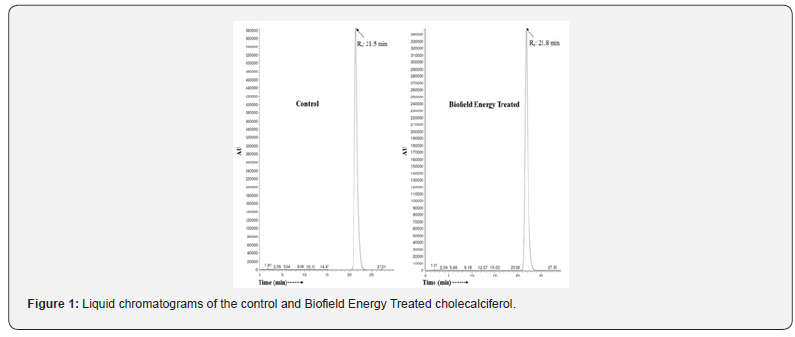
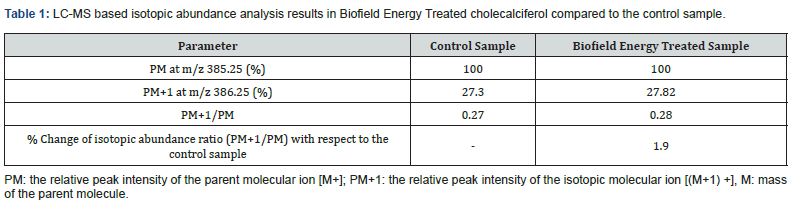
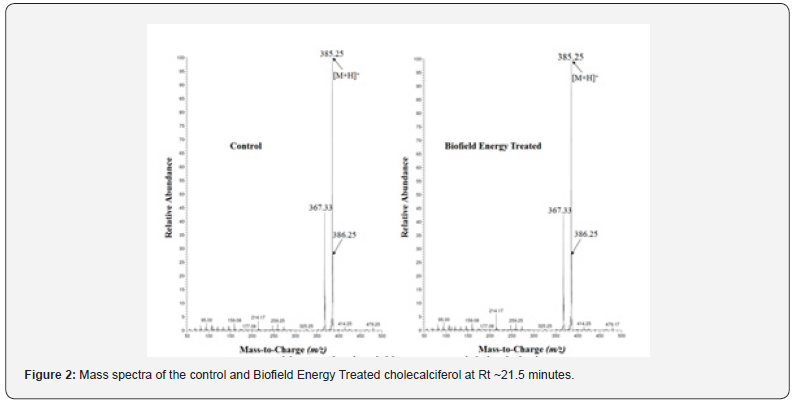
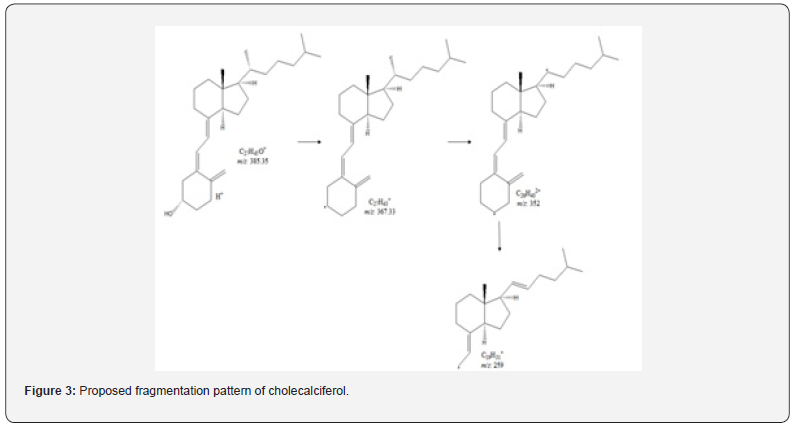
The chromatograms of the control and Biofield Energy Treated cholecalciferol are shown in (Figure 1). A single major chromatographic peak of the control cholecalciferol was observed at retention time (Rt) of 21.5 minutes, whereas the peak was observed at 21.8 minutes in the Biofield Energy Treated sample (Figure 1). This indicated that the polarity of both the samples was very close to each other. Similarly, the mass spectra of both the samples of cholecalciferol are shown in (Figure 2). The control and Biofield Energy Treated cholecalciferol were ionized via ESI in +ve ion mode. The mass spectra of the control and Biofield Energy Treated samples at Rt of ~21.5 minutes exhibited the presence of the molecular ion of cholecalciferol (C27H45O+) adduct with hydrogen ion (Figure 2) at m/z 385.25 (calcd for C27H45O+, 385.35). The lower m/z showed the presence of the [M-OH] + ion mass peak at m/z 367.33 (calcd for C27H43+, 367.3) in the control and Biofield Energy Treated cholecalciferol (Figure 2 & 3). The experimental data were well correlated with the literature reported data [39]. The control and Biofield Energy Treated samples showed the mass of a molecular ion at m/z 385.25 (calcd for C27H45O+, 385.35) with 100% relative abundance in the spectra. The theoretical calculation of isotopic peak PM+1 for the protonated cholecalciferol presented as below:
P (13C) = [(27 x 1.1%) x 100% (the actual size of the M+ peak)] / 100% = 29.7%
P (2H) = [(45 x 0.015%) x 100%] / 100%= 0.675%
P (17O) = [(1 x 0.04%) x 100%] / 100% = 0.04%
PM+1 i. e.13C, 2H, and 17O contributions from C27H45O+ to m/z 386.25 = 30.42%
The calculated isotopic abundance of PM+1 value 30.42% was higher to the experimental value (27.3%) (Table 1). From the above calculation, it has been found that 13C has the major contribution to m/z 386.25. The LC-MS based isotopic abundance ratio analysis PM and PM+1 for cholecalciferol near m/z 385.25 and 386.25, respectively of the control and Biofield Energy Treated samples, which were obtained from the observed relative peak intensities of [M+] and [(M+1) +] peaks, respectively in the ESI-MS spectra (Table 1). The isotopic abundance ratio of PM+1/ PM (2H/1H or 13C/12C or 17O/16O) in Consciousness Energy Healing Treated cholecalciferol was increased by 1.9% compared to the control sample (Table 1). Thus, the 13C, 2H, and 17O contributions from C27H45O+ to m/z 386.25 in the Biofield Energy Treated sample was increased compared to the control sample.
Gas chromatography-mass spectrometry (gc-ms) analysis
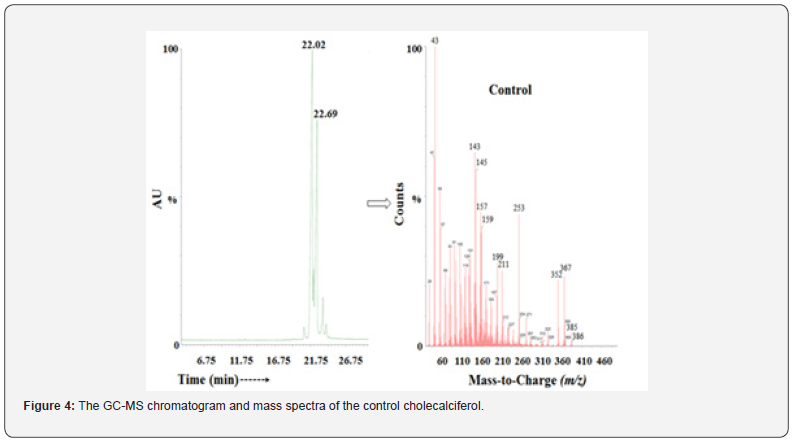
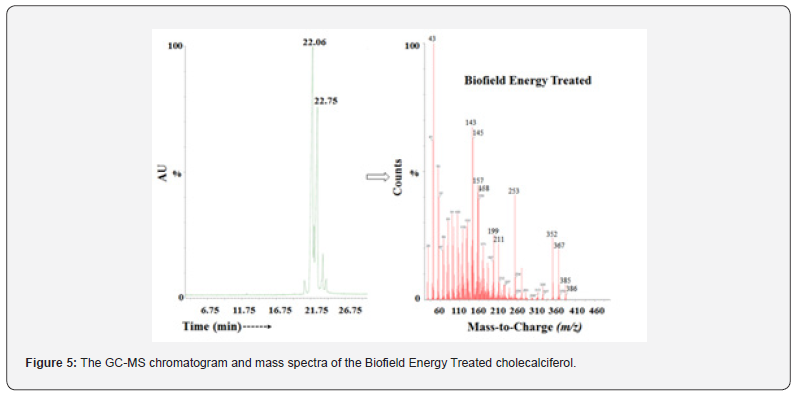
The control and Biofield Energy Treated cholecalciferol showed two major independent peaks in the GC-MS chromatograms (Figure 3). The Rt of the control sample was at 22.02 and 22.69 minutes, whereas Biofield Energy Treated sample showed at 22.06 and 22.75 minutes, which indicated that retention times of both the sample were very close. The results indicated that the polarity of the Biofield Energy Treated cholecalciferol remained close compared to the control sample. The chromatograms of both the control and Biofield Energy Treated showed two peaks might be due to the cis and trans isomers of cholecalciferol. The GC-MS spectra of the control and Biofield Energy Treated samples at Rt of 22.7 minutes exhibited the presence of the molecular ion peak of cholecalciferol (C27H44O+) (Figure 4) at m/z 385 (calcd for C27H44O+, 384.34). The low molecular mass fragmentation peak at m/z 367, and 352 for C27H43+ and C26H40+, respectively in both the control and Biofield Energy Treated cholecalciferol (Figure 4). The mass fragmentation pattern of the Biofield Energy Treated cholecalciferol was similar to that of the control sample. But the mass peak intensities of the Biofield Energy Treated cholecalciferol were altered compared to the control sample. The isotopic abundance ratio depends upon the mass peak intensities of the particular compounds, which was well supported by the LC MS based isotopic abundance ratio analysis. The GC-MS spectra of both the control and Biofield Energy Treated cholecalciferol showed the mass of the molecular ion peak [M]+ at m/z 385 (calcd for C27H44O+, 384.34). The theoretical calculation of PM+1 and PM+2 for cholecalciferol was presented as below:
P (13C) = [(27 x 1.1%) x 9.06% (the actual size of the M+ peak)] / 100% = 2.69%
P (2H) = [(44 x 0.015%) x 9.06%] / 100%= 0.06%
P (17O) = [(1 x 0.04%) x 9.06%] / 100% = 0.004% PM+1 i. e.13C, 2H, and 17O contributions from C27H45O+ to m/z 386 = 2.75%
Similarly, the theoretical calculation of isotopic peak PM+2 for the protonated cholecalciferol was presented below:
P (18O) = [(1 x 0.20%) x 9.06%] / 100% = 0.02%
PM+2 of 18O contribution from C27H45O+ to m/z 387 = 0.02%

The calculated isotopic abundance of PM+1 and PM+2 values were close to the calculated value (Table 2). From the above calculation, it has been found that 13C and 18O have major. The GC-MS based isotopic abundance ratio analysis of the Biofield Energy Treated samples were calculated compared to the control sample. PM, PM+1, and PM+2 for cholecalciferol near m/z 385, 386, and 387, respectively of the control and Biofield Energy Treated samples, which were obtained from the observed relative peak intensities of [M+], [(M+1) +], and [(M+2)+] peaks, respectively in the mass spectra and are presented in Table 2. The isotopic abundance ratio of PM+1/PM and PM+2/PM in the Biofield Energy Treated cholecalciferol was increased by 1.99% and 15.69%, respectively compared with the control sample (Table 2). Hence, it can be concluded that 13C, 2H, 17O and 18O contributions from C27H44O+ to m/z 386 and 387 in the Biofield Energy Treated sample were significantly increased compared with the control sample. LC-MS and GC-MS study confirmed the sample as cholecalciferol. The isotopic abundance ratios of PM+1/PM (2H/1H or 13C/12C or 17O/16O) and PM+2/PM (18O/16O) in the Biofield Energy Treated cholecalciferol were significantly increased compared to the control sample. According to the physics, the neutrinos change identities which are only possible if the neutrinos possess mass and have the ability to interchange their phase from one phase to another internally. Therefore, the neutrinos can interact with protons and neutrons in the nucleus, which indicated a close relation between neutrino and the isotope formation [15,34,35]. The altered isotopic composition in molecular level of The Trivedi Effect®-Consciousness Energy Healing Treated cholecalciferol might have altered the neutron to proton ratio in the nucleus. It can be hypothesized that the changes in isotopic abundance could be due to changes in nuclei possibly through the interference of neutrino particles via The Trivedi Effect® - Consciousness Energy Healing Treatment. The Biofield Energy Treated cholecalciferol would be more suitable for the prevention and treatment of various diseases such as vitamin D deficiency, rickets, osteoporosis, arthritis, diabetes mellitus, multiple sclerosis, cancer, cardiovascular diseases, inflammations, infections, mental disorders, stress, aging, glucose intolerance, Parkinson’s and Alzheimer’s diseases, dementia, cognitive impairment in older adults, etc.
Conclusion
The Trivedi Effect®-Consciousness Energy Healing Treatment (Biofield Energy Treatment) showed the significant impact on the isotopic abundance ratios of cholecalciferol. The LC-MS spectra of the control and Biofield Energy Treated the samples at retention time (Rt) ~21.5 minutes exhibited the mass of the molecular ion peak at m/z 385.25 (calcd for C27H45O+, 385.35). The LC-MS based isotopic abundance ratio of PM+1/ PM in the Biofield Energy Treated cholecalciferol was increased by 1.9% compared with the control sample. The control and Biofield Energy Treated cholecalciferol showed the presence of the chromatographic peak at the retention time of ~22.7min in the GC-MS chromatograms. The GC-MS based isotopic abundance ratio of PM+1/PM and PM+2/PM in the Biofield Energy Treated cholecalciferol was significantly increased by 1.99% and 15.69%, respectively compared with the control sample. Hence, 13C, 2H, 17O and 18O contributions from C27H44O+ to m/z 386 and 387 in the Biofield Energy Treated sample were significantly increased compared with the control sample. The isotopic abundance ratios of PM+1/PM (2H/1H or 13C/12C or 17O/16O) and PM+2/PM (18O/16O) in the Biofield Energy Treated cholecalciferol were significantly increased compared to the control sample. It can be assumed that the changes in isotopic abundance and mass peak intensities could be due to changes in nuclei possibly through the interference of neutrino particles via The Trivedi Effect® - Consciousness Energy Healing Treatment. The new form of cholecalciferol would be better designing novel pharmaceutical formulations that might offer better therapeutic response against rickets, osteoporosis, arthritis, multiple sclerosis, cancer, diabetes mellitus, mental disorders, cardiovascular diseases, infections, cognitive impairment in older adults, Parkinson’s and Alzheimer’s diseases, dementia, glucose intolerance, multiple sclerosis, etc.
Acknowledgement
The authors are grateful to Sophisticated Instrumentation Centre for Applied Research & Testing (SICART) India, Trivedi Science, Trivedi Global, Inc., Trivedi Testimonials, and Trivedi Master Wellness for their assistance and support during this work.
References
- Coulston AM, Carol B, Mario F (2013) Nutrition in the prevention and treatment of disease. Academic Press, p. 818.
- WHO Model Formulary (2008) World Health Organization, p. 496.
- Samuel S, Sitrin MD (2008) Vitamin D's role in cell proliferation and differentiation. Nutr Rev 66: S116-S124.
- Simana E, Simian R, Portnoy S, JaffeA, Dekel BZ (2015) Feasibility Study -Vitamin D loading determination by FTIR-ATR.Information & Control Systems76: 107-111.
- Ritu G, Gupta A (2014) Vitamin D Deficiency in India: Prevalence, Causalities and Interventions. Nutrients 6: 729-775.
- Lawson DE, Wilson PW, Kodicek E(1969) Metabolism of vitamin D. A new cholecalciferol metabolite, involving loss of hydrogen at C-1, in chick intestinal nuclei. Biochem J 115: 269-277.
- Ross CA, Taylor CL, Yaktine AL, Valle HBD (2010) Dietary reference intakes for calcium and Vitamin D. Washington (DC): National Academies Press (US), 2011. (access on 02.05.2018).
- Koshy KT, Beyer WF (1984) Vitamin D3 (Cholecalciferol) in Analytical Profiles of Drug Substances. In: Florey K (Ed.), Academic Press, Inc., Orlando, USA, pp. 656-707.
- Collins ED, Norman AW (2001) Vitamin D in Handbook of Vitamins. In: Rucker RB, Suttie JW, McCormick DB, Machlin LJ, Marcel Dekker (Eds.), (3rdedn), Inc., New York, USA, pp. 51-114.
- Lehmann U, Hirche F, Stangl GI, Hinz K, Westphal S, Dierkes J (2013) Bioavailability of vitamin D(2) and D(3) in healthy volunteers, a randomized placebo-controlled trial. J Clin Endocrinol Metab 98: 4339-4345.
- Branton A, Jana S (2017) Effect of the biofield energy healing treatment on the pharmacokinetics of 25-hydroxyvitamin D3 [25(OH)D3] in rats after a single oral dose of vitamin D3. American Journal of Pharmacology and Phytotherapy 2: 11-18.
- Branton A, Jana S (2017) The influence of energy of consciousness healing treatment on low bioavailable resveratrol in male Sprague Dawley rats. International Journal of Clinical and Developmental Anatomy 3: 9-15.
- Branton A, Jana S (2017) The use of novel and unique biofield energy healing treatment for the improvement of poorly bioavailable compound, berberine in male Sprague Dawley rats. American Journal of Clinical and Experimental Medicine 5: 138-144.
- Trivedi MK, Mohan TRR (2016) Biofield Energy Signals, Energy Transmission and Neutrinos. American Journal of Modern Physics 5: 172-176.
- Rubik B, Muehsam D, Hammerschlag R, Jain S (2015) Biofield Science and Healing: History, Terminology, and Concepts. Global Advances in Health and Medicine 4: 8-14.
- Warber SL, Cornelio D, StraughnJ, Kile G (2004) Biofield energy healing from the inside. J Altern Complement Med 10: 1107-1113.
- Movaffaghi Z, Farsi M (2009) Biofield therapies: biophysical basis and biological regulations? Complement Ther Clin Pr 15: 35-37.
- Koithan M (2009) Introducing complementary and alternative therapies. J Nurse Pract 5: 18-20.
- Barnes PM, Bloom B, Nahin RL (2008) Complementary and alternative medicine use among adults and children: United States, 2007. Natl Health Stat Report 12: 1-23.
- Trivedi MK, Branton A, Trivedi D, Nayak G, Singh R, et al. (2015) Characterization of physical, thermal and spectroscopic properties of biofield energy treated p-phenylenediamine and p-toluidine. J Environ Anal Toxicol 5: 329.
- Trivedi MK, Branton A, Trivedi D, Nayak G, Singh R, et al. (2015) Characterization of biofield energy treatedchloronitrobenzene: Physical, thermal, and spectroscopic studies. J Waste Resources 5: 183.
- Trivedi MK, Tallapragada RM, Branton A, Trivedi D, Nayak G, et al. (2015) Effect of biofield energy treatment on physical and structural properties of calcium carbide and praseodymium oxide. International Journal of Materials Science and Applications 4: 390-395.
- Trivedi MK, Nayak G, Patil S, Tallapragada RM, Latiyal O (2015) Studies of the atomic and crystalline characteristics of ceramic oxide nano powders after bio field treatment. Ind Eng Manage 4: 161.
- Trivedi MK, Branton A, Trivedi D, Nayak G, Balmer AJ, et al. (2017) Evaluation of physicochemical, thermal, structural, and behavioral properties of magnesium gluconate treated with energy of consciousness (The Trivedi Effect®). Journal of Drug Design and Medicinal Chemistry3: 5-17.
- Trivedi MK, Patil S, Shettigar H, Bairwa K, Jana S (2015) Spectroscopic characterization of biofield treated metronidazole and tinidazole. Med chem 5: 340-344.
- Trivedi MK, Branton A, Trivedi D, Shettigar H, Nayak G, et al.(2015) Antibiogram typing of biofield treated multidrug resistant strains of Staphylococcus species. American Journal of Life Sciences 3: 369-374.
- Trivedi MK, Branton A, Trivedi D, Shettigar H, Nayak G, et al.(2015) Antibiogram, biochemical reactions and genotyping characterization of biofield treated Staphylococcus aureus. American Journal of BioScience 3: 212-220.
- Sances F, Flora E, Patil S, Spence A, Shinde V (2013) Impact of biofield treatment on ginseng and organic blueberry yield. AGRIVITA. Journal of Agricultural Science 35: 1991-8178.
- Trivedi MK, Branton A, Trivedi D, Nayak G, Gangwar M, et al. (2015) Agronomic characteristics, growth analysis, and yield response of biofield treated mustard, cowpea, horse gram, and groundnuts. International Journal of Genetics and Genomics 3: 74-80.
- Trivedi MK, Branton A, Trivedi D, Nayak G, Panda P, et al. (2016) Evaluation of the isotopic abundance ratio in biofield energy treated resorcinol using gas chromatography-mass spectrometry technique. Pharm Anal Acta 7: 481.
- Trivedi MK, Branton A, Trivedi D, Nayak G, Panda P, et al. (2016) Gas chromatography-mass spectrometric analysis of isotopic abundance of 13C, 2H, and 18O in biofield energy treated p-tertiary butylphenol (PTBP). American Journal of Chemical Engineering 4: 78-86.
- Schellekens RC, Stellaard F, Woerdenbag HJ, Frijlink HW, Kosterink JG (2011) Applications of stable isotopes in clinical pharmacology. Br J Clin Pharmacol 72: 879-897.
- Muccio Z, Jackson GP (2009) Isotope ratio mass spectrometry. Analyst 134: 213-222.
- Weisel CP, Park S, Pyo H, Mohan K, Witz G (2003) Use of stable isotopically labeled benzene to evaluate environmental exposures. J Expo Anal Environ Epidemiol 13: 393-402.
- Rosman KJR, Taylor PDP (1998) Isotopic compositions of the elements 1997 (Technical Report). Pure Appl Chem 70: 217-235.
- Smith RM (2004) Understanding Mass Spectra: A Basic Approach.(2ndedn), John Wiley & Sons, Inc.
- Jürgen H (2004) Gross Mass Spectrometry: A Textbook. (2ndedn), Springer, Berlin.
- Holick MF, Garabedian M, DeLuca HF (1972) 5,6-Trans isomers of cholecalciferol and 25-hydroxycholecalciferol. Substitutes for 1,25-dihydroxycholecalciferol in anephric animals. Biochemistry 11: 2715-2719.
- Okamura WH, Midland MM, Hammond MW, Abd Rahman N, Dormanen MC, et al. (1995) Chemistry and conformation of vitamin D molecules. J Steroid Biochem Mol Biol 53: 603-613

























