




 GJORM Home



Women’s Childbearing Age Associated with Optimal Fetal and Infant Outcomes: A Population-Based Study
Xiaoyu Zhang1, Uma M Reddy2 and Jun Zhang1*
1Ministry of Education-Shanghai Key Laboratory of Children’s Environmental Health, Shanghai Jiao Tong University School of Medicine, China
2 Department of Obstetrics, Gynecology and Reproductive Sciences, Yale School of Medicine, USA
Submission:August 09, 2020; Published:August 13, 2020
*Corresponding author:Jun Zhang, Ministry of Education-Shanghai Key Laboratory of Children’s, Environmental Health, Xinhua Hospital, Shanghai Jiao Tong University School of Medicine, Shanghai, 200092, China
How to cite this article:Xiaoyu Z, Uma M R, Jun Z. Women’s Childbearing Age Associated with Optimal Fetal and Infant Outcomes: A Population- Based Study.Glob J Reprod Med. 2020; 8(1): 5556728. DOI: 10.19080/GJORM.2020.08.555728.
Abstract
Background: Both teenage and delayed childbearing were associated with adverse pregnancy outcomes. However, the optimal maternal age that is associated with the lowest risk of fetal and infant mortalities and morbidity is unclear.
Methods: In this retrospective cohort, we pooled nulliparous singleton births from the U.S. Cohort Linked Birth-Infant Death Data, Natality and Fetal Death Data from 2011 to 2017. The study population included non-obese (body mass index < 30 kg/m2) nulliparous women with singleton gestation and greater than 20 weeks of gestation. The optimal maternal age at first childbirth for the lowest risk of fetal death, infant mortality, and neonatal morbidity (early preterm birth and severe small-for-gestational-age) was identified by using a second-degree fractional polynomial regression, stratified by race/ethnicity.
Results: A total of 5,285,126 singleton births were analyzed for the outcomes of infant mortality and morbidity, and 4,386,757 were analyzed for fetal mortality rate. Non-Hispanic White, Hispanics and Asian American women shared similar maternal age patterns. Maternal age at 26-31 years was associated with the lowest risk of adverse fetal and infant outcomes. However, non-Hispanic Black had the optimal age 2-4 years earlier than other race/ethnic groups, namely 24-27 years old.
Conclusion: Maternal age for the optimal pregnancy outcomes is around 24 to 31 years old for the majority of first-time mothers. Our results may provide useful information for counseling women regarding optimal timing of childbearing.
Keywords:Maternal childbearing age; Infant mortality; Fetal death; Neonatal morbidity
Introduction
Delayed childbearing has become a global phenomenon in the past several decades. For instance, in the United States, the mean maternal age at first birth increased from 24.9 years in 2000 to 26.3 years in 2014; the proportion of first births to women over 35 years rose from 7.4% to 9.1% during the same period [1] The consequences are significant as advanced maternal age is associated with increased risks of infertility and adverse pregnancy outcomes [2-4]. For instance, female fecundability declines precipitously after 35 years of age [5]. While risks of miscarriage and preeclampsia increase [6]. Advanced maternal age is a significant risk factor for diabetes (including gestational diabetes), pregnancy hypertension and preterm birth [7,8]. These complications, in turn, contribute to higher neonatal and infant morbidity and mortality in older women [9]. The financial and social costs of the sequelae of delayed childbearing are significant but have not been well evaluated [10].
Numerous studies have examined the consequences of pregnancies in teenagers and advanced maternal age women, but few tried to directly answer what is the optimal maternal age associated with the best perinatal outcomes especially for first-time mothers. Furthermore, selection bias due to decreasing fecundability with advancing woman’s age and over-adjustment of mediation factors may be important methodological deficiencies that may have masked the total effects of advanced maternal age on pregnancy outcomes and child health. More specifically, less fertile women may be unable to achieve pregnancy with advancing age. Since low fecundability is associated with poor perinatal outcomes [11]. The exclusion of infertile women would lead to an underestimation of age effect on adverse pregnancy outcomes [12]. Besides, many studies adjust for gestational age and pregnancy complications (e.g. gestational diabetes mellitus) in examining the association between maternal age and perinatal outcomes and infant mortality [7,13]. As these complications are age-related, adjusting for these mediators can underestimate the total effects of maternal age on the outcomes of interest. Our study uses population- based data to explore the optimal maternal age that is associated with the lowest risk of adverse fetal and infant outcomes.
Methods
This study used data from the U.S. Cohort Linked Birth-Infant Death Data in 2011-2015, the Natality Data and Fetal Death Data in 2014-2017. Because the information on body mass index (BMI) is not available in the database every year, we had to select different years for different analyses. All databases are publicly available from the U.S. National Center for Health Statistics and well described elsewhere [14]. The Linked Birth-Infant Death Data links livebirth certificates with infant death certificates within 1 year of age. The Natality Data and Fetal Death Data were combined to calculate fetal mortality rates. The combined data represent almost all pregnancies longer than 20 weeks of gestation in the U.S. in a given calendar year.
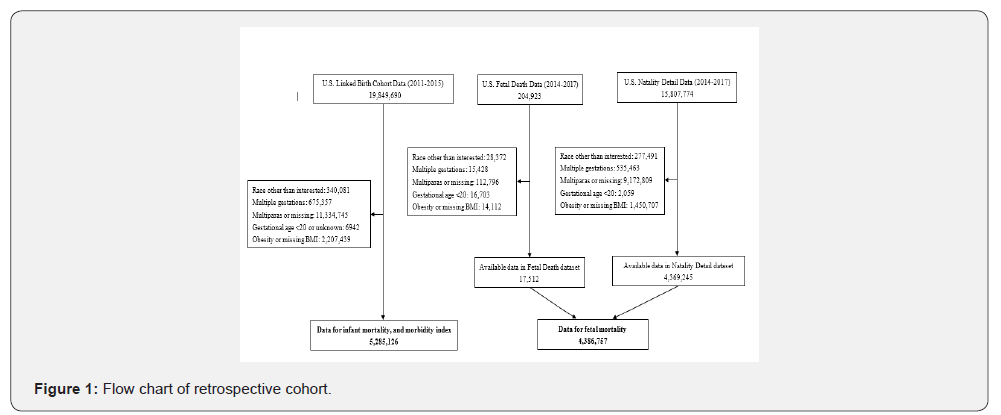
There were 19,849,690 pregnancies in the U.S. Birth Cohort Linked Birth-Infant Death Data 2011-2015, 204,923 in the Fetal Death Data 2014-2017, and 15,807,774 in the Natality Data 2014- 2017. The following women were excluded for the current analysis:
a. Race/ethnicity other than non-Hispanic White, non-Hispanic Black, Hispanics or Asian
b. Multiple gestation
c. Multiparous
d. Pregnancies less than 20 weeks of gestation
e. Had pre-pregnant obesity (BMI at or greater than 30 kg/ m2).
We limited to non-obese women as the effect of pre-pregnancy obesity on perinatal outcomes differs by maternal age and race/ ethnicity [15]. For example, it was after 20 years old that obesity began to be positively associated with preterm birth in non-Hispanic White women, while the age of turning point for non-Hispanic Black women was 30 years old.
The current study measures optimal fetal and infant outcomes based on the following parameters: fetal death, infant death, and neonatal morbidity which was composed of early preterm birth and severe small-for-gestational-age. Fetal death includes antepartum and intrapartum fetal deaths with 20 weeks of gestation or more. Infant death is death of live-born baby within 1 year of age. Early preterm birth refers to a livebirth born at or after 20 weeks but before 34 weeks of gestation. Severe small-for-gestational- age is defined as a weight below the 3rd percentile for the gestational age in our dataset. All analyses were stratified by maternal race/ethnicity (Non-Hispanic White, Non-Hispanic Black, Non-Hispanic Asian and Hispanic).
To provide a more flexible parameterization for maternal age, a second-degree fractional polynomial regression was performed to fit a non-linear relationship between continuous maternal age and each outcome of interest. The model restricted powers in a given set of (-2 -1 -0.5 0 0.5 1 2 3), with x0 denoting logarithm of covariate (ln( X )) . If a second-degree fractional polynomial model was selected with powers ( p1, p2 ) . FP function would be
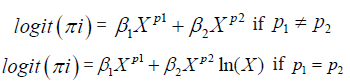
where πi was the probability of mortality/morbidity for individual i. The coefficients of maternal age (β ) were generated. The predicted probability for each infant outcome was then calculated by the formula: odds/(1+odds), where odds= eβ . In order to be consistent with the expression of mortality rates (death per 1,000 live births), the predicted probability was expressed as per 1,000. The plot of predicted probability against maternal age was then drawn to visually show the pattern of each outcome by maternal age, by using R studio (Version 1.0.136). All analyses were performed using Stata/IC 15.1.
The maternal age associated with the lowest mortality and morbidity rates was calculated by first estimating the final FP model using logistic regression. To derive the optimal maternal age, the first derivative of the estimated FP function was set to be 0 and used to solve maternal age. For example, FP function as

Results
Figure 1 shows the selection of the study population. A total of 5,285,126 nulliparous singleton births from the Linked Birth Cohort were included for the analysis of infant mortality and morbidity rates, and 4,386,757 from the combined Natality and Fetal Death datasets for the analysis of fetal mortality rate.
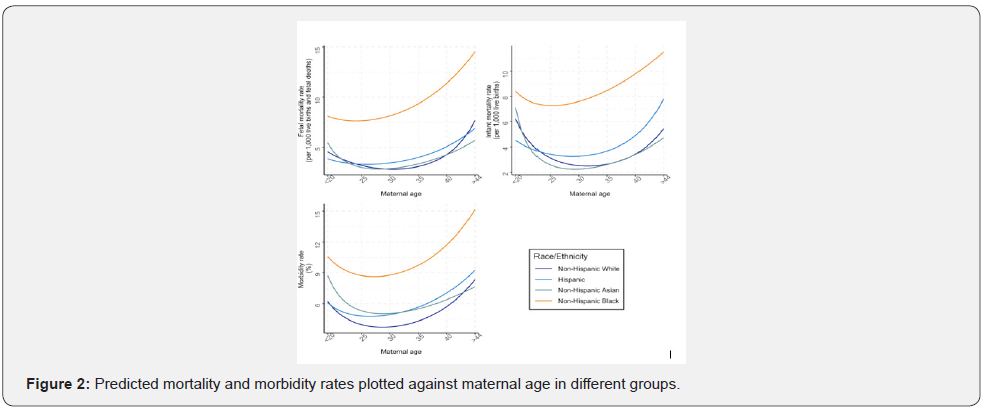
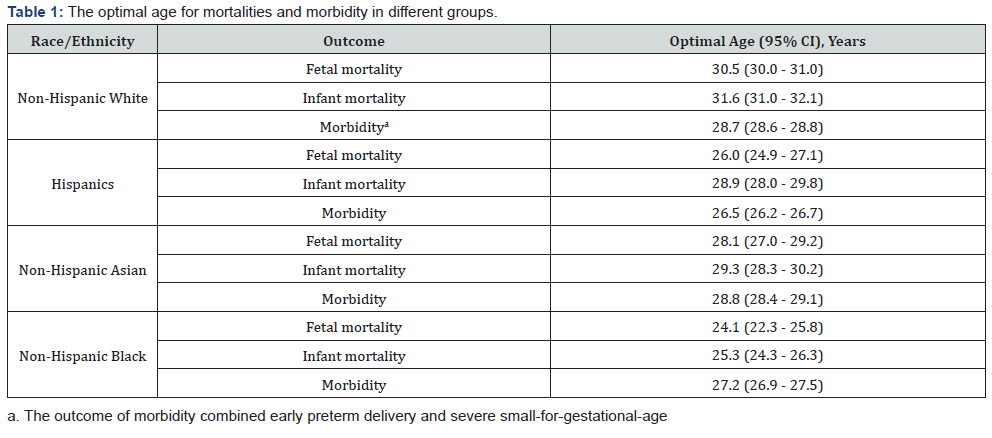
Figure 2 & Table 1 show the patterns of fetal and infant mortalities and morbidity by maternal age, stratified by race/ethnicity. There were J-/U- shape relationships between maternal age and each outcome, and the relationships were very similar among different outcomes. On the other hand, non-Hispanic White, Hispanics and Asian American women also shared similar patterns. Maternal age at 26-31 years, in general, was associated with the lowest morbidity and mortalities. The morbidity and mortality risks in non-Hispanic Black were generally higher than those in other race/ethnic groups; and the nadirs were all shifted toward 2-4 years younger, i.e., at 24-27 years old
Discussion
With combined data from the US Linked Birth Cohort Data, Natality Data and Fetal Death Data, our study shows that there is a J-/U-shaped relationship between maternal age and adverse fetal and infant outcomes, i.e., the younger (<20 years) and older ages (>35 years) are associated with higher risks of adverse outcomes. Our findings suggest that the maternal age for the optimal infant outcomes is around 24 to 31 years old for non-obese first-time mothers in general. Non-Hispanic Black women had the lowest mortality/morbidity rates 2-4 years younger than other race/ethnic groups.
The association between maternal age and adverse infant outcomes results from a mixture of physiological and socioeconomic factors. Physiologically, after puberty, women reach sexually maturity and are prepared to undergo pregnancy. However, young women who are undergoing growth may compete with the developing fetus for intrauterine resources (e.g. nutrients), contributing to restricted fetal growth and, subsequently, place the fetus at the risk for certain health problems [16]. Biological immaturity may also predispose young mothers to infection-mediated preterm delivery [17].
The risk of adverse pregnancy outcomes gradually rises as the reproductive system mature; increased myometrial sclerotic lesions with advancing age may cause uteroplacental under-perfusion and, consequently, increase the risk of stillbirth [18]. Furthermore, chronic diseases (e.g. hypertension, diabetes, renal disease) associated with advancing maternal age, potentially increase the risk of adverse outcomes [19].
Heffner et al. [20] suggested that maternal age between 25 and 35 would be ideal for childbearing in westernized societies. One retrospective cohort study with 203,517 mothers of singleton gestation found that maternal age of 25-30 years old was associated with the lowest risks of low birth weight (<2500g), admission to neonatal intensive care unit and perinatal mortality, after controlling for race, parity, insurance type, BMI, pre-existing medical conditions, substance use, and clinical site [21]. Another study using hospital inpatient stay data with 4,109,297 weighted sample, also found that maternal age of 25-29 was related to the lowest odds for most of maternal complications (e.g. chorioamnionitis, preeclampsia, eclampsia, pregnancy-related hypertension) with the adjustment of demographics and comorbidities (e.g. gestational diabetes, cardiac disease) [13]. However, as adjustment of age-related medical conditions may undermine the total effects of maternal age on pregnancy outcomes, we did not adjust for medical conditions.
Our study is population-based, involving the whole U.S. birth population and examined race/ethnicity-specific patterns. Overall, maternal age associated with the optimal fetal and infant outcomes was 24-31 years old for the vast majority of non-obese first-time women. The optimal age for African American mothers was 2-4 years earlier than other race/ethnic groups. One possible explanation is the cumulative exposure to socioeconomic disadvantage that leads to Black women to experience earlier health deterioration, what Geronimus proposed as “whethering hypothesis” [22]. In addition, adaptation to such chronic stress results in wear and tear on the body, which is referred as “allostatic load” [23]. Lu & Halfon [24] suggested that allostatic load may affect reproductive health in Black women, which partly explains the racial/ ethinic disparities in birth outcomes.
The current study has several strengths. It included a population- based large sample size, which allowed the analysis of rare outcomes such as feta land infant mortality. Statistically, we applied a flexible method to fit the non-linear and asymmetric relationship between maternal age and each pregnancy outcome, letting the data determine the functional form of the equation relating maternal age and outcome. Use of the fractional polynomial regression preserves the continuous nature of maternal age and the non-linear nature of the association between maternal age and adverse outcomes, enabling us to find an optimal age rather than an age group.
Nonetheless, our study has some limitations. First, we did not identify the optimal maternal age for maternal morbidity (e.g. hemorrhage, postpartum sepsis, pre-eclampsia/eclampsia), maternal mortality and severe neonatal morbidity because previous studies found that maternal and neonatal morbidity information had substantial underreporting in the birth certificate data [25]. We, therefore, used severe small-for-gestational-age and early preterm birth as a combined morbidity index. While severe neonatal outcomes have more clinical implications, less severe morbidity may also have long-term concerns for adult chronic diseases. Second, we could not provide a single index to identify the optimal maternal age, as the incidences of mortality (in per 1,000 births) and morbidity (in per 100 births) differed greatly and the datasets used for fetal and infant mortalities were different; instead, we used three indexes. As the maternal age patterns for mortalities and morbidity were very similar, the conclusion is reassured. Third, the findings in the study apply to non-obese women only. Finally, as we did not have good information on socioeconomic status, the study may be susceptible to residual confounding.
Conclusion
For non-obese first-time mothers, 24-31 years of age was associated with optimal fetal and infant mortality and morbidity, depending on mothers’ race/ethnicity. Our results should not be used in the clinical settings in a proscriptive way. Rather, it may provide useful information for counseling women regarding optimal timing of pregnancy, according to their own contextual situation.
Funding
This study was partly supported by the grant from the Shanghai Municipal Health Commission (GWIV-26).
References
- Mathews TJ, Hamilton BE (2016) Mean age of mothers is on the rise: United States, 2000-2014. NCHS Data Brief 232: 1-8.
- Kenny LC, Lavender T, McNamee R, O Neill SM, Mills T, et al. (2013) Advanced maternal age and adverse pregnancy outcome: evidence from a large contemporary cohort. PloS One 8(2): e56583.
- Lean SC, Derricott H, Jones RL, Heazell AE (2017) Advanced maternal age and adverse pregnancy outcomes: A systematic review and meta-analysis. PloS One 12(10): e0186287.
- Balasch J, Gratacós E, Gynecology (2012) Delayed childbearing: effects on fertility and the outcome of pregnancy. Curr Opin Obstet Gynecol 24(3):187-193.
- Steiner AZ, Jukic AM (2016) Impact of female age and nulligravidity on fecundity in an older reproductive age cohort. Fertil Steril 105(6):1584-1588.
- Khalil A, Syngelaki A, Maiz N, Zinevich Y, Nicolaides K (2013) Maternal age and adverse pregnancy outcome: a cohort study. Ultrasound Obstet Gynecol 42(6):634-643.
- Luke B, Brown M (2007) Elevated risks of pregnancy complications and adverse outcomes with increasing maternal age. Hum Reprod 22(5):1264-1272.
- Sheen JJ, Wright JD, Goffman D, Kern Goldberger AR, Booker W (2018) Maternal age and risk for adverse outcomes. Am J Obstet Gynecol 219(4): e1-390.
- Murphy SL, Kochanek KD, Xu J (2015) Deaths: final data for 2011.
- Mill C, Enders J, Montanaro C, Moore KM (2016) Delayed parenthood on the rise: A call for upstream preconception health promotion in Canada. Can J Public Health 107(3): e333-e5.
- Axmon A, Hagmar L (2005) Time to pregnancy and pregnancy outcome. Fertil Steril 84(4): 966-974.
- Schimmel M, Bromiker R, Hammerman C, Chertman L, Ioscovich A (2015) The effects of maternal age and parity on maternal and neonatal outcome. Arch Gynecol Obstet 291(4): 793-798.
- Cavazos Rehg PA, Krauss MJ, Spitznagel EL, Bommarito K, Madden T, et al. (2015) Maternal age and risk of labor and delivery complications. Matern Child Health J 19(6): 1202-1211.
- (2018) Birth Cohort Linked Birth-Infant Death Data Files and Fetal Death Data Files. Public-use data file and documentation. National Center for Health Statistics.
- Liu B, Xu G, Sun Y, Du Y, Gao R, et al. (2019) Association between maternal pre-pregnancy obesity and preterm birth according to maternal age and race or ethnicity: a population-based study. Lancet Diabetes Endocrinol 7(9): 707-714.
- Wallace JM (2019) Competition for nutrients in pregnant adolescents: consequences for maternal, conceptus and offspring endocrine systems. J Endocrinol 242(1): T1-T19.
- Stevens Simon C, Beach RK, McGregor JA (2002) Does incomplete growth and development predispose teenagers to preterm delivery? A template for research. J Perinatol 22(4): 315.
- Naeye LR (1983) Maternal Age, Obstetric Complications, and the Outcome of Pregnancy. Obstet Gynecol 61(2): 210-216.
- Coletta LJ, Simpson LL (2010) Maternal Medical Disease and Stillbirth. Clin Obstet Gynecol 53(3): 607-616.
- Heffner LJ (2004) Advanced maternal age-how old is too old. N Engl J Med 351(19): 1927-1929.
- Timofeev J, Reddy UM, Huang CC, Driggers RW, Landy HJ, et al. (2013) Obstetric complications, neonatal morbidity, and indications for cesarean delivery by maternal age. Obstet Gynecol 122(6): 1184.
- Geronimus AT (1992) The weathering hypothesis and the health of African American women and infants: evidence and speculations. Ethn Dis 2(3): 207-221.
- Mc Ewen BS (2006) Protective and damaging effects of stress mediators: central role of the brain. Dialogues Clin Neurosci 8(4): 367.
- Lu MC, Halfon N (2003) Racial and ethnic disparities in birth outcomes: a life-course perspective. Matern Child Health J 7(1): 13-30.
- Boulet SL, Shin M, Kirby RS, Goodman D, Correa A (2011) Sensitivity of birth certificate reports of birth defects in Atlanta, 1995–2005: effects of maternal, infant, and hospital characteristics. Public Health Rep 126(2): 186-194.

























