




 GJAA Home



Where Did the Hands and Teeth Go? A Practical Analysis of Systematic Loss of Diagnostic Elements in Burial Recovery in Different Excavation Scenarios
M. Mattia*, C. Cattaneo
LABANOF, University of Milan, Milan, Italy
Submission:February 5, 2026; Published:February 20, 2026
*Corresponding author:Mirko Mattia, LABANOF, University of Milan, Milan, Italy
How to cite this article:M. Mattia, C. Cattaneo. Where Did the Hands and Teeth Go? A Practical Analysis of Systematic Loss of Diagnostic Elements in Burial Recovery in Different Excavation Scenarios. Glob J Arch & Anthropol. 2026; 14(5): 555896.DOI: 10.19080/GJAA.2026.14.555896
Abstract
Skeletal completeness is essential for robust bioarchaeological interpretation, yet cemetery assemblages are often shaped by structured loss that may reflect not only burial environment but also recovery and post-excavation workflows. We quantified representation and preservation in 150 individuals from three burial contexts in the Milan area (Italy), spanning the Roman period (MiUC) to the 7th century AD (LV) (two necropolises) and the 15th–16th centuries AD (one cemetery context, MtNAP), and compared archaeological outcomes with seven forensic recoveries performed under an osteologist’s supervision. Concerning the ancient necropolises and cemeteries, MiUC is a Roman-period assemblage recovered within a university field-training excavation, conducted primarily for teaching purposes under archaeological supervision. LV is a 7th-century assemblage excavated within a commercial, contract archaeology framework. MtNAP (15th–16th centuries) derives from a rescue excavation linked to construction works, carried out under stricter time constraints. Completeness was summarized using the Bone Representation Index (BRI; observed/expected elements ×100) and an Anatomical Preservation Index reported as the proportion of wellpreserved elements among observed elements (API_obs; absence excluded). Adults showed moderate representation (mean BRI 52.0–61.5%), whereas subadults were consistently less represented (28.4–38.3%). In contrast, forensic recoveries approached near-complete representation (mean BRI 94.1%). Among recovered elements, preservation was generally high in all groups (mean API_obs 85.5–95.7% in archaeological contexts; 98.6% in forensic cases), indicating that the main limitation in archaeological assemblages is often element absence rather than fragmentation of recovered bones. Missingness was anatomically patterned, with recurrent deficits in dentition and limb extremities, and it disproportionately affected subadults. These findings highlight the need to report representation and preservation separately and support targeted recovery strategies, particularly for small and developmentally informative elements, to reduce bias in palaeodemography and pathological reconstruction.
Keywords: Skeletal Completeness; Recovery Bias; API; BRI; Dentition; Subadults; Palaeodemography
Introduction
Human skeletal remains are a key source of evidence for reconstructing the demography, social organisation, and health of past populations. Osteological data can complement, refine, and sometimes challenge information derived from historical and written records, thereby strengthening archaeological interpretation. For these reasons, human remains are widely regarded as part of our shared heritage. Nevertheless, recovery during archaeological excavation is not always complete, and portions of the skeleton may be missed or lost during exhumation. Such losses can substantially limit anthropological analysis because diagnostically important information may no longer be available. For example, the absence of phalanges or craniofacial bones can prevent the observation of pathological changes associated with conditions such as leprosy [1]. Subadult remains are particularly vulnerable: high fragmentation of long bones, poor dental recovery, and the loss of ossification centres can reduce the precision of age estimation and constrain biological profiling [2,3]. The consequences of incomplete recovery extend beyond archaeology. In forensic contexts or in ancient contexts where violent traumatic death needs to be investigated, failure to recover fragile elements, such as the hyoid bone, may compromise investigations, as this structure can be relevant in cases of homicidal strangulation [4].
Potential bias in the reconstruction of past population structure has been explicitly addressed by Bello et al. [5], who discussed intrinsic and extrinsic factors that can lead to differential preservation and representation, ultimately affecting palaeodemographic interpretation. Multiple variables influence bone preservation, including taphonomic and cultural factors such as age at death [5], soil properties, climate, scavenger activity, burial practices, and post-burial treatment of remains [6]. Merbs [7] also noted that preservation and recovery may vary according to burial setting, for example rock shelters versus inground burials. Importantly, recovery is not determined only by burial environment. Excavation conditions and field procedures can also influence completeness. Time-constrained interventions, particularly in rescue or emergency contexts, may increase the risk of overlooking small or dispersed elements. Recovery outcomes may therefore reflect not only taphonomic processes but also excavation strategy and the experience of the personnel involved.
Several authors have emphasised the value of osteological expertise during excavation. Roberts [8] argued that bioarchaeologists should be involved from the earliest stages of recovery to minimize data loss. O’Meara [9] similarly considered recovery rates in relation to the osteoarchaeological training and experience of excavators. Methodological choices can also affect what is retained: differences in sediment processing and screening, including mesh size, have been shown to influence the recovery of small skeletal elements [10,11], with finer approaches generally increasing recovery.
Several studies have quantitatively assessed skeletal completeness and recovery, either by formalizing preservation and representation through indices or by experimentally measuring the effect of recovery protocols. Bello et al. [5] introduced a structured framework to evaluate preservation and to identify age-related and sex-related biases by separating the quantity of bone preserved from the representation of elements and cortical surface condition, using API, BRI and QBI. In particular, subsequent work has applied these indices to large cemetery samples to quantify differential preservation in non-adults, for example Manifold [1] assessed preservation and representation in 790 children and adolescents from six medieval cemeteries, explicitly using API, BRI and QBI to compare patterns across contexts.
In parallel, recovery strategy itself has been quantified through field experiments. Mays et al. [12] tested successive sieving of grave fills after hand collection in adult inhumations and reported that sieving substantially increased the recovery of bone fragments and loose teeth, demonstrating that a measurable fraction of skeletal and dental material can remain in the sediment unless explicitly targeted by screening. Similarly, controlled screening experiments on very small remains show how mesh size can drive recovery outcomes: Pokines and De La Paz [13] quantified that a 6.4 mm mesh resulted in large overall losses of fetal skeletal elements, including diagnostic elements, whereas a 1.0 mm mesh retained diagnostic elements, underscoring the scale of methodological loss that can occur when recovery is not sensitive to small components.
Together, these studies indicate that completeness can be quantified and that recovery protocols, not only burial environment, can strongly shape what is ultimately available for analysis. However, comparatively fewer studies have quantified how different excavation settings and operational constraints translate into anatomically structured missingness in cemetery assemblages, particularly with a direct focus on diagnostic domains such as dentition and limb extremities.
To fill this void, this paper presents an analysis of recovery and preservation in skeletal assemblages from three necropolises in Milan (Italy) and its surrounding area. Two contexts date to between the 1st and 7th centuries AD, whereas the third is a later burial context dating to the 15th –16th centuries AD. We report recovery and preservation patterns across anatomical regions and explore the factors that may explain differential representation. Specifically, we examine whether excavation circumstances may have influenced skeletal recovery and, consequently, the reliability and completeness of anthropological analysis, both on children and adults. Finally, we evaluate the potential impact of on-site osteological supervision by comparing archaeological results with recovery outcomes from seven forensic cases conducted with anthropological supervision.
Materials and Methods
The dataset includes 150 individuals, 75 adults and 75 subadults, from three Northern Italian burial contexts. MiUC is a Roman-period assemblage recovered within a university field-training excavation [14], conducted primarily for teaching purposes under archaeological supervision. LV is a 7th-century assemblage excavated within a commercial, contract archaeology framework [15]. MtNAP (15th –16th centuries) derives from a rescue excavation linked to construction works, carried out under stricter time constraints [16].
Only single, primary, non-disturbed burials were included. Nevertheless, no anthropologist or osteological expert was involved in the excavations of the three sites. These three settings differ primarily in operational constraints. Field-training excavations typically allow slower exposure and repeated checks of small finds during recovery, whereas contract archaeology frequently follows fixed schedules and standard deliverables. Rescue excavations associated with ongoing construction often require rapid decision-making and faster sediment removal, conditions that can increase the likelihood of missing small, dispersed, or fragile skeletal elements. To contextualize the influence of recovery protocols on skeletal completeness, we included a comparative forensic series of seven buried cases processed at LABANOF under the supervision of an osteologist. All cases involved clandestine or non-standard burials and were recovered following standard forensic recovery principles, including controlled excavation, systematic documentation of the burial context, and careful collection of small and fragile elements. For each case, skeletal elements and dental remains were recorded using the same presence or absence structure adopted for the archaeological sample, allowing direct comparison of overall representation and anatomical patterns of missingness. Forensic cases were used as a methodological contrast rather than as a demographic sample, and no individual identifying information is reported.
Because the sites are located within the same broader geographic area, major climatic differences are unlikely to be the sole driver of the recurrent anatomical signature of missingness. That said, soil and burial micro-environments remain important determinants of skeletal survival. Bone diagenesis is strongly shaped by local geochemistry and hydrology, including pH, moisture availability, groundwater fluctuation, and microbial activity, and these factors can vary substantially even between adjacent graves. Reviews and experimental work emphasize that preservation outcomes are often highly site-specific and depend on complex interactions between burial environment and bone properties, which can produce divergent patterns even within broadly comparable settings.
At the same time, the relationship between soil setting and observed completeness is not necessarily linear. Assemblages may show relatively good preservation among recovered elements while still exhibiting low representation of expected elements, a pattern compatible with a recovery-related filter superimposed on taphonomic processes. In this perspective, burial conditions influence what survives, but excavation procedures and sediment handling influence what is actually retrieved and curated, particularly for small elements such as teeth and the bones of hands and feet. However the three necropolises examined do not have significant differences in soil type and composition as extrapolated from the archeological excavation reports [14-16].
Each skeletal element was recorded as present or absent and assigned to one of ten anatomical regions: skull, thorax, spine, right shoulder girdle, left shoulder girdle, pelvis, right upper limb, left upper limb, right lower limb, left lower limb. For subadults, the theoretically expected number of elements was defined with reference to developmental status a posteriori, recognizing that expected units vary with age due to multiple ossification centres and fusion status.
To quantify skeletal completeness in a way that distinguishes absence from fragmentation, we calculated two complementary measures, following the conceptual framework proposed by Bello et al. [5].
BRI, Bone Representation Index, measures representation,
that is, the proportion of the theoretically expected skeletal
elements that were actually recovered. For each individual, BRI
was computed as:
BRI = (number of observed elements / number of expected
elements) × 100.
In this sense, BRI captures what is missing entirely from the curated assemblage, regardless of how complete the recovered elements are. For interpretative purposes, individual BRI values were additionally summarized by anatomical district by calculating the proportion of represented elements within each district.
API, Anatomical Preservation Index, measures preservation of recovered elements, that is, how complete each recovered element is once it has been retrieved. Elements were assigned to preservation classes based on the proportion of the element present. API was recorded as categorical classes based on the estimated proportion of each element preserved (0%, 1–24%, 25–49%, 50–74%, 75–100%). In the original Bello et al. scheme, a separate class is reserved for elements preserved at 100%. In the present dataset, no element was recorded as fully preserved, therefore the 100% class was not applied. The upper category was 75–100% preserved. Together, BRI and API allow a clearer interpretation of completeness: BRI reflects loss or non-recovery of elements of an individual, whereas API reflects degree of fragmentation among recovered elements.
Dental recovery was calculated separately for maxilla and mandible as number of recovered teeth / expected number of teeth × 100.
Results
Adults show moderate skeletal representation across contexts, with mean BRI values of 52.03% in MtNAP, 61.52% in LV, and 59.99% in MiUC. Subadults are consistently less represented, with mean BRI values of 28.40% in MtNAP, 38.34% in LV, and 36.10% in MiUC (Table 1). The proportion of well-preserved elements under API is higher in adults than in subadults in all contexts, with adult values of 47.74 to 57.61% and subadult values of 26.15 to 33.98%. API class distributions show that absence dominates a large share of expected elements, particularly among subadults (Figures 1-3).

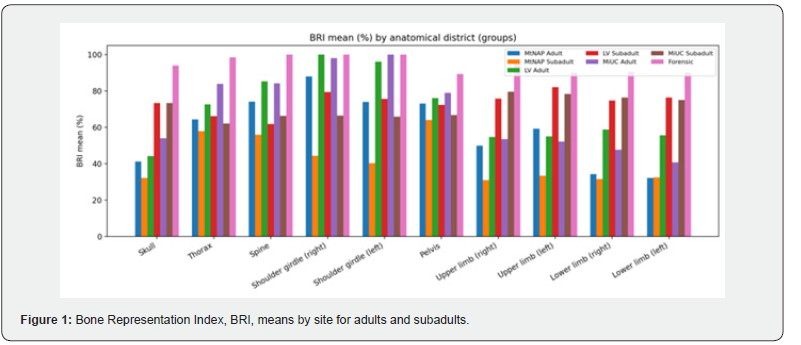
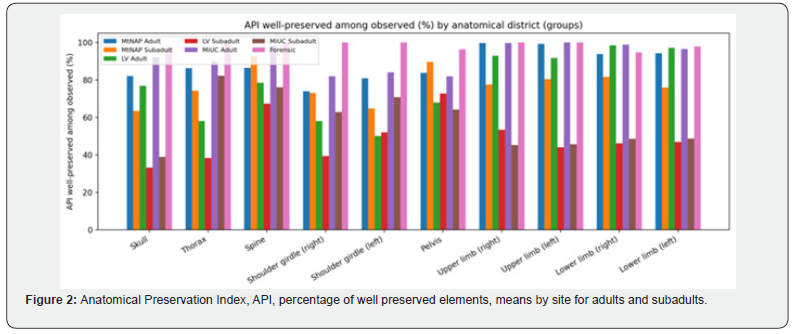
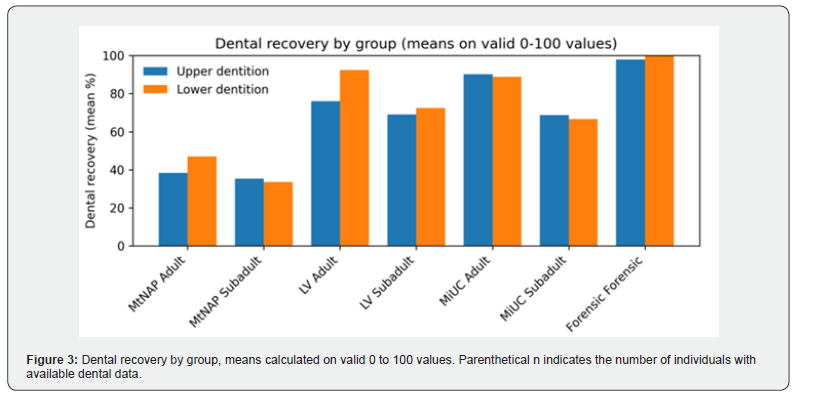
Dental recovery differs markedly by site and age group. Where dental data are available, MiUC shows higher mean recovery than MtNAP, and subadults generally show lower and more variable recovery than adults. Across contexts, reduced representation and recovery concentrate in the skull, dental remains, and limb extremities, regions that include many small elements. This pattern is amplified in subadults, consistent with the vulnerability of small and unfused elements to under recovery and loss.
Discussion
Despite the limitations outlined below, this is, to our knowledge, the first study to compare adult and subadult completeness across multiple recovery settings, including academic field excavation, contract archaeology, rescue excavation, and a forensic series recovered under osteological supervision. The results indicate that incompleteness in cemetery assemblages is not only frequent but also systematically patterned. Across contexts, deficits recur in the cranium and dentition and in distal limb segments, and the magnitude of these losses is consistently greater in subadults. This matters because these regions contain a disproportionate share of information used for juvenile ageing, dental and craniofacial palaeopathology, and the recognition of trauma and activityrelated change.
Representation and preservation capture different problems
A central contribution of this work is the separation of element absence from fragmentation. BRI describes how much of the expected skeleton is represented and therefore captures losses that may result from destruction, dispersal, non-recognition, or non-recovery. API, reported here among observed elements (API_obs), describes the condition of what has been retrieved. In our data, API_obs is generally high even where BRI is moderate or low, indicating that the main constraint in the archaeological assemblages is often element absence rather than severe fragmentation of the elements that were curated. This divergence supports an interpretation in which completeness reflects at least two filters: processes that determine what survives in the ground and processes that determine what is actually recovered and retained.
Burial conditions contribute, but they are unlikely to be the sole driver
Taphonomic and cultural processes influence skeletal survival, including age-at-death-related vulnerability, burial practices, scavenger activity, and local soil and moisture regimes [1,2]. These factors plausibly contribute to between-site variation in absolute completeness. However, the most striking feature of our dataset is the repeated anatomical signature of missingness. Across sites, recurrent deficits involve small and easily dispersed elements and complex craniofacial and dental materials. If burial environment were the dominant driver, one would expect loss to track overall preservation more closely and to affect anatomical districts less selectively. Instead, the pattern is consistent with a superimposed recovery-related component, where small elements are disproportionately lost between exposure, lifting, and post-excavation processing.
Excavation setting and workflow can generate structured loss
The three archaeological contexts differ in operational constraints, and those constraints matter because the recovery of small elements is time- and workflow-dependent. When exposure proceeds rapidly, the opportunity to fully define the grave cut, document the body before removal, and conduct controlled micro-recovery around hands, feet, and craniofacial structures is reduced. Under such conditions, small bones and loose teeth are more likely to be displaced into spoil deposits or remain in the sediment, where later recognition becomes unlikely. Even modest differences in excavation tempo and sediment handling can therefore produce a predictable signature: under-representation of the smallest and most mobile components.
This vulnerability is amplified in juveniles. Subadult skeletons include a higher proportion of small unfused elements and multiple ossification centres, and many informative indicators for age estimation require recovery of dental evidence and epiphyseal or apophyseal centres [3,4]. Consequently, recovery strategies that are not explicitly optimized for the smallest remains will disproportionately reduce subadult representation. The consistently lower subadult BRI values across contexts support this interpretation, and the anatomical distribution of losses reinforces it.
Expertise and recognition are recovery variables
Recovery does not depend on time alone; it also depends on recognition. Small and fragmentary bones are easy to miss or misclassify as stones or building debris, especially under time pressure and when recovery is conducted by personnel with limited osteological training. Even when bone is recognized, incomplete anatomical familiarity can lead to inadvertent loss through recovery sequence, for example by prioritizing the trunk while leaving hands and feet unsupported or by treating loose teeth as incidental rather than as individually informative evidence. This aligns with recommendations that bioarchaeologists should be involved from the earliest stages of recovery to minimize data loss and maximize interpretive value [5,6].
Sediment processing and post-excavation handling as systematic filters
Several steps after exposure can also shape completeness. Screening strategy and mesh size determine whether very small elements and tooth germs can be retained at all, and previous work has shown that these choices measurably affect recovery outcomes for small skeletal components [7,8]. Post-excavation handling introduces further risk. Transport, washing, sorting, and packaging can separate loose teeth and very small bones from their individual association unless dedicated containers and traceable procedures are used throughout. In this sense, recurrent loss of small elements is best understood as a chain of vulnerabilities rather than a single point of failure.
The forensic series as a methodological contrast
The forensic series is not intended as a demographic comparator; its value is methodological. In those cases, completeness is an explicit objective and recovery protocols prioritize small and diagnostically valuable elements, which is reflected in near-ceiling representation and dental recovery. Selective losses can still occur where case-specific factors promote dispersal, such as scavenger activity, or where craniofacial structures are severely fragmented. Even so, the contrast supports a key inference: burial does not inherently preclude the recovery of small and fragile elements. Rather, recoverability is strongly conditioned by protocol intensity, expertise, and time allocation. The implication is not that archaeological projects should replicate forensic workflows wholesale, but that targeted procedures, especially for dentition and distal elements, can plausibly reduce predictable loss.
Implications for bioarchaeological inference
The consequences of structured missingness are direct. Juvenile under-representation can bias cemetery-derived mortality profiles and reduce the precision of subadult age estimation, particularly when dental evidence and ossification centres are preferentially lost [1,3]. Preferential loss of craniofacial and dental elements can reduce the visibility of stress markers and dental pathology [9]. Under-representation of hands and feet can bias the detection and anatomical distribution of trauma and activity-related change, shifting apparent lesion patterns toward regions that are more readily recovered. Together, these effects can make assemblages not simply incomplete, but systematically skewed toward what is easiest to retrieve.
Results hence indicate that first, completeness should be routinely quantified with metrics that separate representation from the condition of recovered elements, because this improves comparability across assemblages and clarifies the interpretive limits of downstream analyses. Second, recovery and processing workflows should explicitly prioritise the element classes most vulnerable to loss, in particular dentition and distal limb elements, and should do so especially for subadults. Operationally, this includes careful micro-recovery of extremities, dedicated collection of loose teeth and tooth germs, systematic screening where feasible, and the involvement of osteological expertise during excavation and early processing to reduce misidentification and inadvertent discard [5-8].
A limitation of this study is the absence of a dedicated cortical surface integrity score, which prevented evaluation of the qualitative component of preservation described by Bello et al. [1]. Interpretations of preservation mechanisms are therefore necessary and focus on representation and preserved quantity. Nevertheless, the repeated anatomical signature of missingness and the divergence between BRI and API_obs support the conclusion that recovery and post-excavation processes are plausible contributors to observed patterns and should be considered explicitly when interpreting cemetery assemblages.
Conclusion
It is widely assumed in archaeology that skeletal recovery varies across excavation settings and that the absence of onsite osteological expertise may increase loss, but the magnitude and anatomical structure of this risk are rarely quantified. This study addresses that gap by providing a comparative, metricbased assessment of skeletal completeness in a Northern Italian context, integrating adult and subadult assemblages from three cemetery settings representing academic field excavation, contract archaeology, and rescue excavation, and contrasting these outcomes with a forensic recovery series conducted under osteologist supervision.
Our results show that incompleteness in burial assemblages is not random. Representation and preservation display clear age-related and anatomical patterning. Subadults are consistently under-represented relative to adults, and missingness repeatedly concentrates in the cranium and dentition and in the distal segments of the limbs, the very regions that carry high diagnostic value for palaeodemography, juvenile age estimation, and the reconstruction of disease, stress, and trauma. Importantly, preservation among recovered elements is generally high, indicating that the main limitation in the archaeological assemblages is often element absence rather than extensive fragmentation of what is retrieved. The near-ceiling completeness observed in the forensic series further supports the interpretation that a substantial component of missingness can reflect recovery and post-excavation filters, particularly for small and easily dispersed elements.
Beyond supporting precedent data and contributing new data on adult and subadult assemblages, this work is distinctive in offering a structured comparison across recovery “assets” that are highly relevant to the Italian archaeological system, where excavations frequently occur under time and logistical constraints and where routine osteological supervision during recovery is not consistently implemented. In this setting, quantifying completeness becomes essential: it makes biases explicit, enables more transparent comparisons between sites, and clarifies the limits of downstream interpretation. Routine reporting of representation and preservation metrics, combined with targeted recovery and handling protocols that prioritize dentition and small distal elements and that include osteological expertise during recovery whenever feasible, would substantially improve the reliability and comparability of bioarchaeological inference in Italy and in similar operational contexts.
References
- Manifold BM (2015) Skeletal preservation of children's remains in the archaeological record. Homo 66(6): 520-548.
- Scheuer L, Black S (2000) Developmental Juvenile Osteology. London: Academic Press.
- Scheuer L, Black S, Schaefer M (2008) Juvenile Osteology: A Laboratory and Field Manual. London: Academic Press.
- Khokhlov VD (1997) Injuries to the hyoid bone and laryngeal cartilages: effectiveness of different methods of medico-legal investigation. Forensic Sci Int 88(3): 173-183.
- Bello SM, Thomann A, Signoli M, Dutour O, Andrews P (2006) Age and sex bias in the reconstruction of past population structures. Am J Phys Anthropol 129(1): 24-38.
- Haglund WD, Sorg MH (2002) Advances in Forensic Taphonomy: Method, Theory, and Archaeological Perspectives. In: Boca Raton (FL) (Ed.), CRC Press.
- Merbs CF (1996) Reference details need verification; please supply full bibliographic information for the Merbs 1996 citation used in the manuscript.
- Roberts C (2009) Human Remains in Archaeology: A Handbook. York: Council for British Archaeology.
- O’Meara J (2013) Reference details need verification; please supply full bibliographic information for the O’Meara 2013 citation used in the manuscript.
- Shaffer BS (1992) Quarter-Inch Screening: Understanding Biases in Recovery of Vertebrate Faunal Remains. Am Antiquity 57(1): 129-136.
- Shaffer BS (1994) Comparison of 1/8″- and 1/4″-Mesh Recovery of Controlled Samples of Small-to-Medium-Sized Mammals. Am Antiquity 59(3): 525-530.
- Mays S, Vincent S, Campbell G (2012) The value of sieving of grave soil in the recovery of human remains: an experimental study of poorly preserved archaeological inhumations. J Archaeol Sci 39(10): 3248-3254.
- Pokines JT, De La Paz JS (2016) Recovering a Late-Term Fetus in a Forensic Context: A Case Study in the Impact of Screening. J Forensic Sci 61(S1): S254-S257.
- Sannazaro M (ed.). (2001) The Late Antique Necropolis: Archaeological Research in the Courtyards of the Catholic University. Proceedings of the Study Days, Milan, 1999.
- Lodi Vecchio (LO), via Fregoni (Campo San Michele) – Indagini archeologiche 2007–08” a firma S. Jorio, G. Ridolfi.
- Mattia M, Piccolo E, Poppa P, Cattaneo C (2012–2013) Studio antropologico e patologico sugli scheletri rinvenuti nello scavo di via Monte Napoleone. Notiziario della Soprintendenza per i Beni Archeologici della Lombardia (NSAL), 2012–2013.

























