




 GJAA Home



Study of Pigments of The Icon of Saint John (1674)” Work of The Painter Agorastos in Skopelos
Stavroula Nakou1, Ioannis Varalis2, Panagiota G Fragouli1, Theodore Ganetsos1, Vasiliki Kalamari3 and Costas Brachos1
1University of West Attica, Industrial Design & Production Engineering, P. Ralli & Thivon 250, Egaleo, Greece
2University o Thessaly, Department of History, Archaeology and Social Anthropology, Volos, Greece
3EPAL High School, Alexandroupolis, Greece
Submission:January 24, 2026; Published:February 02, 2026
*Corresponding author: Theodore Ganetsos, University of West Attica, Industrial Design & Production Engineering, P. Ralli & Thivon 250, Egaleo,Greece
How to cite this article:Stavroula N, Ioannis V, Panagiota G F, Theodore G, Vasiliki K, et al. Study of Pigments of The Icon of Saint John (1674)” Work of The Painter Agorastos in Skopelos. Glob J Arch & Anthropol. 2026; 14(3): 555895.DOI: 10.19080/GJAA.2026.14.555895
Abstract
The present study focuses on the analysis of the pigments of the icon of Saint John with scenes from his life (1674). The icon is a work of the Cretan hagiographer Antonios Agorastos and is housed in the Church of Saint John in Skopelos.
The analysis of the pigments was carried out using non-destructive Raman and XRF spectroscopy techniques. Using the Thunder Optics - Gem Raman System and the Niton XLp 818 spectrometer, inorganic pigments such as: lead white, azurite, verdigris, iron ochre, cinnabar and realgar were identified. The analysis was supported by the Spectragryph software.
The combined Raman and XRF techniques provided valuable information on the composition of the pigments. The study was carried out with the support of the Ephorate of Antiquities of Magnesia and the Holy Metropolis of Chalkida, following the regulatory provisions of the Ministry of Culture.
Keywords: Iconography; Pigment analysis; Post-Byzantine painting; Agorastos of Skopelos; 17th century Greek Icons
Introduction
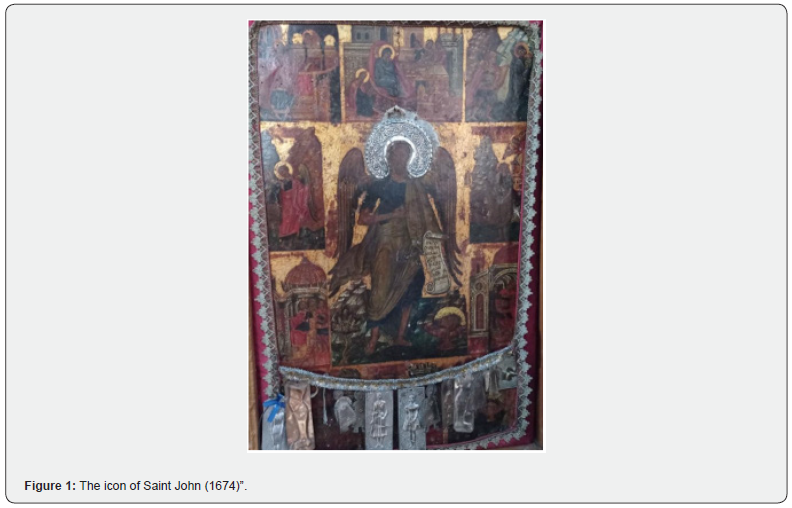
The present study focuses on the analysis of the pigments of a post-Byzantine icon of Saint John with scenes from his life (1674). The icons are the work of the Cretan hagiographer Antonios Agorastos and are housed in the Church of Saint John in Skopelos. Saint John with Scenes from His Life (1674) is an icon presented in the Church of Saint John of Molos in Skopelos. It is placed on the iconostasis, to the left of the Beautiful Gate, and exclusively the pigments were analyzed.
The icon depicts Saint John as the central figure (Figure 1), surrounded by ten scenes describing events from the life of the Baptist. In the central theme, the saint is depicted facing forward, wearing a silver-plated halo. With his right hand he gives a blessing, while with his left he holds an open scroll. His clothing includes a blue hairy garment with sleeves and an olive cloak. The background of the icon is gold.
In the upper zone of the icon, the Annunciation of Zechariah, the Birth of the Forerunner and the Flight of Elizabeth into the desert are depicted. Then, to the left of the central theme, Saint John is shown being guided by an angel into the desert, while to the right, John is depicted baptizing in the Jordan, preaching a baptism of repentance.
In the lower zone, the Finding of the Head of the Forerunner, the Beheading of the Righteous Head of Saint John, and the second finding of the Prophet’s head are depicted.
The icon bears the inscription Saint John the Forerunner. In one of the scenes depicting the beheading, there is the signature Hand of Anthony of Agoras of Crete, referring to the creator of the icon (Figure 2). (Tr. Papazisis, Hagiographers of the 16th - 18th centuries in Tyrnavos and its province. Votokopoulos 1990 1 no.1 Saint John the Baptist).
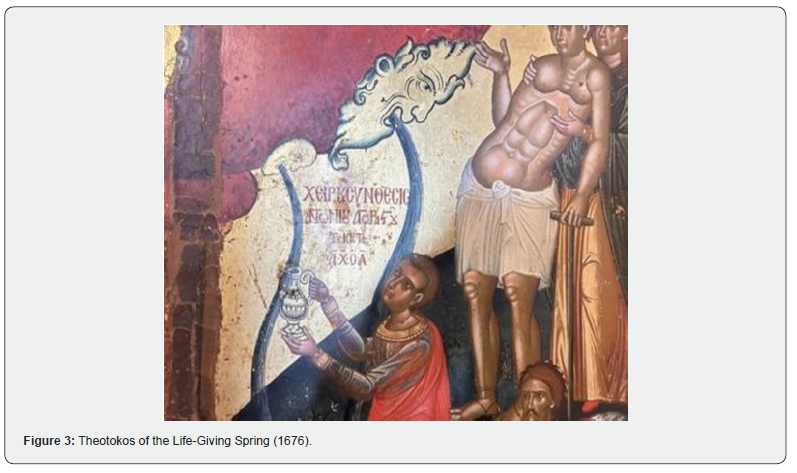
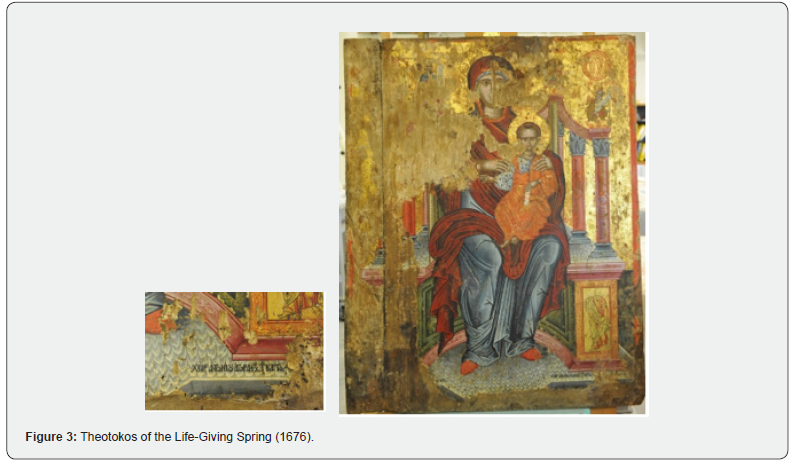
Theotokos of the Life-Giving Spring (1676) Icon of the Life- Giving Spring (2.05x1.05m.) in the catholicon of the monastery of Livadiotissa in Skopelos, also called Panagia Livadiotissa. On this, Agorastos signs in a different way. Hand and composition of Antonios Agorastos, Judge of the AXOs (Figure 3).

Conservation work
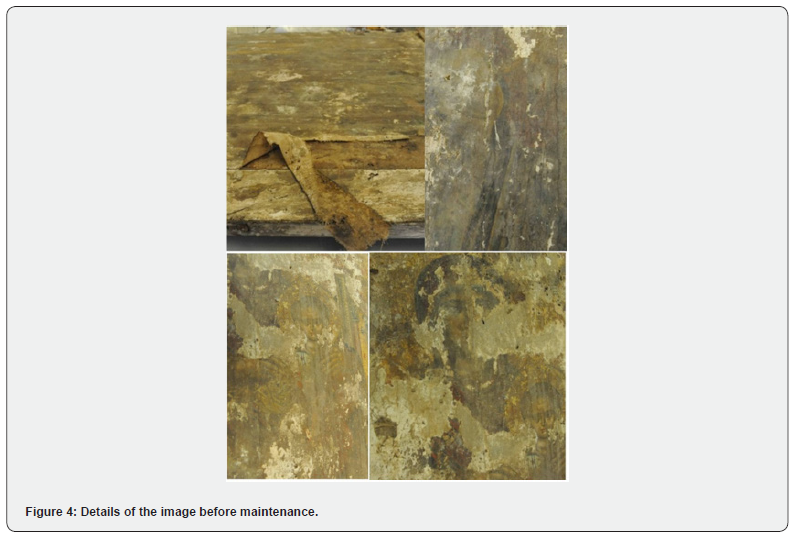
Apart from Skopelos, the painter’s works adorn iconostasis in the Tyrnavos region, specifically in the churches of Agios Georgios and Agioi Anargyroi. The icon of the Theotokos Enthroned and Holding the Child (1687) from the Church of Agios Georgios in Tyrnavos. The icons showed severe damage, such as loss of surface paint, cracks in the wooden substrates, the effect of wood-eating insects and damage from oxidized varnish. The conservation work included fixing the paint layer with acrylic emulsions, disinfestation using an anoxic method, aesthetic restoration with watercolors and the application of new varnish. The surface deposits and oxidized varnish were removed mechanically and chemically, revealing the original painting (Figure 4).
The project highlighted the complexity of the conservation of historical objects and the importance of an interdisciplinary approach. The combined Raman and XRF techniques provided valuable information on the composition of the pigments, while the conservation procedures ensured the stability and aesthetic integrity of the icons. The contribution of scientific and artistic methods highlights the possibility of highlighting cultural heritage through conservation.
The study was carried out with the support of the Ephorate of Antiquities of Larissa and the Holy Metropolis of Larissa and Tyrnavos, following the regulatory provisions of the Ministry of Culture (Figure 5).
Experimental Results and Discussion
Why analyse pigments? The analysis of pigments used on manuscripts is of major significance. It provides information on the materials used in the making of the object. It is necessary before conservation treatments. It can provided information for authenticated and dating objects.
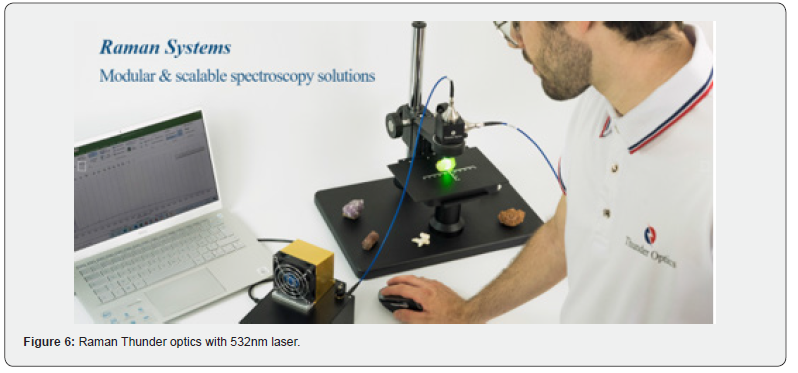
Using Raman spectroscopy, by varying the frequency of the radiation, a spectrum can be produced, showing the intensity of the exiting radiation for each frequency. This spectrum will show which frequencies of radiation have been absorbed by the molecule to raise it to higher vibrational energy states. When Light hits a sample, It is Excited, and is forced to vibrate and move. It is these vibrations which we are measuring (Figure 6).
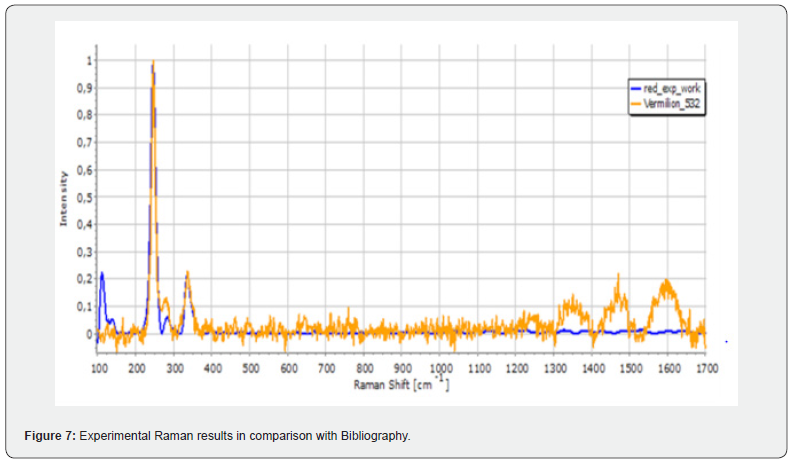
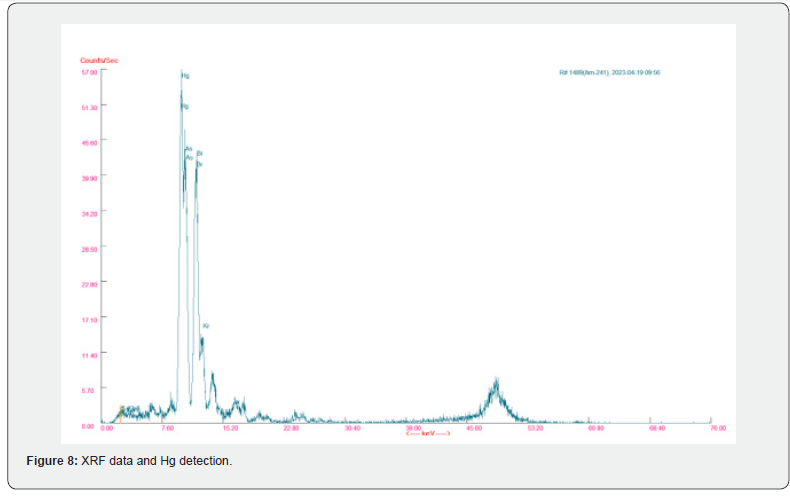
For the measurements of the pigments in the images, the
following were used: a) Raman spectroscopy Thunder Optics -
Gem Raman System with 532nm laser excitation, while before
identification, the spectra were subjected to a process such as
baseline correction, Savitzky - Golay smoothing - normalization
and b) the XRF technique Niton XLp 818 spectrometer with a 241
Αm excitation source. The analysis of the Raman and XRF spectra
was carried out with the help of the Spectragryph software
(Figures 7 & 8). The identification of the pigments using the
two complementary techniques revealed the use of a variety of
inorganic pigments such as:
i. lead white,
ii. copper green (verdigris),
iii. copper blue (azurite),
iv. for yellow (realgar),
v. iron ochres (red and yellow),
vi. cinnabar for the red color.
Conclusion
Pigment identification in cultural heritage relies on the complementary strengths of Raman and X-ray Fluorescence (XRF) spectroscopies to determine both molecular structure and elemental composition non-destructively. In this research article we present the identified pigments in an icon, work of the Cretan hagiographer Antonios Agorastos and is housed in the Church of Saint John in Skopelos.
References
- Doumas D (2010) Reconstructing the Image: A Discussion on the Effectiveness of Restoration Methods for Painted Surfaces. Theory and Practice at the Benaki Museum. Conservation Department, Mouseio Benaki 10: 84-89.
- Hermens E (2012) Technical Art History: The Synergy of Art, Conservation and Science. In: Rampley M et al. (eds.), Art History and Visual Studies. Chapter: Technical Art History: The Synergy of Art, Conservation and Publisher: Brill Leiden & Boston Editors, pp.151-166.
- Lycke S A, Vandenabeele A, Rousaki A, Bottura-Scardina S, Miguel C, et al. (2023) TECHNART2023.
- Menges F (2020) Spectragryph – Οptical Spectroscopy Software, version 1.2.15.
- Milanou Κ (2010) A Thirteenth-Century Icon of the Virgin and Child in the Benaki Museum: Observations on its Technique and Restoration, Mouseio Benaki, 10, p. 53-66
- Lazidou D, Drosaki D (2008) Icons conservation manual, National Museum of Medieval Art of Koritsa, Museum of Thessaloniki, p. 293-379.
- Sdrolia S (1991) The post-Byzantine temples of Tyrnavos. Proceedings of the 1st Tyrnavos Conference, Studies, Tyrnavos.
- Katsantoni Meropi, Ganetsos Theodore, Theologos Alexandrakis & Panagiotis Douros (2023) Pigments Identification: Comparative Examination of Materials and Techniques in The Hermitage Ascension in Pythion of Olympus, Greece. International Journal of Research in Education Humanities and Commerce. 4(3): 235-241.
- MC Caggiani, Cosentino A, Mangone A (2016) Pigments Checker version 3.0, a handy set for conservation scientists: A free online Raman spectra database. Microchemical Journal 129: 123-132.

























