




 GJAA Home



Archaeological Landscape Perceptions: Gruta Do Diogo 2 Archaeological Site, Serranópolis, Brazil
Julio Cezar Rubin de Rubin*
Professor, Goiano Institute of Prehistory and Anthropology, Pontifical Catholic University of Goiás, Brazil
Submission:December 01, 2025; Published:December 09, 2025
*Corresponding author:Professor, Goiano Institute of Prehistory and Anthropology, Pontifical Catholic University of Goiás, University Avenue 1440, Zip Code: 74605-080, Goiânia, Goiás, Brazil
How to cite this article:Julio Cezar Rubin de Rubin. Archaeological Landscape Perceptions: Gruta Do Diogo 2 Archaeological Site, Serranópolis, Brazil. Glob J Arch & Anthropol. 2025; 14(3): 555892.DOI: 10.19080/GJAA.2025.14.555892
Short Communication
Landscapes have taken up my time and thoughts over recent years. I will not discuss the multiple definitions adopted by authors from different fields or even from different theoretical schools of thought in archaeology. Nor will I approach the theme from the perspective of geoarchaeology or landscape archaeology. My goal is to engage in some free reflection, considering the landscape as an artifact, a product of human action, where natural processes with specific intensities and characteristics have acted and continue to act in different ways depending on the region, period or geological era.
This free reflection has already been cited in some articles in which I have participated, but not as clearly as here. This interaction or immersion in the landscape has brought to light what I have been considering landscape secrets. But what are landscape secrets? I have often said that with a good grounding in geosciences it is possible to approach the landscape in relation to what happened, what is happening and what might happen.
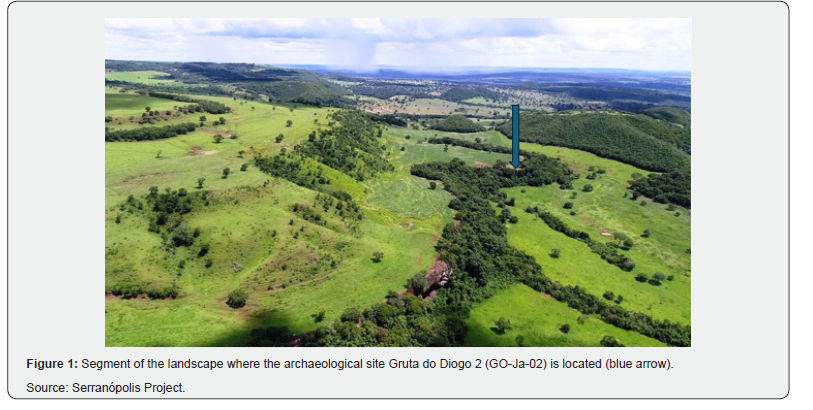
To this end, I immerse myself in reflections related to research at the pre-colonial archaeological site Gruta do Diogo 2 (GO-Ja-02), a sandstone rock shelter excavated in the 1980s by the team coordinated by Dr. Pedro Ignácio Schmitz and reopened in 2021 (Figure 1).
But what does this mean? It means that with these questions it is possible to contextualize the temporality, natural processes and human action involved in a landscape.
And the secrets? These involve a set of natural processes and human actions that I do not identify or recognize in the landscape. Yet, if I do not recognize them, what is the problem? Is there a problem? Let us see: If I consider that this silence may contain relevant information, yes! So, this secret instigates me, sharpens my inquisitiveness.
According to Ferreira [1], a secret is “that which cannot be revealed; secrecy”. A Google search, so common today, reveals that it is “that which is most hidden; that which is hidden from view and knowledge”. In his 2022 book “The Secret Life of Secrets”, psychologist Michael Slepian looks into the consequences that the act of keeping secrets has on people’s mental health. This is not the case discussed here; on the contrary, when I am instigated, I feel challenged (Figures 2).
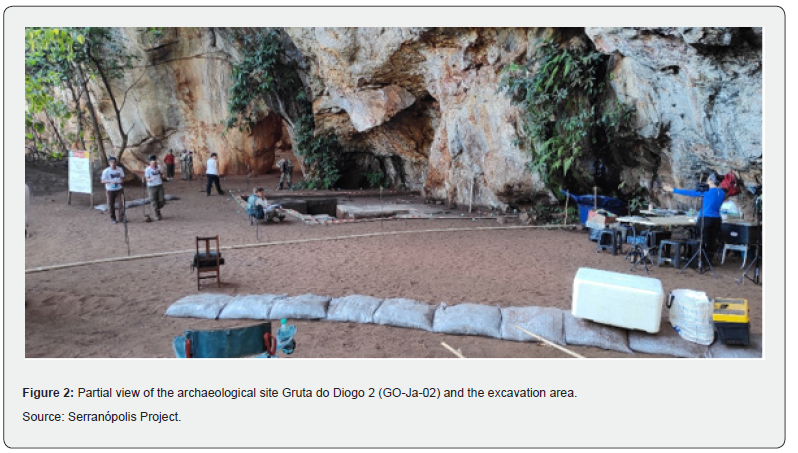
For example, every day I spend at the GO-Ja-02 archaeological site, awakens multiple sensations. I ask myself: what am I missing? What am I not able to see? I ponder: how is this landscape involving me? How much is it instigating my observations and perceptions?
As the days go by, I feel that the landscape exerts an influence on my sensations, on my body, based on the different sounds, odors, luminosity, air currents, temperature, and even the position of the sun and moon, for example. The landscape becomes a living element and with it I establish a relationship of exchange, interaction, and complicity, where I search for its secrets, those that it keeps under lock and key, which I seek to uncover.
Do I really wish to know? Do I need to? These secrets move me capriciously along a path of reflections where I invariably find myself going over other moments of my life, sometimes within the same landscape. I am no longer the same person who was here the first time, thank goodness!
But in this relationship, trust is a dangerous element. I can find myself imprisoned and enchanted by my hypotheses and conclusions and, as a consequence, hinder, impede or harm the full relationship with the landscape. The walk from the Bela Vista stream to the farm, a route of approximately 800m, amid pastureland and a few heads of cattle, is a world of pure sensation, where the sound of silence commands the interaction. The same thing happens when traveling from the headquarters of Fazenda Maria Barbara to the farm, where the compartmentalization of the relief highlights an emblematic landscape with rivers, slopes, testimonial hills, fauna, flora, sounds and, mainly, possible interaction to a certain extent.
When you arrive in a new landscape, the unknown brings with it fear, insecurity, worries and concerns. After all, how can you fit yourself into this living element? How can you relate to it? As time goes by, these issues are minimized, confidence arises and increases with notes, photos, observations and knowledge. Something that is misleading in my case!
Secrets, the search for them, the disquiet and hypotheses are the basis of involvement, of feeling not an integral part of the landscape, yet as my body and the landscape merge, I breathe with it, I feel its scars, the signatures of different human groups that have interacted with it, its nuances are present in my body. When I look at a certain place, it is as if it were looking at myself.
I feel the air currents, the aromas, the sounds, I feel the geochemical processes. When I want to interact in a more introspective way, I close my eyes and let the landscape speak. And it does in a poetic, soft and calm way, even on stormy days, despite the way it is being treated. Some of its cries for help are visible, they are wide open. However, others are within the universe of secrets. This is when I imagine human groups of hunter-gatherers, farmer-ceramists, and possibly Oriental Bororo and Southern Kayapó building landscapes, moving around, interacting with them, leaving their signatures, some visible and others not so, imbeding themselves into the secrets!
But why am I writing from this perspective? Is this the result of a long period of research? An attempt to create a counterpoint to the self in a not-so-distant past? To reach the new generations of archaeologists? Who knows, perhaps to encourage a series of authors to walk with me through the landscape, or even the commitment to write about the past from the viewpoint of the present and see the people in it? (Figure 3)
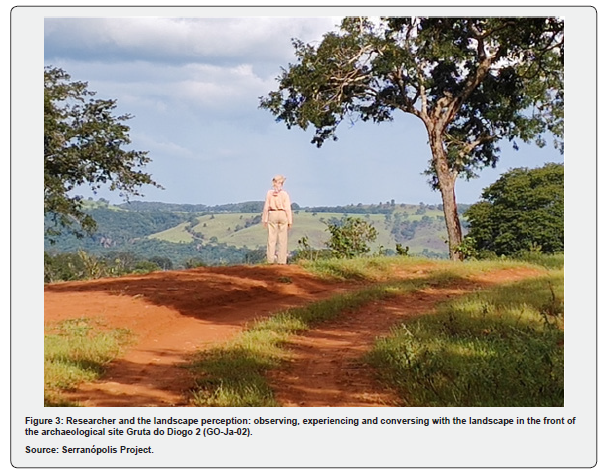
Perhaps a little of everything. Certainly, people, landscapes, theories, investigations, the GO-Ja-02 site, the Serranópolis Archaeological Complex and freedom of thought result in a challenging, simple, complex, poetic, engaging, lively and dynamic context. I could mention a hundred adjectives.
Perhaps the best and most comprehensive is “exuberant”, in which all adjectives can be included, while still capable of daily challenging the researcher!
References
- Ferreira ABH (1999) Aurélio século XXI: o dicionário da língua portuguesa. 3rd Rev. and ampl. Nova Fronteira, Brazil.

























