



 GJAA Home



Shape and Sexual Dimorphism of Canines in New World Monkeys Words : Canine Outline, Shape Dimorphism, Social Structure, Food Nature New World Monkeys
Hiroyuki Yamada*
Department of Oral Anatomy, School of Dentistry, Aichi-Gakuin University, Nagoya, Japan
Submission: September 23, 2025; Published: September 30, 2025
*Corresponding author: Hiroyuki Yamada, Department of Oral Anatomy, School of Dentistry, Aichi-Gakuin University, Nagoya, Japan
How to cite this article:Hiroyuki Yamada. Shape and Sexual Dimorphism of Canines in New World Monkeys Words : Canine Outline, Shape Dimorphism, Social Structure, Food Nature New World Monkeys. Glob J Arch & Anthropol. 2025; 14(3): 555890. DOI: 10.19080/GJAA.2025.14.555890
Abstract
The outline of the upper and lower canines and their sexual dimorphism were compared among phylogenies for many extant New World monkeys. The shape of the upper canines in male New World monkeys consisted of two main shape types. The first was dagger-shaped. The second type was hook-shaped, which was primarily found in leaf-eating monkeys, such as Alouatta and Brachyteles. The dagger-shaped comprised three subtypes. One was common and ideal for eating ripe fruit, such as Ateles. Another example is the chisel-shaped canines of Pithecia, or the trigonal pyramid-shaped canines of Chiropotes, perfect for crushing hard seeds. The third had rounded, slanted tips suited to extracting gum like Callicebus and Callithrix. Sexual dimorphism in size and shape of canines was evident in both polygynous and monogamous species. However, this relationship was not observed in the following six species: Callicebus moloch, Callithrix jacchus, Sapajus apella, Saimiri sciureus, Saimiri boliviensis and Ateles geoffroyi. The deciduous canines in shape resembled an equilateral triangle, except for those of Pithecia monachus. The outline of the lower canines in males varied from a distorted triangle to a distorted hexagon, depending on the position of the mesial tubercle and the degree of development of the heel-shaped protrusions. The differences in shape between species were minor.
Keywords: Social Structure; Dimorphism; Morphology; Paleontology; Human Behavior; Anthropology
Introduction
The morphology of teeth is strongly influenced by genetics and closely reflects phylogenetic ancestry. In particular, the role of canines in primate evolution is clear, in regards to both phylogeny and sexual dimorphism [1]. In general, male canines are significantly larger than female canines and have played an important part in sex determination in paleontology, and there are numerous reports on canine size [2-9]. However, few studies have examined canine shape [10-12]. This is probably because canine teeth are conical and little characteristics that can be used to describe their morphology. It is also difficult to express changes in their outline and it has been believed that there is little variation in shape.
Nevertheless, a detailed examination of canine morphology revealed subtle differences that cannot be distinguished by conventional quantitative analyses such as mesiodistal and buccolingual crown diameters [1, 11-13]. For example, there are reports of several primates whose canines have changed in response to their lifestyle [3, 14-16]. The saki in the Pitheciidae has a chisel-shaped tooth, the gibbon in the Hominoidea has a sabre-shaped tooth, and the great apes in the Hominidae have a wide-based, tall, triangular tooth [3, 14-19]. The shape of the canines of primates is thought to be closely related to their evolutionary history [3]. However, it is not easy to describe the outline and degree of their differentiation. One possible method of analysing sexual dimorphism in canine shape is to classify the degree of similarity in four categories: none, slight, moderate or strong. However, this method is subjective and lacks objectivity.
This study aimed to confirm the shape of canines using real examples, investigate the factors that influence their shape, and clarify the relationship with diet, social structure, lineage, and canine shape and sex dimorphism.
Materials and Methods
The materials used in this study consisted of five families: Pitheciidae, Atelidae, Cebidae, Callitrichidae, and Aotidae. The skull specimens were housed in the collections of the Japan Monkey Center (JMC), Department of Natural Anthropology, Faculty of Science, Kyoto University, and Center for the Evolutionary Origins of Human Behavior, Kyoto University (EHUB). The canines were photographed from the lingual aspect with the camera set so that its optical axis was perpendicular to the canine coronal axis. After taking impressions with silicone dental impression material (Provil: Heraeus Kulzer GmbH), plaster models were made and photographed using the same method.
The mesiodistal crown diameter (MD) of the upper canine teeth is a measurement of the distance between the most mesial and the most distal points on a line drawn parallel to the crown axis. The labiolingual tooth diameter (LL) is the greatest measurement between labial and lingual aspects of the tooth crown on a line perpendicular to mesiodistal diameter. The lower canine is the maximum distance on a long tooth crown axis in the crown crosssection as mesiodistal diameter, and the maximum distance on a short axis as labiolingual diameter on a line perpendicular to mesiodistal diameter. The size of the canines was expressed as the canine area which was calculated (MD×LL). The size dimorphism was exhibited using the average value in males divided by the average value in females. These values were then divided into four categories: 1. None: 1.00–1.09; 2. Small: 1.10–1.19; 3. Moderate: 1.20–1.29; and Large: 1.30 or higher. The average values for the canines of New World monkeys (MD and LL) were taken from the data sources [1, 13, 20-21]. The area values were classified as follows: The size is categorised as follows: less than 10.0 mm² is small, between 10.0 and 20.0 mm² is medium, and greater than 20.0 mm² is large. The dimorphism of the outline was determined in detail by observing photographs of individuals of both sexes. The categories were as follows: none, slight, moderate, and strong.
The lingual outline of the upper canine consists of five components: the mesial and distal crests, the mesial and distal marginal ridges, and the cervical ridge [22]. The shape of the crown was estimated based on these components. Previous studies have examined the outline of the crown from the occlusal surface using the crown index, a simple ratio of MD to LL [1, 6-7, 10, 23]. However, this value only indicates whether the crown outline is longer vertically or horizontally; it does not reflect actual shape.
One way to analyse morphology in detail is to analyse it numerically in three dimensions. But this method takes a long time when investigating a large number of individuals. The present approach enables detailed descriptions to be based on observation. Unfortunately, it is subjective and lacks objectivity. To avoid this problem, the shape of the teeth was described as accurately as possible using specific examples. Concrete expressions such as “chisel-like shape”, “dagger-like shape”, “hook shape”, “half spindle shape” and “spatula shape” were used.
The primate classification was based on the JMC and the EHUB [24], as well as Fleagle (2013) [25]. Sex identification was determined using records from the research institution. The social structure of New World monkeys was based on the previous research [25-27].
Results
Upper canine
Pitheciidae
Pithecia
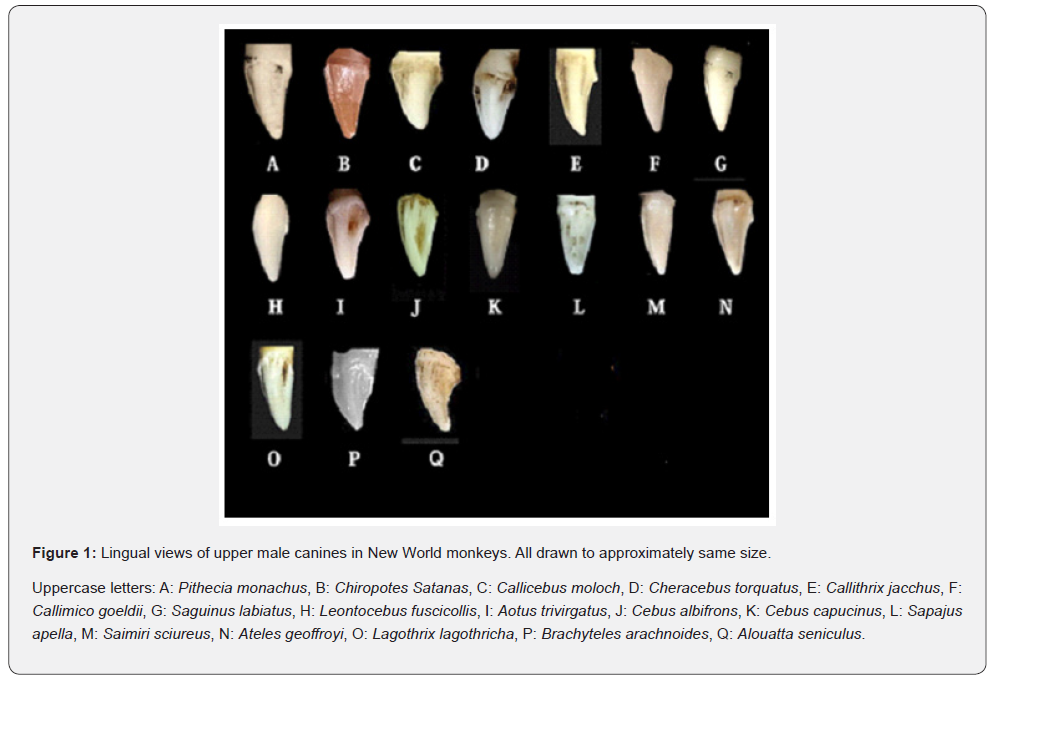
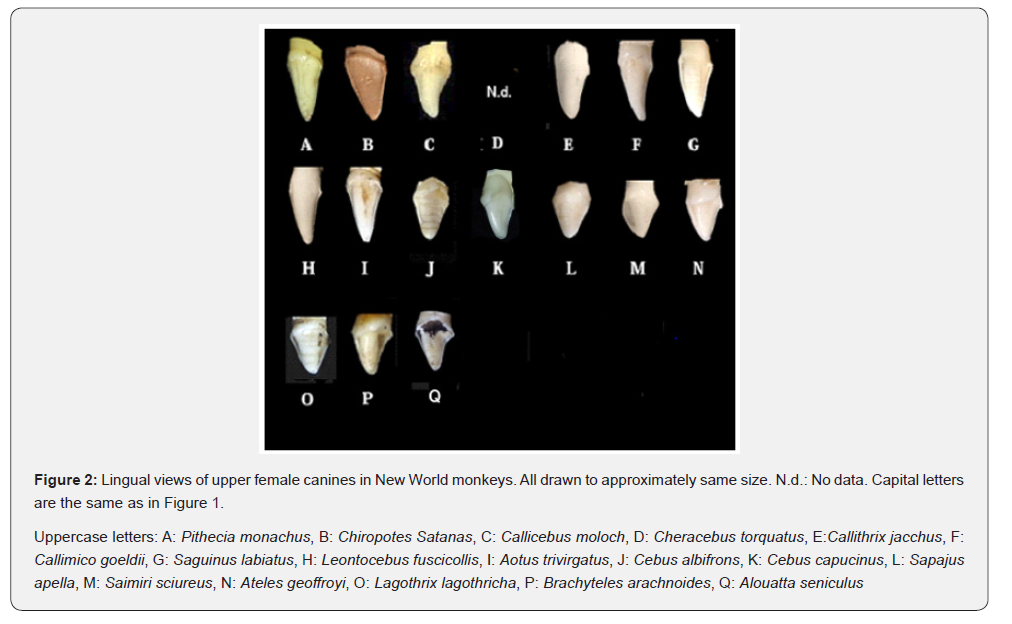
The upper canine teeth of the male Pithecia monachus (Figure 1-A) had well-developed labial, mesial, and lingual ridges, giving them an overall chisel-like shape. The distal crest was as sharp and pointed as a knife blade. From a lingual view, the mesial groove was interrupted by the marginal ridge, and the cervical ridge was moderately swollen. The mesial tubercle, also known as the style or shoulder, was slightly projected, and the distal tubercle was slightly developed. The canines were large in size. The female (Figure 2-A) was very similar in shape to the male. However, the cervical ridge was more well-developed than in the male. The cross- section was orbicular. Shape dimorphism in canines was slight.
Chiropotes
As a whole, the canines of the male Chiropotes satanas had a trigonal pyramid-shaped canines. The crown was curved distally. The distal crest was as sharp and pointed as a knife blade (Figure 1-B). The distal crest was concave. The cervical ridge was moderately developed and surrounded the cervical region. The cross-section was elliptical. The canines were large in size. The female canines (Figure 2-B) were almost identical to those of the males. There was no shape dimorphism.
Callitrichidae
Callicebus
The male Callicebus moloch (Figure 1-C) had dagger-shaped canines with rounded tips that sloped distally, as well as a loosely concave distal crest. The mesial and distal tubercles both projected slightly outward. The distal tubercle was located further apically. The basal cross-section was elliptical in the mesiodistal direction. It was small for a canine. The female (Figure 2-C) had dagger-shaped teeth and a slender appearance. The mesial tubercle projected strongly outward. The cervical ridge was well developed and swollen. The cross-section was almost circular. There was slight shape dimorphism.
Cheracebus
The canines of the male Cheracebus torquatus (Figure 1-D) were dagger-shaped, with a concave distal crest. The mesial groove was interrupted by the mesial marginal ridge. The width of the cervical ridge was about one-third of the crown height. The distal tubercles were mildly elevated. The cross-section was elliptical in a labiolingual direction. The canines were small in size.
Callithrix
The outline of the male Callithrix jacchus (Figure 1-E) was dagger-shaped. The tips of the canines were curved distally and the distal crests were moderately concave. The deep mesial groove was interrupted by the marginal ridge. The lingual ridge was well-developed. The distostyle was nodular and piercing, and located more apically than the mesial one. The cross-section was triangular. The canines were small in size. Females (Figure 2-E) had a similar shape to males but were rounder overall. The distostyle was slightly smaller than in the male. The cervical ridge was more prominent. The cross-section was triangular. Moderate sexual dimorphism was present in shape.
Callimico
The Callimico goeldii (Figure 1-F) had a dagger-shaped tooth with a crown that sloped distally. The mesial and distal crests were straight. The mesial and distal tubercles were moderately nodular. The distal tubercle was positioned closer to the apex than the mesial one. The size of the canines was small. The female (Figure 2-F) was fairly similar in shape to the male. Sexual dimorphism in shape was rarely observed.
Saguinus
The outline of the male Saguinus labiatus was a broad and dagger-shaped (Figure 1-G). The mesial crest was loosely convex, while the distal was straight. The lingual ridge was well-developed. The distal tubercle was nodular and projected moderately, being located more apically than the mesial. It was small in canine size. Females had a similar shape to males but were rounder overall (Figure 2-G). There was no sexual dimorphism in the outline.
Leontocebus
The canines of both sexes of the Leontocebus fuscicollis were found to be very similar in size and shape to those of Saguinus labiatus (Figures 1,2-H). The female had a slender shape and a more prominent distal tubercle than the male. The canine was small in size. There was no sexual dimorphism in the outline.
Aotidae
Aotus
The male Aotus trivirgatus had a dagger-shaped canines (Figure 1-I). The distal crest was slightly concave. The distal tubercle was moderately swollen and positioned further apically than mesial. The deep mesial groove was interrupted by the marginal ridge. The cervical ridge was quite swollen. It was small in canine size. The females were also very similar in shape to the males (Figure 2-I). The cervical ridge was more developed than in males. There was no sexual dimorphism in shape.
Cebidae
Cebus
The male Cebus albifrons had a dagger-shaped tooth (Figure 1-J). The distal tubercle was slightly developed. Both the mesial and distal crests were slightly convex. The deep mesial groove was interrupted by the mesial marginal ridge. The cervical ridge showed little bulging and was thin. The canine tooth was large. The female (Figure 2-J) was shaped like a distorted rhombus or pentagon. It had a deep mesial groove. The distal tubercle was moderately developed and located more apically. The cervical ridge was more pronounced, with moderate sexual dimorphism observed in the outline.
Sapajus
The outline of the canines of the male Sapajus apella was dagger-shaped (Figure 1-L). The mesial and distal crests were slightly convex. The cross-section was triangular. The distal tubercle bulged mildly and was located more apically. The canines were large. The female canines were similar in shape to those of Cebus albifrons, and rounded overall (Figure 2-L). Moderate dimorphism in shape was observed.
Saimiri
The male Saimiri sciureus had dagger-shaped canines with gently curved crowns. The mesial and distal tubercles were not particularly pronounced. The cervical ridge developed mildly. The canine was of medium size. The deep mesial groove was not interrupted by the marginal ridge. The cross-section was heartshaped (Figure 1-M). The female was either a distorted pentagon or a distorted rhombus with a slightly concave distal crest (Figure 2-M). The distal tubercle protruded strongly. There was strong sexual dimorphism in shape. The basal cross-section was elliptical in the mesiodistal direction.
Atelidae
Ateles
Ateles geoffroyi (Figure 1-N) had a dagger-shaped outline with a loosely concave distal crest. The distal tubercle was moderately projected and located more apically than the mesial. The cross-section was triangular. The canines were large in size. The female (Figure 2-N) was slightly equilateral triangle in shape. The cervical ridge sloped downwards at an angle. The crosssection was triangular. Overall, the morphology was rounded. The distal tubercle projected strongly and a wedge-shaped notch was observed between the distal marginal ridge and the cervical ridge. There was strong sexual dimorphism in shape.
Lagothrix
The male Lagothrix lagothricha (Figure 1-O) was tall and sturdy with a dagger-like shape. Its mesial groove was deep and interrupted by the marginal ridge. The lingual ridge was wide and well-developed. The distal tubercle was slightly swollen. The basal cross-section was elliptical in a mesiodistal direction. The canines were large. The female (Figure 2-O) was short and stout, resembling an equilateral triangle. It had a more developed cervical ridge than the male. The basal cross-section was elliptical labiolingually. There was moderate sexual dimorphism.
Brachyteles
The outline of the male Brachyteles arachnoides resembled a hook-shaped (Fig. 1-P), with a convex mesial crest and a moderately concave distal crest. Its mesial groove was not interrupted by the marginal ridge. The cervical ridge was well developed. The distal tubercle bulged slightly. The canine tooth was large. The crosssection was triangular. The female (Figure 2-P) had a similar shape to the male, with a particularly well-developed cervical ridge that sloped downwards at an angle. The cross-section was triangular. The distal tubercle was well developed and projected strongly. There was slight sexual dimorphism in outline.
Alouatta
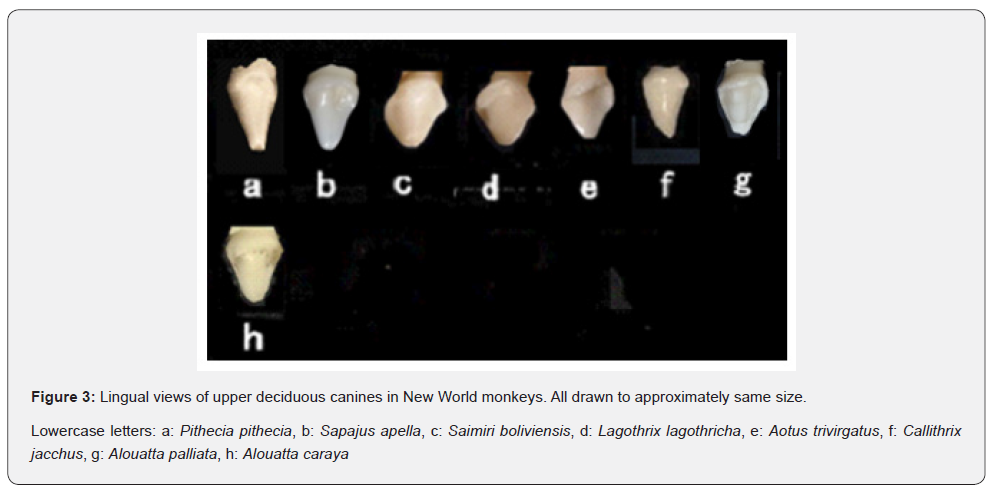
The outline of the male Alouatta seniculus (Figure 1-Q) was hook-shaped. It had a markedly convex mesial crest and a distinctly concave distal crest. The distal tubercle was noticeably swollen. The cross-section was heart-shaped. The canines were large. The female (Figure 2-Q) had a distorted hexagonal outline with a strongly concave distal crest. The basal cross-section was elliptical mesiodistally. The canine exhibited strong sexual dimorphism in shape (Figure 3).
Deciduous canines
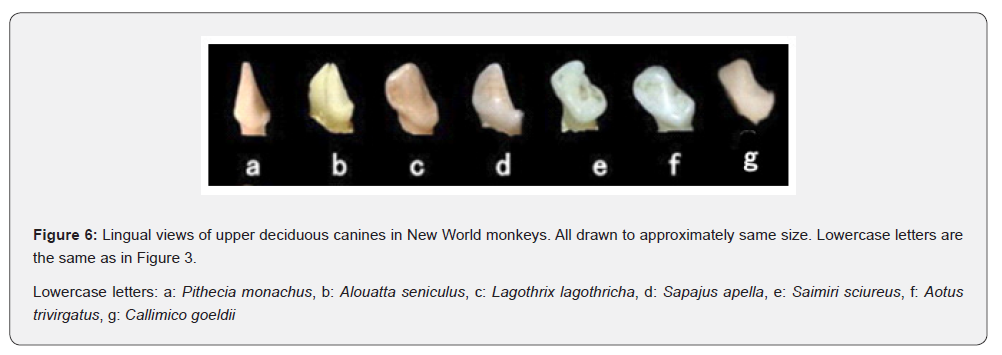
The Pithecia pithecia was a slightly elongated isosceles triangle. The mesial and distal crests were straight. The cervical ridge was well-developed, surrounding the neck of the tooth. The lingual views of the deciduous canines of other species were all similar to equilateral triangles and had well-developed cervical ridges.
Lower canines
In general, the crown morphology of the lower canines in New World monkeys were conical in the anterior region and had a nodule-like “heel” in the posterior region.
Pitheciidae
Pithecia
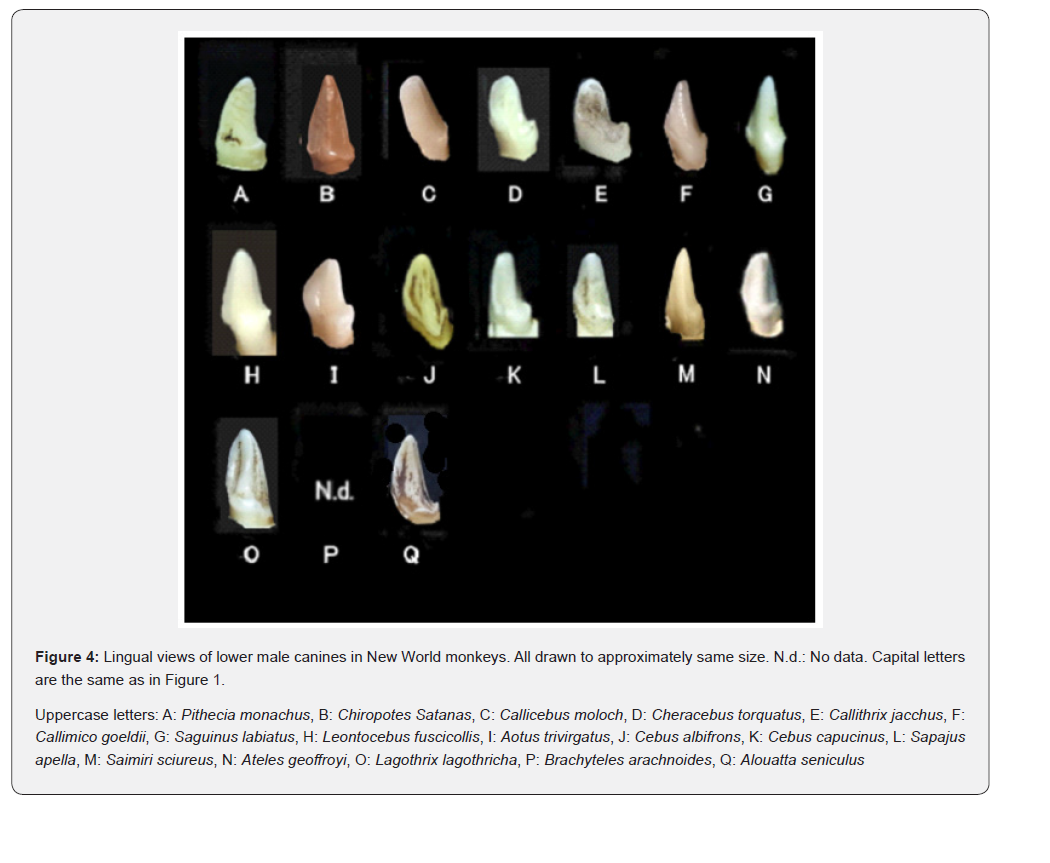
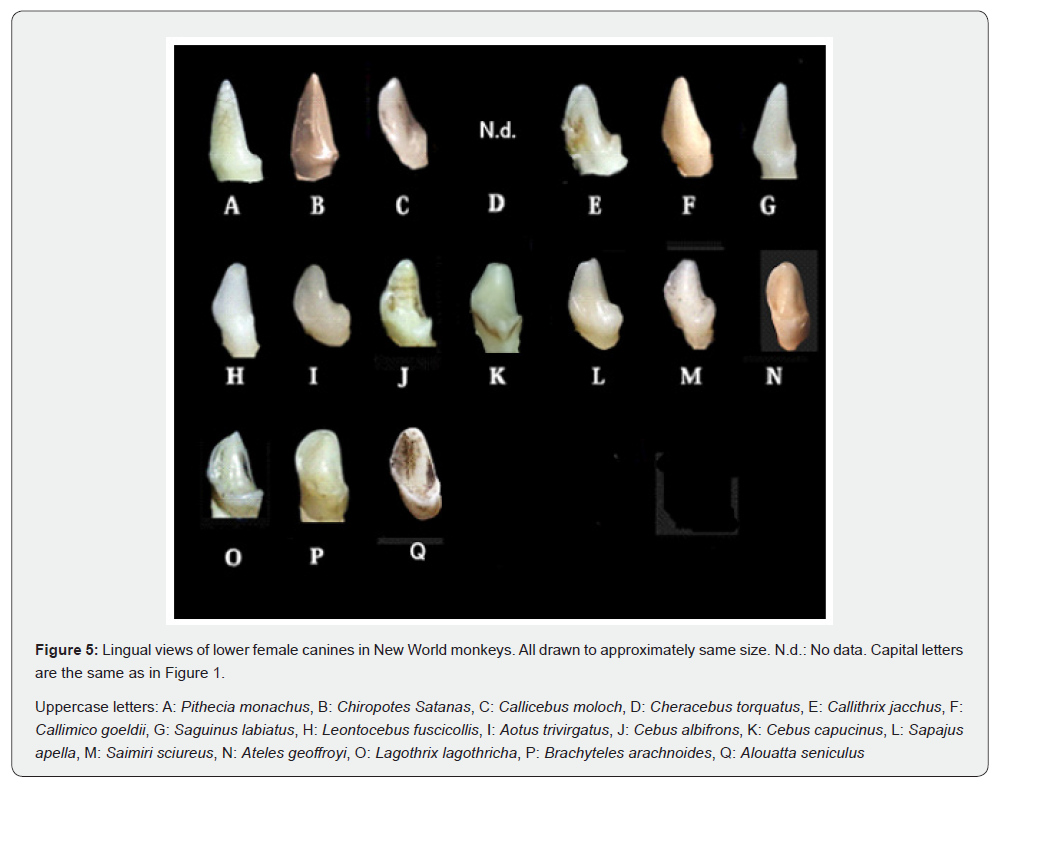
The outline of the male Pithecia monachus (Figure 4-A) had a trigonal pyramid-shaped canines as a whole. From the lingual aspect, tall isosceles triangle was observed with a swollen structure resembling a heel. The distal crest was as sharp and pointed as a knife blade. Its cross-section was triangular. The cervical ridge was mildly swollen. Females (Figure 5-A) were similar in form to males.
Chiropotes
The male Chiropotes satanas had trigonal, pyramid-shaped canines. The distal crest was shaped like a knife blade, being both sharp and pointed (Figure 4B). These were relatively similar to those of Pithecia (Figure 4B). The lingual mesial and distal crests were straight. The mesial groove was interrupted by the marginal ridge. The heel-shaped elevation was poorly developed. The cervical ridge was moderately bulging and the mesial and distal tubercles were located near the cervical region. The female canines (Figure 5B) were similar in shape to those of the males.
Callitrichidae
Plecturocebus
The presence of distorted, pentagonal, spatula-shaped lower canines was observed on the male Plecturocebus moloch (Figure 4-C). The mesial crest was slightly convex and the distal crest concave. The crown inclined forwards. There were poorly developed, heel-shaped protrusions on the distal base. The crosssection was elliptical. The outline of the female canine was almost identical to that of the male (Figure 5-C). The cross-section was elliptical along the long tooth axis. However, the cervical ridge was more pronounced in the female tooth.
Cheracebus
The outline of the male Cheracebus torquatus canines was a distorted hexagon, with a convex mesial crest and a straight distal crest (Figure 4-D). They appeared comparatively similar to those of Callicebus. The heel-shaped swelling was moderate.
Callithrix
The outline of the male Callithrix jacchus had a distorted, hexagonal shape (Figure 4-E). A strongly developed, heel-shaped protrusion was observed at the distal base. The mesial tubercle was located approximately half the height of the tooth crown from the cervical line. The cross-section was elliptical along the long tooth axis. The outline of the female (Figure 5-E) was similar to that of the male.
Callimico
The shape of Callimico goeldii was a distorted hexagonal, with a heel-shaped protrusion that developed at the distal base (Figure 4-F). Its cervical ridge was thick and broad. The mesial and distal crests were straight. The mesial tubercle was observed at approximately half the height of the crown. The distal tubercle was well developed and bulging. Females had a similar outline to males (Figure 5-F).
Saguinus
The male Saguinus labiatus had an outline that was distorted into a pentagon or hexagon (Figure 4-G). The mesial and distal crests were straight. The mesial tubercle was positioned one-third of the crown height from the cervical line. The distal tubercle was small. The mesial and distal tubercles were located near the cervical region. The females were similar in shape to the males (Figure 5-G). However, the degree of flexion around the mesial tubercle was greater in the female. The mesial tubercles were located approximately at the quarter point of the crown from the cervical line.
Leontocebus
The outline of the male Leontocebus fuscicollis was a strongly symmetrical distorted hexagon (Figure 4-H). The mesial and distal crests were straight, and the mesial and distal tubercles were located approximately one quarter of the height of the crown from the cervical line. The female canines were quite similar in shape to the male ones (Figure 5-H). The mesial tubercle was located more apical than in males.
Aotidae
Aotus
The male Aotus trivirgatus had a distorted hexagonal outline with a heel-shaped protrusion that developed distally (Figure 4-I). The mesial tubercle was well developed and positioned approximately one-half of the crown height. The female outline was similar to the male (Figure 5-I). Both sexes exhibited strong flexion around the mesial tubercle. However, the heel-shaped protrusion was weaker in females than in males. Cebidae
Cebus
The outline of the lower canines of the male Cebus albifrons was a distorted hexagon with straight incisal crests mesially and distally (Figure 4-J). The mesial tubercle was located approximately halfway up the crown and the distal tubercle was situated one-third of the way from the cervical line. The female had a similar distorted hexagonal outline with straight mesial and distal crests (Figure 5-J). The mesial tubercle was located approximately halfway from the cervical line. There was a steeper degree of flexion around the mesial tubercle. The dimorphism in shape was moderate.
The male Cebus capucinus had a distorted hexagonal outline (Figure 4-K). The mesial tubercle was positioned approximately two-thirds of the crown height. The female outline formed a distorted quadrilateral (Figure 5-K). Strong flexure was observed around the mesial cusp of the female. However, the heel-like protrusion was weak.
Sapajus
The male Sapajus apella had an outline that was distorted and quadrangular (Figure 4-L). It had a poorly developed heel. The cross-section was eliptical. The mesial tubercle was located at approximately half the height of the tooth crown. The female (Figure 5-L) had a more distorted, hexagonal shape than the male, resulting in a stronger degree of flexion around the mesial tubercle. The heel-like bulge at the distal base and the cervical ridge were more pronounced than in males. The cross-section was elliptical.
Saimir
The male Saimir sciureus had a vertically distorted, pentagonal shape with a small tubercle at its distal base (Figure 4-M). The mesial crest was straight, while the distal crest was slightly concave. The cross-section was elliptical along the long tooth axis. The mesial and distal tubercles were located in the cervical region. The outline of the female (Figure 5-M) was a distorted hexagon and the mesial tubercle was located approximately two-thirds of the crown from the cervical line. The degree of flexion around the mesial tubercle was stronger in the female. The heel-shaped bulge was more pronounced than in males. The cross-section was elliptical along the long tooth axis. There was a strong shape sexual dimorphisn.
Atelidae
Ateles
The male Ateles geoffroyi had a distorted, pentagonal shape, with straight mesial and distal crests (Figure 4-N). There was minimal bulging at the distal base. The mesial groove was interrupted by the marginal ridge. The cervical ridge was moderate. The cross-section was elliptical along the long tooth axis. The shape of the female (Figure 5-N) was similar to that of the male, but the mesial tubercle was positioned apically. The cervical ridge was strongly developed. The cross-section was elliptical along the long tooth axis.
Lagothrix
The outline of the Lagothrix lagothricha canine was a distorted triangle (Figure 4-O). The mesial and distal crests were convexly curved. The mesial groove was interrupted by the marginal ridge. The lingual ridge was broad and well-developed. The cervical ridge was well-developed and slanted downwards at an angle. The cross-section was elliptical along the long tooth axis. The canines of the females were distorted and hexagonal in shape (Figure 5-O). The mesial tubercle was located more apically, resulting in a stronger degree of flexion around the mesial tubercle than in males. The heel-like protrusion was much more pronounced in females. The cross-section was elliptical along the long tooth axis.
Brachyteles
The female Brachyteles arachnoides had a distorted, hexagonal outline (Figure 5-P). The mesial tubercle was developed and positioned approximately one half of the crown height. The cervical ridge was moderately swollen with a slight heel-shaped bulge present at the distal base. The cross-section was elliptical along the long tooth axis.
Alouatta
The Alouatta seniculus had a distorted, pentagonal shape (Figure 4-Q). The cervical ridge was notably well developed. The protrusions at the distal base were highly developed. The crosssection was elliptical along the long tooth axis. In females (Figure 5-Q), the shape was more distorted and pentagonal, with the mesial tubercle located more apically than in males, resulting in a stronger degree of flexion around the mesial tubercle than in males. The heel-shaped protrusions were weakly developed. The cross-section was elliptical along the long tooth axis. There was a strong shape sexual dimorphism (Figure 6).
Deciduous canines
The deciduous lower canines of Pithecia monachus were elongated isosceles triangle. They were surrounded by a moderately developed cervical ridge. No dimorphism in the shape of the crown was observed. The deciduous lower canines of other species commonly appeared as distorted hexagons. The degree of flexion around the mesial tubercle was stronger than in the permanent lower canines.
Discussion
Primates are omnivorous and eat a variety of foods, including leaves, fruit, bark, tree sap, insects, and so on. The large canines of male primates are used as weapons of aggression against predators and other males, both within and between troops. They are also involved in sexual selection [3, 21]. However, some scholars argue that, although large canines are designed for piercing and cutting prey, they are rarely used for feeding purposes, such as folivorous and frugivore and are therefore not closely linked to feeding behaviour [3, 28]. However, it is well known that diet significantly affects canine form [10]. New World saki monkeys, for instance, have chisel-like canines that they use to open hard fruits, and their teeth are specially adapted for this activity [19].
The size of the canines of monkeys belonging to the Cercopithecoidea is generally a reliable indicator of their sex. This is because the canines of males are larger than those of females. However, in some Platyrrhini species, it is not possible to distinguish between the sexes based on tooth size alone. Even if the size of the canines is the same in both sexes, sexual dimorphism in shape still exists if their shape differs. Although changes in the shape of canine teeth are significant, reports on the shape of canines in primates are scarce, and studies on sexual dimorphism in this respect are rare [3, 21, 29]. Plavcan and van Schaik [3] stated that the shape of the canines also strongly correlated with phylogeny and could serve as a means of classification, emphasizing its necessity.
The shape of the canines is most closely related to the nature of the food consumed. The first factor to consider in this relationship is the hardness, softness or toughness of the food, followed by determining whether the species is herbivorous, frugivorous or omnivorous [10, 30]. Hershkovitz (1977) [22] described the upper canines of all other living platyrrhines as follows: “The canine tooth is a subtriangular cross-section with sharp mesial and distal edges, anterior and posterior cingula always present and distal and/or mesial tubercles often preserved.”
New World monkeys are omnivorous and mainly eat plant matter. Saki monkeys primarily consume seeds, but they are also adaptable frugivores that eat hard, unripe fruit earlier than other monkeys [21, 25, 31-33]. The Callicebus diet consists of more than 70% fruit. The remainder of their diet consists of leaves, insects and seeds [1, 14]. Callithrix use their claws to cling to tree trunks and drill holes in which to lick or scrape out sap. Nearly 70% of their diet consists of sap, and they also enjoy eating fruit and insects. The diet of the Aotus species consists primarily of fruit, with consumption of berries, flowers, leaves, nectar, insects and spiders also being a feature [21-22]. The Cebidae are highly omnivorous, primarily feeding on fruit and insects. They also hunt and eat small animals, such as mice, bats and squirrels. They have been observed using their canines and stones to crack open hard fruits [34]. Ateles mostly eat fruit, especially ripe fruit [35]. Lagothrix also eat fruit, but their diet includes tree leaves, seeds and other plant matter. Brachyteles tend to eat leaves [25]. Alouatta primarily feed on leaves, particularly young ones, as well as flowers and fruits, making them mainly folivorous. They also selectively consume certain insects and small vertebrates.
Male permanent upper canines
The shape of the upper canines of male New World monkeys could be categorised into two main types, depending on their diet. One type involved teeth shaped like daggers. This type was further divided into three subtypes. One of these was adapted for eating ripe fruit and included the following species: Cheracebus torquatus, Callimico goeldii, Saguinus labiatus, Leontocebus fuscicollis, Aotus trivirgatus, Cebus albifrons, Cebus capucinus, Sapajus apella, Sapajus nigritus, Saimiri sciureus, Ateles geoffroyi and Ateles paniscus. A second subtype had either chisel-like canines, like those of Pithecia monachus, or trigonal, pyramidshaped canines, like those of Chiropotes satanas. These canines were used for crushing hard seeds. A third subtype had rounded, slanted teeth for extracting resin and included Callicebus moloch and Callithrix jacchus. Another main shape type was observed in folivorous primates with hook-like canines and included Alouatta seniculus, Alouatta caraya and Brachyteles arachnoides.
As with Old World monkeys, New World monkeys also exhibit diverse social structures. According to Kay et al. [26], the greater the dimorphism of canine size teeth, the higher the level of competition between males. Those species with monogamous and polyandrous social structures exhibit the lowest canine dimorphism, while species with male dominance hierarchies show the highest. Species with fission-fusion social structures and transitory intermale breeding-season competition fall between these extremes.
This study found that pair-living primates among New World monkeys was more diverse than among Old World monkeys [27]. The saki monkey is monogamous, much like the Plecturocebus and Aotus groups [25, 27]. By contrast, Callithrix exhibit a variety of social structures, including monogamous pairs and polygynous, polyandrous, and polygynandrous groups [21, 25, 27]. The Cebus species exhibit a promiscuous, multimale/multifemale mating system [25-26], whereas the Saimiri have a multimale/ multifemale society in which females are dominant throughout the year and intense competition between males occurs during the short mating season [25-27]. Ateles form promiscuous multimale/multifemale groups [26]. These groups live in fissionfusion societies that are similar to those of chimpanzees [25, 35- 38]. The social structure of Alouatta is characterised primarily by multimale/multifemale fission-fusion promiscuity [25-27]. In addition, the dimorphism of canines in New Old monkeys is significantly correlated with body size among different species [3, 15, 26] (Table 1).
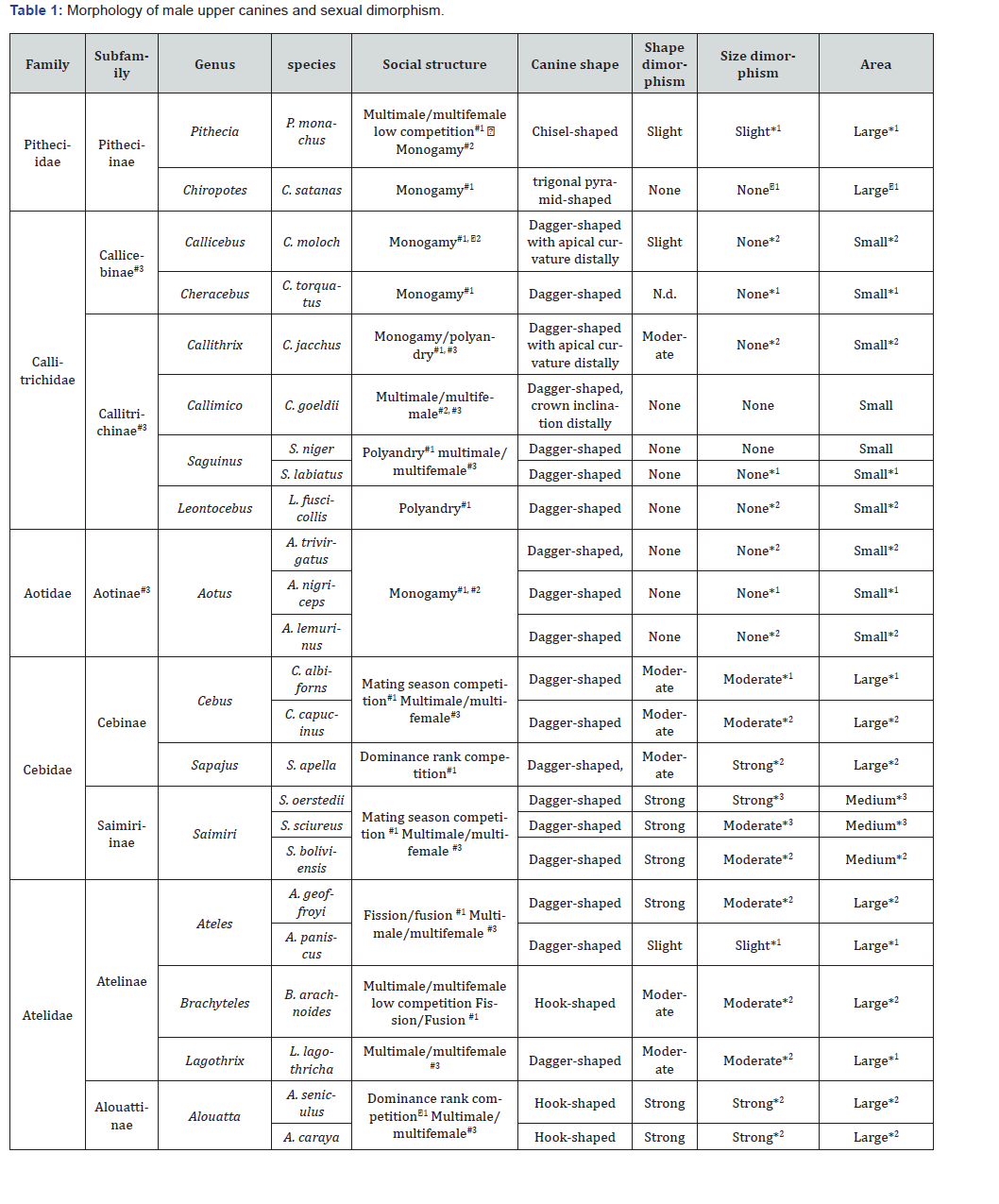
*1: Tejedor (13); *2: Plavcan and Ruff (21); *3: Swindler (20); #1: Kay et al. (26); #2: Fleagle (25); #3: Izawa (27), N.d.: No data
The size of canines was also sexually dimorphic in the New World monkey [2, 3, 25-26, 36-37]. Generally, groups with monogamous social structures exhibit little dimorphism, whereas those with polygamous structures tend to display strong dimorphism [3, 39]. Intense competition among males for females is likely to cause the canines in males to enlarge, thereby increasing the degree of dimorphism [26].
The same trend was observed in canine shape dimorphism. Species with monogamous social structures exhibited less shape dimorphism, which is a key feature of such structures. By contrast, species with polygynous social structures exhibited pronounced sexual dimorphism in shape. Furthermore, species with small canines displayed less sexual dimorphism in shape than those with large canines.
In many species of New World monkey, tooth size dimorphism was associated with shape dimorphism, though this was not always consistent across all species. According to the survey data used here, six species showed a mismatch between size and shape dimorphism in the upper canines: Plecturocebus moloch, Callithrix jacchus, Sapajus apella, Saimiri sciureus, Saimiri boliviensis and Ateles geoffroyi.
Female permanent upper canines
In general, female anthropoids have smaller canines than males. It is thought that this is because female canines have little evolutionary value as weapons [19]. The outlines of female canines in species with little shape dimorphism were similar to those of males, but the outlines of females showing marked shape dimorphism were pentagonal or distorted rhombic. In addition, the cervical ridge was more prominent than in males, giving the overall appearance a rounded shape.
Deciduous upper canines
Deciduous teeth exhibit more conservative characteristics than permanent teeth [40-41]. Lucas et al. (1986) [42] reported that the size and shape of deciduous canines in anthropoids (Ceboidea, Cercopithecoidea and Hominoidea) resembled those of permanent canines in females but differed greatly from those in males. The deciduous canines of New World monkeys were shaped like equilateral triangles. In contrast, only the canines of Pithecia monachus were elongated isosceles triangle. There was little variation in the shape of deciduous canines throughout phylogenetic groups, and no sexual dimorphism was observed. This similarity suggests that this shape is primitive.
Lower canines
In general, the lower permanent canines were simpler in shape throughout phylogenetic groups than the upper canines [43]. The outline of the crown varied from a distorted triangle to a distorted hexagon across all classified species. This variation depended on the position and degree of flexion of the mesial tubercle, and on the degree of development of the heel-shaped tubercle at the distal base. If the distal tubercle was underdeveloped, the shape became distorted and looked like a triangle. If it was well developed, the shape was more likely to be a distorted hexagon. Unlike the upper canines, diet was not a factor here [44-47].
The shape of the female lower canines was similar to that of the male ones, but the mesial tubercle was located further apically and the degree of flexion around the mesial tubercle was stronger than in the permanent lower canines.
Deciduous lower canines
In deciduous canines, all species had well-developed mesial and distal tubercles. Many species exhibited a distorted hexagonal shape. Unlike these species, Pithecia had a distorted isosceles triangle shape.
Conclusion
The crown outlines and sexual dimorphism were examined in the context of their phylogenetic relationships. The outline of the upper canines of males could be categorised into two main shape types, depending on their diet. The first type was daggershaped, while the second type was hook-shaped. The latter was predominantly observed in leaf-eating. The dagger-shaped group can be divided into three subtypes. One of these had adapted canines for eating ripe fruit, including the species. Another species had chisel-like canines (Pithecia monachus) or trigonal pyramid-shaped canines for crushing hard seeds. A third subtype had rounded, slanted teeth for extracting resin. Species with little shape dimorphism tended to be monogamous or polyandrous, and had small canines and ate tree sap, fruit and insects. In contrast, species with pronounced shape sexual dimorphism tended to be polygamous or multimale/multifemale. They had a strong male hierarchy and large canines. Their diet mainly consisted of ripe fruit and leaves. Dimorphism in the size and shape of the upper canines was similar in many species of New World monkey, though not always consistent. Six species exhibited discrepancies between size and shape dimorphism. In species with little shape dimorphism, the shape of the female canine resembled that of the male. In contrast, species exhibiting significant shape dimorphism had unique female canine shapes, such as short pentagons or distorted rhombi. The shape of the deciduous canines resembled an equilateral triangle, in this study among the New World monkeys except for Pithecia monachus.
The shape of the lower canines in males varied from a distorted triangle to a distorted hexagon. Only slight differences between species were observed. The female lower canines were similar in shape to those of the males. The deciduous lower canines were distorted and hexagonal in shape, except for those of the Pithecia monachus which were isosceles triangular.
Acknowledgments
I would like to express my sincere gratitude to the Department of Anthropology, Faculty of Science, Kyoto University, Center for the Evolutionary Origins of Human Behavior (EHUB) at Kyoto University, and the Japan Monkey Centre (JMC) for kindly granting me permission to use materials relating to New World monkeys in this article. I would also like to thank Professor Eishi Hirasaki (EHUB) and Dr Yuta Shintaku (JMC) for their guidance on primate skeletal specimens. This research would not have been possible without their cooperation. The author extends their sincere gratitude.
References
- Plavcan JM (2001) Sexual dimorphism in primates evolution. Yearbook of Physical Anthropology 33: 25-53.
- Leutenegger W & Shell B (1987) Variability and sexual dimorphism in canine size of Australopithecus and extant hominoids. Journal of Human Evolution 16: 359-367.
- Plavcan JM & van Schaik CP (1994a) Canine dimorphism. Evolutionary Anthropology 2(6): 208-214.
- Scott GR &Turner Ⅱ CG (1997) The anthropology of modern human teeth. Cambridge University Press.
- Ward CV, Leaky MJ & Walker AW (2001) Morphology of Australopithecus anamensis from Kanapoi and Allia Bay, Kenya. Journal of Human Evolution 41(4): 255-368.
- Kimbel W, Rak Y & Johanson DC (2004) The Sull of Australopithecus afarensis Oxford press, New York, pp. 254.
- Moggi-Cecchi J, Grine FE & Tobias PV (2006) Early hominid dental remains from Members 4 and 5 of the Sterkfontein Formation (1966-1996 excavations): Catalogue, individual associations, morphological descriptions and initial metrical analysis. Journal of Human Evolution 50(3): 239-328.
- Suwa G, Kono RT, Simpson SW, Asfaw B, Lovejoy CO, et al. (2009) Paleobiological implication of the Ardipithecus ramidus dentition. Science 326: 94-99.
- Suwa G, Sasaki T, Semaw S, Rogers MJ, Simpson SW, et al. (2021) Canine sexual dimorphism in Ardipithecus ramidus was nearly human-like. PNAS 118(49): 1-11.
- Berthaume MA, Vincent Lazzari V & Guy F (2020) The landscape of tooth shape: Over 20 years of dental topography in primates. Evolutionary Anthropology 29(5): 245-262.
- Yamada H (2024a) Morphology of deciduous canines in African apes. Global Journal of Archaeology & Anthropology 13(4): 1-7.
- Yamada H (2024b) Morphology of deciduous canines in Asian apes. Global Journal of Archaeology & Anthropology 14(1): 1-8.
- Tejedor MF (2002) Primate canines from the early Miocene Pinturas Formation, Southern Argentina. Journal of Human Evolution 43(2): 127-141.
- Kinzey WG (1972) Canine teeth of the Monkey, Callicebus moloch: Lack of sexual dimorphism. Primates 13(4): 365-369.
- Plavcan JM & van Schaik CP (1994b) Intrasexual competition and canine dimorphism in anthropoid primates. American Journal of Physical Anthropology 87(4): 461-477.
- Yamada H (2014) Canine crown morphology and sexual dimorphism in the Hylobates lar. Anthropological Science (Japanese Series) 122(2): 133-143.
- Frisch JE (1963) Sex-differences in the Canines of the Gibbon (Hylobates lar). Primates 4(2): 1-10.
- Plavcan JM (1993) Canine size shape in male anthropoid primates. American Journal of Physical Anthropology 92(2): 201-216.
- Greenfield LO (1992) Origin of the human canine: A solution to an old Enigma. Yearbook of Physical anthropology 35(S15): 153-185.
- Swindler DR (2002) Primate Dentition. Cambridge University Press.
- Plavcan JM & Ruff CB (2008) Canine size, shape, and bending strength in Primates and Carnivores. American Journal of Physical Anthropology 136(1): 65-84.
- Hershkovitz P (1977) Living New World monkeys. Univ. od Chicago Press. Vol. 1.
- Yamada H, Nakatsukasa M, Kunimatsu Y & Ishida H (2022) Evolution of humans in view of maxillary canine morphology. Anthropological Science 130(1): 21-54.
- The Working Group on Japanese Nomenclature of Primate Species at Japan Monkey Centre. 2024 Report.
- Fleagle JG (2013) Hominidae. In: Primate Adaptation and Evolution. (third edition). Academic Press, Amsterdam.
- Kay RF, Plavcan JM, Glander KE & Wright PC (1988) Sexual selection and canine dimorphism in New World monkeys. American Journal of Physical Anthropology 77(3): 385-397.
- Izawa K (1991) Another path of evolution. A Cultural History of Monkeys. In: Nishida T, Izawa K, Kanou T(Eds.), Heibonsha Co. Ltd.
- Plavcan JM, Christopher & Ruff B (2008) Canine Size, Shape, and Bending Strength in Primates and Carnivores. American Journal of Physical Anthropology 136(1): 65-84.
- Yamada H, Hamada Y & Ishida H (2013) Canine crown morphology and sexual dimorphism in the Pan paniscus. Anthropological Science 121(2): 89-104.
- Berthaume MA (2016) Food mechanical properties and dietary ecology. American Journal of Physical Anthropology 159: 79-104.
- Seth P & Seth S (1986) The Primates. New Delhi/Allahabad: Northern Book Centre.
- Take M, Yumoto T & Barnett AA, Onizawa K, Spironello WR (2023) Eat the fruit earlier: Sakis (Pithecia chrysocephala) show enhanced temporal fruit resource access compared with squirrel monkeys (Saimiri sciureus) in an urban forest fragment in Brazil. American Journal of Primatology.
- Gottstein M, Morris AL, Heer K, & Heymann EW (2023) Feeding ecology of monk sakis (Pithecia monachus) in a seasonally flooded forest in western Amazonia.
- Moynihan M (1976) The New World Primates. New Jersey: Princeton University Press, United States.
- Hershkovitz P (1981) Comparative anatomy of platyrrhine mandibular cheek teeth dpm4, pm4, m1, with particular reference to those of Homunculus (Cebidae), and comments on platyrrhine origins. Folia Primatologica 35(2-3): 179-217.
- Nowak R (1999) Woolly Monkeys. In: Baltimore MD, Walker's Mammals of the World, 6th Edition, The John Hopkins University Press, United States.
- Defler T (1999) Locomotion and posture in Lagothricha lagothricha. Folia primatologica 70(6): 313-327.
- Nishida T (2008) Society of chimpanzees. Toho Publishing, Japan, pp. 200.
- Cortes-Ortiz L, Canales Espinosa D, Marsh LK, Mittermeier RA, Mendez-Carvajal P, et al. (2020) Ateles geoffroyi, Geoffroy’s Spider Monkey.
- Shimooka Y (2023) “fission–fusion” in Encyclopedia of Primatology. Japanese Primatological Society (ed.), Maruzen Publishing, pp. 474-475.
- Groves CP (2005) Mammal Species of the World, Third Edition. In: Wilson DE & Reeder DM (eds.), The Johns Hopkins University Press, Baltimore, p. 43-70.
- Minton K (1985) Multimale mating and absence of canine tooth dimorphism in woolly spider monkeys (Brachyteles arachnoides) American Journal of Biological Anthropology 68(4): 519-523.
- Abondano L, Fernandez-Duque E, Link A, Schmitt CA & Di Fiore A (2015) Reevaluation of Sexual Selection Theory for Canine Size in New World Monkeys:Implications for Pitheciine Primates. American Journal of Physical Anthropology 156 (S60): 66-66.
- Kinzey WG (1971) Evolution of the human canine tooth. Am Anthropol 73: 680-694.
- Hanihara K (1992) A story of teeth and anthropology. Ishiyaku Publishers, Inc. Tokyo.
- Lucas PW, Corlett RT & Luke DA (1986) Sexual Dimorphism of Tooth Size in Anthropoids. Human Evolution 1: 23-39.
- Schwartz JH & Tattersall I (2005) The Human Fossil Record. Volume Four A John Wiley & Sons, Inc., Publication.

























