




 GJAA Home



Urban Islamic Sisterhood: An Anthropological Study of Women’s Majelis Taklim as Agents of Social And Religious Change in Jakarta
Badrah Uyuni1*, Mohammad Adnan2, Muallimah Rodhiyana3, Rabiah Al Adawiyah4 and Sutiono Sutiono5
1 Faculty of Islamic Studies, As-Syafiiyah Islamic University, Jakarta, Indonesia
2 Sekolah Paskasarjana Universitas Islam Negeri Syarif Hidayatullah, Jakarta
3 Faculty of Islamic Studies, As-Syafiiyah Islamic University, Jakarta, Indonesia
4 Sekolah Tinggi Agama Islam At-Taqwa, Bekasi, Indonesia
5 Faculty of Islamic Studies, As-Syafiiyah Islamic University, Jakarta, Indonesia
Submission: May 14, 2025; Published: June 05, 2025
*Corresponding author: Badrah Uyuni, Faculty of Islamic Studies, As-Syafiiyah Islamic University, Jakarta, Indonesia
How to cite this article:Badrah Uyuni, Mohammad Adnan, Muallimah Rodhiyana, Rabiah Al Adawiyah and Sutiono Sutiono. Urban Islamic Sisterhood: An Anthropological Study of Women’s Majelis Taklim as Agents of Social And Religious Change in Jakarta. Glob J Arch & Anthropol. 2025; 14(3): 555887. DOI: 10.19080/GJAA.2025.14.555887
Abstract
This article explores the dynamic role of women’s majelis taklim (Islamic study circles) in Jakarta as agents of social solidarity and religious transformation in urban Muslim communities. Drawing on ethnographic fieldwork involving participant observation and in-depth interviews with 22 informants from diverse socioeconomic backgrounds, the study investigates how urban Muslim women engage in majelis taklim as spaces for religious learning, social support, and collective agency. Through a theoretical lens combining feminist anthropology and Islamic piety studies, this research reveals that these gatherings are not merely devotional but active sites of Islamic sisterhood, social mobility, and digital engagement. The findings illustrate how women mobilize religious authority, negotiate piety within modern urban life, and use digital platforms to expand their influence. The study contributes to broader debates on gender, religion, and urban transformation in the Global South, offering an anthropological perspective on Muslim women’s collective agency in shaping Islamic public life.
Keywords: Majelis Taklim; Muslim Women; Islamic Learning; Religious Agency; Urban Anthropology
Introduction
In recent decades, grants within Islam’s anthropology have witnessed a paradigm shift from analyzing Islam as a literary or theological tradition to understanding it as a lived, encapsulated, and socially arranged practice. Seminal works by Mahmood [1], Deeb [2], and Rinaldo [3] have emphasized how Muslim women, in particular, shape their subjectivities and ethical selves through pious practices, challenging liberal assumptions about agency, autonomy, and religiosity. These studies illuminate how Muslim women inhabit religious life, not as passive recipients of patriarchal authority, but as active agents cultivating moral and spiritual capacities within their socio-political contexts.
This anthropological turn towards lived religion becomes especially pertinent when analyzing Islamic practices in urban Muslim societies. In the case of Indonesia—the world’s largest Muslim-majority country—the urban religious landscape is marked by dynamic forms of Islamic expression, institutional diversification, and gendered spiritual mobilization. Nowhere is this more visible than in the proliferation of majelis taklim. These informal religious gatherings have become a prominent space for women’s Islamic education, social engagement, and moral community-building. In urban centers like Jakarta, majelis taklim has evolved into sophisticated platforms where women reinterpret Islamic knowledge, forge networks of solidarity, and address contemporary urban challenges such as poverty, digital influence, moral anxiety, and social fragmentation [4].
These gatherings, often held in homes, mosques, offices, or malls, are not devotional circles. Rather, they are hybrid spaces combining Islamic learning (ta’lim), emotional support and health awareness, social outreach, and economic empowerment. In these majelis, members engage in Qur’anic recitation, hadith studies, spiritual reflection, and dakwah strategies while navigating urban life’s weights and conceivable outcomes. The presence and leadership of women in such settings highlight an alternative mode of religious authority rooted not in formal clerical training but in experiential piety, charisma, and ethical credibility.
Despite the visibility and influence of majelis taklim perempuan in Jakarta, scholarly engagement with these groups remains uneven. Much of the literature still focuses on male-dominated religious institutions or political Islamic movements, leaving a significant gap in understanding how women shape religious knowledge and social ethics in everyday urban spaces. Moreover, the digital transformation of majelis taklim—especially during and after the COVID-19 pandemic—has accelerated their reach and influence. Yet, little ethnographic research has investigated how digital platforms mediate Islamic sisterhood, learning, and activism.
There is also a conceptual lacuna in how Islamic solidarity among women is framed. Existing models often rely on either liberal feminist notions of empowerment or top-down statedriven discourses of pengajian ibu-ibu. These approaches overlook the complex ways Islamic sisterhood is enacted through shared ethical commitments, affective ties, and mutual obligations, beyond individualistic empowerment frameworks.
To address these gaps, this study addresses the following research questions: (1) How do Muslim women in Jakarta construct religious authority through their participation in majelis taklim? (2) In what ways do these gatherings foster Islamic sisterhood and urban solidarity? (3) How has digitalization reshaped their religious practices and public engagement?
This research explores how Islamic women’s gatherings in Jakarta operate as transformative spaces of religious knowledge production, social care, and urban ethics. Understand the role of majelis taklim perempuan in building Islamic sisterhood that transcends class and spatial boundaries. Analyze how digital platforms reshape the modes of dakwah, interaction, and identity construction within these women-led religious groups.
The centrality of this research lies in its contribution to broadening the talk on Muslim women beyond political or institutional domains by focusing on grassroots religious spaces. Enhancing urban Islamic thinks about with ethnographic experiences into gendered religious practices in modern Southeast Asia. Offering theoretical models for understanding Islamic solidarity, ethics, and digital piety grounded in localized, relational, and affective forms of religious life.
The novelty of this study lies in its ethnographic focus on the intersection of gender, urban Islam, and digital transformation in the context of Indonesian majelis taklim. While previous works such as Mahmood [1] and Deeb [2] have provided frameworks for understanding embodied piety and ethical self-formation among Muslim women in the Middle East, this research brings those insights into the Southeast Asian context, highlighting how JaJakarta’s majelis taklim perempuan forge religious subjectivities and community amid the distinct pressures of Indonesian urban modernity. Additionally, by theorizing the concept of Islamic sisterhood as a full of feeling, moral, and academic venture, this thinking offers a new viewpoint that moves past parallel systems of empowerment versus submission.
This research contributes to a growing body of work that takes seriously Muslim intellectual and social labor in constructing alternative Islamic modernities—grounded in piety, solidarity, and care—in the global South.
Theoretical Framework
This study adopts an interpretive anthropological approach grounded in symbolic anthropology, feminist theory, and urban Islamic studies to examine the role of women’s majelis taklim in Jakarta. Drawing from the works of Clifford Geertz, Pierre Bourdieu, Saba Mahmood, Lara Deeb, and Rachel Rinaldo, the framework conceptualizes majelis taklim as performative religious spaces where Muslim women cultivate agency, authority, and ethical subjectivities through embodied religious practice.
Historical Roots of Female Islamic Learning
The intellectual participation of women in Islamic history has deep roots. Classical Islamic tradition recognizes the roTheorizingn as transmitters and teachers of religious knowledge, exemplified by figures such as Aisha bint Abi Bakr and Umm al-Darda’ al- Sughra [5]. A frequently cited moment is the hadith recorded in Sahih al-Bukhari, in which women requested a re-theorized of religious instruction from the Prophet Muhammad, illustrating early claims to epistemic access. These historical precedents underpin the epistemological continuity of contemporary majelis taklim, positioning them not as modern anomalies but as inheritors of long-standing female religious engagement [6,7]. In Indonesia, the revival of female religious circles draws from both classical textual legitimacy and post-colonial religious reform movements [3,8].
Urban Islam and the Gendering of Religious Authority
In urban Indonesia, women’s religious authority has emerged in response to structural exclusions from formal institutions. While male scholars dominate official religious discourse, majelis taklim offers a parallel epistemic space where women can interpret, teach, and practice Islam collectively [9,10]. These practices align with what Bano [11] refers to as the “re-democratization of Islamic knowledge,” where women assume leadership through informal but socially legitimized settings. Drawing on Bourdieu’s [12] concept of symbolic capital, female religious authority in majelis taklim is constructed through piety, charisma, and moral discipline rather than institutional credentials.
Note: Data is collected with the consent of the informant, and anonymity is anonymized to maintain privacy.
These female-led religious spaces are also embedded in broader urban socio-political dynamics. As urban life accelerates individualization, dislocation, and economic fragmentation, Majelis Taklim provides moral grounding and social anchoring for women navigating Jakarta’s neoliberal cityscape [13,14]. The informal leadership they cultivate disrupts conventional binaries between public/private, male/female, and formal/informal authority.
Islamic Sisterhood as Ethical Community
A central analytic concept in this study is Islamic sisterhood—a term that refers to affective and ethical bonds among Muslim women built through shared religious rituals, responsibilities, and social care (Badran, 2009) [3]. These circles constitute what Mahmood [1] calls a “modality of agency” shaped not by resistance to authority but through embodied discipline, ethical self-cultivation, and collective solidarity. Women’s religious agency here is not oppositional, but constructive, anchored in notions of submission (ubudiyyah), trust (amanah), and mutual care (ukhuwah imaniyah) [2,4].
In this regard, majelis taklim fosters what Bardazzi and Bazzoni [15] term “gendered authority”—a form of authority not derived from institutional rank, but from moral credibility, teaching competency, and community trust. Such authority is often sustained through consistent participation, affective labour, and everyday ethical conduct, reinforcing women’s moral centrality in urban Islamic life [16].
Habitus and the Performance of Urban Piety
Building on Bourdieu’s [12] theory of habitus, this study understands daily religious practices within majelis taklim, such as Qur’an recitation, modest dressing, and group prayer, not as isolated rituals, but as embodied dispositions that structure moral subjectivity over time. These routines allow women to internalise religious discipline and construct Islamic selves that are conceptualised and ethically coherent.
The concept of performative piety is also useful here. Drawing from Mahmood [1] and Butler’s theory of performativity, the gatherings are read as performative arenas where Islamic identity is not merely expressed but enacted, negotiated, and solidified. This aligns with the research that recognizes modernity in the Middle East and Southeast Asia, which shows how public religiosity becomes a resource for civic engagement, gendered participation, and moral reform [2,17].
In the context of Jakarta, majelis taklim increasingly intersect with digital platforms such as WhatsApp and Instagram [18,19], enabling what Abusharif [20] terms “digital Islam”—the convergence of Islamic teaching, affective community, and online media. These digital extensions do not replace traditional rituals, but rather amplify and recontextualize them in ways that expand religious visibility and female influence.
This theoretical framework positions majelis taklim as hybrid spaces where women enact Islamic agency through ritual, teaching, solidarity, and civic work. It connects Indonesian Muslim women’s experiences to global debates on urban religiosity, Islamic feminism, and moral subject formation, contributing to a de-essentialized, context-sensitive anthropology of Islam [21,22].
Research Methods
This research adopts a qualitative anthropological approach through mini-ethnography, which is particularly effective in exploring Muslim women’s religious experiences and gendered subjectivities in urban contexts. Drawing inspiration from scholars such as Abu-Lughod [23] and Mahmood [1], this study views majelis taklim not merely as sites of religious instruction but as dynamic arenas of female agency, piety, solidarity, and negotiation with urban life. Fieldwork was conducted over six months (January–June 2024) in East and South Jakarta—two urban areas known for their vibrant Islamic public life and socio-economic diversity. These sites offered a broad spectrum of majelis taklim types, ranging from mosque-affiliated study circles to informal home-based gatherings and digital religious communities.
Three primary data collection techniques were employed: participant observation, in-depth interviews, and document/ media analysis. Through participant observation, the researcher engaged in weekly Qur’anic recitations, charitable events, and informal discussions, while taking detailed field notes on ritual performances, affective exchanges, and everyday interactions. This was complemented by 22 semi-structured interviews with a diverse group of Muslim women, including ustadzah, housewives, entrepreneurs, and community activists. The interviews explored their motivations, religious practices, social roles, and how Islamic teachings are internalized and enacted in daily life. Additionally, various digital and physical documents—such as flyers, WhatsApp group messages, Instagram posts, and religious pamphlets— were collected and analyzed to understand the symbolic and communicative infrastructure of the majelis taklim.
Establishing trust with participants was a central aspect of this research. The researcher built rapport through sustained involvement, transparency, and reciprocity—participating in logistical support, sharing digital skills, and holding a feedback session with community members after fieldwork. Informants were selected using purposive and snowball sampling, with particular attention to their role, length of participation, and generational or socio-economic background, ensuring representation from leadership and lay members.
The collected data were analyzed through narrative and thematic analysis, following Clarke & Braun [24] inductive framework. The researcher categorized repeating patterns and themes related to piety, moral leadership, gendered solidarity, and the pressures between Islamic beliefs and the realities of urban modernity. Throughout this process, reflexivity and iterative comparison between field information and theoretical frameworks were kept up to guarantee analytical rigor. Moral considerations were carefully observed: participants were fully informed of the research purpose, consent was obtained, identities were anonymized, and the study followed ethical research guidelines, emphasizing voluntary participation, regard for religious spaces, and the integrity of participants’ voices [25-30].
Results and Discussions
Data Presentation and Analysis
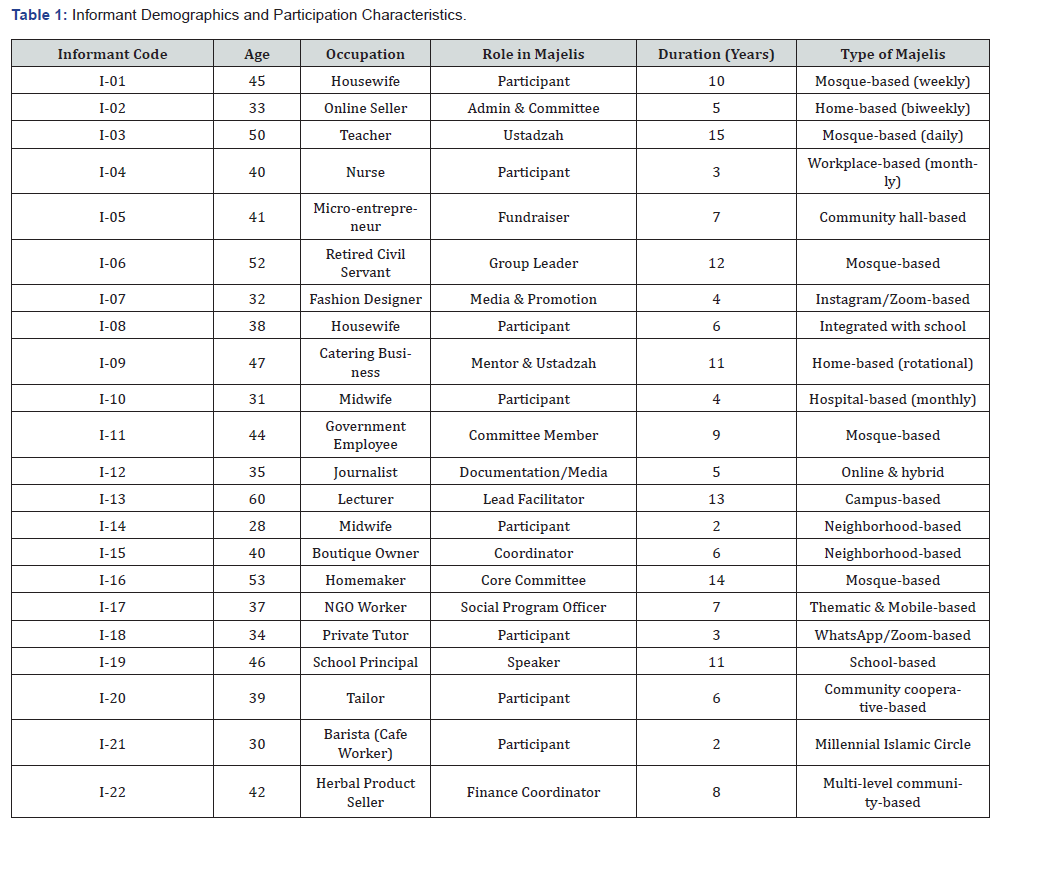
This study collected data from 22 Muslim women informants who were active in various forms of the majelis taklim in East and South Jakarta. Informants vary in social class, profession, and organizational role, ranging from housewives, small entrepreneurs, ustadzah, assembly administrators, and working women. The methods used were participatory observation, indepth interviews, and analysis of social media documents. The data collection period lasted for six months, between January and June 2024. The analysis is organised thematically to reflect the central research questions and theoretical frameworks guiding this study [31-40].
The following table summarizes the main characteristics of the informant:
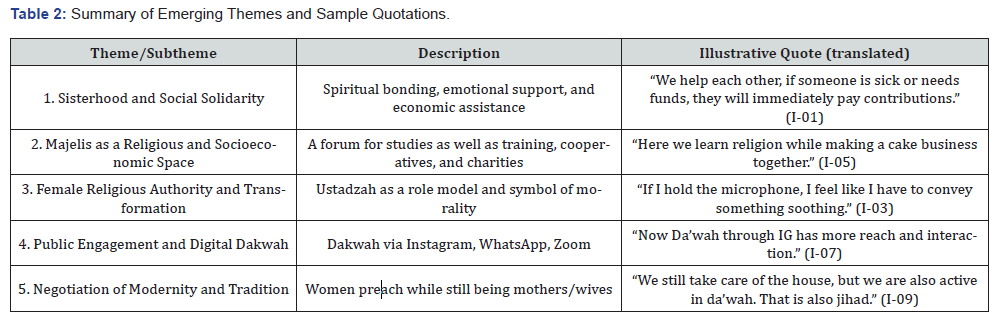
From the data processing, three main themes emerged that were in accordance with the research questions:
(1) the form of sisterhood and socio-religious solidarity, (2) the functional role of the assembly in da’wah and economic activities, and (3) the transformation of Muslim women’s identity and authority.
Based on the data and quotes above, we can see that sisterhood in majelis taklim is not an abstract concept, but is concretely manifested in the form of social and spiritual support, such as sudden contributions for sick members, fundraising for the poor, and the “Friday rice” program. This shows that Muslim women are not only spiritual agents, but also social welfare agents—a role that has rarely been highlighted in the study of urban Islam [41- 50].
In addition, majelis taklim has also developed into a productive space that combines da’wah with economic activities and empowerment. This supports the research results of Rinaldo [3] and Mahmood [1] that women’s participation in religious activities gives them social capital to play a wider role. Economic activities such as sharia social gatherings, cooking training, and women’s cooperatives strengthen collective capacity and expand the meaning of da’wah as a social charity.
No less important, the data shows that women are also undergoing a transformation of religious identity and public authority. Ustadzah is not only seen as a teacher of ngaji, but as an inspiring moral symbol. In some groups, women have even become key leaders—designing curriculum, managing funds, and directing digital da’wah activities. This shows a shift from a subordinate position towards the production of an equal and sometimes dominant Islamic meaning [51-55].
Finally, the integration of online space is a new dimension of women’s da’wah. Informants I-07 and I-03 stated that da’wah on Instagram and WhatsApp Groups not only reaches a wider reach, but also strengthens the reach of cross-city majelis taklim and social classes. Here, urban Muslim women demonstrate religious digital prowess that affirms their agency and flexibility in responding to urban modernity.
Performing Sisterhood: Spirituality, Solidarity, and Moral Labor
Field findings show that majelis taklim in Jakarta is not only a space for religious learning, but also an arena for the formation of strong social and religious solidarity among Muslim women. This solidarity is manifested in the form of social assistance networks, concern for members who are experiencing economic difficulties, and collective work in religious activities such as recitation, tahlilan, and social service.
Sisterhood in majelis taklim emerges through emotional and spiritual bonds that strengthen a sense of togetherness and mutual support. This is in line with the findings of Deeb [2] and Rinaldo [3], who show that Muslim women form faith-based solidarity communities that are not only spiritual, but also social and political. In this context, majelis taklim functions as a “community of religious intimacy” [1], where affection, nurturing, and obedience are configured as forms of moral strength.
This phenomenon directly challenges the passive narrative of Muslim women who are only perceived as recipients of religious doctrine. In contrast, women in the Jakarta Majelis taklim are actively forming a network of spiritual and social support that contributes to the resilience of Muslim urban communities.
Hybrid Religious Spaces: Majelis Taklim as Urban Islamic Civics
Beyond spiritual bonding, majelis taklim has evolved into hybrid spaces that combine religious education, civic activism, and economic cooperation. Several groups have initiated training in home-based enterprises (I-05), created internal savings groups, and organised community bazaars. These practices illustrate that urban Muslim women are not only spiritually active but also socially and economically engaged citizens.
This convergence of religion, economy, and public engagement reflects what Bayat [13] describes as “life as politics,” where ordinary people engage in meaningful change through everyday acts. In this case, women’s dakwah is not limited to proselytising but includes building community welfare, organising relief funds, and managing group finances.
Importantly, women in these assemblies do not merely consume religious knowledge—they produce, curate, and disseminate it. They lead prayers, interpret Qur’anic texts, and respond to contemporary moral issues, roles historically reserved for men in formal institutions [11]. This supports Rinaldo’s [3] argument that informal Islamic spaces offer emancipatory platforms for Muslim women’s leadership outside patriarchal control.
As one informant (I-03) stated, “When I hold the microphone, I feel a moral responsibility to calm others and bring clarity.” Such acts exemplify Bourdieu’s [12] concept of symbolic capital—moral credibility built through religious competence and communal trust, through which women acquire authority and shape social norms.
Negotiating Piety in Digital Spaces: Authority, Visibility, and Gender
The third theme explores how digital platforms have transformed majelis taklim into fluid, cross-geographic religious networks. Informants like I-07 and I-12 actively manage Instagram pages, WhatsApp groups, and Zoom-based sessions, extending the reach of their dakwah beyond local circles.
These platforms allow women to assert religious authority and construct pious visibility in ways that were previously inaccessible. As Abusharif [20] and Slama [18] note, the digital sphere opens new religious frontiers where Islamic authority can be negotiated through media fluency, charisma, and online presence.
Digital majelis taklim does not replace physical gatherings, but complements them by offering flexibility for working women and mothers. This adaptation reflects what Uyuni et al. [19] call “religious digital agency”—the capacity of Muslim women to curate, engage, and expand religious practice through technology.
Crucially, women negotiate their digital roles within Islamic ethical frameworks. Informant I-09 clarified, “We are still mothers and wives, but our dakwah is additionally a frame of jihad.” This explanation typifies the idea that piety is not weakened by advancement or innovation, but is reconfigured through computerised spaces to protect ethical specialists while exploring urban demands [56-60].
Taken together, these discoveries challenge the classical story of inactive Muslim womanhood and instead display Muslim ladies as moral actors, religious interpreters, and civic members. Their association in majelis taklim constitutes both a person’s spiritual interest and a collective civic venture. Through face-to-face gatherings and digital systems, ladies build religious communities, sanction ethical administration, and rethink Islamic authority in Jakarta’s quickly changing urban landscape [61, 62].
These experiences certify Mahmood’s [1] recommendation that female agency in Islamic contexts cannot be understood exclusively through liberal paradigms of resistance. Instead, women’s agency unfolds through embodied religiosity, ethical care, and strategic adaptation, making majelis taklim not only sites of devotion but also instruments of social change.
Conclusion
This study has demonstrated that women’s majelis taklim in urban Jakarta are not just reverential gatherings for schedule religious recitation but have advanced into multifaceted social fields where Islamic sisterhood, religious authority, and civic engagement meet. These congregations encourage the arrangement of full of feeling, otherworldly, and financial back systems, which engage ladies to explore both their private obligations and public roles. Remote from being passive recipients of religious teachings, the ladies effectively reinterpret Islamic values, accept casual authority, and extend their impact through social programs and digital platforms.
Participants of majelis taklim enact dual roles: as spiritual agents committed to ethical self-cultivation, and as civic actors who initiate collective economic initiatives, community welfare efforts, and digital dakwah. Through these roles, they produce, negotiate, and disseminate religious meaning in ways that are contextually embedded and socially impactful. The practices observed affirm that Islamic religiosity, as experienced by women in Jakarta’s urban milieu, is not static or domestic-bound but dynamic, mobile, and socially generative.
These findings reinforce the theoretical arguments of Mahmood [1], Deeb [2], and Rinaldo [3], who contend that Muslim women’s agency must be understood not through liberal-secular frameworks of resistance but through the ethical and embodied ways in which women engage with religious norms. In this way, the majelis taklim develops as an imperative location of Islamic subject arrangement and grassroots change. Advertising proves that ladies are not fringe but central operators in forming modern Muslim society.
Implication
This inquire carries a few imperative suggestions over hypothetical, viable, and future inquire spaces:
Theoretical Implications
i. This study contributes to the anthropology of Islam
and gender by promoting an ethnographic account of Muslim
women’s organization that transcends binary framings of
conservatism versus progressivism. It underscores the centrality
of understanding religious subjectivities inside their moral,
epitomized, and sociocultural contexts.
ii. The research highlights the value of intersectional and
mini-ethnographic approaches in exploring the lived religious
experiences of women, especially in urban Muslim settings where
multiple forms of power, identity, and resistance intersect.
Practical Implications
i. For Islamic institutions and dakwah organizations,
women-led majelis taklim provide a scalable model for
community-based dakwah that integrates spiritual education
with social and economic empowerment.
ii. Local governments and religious councils could partner
with these assemblies as strategic allies in promoting women’s
empowerment, religious literacy, family resilience, and social
cohesion.
iii. Digital majelis taklim, coordinated by women, presents
significant potential for collaboration with media, technology,
and youth platforms to promote inclusive and adaptive forms of
Islamic outreach suited to younger, urban audiences.
Implications for Further Research
i. This study opens avenues for more targeted
investigations into how digitalization shapes and reshapes
religious authority among Muslim women in urban Southeast
Asia.
ii. Comparative research across different towns, territories,
or socio-economic strata could disclose the different expressions
of Islamic sisterhood and majelis taklim practice, enriching our
understanding of the pluralities inside Indonesian Islam.
Recommendations for Future Research
While this study provides valuable insights into the role of majelis taklim in Jakarta, there are several areas for future research. First, a comparative study between urban and rural majelis taklim in Indonesia could provide a deeper understanding of how geographic location influences the function of these gatherings. Second, research on the intersection of majelis taklim and other forms of social activism, such as environmental movements or women’s rights, could further reveal the scope of their impact on societal change. Finally, the role of digital platforms in expanding the reach and influence of majelis taklim presents an exciting avenue for future exploration, particularly in the context of the ongoing digitalization of religious practices worldwide.
References
- Mahmood S (2006) Feminist theory, agency, and the liberatory subject: Some reflections on the Islamic revival in Egypt. Temenos-Nordic Journal for the Study of Religion, 42(1).
- Deeb L (2006) An enchanted modern: Gender and public piety in Shi'i Lebanon. Princeton University Press.
- Rinaldo R (2013) Mobilizing piety: Islam and feminism in Indonesia. Oxford University Press.
- Uyuni B, & Adnan M (2021) Woman Ulama’S Authority on Social Media. Ilmu Ushuluddin 8(2): 237-254.
- Hershkovits KA (2023) Agents of Conversion Agency of Women in Early Islam. Betwixt and Between Liminality and Marginality: Mind the Gap, pp. 225.
- Ahmed L (2021) Women and gender in Islam: Historical roots of a modern debate. Yale University Press, United States.
- Doorn-Harder PV (2006) Women shaping Islam: Indonesian women reading the Quran. University of Illinois Press.
- Latief H, & Madjid A (2022) Majlis Taklim and The Path of Women's Islamization In Indonesia. The Muslim World 112(4): 457-472.
- Hasanah U (2019) Majelis Taklim and the Shifting of Religious Public Role in Urban Areas. Ilmu Dakwah: Academic Journal for Homiletic Studies 13(1): 80-100.
- Uyuni B, Arief KM, & Adnan M (2023) Contribution of Woman Ulama in The Digital Era. International Journal of Emerging Issues in Islamic Studies 3(1): 1-11.
- Bano M (2017) Female Islamic education movements: The re-democratization of Islamic knowledge. Cambridge University Press, United Kingdom.
- Bourdieu P (2017) Habitus. In Habitus: A sense of place. Routledge, pp. 59-66.
- Bayat A (2013) Life as politics: How ordinary people change the Middle East. Stanford University Press, United States.
- Rudnyckyj D (2009) Spiritual economies: Islam and neoliberalism in contemporary Indonesia. Cultural anthropology 24(1): 104-141.
- Bardazzi A, & Bazzoni A (2020) Introduction: Gender and Authority. Gender and Authority across Disciplines, Space and Time, p. 1-13.
- Millie J (2021) Men's politics, women's piety: The gendered asymmetry of Indonesia's new public Islams. The Australian Journal of Anthropology 32(2): 135-149.
- Afrianty D (2020) Rising public piety and the status of women in Indonesia two decades after reformasi. TRaNS: Trans-Regional and-National Studies of Southeast Asia 8(1): 65-80.
- Slama M (2017) A subtle economy of time: Social media and the transformation of Indonesia's Islamic preacher economy. Economic Anthropology 4(1): 94-106.
- Uyuni B, Adnan M, Hadi A, Rodhiyana M, & Anim S (2025) Virtual Spaces of Islamic Preaching: Digital Majelis Taklim and the Changing Role of Women in Indonesia. Nature Anthropology 3(2): 10005.
- Abusharif IN (2023) Islam and Digital. The Oxford Handbook of Digital Religion, p. 52.
- Asad T (2009) The idea of an anthropology of Islam. Qui parle 17(2): 1-30.
- Fadil N & Fernando M (2015) Rediscovering the “everyday” Muslim: Notes on an anthropological divide. HAU: journal of ethnographic theory 5(2): 59-88.
- Abu-Lughod L (Ed.), (1998) Remaking women: Feminism and modernity in the Middle East. Princeton University Press, United States.
- Clarke V & Braun V (2017) Thematic analysis. The journal of positive psychology 12(3): 297-298.
- Aljunied K (2016) Muslim cosmopolitanism: Southeast Asian Islam in comparative perspective. Edinburgh University Press, United Kingdom.
- Bayat A (2009) Middle Eastern Megacities: Social Exclusion, Popular Movements and the Quiet Encroachment of the Urban Poor. Megacities: The Politics of Urban Exclusion and Violence in the Global South, pp. 82-106.
- Butler J (2025) Performative acts and gender constitution: An essay in phenomenology and feminist theory. In The performance studies reader. Routledge, pp. 186-196.
- Campbell HA, & Connelly L (2020) Religion and digital media: Studying materiality in digital religion. The Wiley Blackwell companion to religion and materiality, pp. 471-486.
- Davis DA, & Craven C (2022) Feminist ethnography: Thinking through methodologies, challenges, and possibilities. Rowman & Littlefield.
- Erwani I & Siregar AS (2025) The Role of Women in Islamic Sacred Texts: A Critical Study of Women's Narratives and Authority in Islamic Tradition.
- Evolvi G & Giorda MC (2021) Introduction: Islam, space, and the internet. Journal of Religion, Media and Digital Culture 10(1): 1-12.
- Geertz C (1971) Islam observed: Religious development in Morocco and Indonesia. University of Chicago press, 37.
- Fealy G & White S (Eds.), (2008) Expressing Islam: Religious life and politics in Indonesia. Institute of Southeast Asian Studies.
- Fotaki M, Altman Y & Koning J (2020) Spirituality, Symbolism and Storytelling in Twentyfirst-Century Organizations: Understanding and addressing the crisis of imagination. Organization Studies 41(1): 7-30.
- Giddens A, Sutton PW (2021) Essential concepts in sociology. John Wiley & Sons.
- Greed C (2019) Gender and Religion in the City. Routledge.
- Hanegraaff WJ (2016) Reconstructing “religion” from the bottom up. Numen 63(5-6): 576-605.
- Hasibuan MRA, Ginting STPN, & Nabila V (2023) The Role of Preachers in Building Ukhuwah Islamiyah Youth in Belawan I, Medan City. MAQOLAT: Journal of Islamic Studies 1(2): 79-86.
- Hayward S (2015) Women, religion, and peacebuilding. Religion, Conflict, and Peacebuilding, pp. 307.
- Hefner RW, & Zaman MQ (Eds.), (2010) Schooling Islam: The culture and politics of modern Muslim education. Princeton University Press.
- Hirschkind C (2006) The ethical soundscape: Cassette sermons and Islamic counterpublics. Columbia University Press.
- Marnissi F (2004) Women and Islam-An Historical and Theological Inquiry. Blackwell.
- Martí G (2017) New concepts for new dynamics: Generating theory for the study of religious innovation and social change. Journal for the Scientific Study of Religion 56(1): 6-18.
- Montgomery DW (2016) On Muslims and the Navigation of Religiosity: Notes on the Anthropology of Islam. In The Ashgate Research Companion to Anthropology. Routledge, pp. 227-254.
- Nakamura M (2020) Anthropology of Civilization: Personal Reflections on Anthropological Approach in the Study of Muslim Societies in Southeast Asia. Afkaruna: Indonesian Interdisciplinary Journal of Islamic Studies 16(2): 140-153.
- Nasser N (2002) Islamicate urbanism: the state of the art. Built Environment 28(3): 173-186.
- Niemelä K (2011) Female clergy as agents of religious change?. Religions 2(3): 358-371.
- Nurasyiah A, Sarwath L, Mahri A J W, Hermawan R, & Karmanto GD (2022) Reducing family poverty through an Islamic women’s empowerment strategy in Indonesia: An analytical network process approach. Al-Uqud: Journal of Islamic Economics 6(2): 206-219.
- Ridho MA, Putra AE, & Jamil M (2023) Majelis Taklim And Its Role In Women's Empowerment. Ijtimaiyya: Jurnal Pengembangan Masyarakat Islam 16(1): 65-90.
- Rizka H, Shuhufi M, & Iqbal NA (2025) Transformasi Peran Ganda Perempuan Perspektif Fikih Gender. Jimmi: Jurnal Ilmiah Mahasiswa Multidisiplin 2(1): 1-8.
- Rothenberg P (2008) Women studies—the early years: When sisterhood was powerful. In The evolution of American women’s studies: Reflections on triumphs, controversies, and change. New York: Palgrave Macmillan US, pp. 67-86.
- Sahar S (2019) Kebudayaan Simbolik; etnografi religi victor turner. sosioreligius: jurnal ilmiah sosiologi agama, 4(2).
- Sajaroh WS, & Mahmudah SH (2017) NU Women's Role in Narrating Moderate Islam with Majelis Taklim. In Third International Conference on Social and Political Sciences (ICSPS 2017). Atlantis Press, pp. 372-375.
- Saputra H, & Prastyo H (2021) Multicultural education and society empowerment based on pesantren-majelis ta'lim. Miyah: jurnal studi islam 17(02): 211-239.
- Smith-Hefner N (2017) Gender and Religious Change in Muslim Southeast Asia. In: Sofjan D, (ed.), Religion, Public Policy and Social Transformation in Southeast Asian Religion, Identity and Gender 2: 35-55.
- Sugianto H, Rahim Karim A, Rofiqi R, & Khoiriyah S (2024) Religious Empowerment Through Majelis Taklim: Islamic Learning Strategy For Migrants. In Proceeding of International Conference on Education, Society And Humanity 2(2): 312-323.
- Sukirman S, Firman F, & Ilham D (2021) The Role of the Taklim Council in the Development of Islamic Education. Journal of Indonesian Islamic Studies 1(1): 9-27.
- Uyuni B, Adnan M, Majid ZA, Maarif S, & Muhibudin M (2024) Empowering women through training islamic inheritance learning: a program for mothers in the majelis taklim. The IMPACT: Jurnal Pengabdian Kepada Masyarakat Universitas Islam As-Syafiiyah 1(1): 16-24.
- Uyuni B, Al Adawiyah R, Quddus R, & Kasyifatudduja K (2024) Transformation of Dakwah MEDIA in Inspiring Muslimah in the Digital Era. Al-Risalah: Jurnal Studi Agama dan Pemikiran Islam 15(2): 711-730.
- Van Bruinessen M (2013) 1. Introduction: Contemporary Developments in Indonesian Islam and the “Conservative Turn” of the Early Twenty-first Century. In Contemporary Developments in Indonesian Islam. ISEAS Publishing, pp. 1-20.
- Van Wichelen S (2016) Reconstructing ‘Muslimness’: new bodies in urban Indonesia. In Geographies of Muslim identities Routledge, pp. 93-108.
- Winn P (2012) Women’s majelis taklim and gendered religious practice in northern Ambon. Intersections: Gender and sexuality in Asia and the Pacific 30: 1-15.

























