




 GJAA Home



Tooth Size Tells the Story of the Modern Human Journey
Hiroyuki Yamada
Department of Anatomy, School of Dentistry, Aichi-Gakuin University, Japan
Submission: April 10, 2025; Published: April 22, 2025
*Corresponding author: Hiroyuki Yamada Ph.D., Department of Anatomy, School of Dentistry, Aichi-Gakuin University, Nagoya 463-0013, Japan
How to cite this article:Hiroyuki Yamada. Tooth Size Tells the Story of the Modern Human Journey. Glob J Arch & Anthropol. 2025; 14(3): 555886. DOI: 10.19080/GJAA.2025.14.555886
Abstract
The size of the teeth of human groups from the Mesolithic to the present has been compared. The value is the sum of the average mesiodistal diameters of 14 measurements, from the central incisors to the second molars of the maxilla and mandible (TATS value). Human populations around the world have been divided into three groups (small, medium, large) based on the size of their teeth. The inhabitants of the African continent belonged to all three groups. The S group included Europe, the Middle East, West Asia, South East Asia, and North East Asia; the M group included South East Asia and East Asia; and the L group included Oceania, the Pacific Islands, and North and South America. Group S included areas around the African continent, and its distribution was similar to the route taken by early humans, so it was speculated that early modern humans who left Africa had small teeth. This distribution was also similar to the results of mitochondrial DNA analysis. It was thought that early modern humans left Africa and spread around the world, retaining their small teeth, and then developed medium to large teeth as they adapted to the climate, culture, environment, nutritional status, etc. of the regions in which they settled.
Keywords: Early Modern Humans; TATS Value; Small Tooth Size; Out of Africa
Tooth Size as represented by TATS Values
The morphology of teeth is strongly influenced by heredity and not much by the environment, so they have played an important role in anthropology. In particular, they have been used to analyse sexual dimorphism in fossil humans and for comparative analysis between populations in modern humans, and there are countless examples of their use [1-6]. Because they develop early in physical growth, teeth are less affected by the external environment, and the processes of growth and eruption are relatively stable, with minimal changes in tooth morphology. It is clear that tooth size is under the control of many genes [7]. Previous studies of tooth size have shown that between 54 and 78 per cent of crown size was due to genetic factors [8-11].
When crown size was analysed using principal component analysis, one of the multivariate analysis methods, the size factor and shape factor were extracted. The size factor accounted for more than 70% of the total information content of the measured items, and the shape factor accounted for the rest [12]. It has always been said that it is more appropriate to use shape factors than size factors for detailed comparison and analysis of the extent of spread, movement, and distribution of human populations [3, 13].
In modern dental anthropology, a factor such as tooth size has been downplayed when analysing population affinities.
However, it was thought that the effect of nutritional status on tooth size was minimal in prehistoric times, and also in historical times when society as a whole was poor and food supplies were not abundant. At the very least, there must have been no changes in the dietary environment that affected the size of a person’s teeth. Therefore, when studying a group of people based on the size of their teeth, it is impossible to ignore the existence of size factors that account for more than 70% of the information about the teeth. The main characterisation of each group on the basis of these size factors seems to be of great importance.
There was a study that calculated the total area (TS value: summary tooth size) of the dental crowns (mesiodistal diameter × buccolingual diameter) from the central incisors to the third molars in the upper and lower jaws to represent the total size as a representative value of tooth size [10]. However, because the TS value includes the highly variable third molars, and the labiolingual diameter of the anterior teeth in the mandible is prone to measurement error in plaster casts [14] (Mizoguchi, 1981), the author devised a new representative total mean value and compared the total size of the teeth in each group. The total average tooth size (TATS) used here is the sum of the average mesiodistal diameters of 14 measurements, from the central incisors to the second molars of the maxilla and mandible. In calculating the TATS, the sample size and standard deviation of each measurement were excluded and only the averages were used.
]The mesiodistal diameters of the dental crowns used were obtained from the Yamada (2018) database [15]. The TATS values for each human district/population/people are listed in the Appendix. By analysing tooth measurements using TATS values, this study aimed to infer the tooth size of modern humans who originating from Africa, and to find out the relationship between the tooth size of modern inhabitants spreading around the world and early modern humans when they migrated out of Africa (Figure 1).
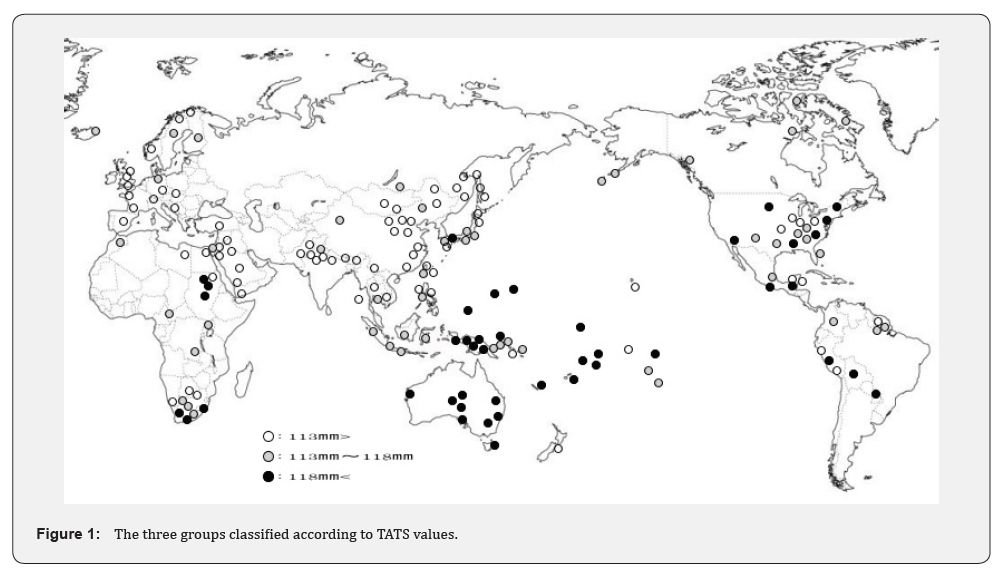
Global distribution based on TATS values
The world population has been divided into three groups (S, M and L groups) on the basis of TATS values. These three groups have certain characteristics in common. The S group of small teeth with TATS less than 113 mm (white circle) included people from Africa, Europe, European Americans, people from the Middle East, the Ainu of Japan, some Chinese, Pakistanis, Bhutanese, Indians, Russians, and people living in South East Asia (Vietnamese, Indonesians, Bruneians, Filipinos, Negrito natives, etc.) and some Polynesians (prehistoric Hawaiians). Most were of European descent and some were of Asian descent.
People in group M, who had a TATS of 113 mm or more but less than 118 mm (gray circle), included people from East Asia and people living on some Pacific islands. This group included Japanese except the Ainu, Inuit from Canada and some Chinese, Koreans, Thais, Indonesians, some Polynesians (Cook Islanders), and Mexicans and some Africans. Most were Asian, but a few were Scandinavian, including Swedes and Finns.
Group L, with large-sized teeth measuring 118 mm or more (black circle), included the inhabitants of South and Central Africa, American blacks, Australian aborigines, the highlanders of New Guinea, and the islanders of Bougainville. There were also Polynesians (Fijians, Tongans, etc.) and Melanesians (Guamese, Palauans, etc.) from the South Pacific. The Native Americans who crossed the Bering Strait and expanded into the Americas also had large teeth, as did the indigenous South Americans. These groups included people of African and Asian descent, but mysteriously no Europeans (Figure 1).
Mother of the Human ancestral
Going back in time to the origin of modern humans, human fossils have been found in East Africa and it was generally accepted that they appeared around 200,000 years ago [16]. Early modern humans are originated in southern Africa, probably in the area around Botswana [17,18]. The Khoi and San (Khoisan) peoples of the Kalahari Desert in South Africa still maintain archaic forms of hunter-gatherer lifestyles and belong to the deepest lineage known to modern humans [19-21].
Looking at the distribution of tooth size among people living on the African continent, we could see that there was a mixture of people with small, medium, and large teeth [22-32]. Among them, the Khoisan had small teeth with a TATS value of 107.5 mm [33] to 113.7 mm [34,35]. The Mesolithic Nubians of Central Africa had large teeth measuring 119.0 mm [36], but the Nubians, who were agriculturalists from 3,300 B.C. to 1,100 B.C. and intensive agriculturalists from 1 A.D. to 1,400 A.D., were placed in the S group.
On the other hand, the oldest known human skull, dating from around 300,000 years ago, was discovered at the African Middle Stone Age (MSA) hominin site of Jebel Irhoud in Morocco, North Africa. The fossil was thought to represent an early stage in the evolution of Homo sapiens. The teeth were large, comparable in size to those of H. erectus, Neanderthals, and Archaic Middle Africans [22]. However, a tooth excavated from the Upper Palaeolithic Taforalt site in Morocco (150,000-20,000 BC) had a TATS of 114.7 mm [23], which was close to the S group.
Spreading from Africa to all over the world
There are two routes believed to have been open to modern humans to leave Africa: the Northern Route and the Southern Route. One of these routes is the Northern Route, which runs through the Sinai Peninsula towards Europe and Asia. In the Levant region along this route, fossils of modern humans dating from 177,000 to 194,000 years ago have been discovered in the Mishliya Cave in Israel [26]. In this photo you can see that the upper molars have degenerated. In addition, the third molars had two cusps mesially and the distal buccal and lingual cusps were missing. Despite the high degree of morphological degeneration, the size of the teeth in this specimen was almost the same as in Qafseh/Skull and Atapuerca (SH), indicating that they were large [26].
Teeth of 113.2 mm [23] have been recovered from the Natufian site in Israel (12,500 BC - 9,500 BC) and 110.0 mm [25] from the Druse site, indicating that most people in this region had small teeth. Even today, people from the Levant region had small teeth [24, 25]. The TATS value for modern Kurds (Turkey) people living in the north of this region was 109.0 mm [24]. Teeth of 111.8 mm [30] have been excavated from Mesolithic sites in Europe, 114.7 mm [38] from Early Mesolithic sites in Germany, and 105.9 mm [38] from Merovingian (5th-8th century) sites in France, all of which were small.
Another southern route starts in South East Africa and runs south from the Somali peninsula, through the Strait of Bab al- Mandeb to the Arabian Peninsula. It continues along the coast to India and South East Asia. The TATS value for the teeth of the Bedouin people in the area of the Arabian Peninsula was small at 112.5 mm [50], and the Yemenis also had small teeth at 106.2 mm [49] and 107.3 mm [24], and there were no people with large teeth in this peninsula. The small-toothed people spread east along the Indian Ocean from the coast of the Middle East, extending their distribution into South East Asia, then further south into Indonesia and north into North East Asia.
For example, small-sized teeth of 105.9 mm and 109.2 mm were found in Afghanistan [52], while in India the Punjabi had teeth of 112.6 mm [80] and the Hindus had teeth of 111.2 mm [79], the Tibetans in the Everest Mountains had teeth of 108.1 mm [81] and Bhutan had teeth of 107.9 mm [82]. The Andaman Islands in the Bay of Bengal had an average of 111.7 mm [13], Vietnam along the East China Sea 109.7 mm [50], Thailand in the Gulf of Thailand 112.6 mm [60] and 112.7 mm [68]. Teeth were also smaller in areas of North East Asia, including China. In China, Anyang (1,500 BC-1,027 BC) was 111.7 mm [60], Chifeng (1,027 BC-200 BC) 113.8 mm [60], Beijing 110.5 mm [66] and Yunnan 112.8 mm [65]. On the shores of Lake Baikal in Russia, Neolithic people had a TATS of 113.7 mm [5], and those living in the surrounding areas had small teeth of 110.8 mm [5] and 112.4 mm [54]. In North East Asia, teeth ranged from 109.4 mm to 112.2 mm [5].
After that, the teeth of the inhabitants who moved from South East Asia to Indonesia, and then to New Guinea and Australia, became larger. The people who moved to the remote Oceania region of the South Pacific also had large teeth. Large teeth were also found in the populations that migrated to the Americas. These distributions due to the TATS values were also similar to the results of mitochondrial DNA analysis [27]. It is thought that early modern humans left Africa and spread around the world, retaining their small-sized teeth, and then developing mediumto large-sized teeth as they adapted to the climate, culture, environment, nutrition, etc. of the regions in which they settled.
Acknowledgements
This research is based on a large amount of valuable dental measurement data collected from human populations around the world. I would like to express my sincere gratitude to the researchers who worked to collect this dental measurement data.
Appendix
TATS values for modern humans

Measurements in mm.
No record: Male, MF: Both sexes pooled
BP: Before Present, Aust. ab.: Australian aboriginals, EP: Early Peruvian Cultural Tradition, LP: Late Peruvian Cultural Tradition.
References
- Hanihara K (1978) Differences in sexual dimorphism in dental morphology among several human populations. In: Butler PM and Joysey KA, (Eds.), Development, function, and evolution of teeth. Academic Press, London.
- Ortiz A, Zhang Y, Jin C, Wang Y, Zhu M, et al. (2019) Morphometric analysis of fossil hylobatid molars from the Pleistocene of southern China. Anthropological Science 127(2): 109-121.
- Matsumura H (1994) A microevolutional history of the Japanese people from a dental characteristics perspective. Anthropological Science 102(2): 93-118.
- Kimbel WH, Lockwood CA, Ward CV, Leakey MG, Rak Y, et al. (2006) Was Australopithecus anamensis ancestral to A.afarensis? A case of anagenesis in the hominin fossil record. Journal of Human evolution 51(2): 134-152.
- Matsumura H, Ishida H, Amano T, Ona H, Yoneda M (2009) Biological affinities of Okhotsk-culture people with East Siberians and Arctic people based on dental characteristics. Anthropological Science 117(2): 121-132.
- Suwa G, Sasaki T, Semaw S, Rogers MJ, Simpson SW, et al. (2021) Canine sexual dimorphism in Ardipithecus ramidus was nearly human-like. PNAS 118(49): 1-11.
- Nakata M (1971) A study of the genetic factors involved in tooth loss. The Journal of the Stomatological Society 46: 131-139.
- Townsend DC, Brown T (1979) Tooth size characteristics of Australian Aborigines. Occasional Papers in Human Biology 1: 17-38.
- Townsend GC (1983) Tooth size in children and young adults with trisomy 21 (Down) syndrome. Archives of Oral Biology 28(2): 159-166.
- Brace CL (1981) Oceanic tooth-size variation as a reflection of biological and cultural mixing. Current Anthropology 22(5): 549-
- Townsend GC (1992) Genetic and environmental contributions to morphometric dental variation. Journal of Human Ecology Special Issue 2: 61-72.
- Yamada H (1977) Factor analysis of human teeth, dental arch and palate. Aichi-Gakuin Journal of Dental Science 15(3): 267-287.
- Matsumura H. and Hudson MJ (2005) Dental perspectives on the population history of Southeast Asia. American Journal of Physical Anthropology 127(2): 182-209.
- Mizoguchi Y (1981) Oceanic tooth-size variation as a reflection of biological and cultural mixing. In: Brace CL, Robert J Hinton, Tasman Brown, Green RC, Edward F Harris, (Eds.), Current Anthropology 22(5): 549-
- Yamada H (2018) Data Set: Odontometric Comparisons of Permanent Dentition in Human Populations. Dental Anthropology 31(2): 27-35.
- Richter D, Grün R, Joannes-Boyau R, Steele TE, Amani F, et al. (2017) The age of the hominin fossils from Jebel Irhoud, Morocco, and the origins of the Middle Stone Age. Nature 546: 293-296.
- Schuster SC, Miller W, Ratan A, Tomsho LP, Giardine B, et al. (2010) Complete Khoisan and Bantu genomes from southern Africa. Nature 463: 943-947.
- Chan EKF, Hardie R-A, Petersen DC, Beeson K, Bornman RMS, et al. (2015) Revised Timeline and Distribution of the Earliest Diverged Human Maternal Lineages in Southern Africa. Plos One 10(3): 1-17.
- Behar DM, Villems R, Soodyall H, Blue-Smith J, Pereira L, et al. (2008) The Dawn of Human Matrilineal Diversity. The American Journal of Human Genetics 82(5): 1130-1140.
- Rito T, Richards MB, Fernandes V, Alshamali F, Cerny V, et al. (2013) The First Modern Human Dispersals across Africa. Plos One 8 (11): 1-16.
- Chan EKF, Timmermann A, Baldi BF, Moore AE, Lyons RJ, et al. (2019) Human origins in a southern African palaeo-wetland and first migrations. Nature 575: 185-189.
- Hublin J-J, Ben-Ncer A, Bailey SE, Freidline SE, Neubauer S, et al. (2017) New fossils from Jebel Irhoud, Morocco and the pan-African origin of Homo sapiens. Nature 546: 289-292.
- Smith P (1979) Regional diversity in epipaleolithic populations. OSSA 6: 243-250.
- Koyoumdjisky-Kaye E, Zilberman Y, and Zeevi Z (1976) A comparative study of tooth and dental arch dimensions in Jewish children of different ethnic descent. 1. Kurds and Yemenites. American Journal of Physical Anthropology 44(3): 437-444.
- Koyoumdjisky-Kaye E, Zilberman Y, Hazen O (1977) A comparative study of tooth and dental arch dimensions in Circassian and Druse children. Zeitschrift für Morphologie und Anthropologie 68(3): 298-306.
- Hershkovitz I, Weber GW, Quam R, Duval M, Grün R, et al. (2018) The earliest modern humans outside Africa. Science 359: 456-459.
- Shinoda K (2022) The origin of humanity: Ancient DNA tells the story of Homo sapiens "great journey". Chuko Shinsho, Japan.
- Tocheri MW (2019) Unknown human species found in Asia. Nature 568: 176-178.
- Jacobson A (1982) The dentition of the South African negro. Birmingham: UAB School of Dentistry Publishers.
- Wajeman G, Levy G (1979) Growth variations in the permanent teeth of modern man. Journal of Human Evolution 8: 817-825.
- Kieser JA, Cameron N, Groeneveld HT (1987) Evidence for a secular trend in the Negro dentition. Annals of Human Biology 14(6): 517-532.
- Van Reenen JF (1982) The effects of attrition on tooth dimensions of San (Bushmen). In, Teeth: Form, Function, and Evolution, ed. B. Kurten. Columbia University Press, New York. Pp. 182-203.
- Van Reenen JF (1966) Dental features of a low-caries primitive population. Journal of Dental Research 45(3): 703-713.
- Kieser JA, Groeneveld HT, Preston CB (1985) An odontometric analysis of the Lengua Indians dentition. Human Biology 57: 611-620.
- Shaw GCM (1931) The teeth, the bony Palate and the Mandible in Bantu Races of South Africa. London: J. Bale and Sons.
- Calcagno JM (1989) Dental reduction in post-Pleistocene Nubia. American Journal of Physical Anthropology 70(3): 349-363.
- Barnes DS (1969) Tooth morphology and other aspects of the Teso dentition. American Journal of Physical Anthropology 30(2): 183-194.
- Frayer DW (1978) Metric dental change in the European Upper Paleolithic and Mesolithic. American Journal of Physical Anthropology 46(1): 109-120.
- Y'Edynak G (1989) Yugoslav Mesolithic dental reduction. American Journal of Biological Anthropology 78(1): 17-36.
- Brace CL (1979) Krapina, “Classic” Neanderthals, and the evolution of the European face. Journal of Human Evolution 8(5): 527-550.
- Lavelle LCB (1972) Maxillary and mandibular tooth size in different racial groups and in different occlusal categories. American Journal of Orthodontics 61(1): 29-37.
- Axelsson G, Kirveskari P (1983) Crown size of permanent teeth in Icelanders. Acta Odontologica Scandinavica 41(3): 181-186.
- Selmer-Olsen R (1949) An odontological study of the Norwegian Lapps. Skrift Norske Vidensk Akademi 3: 1-167.
- Kirveskari P, Hansson H, Hedegard B, Karl N (1977) Crown size and hypodontia in the permanent teeth of modern Skolt Lapps. American Journal of Physical Anthropology 48(1): 107-112.
- Seipel CM (1946) Variation in tooth position, a metric study of variation and adaptation in the deciduous and permanent dentitions. Swedish Dental Journal 39: 1-176.
- Alvesalo L (1985) Dental growth in 47, XYY males and in conditions with other sex-chromosome anomalies. In: The Y Chromosome, Part B: Clinical Aspects of Y Chromosome Abnormalities Alan R. Liss, New York. Pp. 277-300.
- Viciano J, Alemán I, D’Anastasio R, Capasso L, Botella MC (2011) Odontometric sex discrimination in the Herculaneum sample (79AD, Napes, Italy), with application to juveniles. American Journal of Physical Anthropology 145(1): 97-106.
- Dahlberg AA (1960) The dentition of the first agriculturists (Jarmo, Iraq). American Journal of Physical Anthropology 18(4): 243-256.
- Rosenzweig KA, Zilberman Y (1967) Dental morphology of Jews from Yemen and Cochin. American Journal of Physical Anthropology 26(1): 15-22.
- Rosenzweig KA, Zilberman Y (1969) Dentition of Bedouin in Israel. American Journal of Physical Anthropology 31(2): 199-204.
- Koyoumdjisky-Kaye E, Steigam S, Gudelevitch B (1978b) A comparative study of tooth and dental arch dimensions in Israel children of Cochin and North-African descent. Zeitschrift für Morphologie und Anthropologie 69(1): 32-42.
- Sakai T, Hanamura H, Ohno N (1971) Tooth size of the Pashtun and Tajik in Afghanistan. Journal of the Anthropological Society of Nippon 79(2): 159-177.
- Matsumura H (1995a) Dental Characteristics of the Neolithic Remains from Jiangnan. In: Yamaguchi B and Xianghong H (Eds.), Studies on the Human Skeletal Remains from Jiangnan, China. National Science Museum Monographs 10: 87-95.
- Matsumura H (1995b) Dental characteristics affinities of the Prehistoric to modern Japanese with the East Asians, American Natives and Australo-Melanesians. Anthropological Science 103(3): 235-261.
- Brace C, Nagai M (1982) Japanese tooth size, past and present. American Journal of Physical Anthropology 59(4): 399-411.
- Hanihara T (1990a) Affinities of the Philippine Negritos with Japanese and the Pacific populations based on dental measurements, The basic population in East Asia, Ⅰ. Journal of the Anthropological Society of Nippon 98(1): 13-27.
- Kibi N (1989) Physical affinity of the Pre- and Proto-historic Japanese of Kinki and Chugoku districts as viewed from dental measurements. Anthropological Reports 48: 1-25.
- Matsumura H (1989) Geographical variation of dental measurements in the Jomon population. Journal of the Anthropological Society of Nippon 97(4): 493-512.
- Oyamada J (1992) Tooth crown size of Yayoi people in the North-West and the North of Kyushu. Journal of the Anthropological Society of Nippon 100(1): 83-100.
- Matsumura H (1994) A microevolutional history of the Japanese people from a dental characteristics perspective. Anthropological Science 102(2): 93-118.
- Suzuki N (1993) Generational differences in size and morphology of tooth crowns in the young modern Japanese. Anthropological Science 101(4): 405-429.
- Inoue N, Takahashi Y, Sakashita R, Wu M-L, Nozaki T, et al. (1992) Morphometrical and dental pathological studies on skulls from Yin-Shang Period. Journal of Anthropological Society of Nippon 100(1): 1-29.
- Goose DH (1977) The dental condition of Chines living in Liverpool. In: Dahlberg AA and Graber TM (Eds.), Orofacial Growth and Development. Mouton, The Hugue. pp. 183-194.
- Brace CL, Vitzthum V (1984a) Human tooth size at Mesolithic, Neolithic and Modern levels at Niah Cave, Sarawak: Comparisons with other Asian Populations. The Sarawak Museum Journal 33: 75-82.
- Brace CL, Shao X, Zhang Z (1984b) Prehistoric and modern tooth size in China. In: Smith FH and Spencer F (Eds.), The Origins of Modern Humans: A world Survey of the Fossil Evidence. New York: Alan R. Liss, pp. 485-516.
- Miura F, Soma K, Kuroki T, Fukawa T, Ishida T, et al. (1991) Dental anthropological study of Mongoloid in China. Journal of the Japanese Stomatological Society 58(2): 566-579.
- Hanihara T (1990b) Studies on the affinities of Sakhalin Ainu based on dental characters, The basic populations in East Asia, Ⅲ. Journal of the Anthropological Society of Nippon 98(2): 425-437.
- Brace CL (1976) Tooth reduction in the Orient. Asian Perspective 19: 203-219.
- Cho D (1973) Studies on the tooth size of Koreans. Journal of Growth 12: 1-18.
- Suzuki A, Han BJ, Takahama Y, Son W-S, Itou K, et al. (1994) Tooth crown affinities among South Koreans, Central Taiwanese, and Certain Japanese populations. 16 Anthropological Science 102(3): 271-283.
- Liao JY (1984) Tooth size of Chinese in Taiwan. Aichi-Gakuin Journal of Dental Science 22: 111-140.
- Liu KL (1977) Dental condition of two tribes of Taiwan Aborigines ― Ami and Atayal. Journal of Dental Research 56(2): 117-127.
- Sasaki M (1982) A physical anthropological study of the teeth in the tribe of Taiwan aborigines, Paiwan. The Journal of the Kyushu Dental Society 36: 433-467.
- Kudo K (1985) A physical anthropological study of the teeth in the Bunun tribe of Taiwan aborigines. The Journal of the Kyushu Dental Society 39: 201-229.
- Hanihara T (1992) Biological relationship among southeast Asians, Jomonese, and the Pacific populations as viewed from dental characters: The basic populations in the east Asia, X. Journal of the Anthropological Society of Nippon 100(1): 53-67.
- Potter RHY, Alcazaren AB, Herbosa FM, To-maneng J (1981) Dimensional characteristics of the Filipino dentition. American Journal of Physical Anthropology 55(1): 33-42.
- Cruz LC (1971) A study of the mesiodistal crown diameters of permanent teeth among young Filipino adults. The Journal of the Philippine Dental Association 23(4): 14-18.
- Mijsberg WA (1931) On sexual differences in the teeth of Javanese. Koninklijke Akademie voor Wetenschap 34: 1111-1115.
- Taverne PP (1980) Een Fysisch Anthropologisch Onderzoek van de Gebitten van Vier Surinaamse Bevolkingsgroepen. Thesis, Rijksuiversiteitte Groningen.
- Bhasin MK, Sharma A, Singh IP, Walter H (1985) Morphological and metric dental study on Indians. Zeitschrift für Morphologie und Anthropologie 76(1): 77-90.
- Sharma JC (1985) Evolutional significance of dental morphology and odontometry. In: Reddy VR (Ed.), Dental Anthropology, Application and Methods. New Delhi, Inter-India Publications, pp. 251-267.
- Prakash S, Kaul V, Kanta S (1979) Observations on the Bhutanese dentition. Human Biology 51(1): 23-30.
- Yamada H, Kawamoto K, Sakai T, Katayama K (1988a) Interisland variation in tooth size of the Cook Islanders, and their biological affinities with other Oceanic people. Journal of the Anthropological Society of Nippon 96(4): 435-448.
- Yamada H, Kawamoto K (1988b) The dentition of Cook Islanders. In: Katayama K and Tagaya A (Eds.), People of the Cook Islands – Past and Present. A report of the physical anthropological and linguistic research in the Cook Islands in 1985-1987 (pp. 143-209), The Cook Islands Library and Museum Society Bulletin No. 5.
- Matsuno M (1997) Dental anthropological study on tooth size in Fiji, Western Samoa and Kiribati. Nihon University Journal of Oral Science 23: 33-52.
- Houghton P (1978) Polynesian mandibles. Journal of Anatomy 127(Pt 2): 251-260.
- Kean MR, Houghton P (1990) Polynesian face and dentition, Functional perspective. American Journal of Physical Anthropology 82(3): 361-370.
- Kanazawa E, Matsuno M, Nakabayashi T, Igarashi Y, Nagai A (1998) Tooth size of living peoples in Western and Eastern Micronesian populations. Anthropological Science 106(3): 199-208.
- Bailit HL, Dewitt SJ, Leigh RA (1968) The size and morphology of the Nasioi dentition. American Journal of Physical Anthropology 28(3): 271-287.
- Doran GA, Freedman L (1974) Metrical features of the dentition and arches of populations from Goroka and Lufa. Papua New Guinea. Human Biology 46(3): 583-594.
- Boyd RC (1972) Appendix Ⅳ: An odontometric and observational assessment of the dentition. In: Little wood RA (Ed.), Physical Anthropology of the Eastern Highlands of New Guinea. University of Washington Press, Seattle and London.
- Kanazawa E, Matsuno M, Sekiguchi H, Suzuki T, Satake T, et al. (2000) Tooth size of people in Wabag, Papua New Guinea Highlanders and its comparison with Pacific peoples. Anthropological Science 108(2): 169-181.
- Janzer O (1921) Die Zahne der Neu-Pommen. Viertel-jhrsschr Zahnhlk 43: 289-319.
- Turner CG, Swindler DR (1978) The dentition of the New Britain West Nakanai Melanesians. Ⅷ. People of the Pacific. American Journal of Physical Anthropology 49(3): 361-372.
- Harris EF, Bailit HL (1987) Odontometric com-parisons among Solomon Islanders and other Oceanic peoples. In: Friedlander JS and Howells WW (Eds.), The Solomon Islands Project: A Long-Term Study of Health, Human Biology, and Culture Change (pp. 215-264). Cambridge: Oxford University Press.
- Campbell TD (1925) Dentition and palate of the Australian Aboriginal. University of Adelaide, The Hassell Press, p. 4-26.
- Barrett MJ, Brown T, MacDonald MR (1963) Dental observations on Australian aborigines, MD crown diameters of permanent teeth. Australian Dental Journal 8(2): 150-156.
- Brown T, Townsend GC (1979) Sex determination by single and multiple tooth measurements. Occasional Papers in Human Biology 1: 1-16.
- Townsend GC, Brown T (1980) Dental asymmetry in Australian Aboriginals. Human Biology 52(4): 661-673.
- Smith P, Brown T, Wood WB (1981) Tooth size and morphology in a recent Australian Aboriginal population from Broadbeach, South East Queensland. American Journal of Physical Anthropology 55(4): 423-432.
- Mayhall JT (1979) The dental morphology of the Inuit of the Canadian Central Arctic. Ossa 6: 199-218.
- Moorrees CFA, Thomsen SO, Jensen E, Yen PKJ (1957) Mesiodistal crown diameters of deciduous and permanent teeth. Journal of Dental Research 36(1): 39-47.
- Hanihara K (1976) Statistical and comparative studies of the Australian aboriginal dentition. The University Museum The University of Tokyo Bulletin No.11: 1-57.
- Hanihara K (1979) Dental traits in Ainu, Australian Aborigines, and New World populations. In: Laughline WS and Harper AB (Eds.), The first Ameri-cans, Origins, Affinities, and Adaptations. New York: Stuttgart, pp. 125-134.
- Richardson ER, Malhotra SK (1975) Mesiodistal crown dimensions of the permanent dentition of American Negroes. American Journal of Orthodontics 68(2): 157-164.
- Garn SM, Lewis AB, Kerewsky RS (1964) Sex difference in tooth size. Journal of Dental Research 43: 306.
- Takehisa S (1957) An anthropological and morpho-logical comparative study of American White teeth and Japanese teeth. Shikagakuhou 57: 1-41.
- Perzigian AJ (1976) The dentition of the Indian Knoll skeletal population odontometrics and cusp number. American Journal of Physical Anthropology 44(1): 113-122.
- İşcan MY (1989) Odontometric profile of a prehistoric Southeastern Florida population. American Journal of Physical Anthropology 78(1): 3-8.
- Miura F, Ichijyo T, Soma K, Kuroki T, Fukawa T, et al. (1989) Dental anthropological study of the Central American Indians. Journal of the Japanese Stomatological Society 56(3): 409-428.
- Harris EF, Nweeia MT (1980) Tooth size of Ticuna Indians, Colombia, with phenetic comparisons to other Amerindians. American Journal of Physical Anthropology 53(1): 81-91.
- Christensen AF (1998) Odontometric microevolution in the Valley of Oaxaca, Mexico. Journal of Human Evolution 34(4): 333-360.
- Nelson CT (1938) The teeth of the Indians of Pecos Pueblo. American Journal of Physical Anthropology 23(3): 261-293.
- Sciulli (1979) Size and morphology of the permanent dentition in Prehistoric Ohio Valley Amerindians. American Journal of Physical Anthropology 50(4): 615-628.
- Moorrees CFA (1957) The Aleut Dentition. Cam-bridge: Harvard University Press.
- Scott EC (1979) Increase of tooth size in prehistoric coastal Peru, 10,000B.P.-1,000 B.P. 50(2): 251-258.

























