




 GJAA Home



CT-Analysis and Facial Reconstruction of Children Mummy from Cerro La Horca (Barranca District, Peru)
Justyna Marchewka1*, Karina Woźniak2, Łukasz Majchrzak3, Beata Borowska2, Veronika Bogdanovich1, Plinio Guillien3, Carlos Escobar3, Marek Michalski4, Jakub Duda1, Jakub Mielch1, Zuzanna Tomporowska1 and Andrzej Długoński5
1Department of Human Biology, Institute of Biological Sciences, Cardinal Stefan Wyszynski University in Warsaw, 1/3 Woycickiego Street, 01-938 Warsaw, Poland
2Department of Anthropology, Faculty of Biology and Environmental Protection University of Lodz, Banacha Street 12/16; 90-237 Lodz, Poland
3Proyecto de Investigación los Valles de Barranca, Av. Lauriama 361, Barranca 15169, Peru
4Natural History Museum of University of Lodz, Faculty of Biology and Environmental Protection University of Lodz, Kilińskiego Street 101; 90-011 Lodz, Poland
5Department of Landscape Architecture, Warsaw University of Life Science, Nowoursynowska Street 166; 02-787 Warsaw
Submission: July 15, 2024; Published: July 25, 2024
*Corresponding author: Justyna Marchewka, Department of Human Biology, Institute of Biological Sciences, Cardinal Stefan Wyszynski University in Warsaw, 1/3 Woycickiego Street, 01-938 Warsaw, Poland
How to cite this article: Justyna Marchewka*, Karina Woźniak, Łukasz Majchrzak, Beata Borowska, Veronika Bogdanovich, Plinio Guillien, et al. CT-Analysis and Facial Reconstruction of Children Mummy from Cerro La Horca (Barranca District, Peru). Glob J Arch & Anthropol. 2024; 14(1): 555877. DOI: 10.19080/GJAA.2024.14.555877
Abstract
The aim of the study was a paleoradiological analysis of one of the few completely preserved pre-Columbian child mummies from the Barranca Valley region. The goal also included an attempt to reconstruction of the antemortem appearance of the face.
The mummy comes from the pre-Columbian cemetery of Cerro la Horca, located in the Fortaleza River Valley. This cemetery has been subjected to systematic looting over the years. The activities of grave robbers resulted not only in the destruction of grave contexts and material culture relics, but also in the destruction of the bodies of the pre-Columbian inhabitants of the valley buried in the cemetery. The examined mummy, to our knowledge, is the only completely preserved body from this archaeological site. The analysis used conventional computed tomography, as well as standard anthropological methods and facial reconstruction techniques.
The age at the time of the death was estimated at 2 to 3 years. The light color of a child’s hair suggests the presence of protein deficits known as kwashiorkor. The condition is most common after weaning and switching to carbohydrate-rich foods. The facial reconstruction performed allowed the reconstruction of the child’s life-like appearance and is the first reconstruction made for mummified remains from the area.
Keywords: Child Mummy; Barranca Valleys; Pro-Columbian Cemetery; CT; Facial Reconstruction
Introduction
The studies of human remains skeletal remains or mummified bodies recovered during archaeological excavations are one of the primary sources of information on the biology and living conditions of populations that inhabited a particular area at a particular time. This is important when no written sources are available, which is the case when researching pre-Columbian cemeteries in Peru. Moreover, some of them were systematically plundered and the bodies of the deceased were removed from the graves creating specific contexts. An individual presented in the following article was discovered by local people directly on the Cerro la Horca site, although we do not know the exact location of its original burial, as the site surface embraces some 50 ha. A seated/crouched position, together with a possible artificial mummification, and a cotton woven textile including the late Interlocking decoration pattern make us believe the individual was buried during the Late Intermediate Period, possibly between the 13 and 15th century AD, as our previous works on a local chronology conducted in the neighboring Huaura valley suggest [1]. The subadult was probably wrapped in layers of textiles and different plant materials, reAbstract moved in the moment when its grave was being plundered. Unfortunately, we do not know its archaeological context, nevertheless there are some information on the site itself.
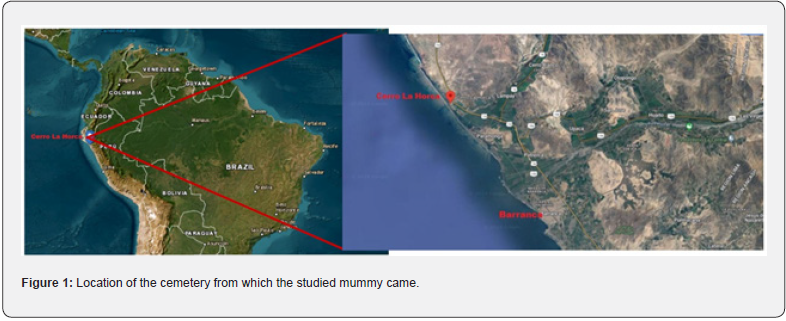
Cerro la Horca is an multi-temporal archaeological settlement located in the Fortaleza valley, some 200 km north of modern Peruvian capital, Lima, in the Barranca region. The site is placed on a cliff hanging over the Pacific seashore, on the left bank of the Fortaleza river. The location of the pre-Columbian cemetery is presented in Figure 1.
In the present, it is covered with a dune, with thousands of plundering trenches penetrating its surface, and one can find countless human remains and archaeological artifacts scattered everywhere, among the ruins of monumental architecture. Only few archaeological prospections [2] and limited excavations [3] were carried in the past, and a high resolution digital DEM (digital elevation model) – based plan has been executed recently by Proyecto de Investigación los Valles de Barranca. Fuentes [2] executed a detailed plan of the site, registering large – area walled enclosures on both sides of the Fortaleza river mouth, with monumental architecture and courtyards inside. Our DEM plan completed Fuentes’s one, indicating that observed architecture was following the patterns known from the Peruvian North Coast, where first Moche (ca. 200 – 900 AD) and then Lambayeque (ca. 900 – 1350 AD) and Chimu (ca. 900 – 1533) cultures developed. On the whole site one can find plundered burials from different epochs, and some 470 of them have been recently studied by Luis Valle [3], who excavated an area located on the eastern edge of the site, along the Panamericana highway. Valle found that burials located in that place were deposited over a period of some 500 years, from the Middle Horizon (900 – 1100 AD) to the end of Late Intermediate Period (1100 – 1470 AD). A pottery discovered in burials was executed in different styles, including Chimu, Lambayeque, Chancay, Pativilca and Casma. A burial pattern was typical for that period, with natural or artificial mummified bodies set up in the flexed position, wrapped with textiles, vegetal materials and artifacts, so that the funerary bundle or fardo was created. The bundles were buried together with different grave goods, and due to the extremely dry conditions of Peruvian coastal desert, all those materials survived to our times. As the archaeological excavation concerned only small percent of the site, it is difficult to reconstruct its biography. Our observations of profiles cut by the Fortaleza river flow suggest a complex stratigraphy, with anthropogenic sediments reaching as deep as 5 meters below modern surface. The monumental architecture, of which remains still can be seen on the surface, was constructed in the last centuries before the Spanish invasion, with an Inca temple of the Sun built on the top of the cliff. We can hypothesize that Cerro la Horca was a local oracle and ceremonial centre, perhaps also a capital of some local state. In the Andes, such places served also as the burial grounds for the elites, both during the periods of prosperity and after the abandonment. Valle [3] discovered a monumental architecture related directly to the burials, something similar we observed also on the El Porvenir site, located some 15 km from Cerro la Horca. The cult of the dead was a central point of Andean religions, and was registered also in valleys adjacent to the Barranca region [1,4]. The fact that the described individual presented an excellent state of preservation at the moment of the study suggests an elaborated treatment of the children bodies, similarly to the funerary ritual in the Chancay culture, studied by us before [5].
The aim of the work was to reconstruct the child’s osteobiography in a way that the integrity of his mummified body was not compromised. In addition, our goal was to try to recreate the lifelike appearance of the dead child.
Material and Methods
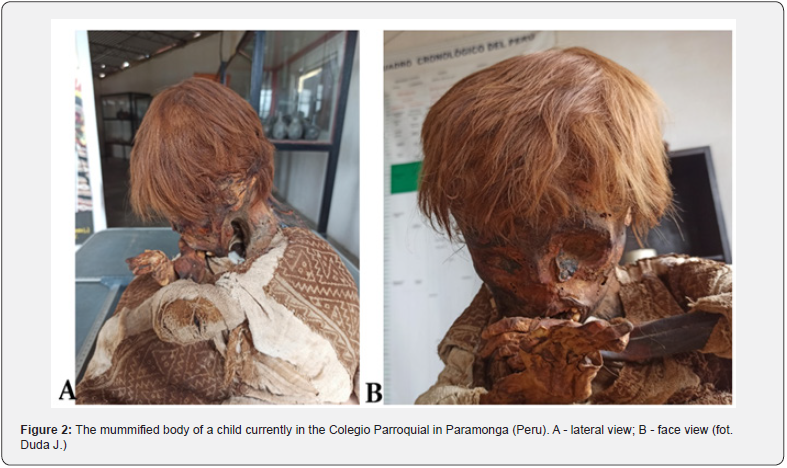
The study material was a child’s mummy in the collection of a museum established at the Colegio Parroquial, Nuestra Seniora del Carmen in Paramonga. In addition to this mummy, the museum also houses pottery and textiles from the Cerro La Horca site. The mummy of the child is in a sitting position and dressed in a textiles. The presence of textiles and the complete mummification of the body prevented precise measurements of the skeleton and complete observation of the dentition. During macroscopic observation of the body, the presence of mummified male genitalia was observed after unwrapping the textiles that had been placed over the body. Of particular note is the color of the mummy’s hair, which is red, which is very unusual for Peruvian populations. Our previous experience in studying human skeletal remains and mummified bodies from this part of the world shows that such hair color cannot be explained by exposure to UV radiation. As the management of Colegio Parroquial did not agree to any invasive examination of the mummy, it was decided to use a tomographic analysis and, based on this, to perform an osteobiography reconstruction. CT scanning was performed at Clínica María Auxiliadora in Barranca (Somatom Scope Siemens). Scanning was performed to an accuracy of 0.2 mm. Volumetric reconstructions were then performed and Radiant DICOM Viewer 2024.1 (64-bit). Measurements of the humerus and femur were taken and the dentition was visualized. Based on these, an assessment of age at death was made. The methodology presented by AlQuahtani et al. [6] and Schaefer et al. [7] was used to assess it. A three-dimensional model of the facial reconstruction was used to make a life-size reconstruction of the face of the skull, obtained using Slicer 5.6.2.The exported STL file, was then imported into Blender 3.6, in which soft tissues were modeled using the Menchester method [8]. The first part of the approximation of the face was to apply soft tissue thickness markers to the anthropometric points of the of the skull. This was followed by modeling facial muscles applied from the “OrtogOn Blender,” according to the anatomy described in Wilkinson [8]. The projection of the nose made follows the methodology used by C. Moraes to reconstruct the Egyptian-Romanian mummies [9]. The final image of the reconstruction (including hair color) is based on also based on the observations made during the visual inspection of the mummy (Figure 2).
Results
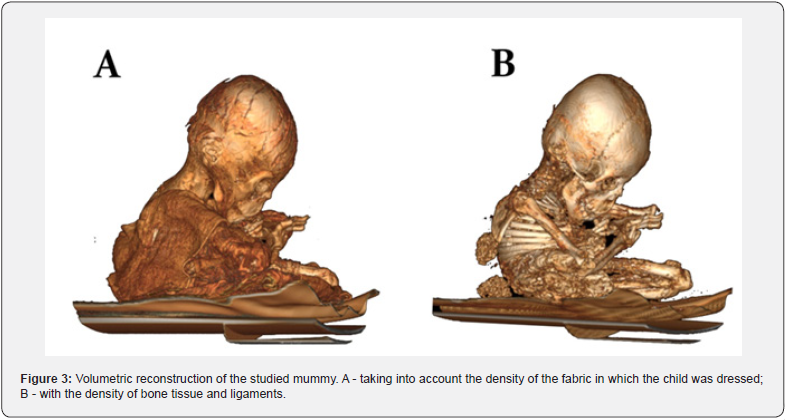
First, a volumetric reconstruction of the body was prepared based on the CT scans. This allowed an accurate assessment of the position in which the body was placed. Measurements were taken of the lengths of the humeral and femoral shafts. The dentition was extracted and on this basis the degree of formation and eruption of deciduous and permanent teeth was determined.
Figure 3 presents the volumetric reconstruction of the child mummy studied. This reconstruction takes into account the density of the skin and fabrics that were put on the body. On the reconstructions made, the sitting position of the deceased is visible, and there is a clear intentional deformation of the skull. This type of deformation is referred to as a tabular erecta deformity, and it involves limiting the growth of the skull in the anterior-posterior direction.
This was followed by extracting the dentition and measuring the lengths of the humerus and femurs. Figure 4 presents the state of formation and eruption of the dentition. Compared to the developmental charts of Al Quahtani et al. [6], the age of the death of the studied body is in the range of 2 to 3 years. The length measurement of the right humerus is 128.2 mm, and the right femur 201.5 mm. Age at death estimated a based on the length of these bones is between 2-2.5 years and 3 to 3.5 years, respectively.
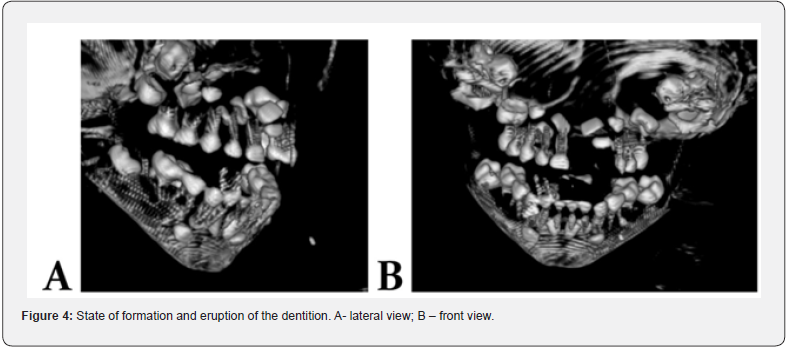
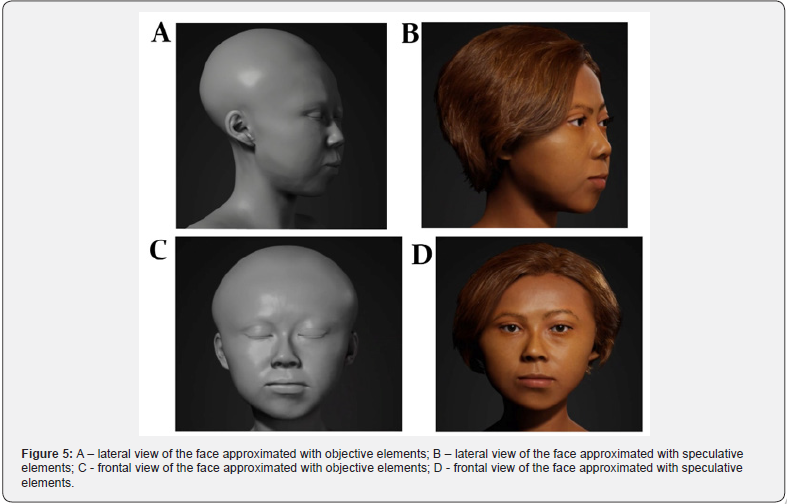
Figure 5 shows the results of a facial reconstruction of a child from Cerro la Horca. It was prepared for a male child (external genitalia preserved) aged about 3 to 4 years. The left part of the figure includes reconstructions of objective elements, the right part is an artistic presentation of the life-like appearance, which includes hair decolorization.
Discussion
Reconstruction of osteobiography based on radiological analysis is an increasingly common means of non-invasive and non-destructive examination of mummified human remains [10- 15]. The use of computed tomography allows the body’s integrity to be preserved and, on the other hand, allows for the determination of the biological profile and health status. On the other hand, the accuracy of CT scanning may cause artifacts and inaccuracies in the analysis, as Cox [16] points out. Pazner et al. [17] also refer to the problems associated with the analysis of radiological images of mummified bodies and indicate that, apart from the method itself, the results may also be influenced by postmortem changes. The authors recommend caution in interpreting the results, but considering the non-invasive nature of computed tomography, its advantages seem to outweigh it. In the case of the mummy we examined, CT was the only available method to assess basic biological parameters. In addition, it also allowed us to reconstruction of the appearance of life.
In the case we studied, both a method based on determining dental age and a morphometric method were used to assess age at death. Tooth eruption is the axial movement mechanism of the tooth germ from the alveolar bone to a functional occlusion position in the oral cavity [18]. Many factors such as nutritional status, low birth weight and prematurity, as well as ethnicity, can affect the eruption of deciduous and permanent teeth [19-22]. Also, growth during childhood, and therefore bone growth in length, depends on the influence of many factors, including nutritional status and socioeconomic factors [23, 24]. In general, in our case, for both methods, the result obtained is similar. A slightly lower age range was obtained for the method based on the analysis of dentition, but given that we do not know the rate of eruption of dentition for pre-Columbian populations, just as we do not know the rate of growth of long bones, the results obtained can be considered compatible. At this point, it is also important to consider the potential impact of malnutrition, which in the case of the studied mummy presents itself primarily in the form of significantly discolored and fine hair. Thus, we cannot exclude the possibility that in the case studied, malnutrition may have caused a delay in the eruption of the dentition and the growth of the skeleton, so de facto we may be dealing with a child older than the dental and morphometric ages indicate. All the more so since the Peruvian population is one of the low-growth ones, and the comparison tables presented by Schaefer et al. [7] were prepared for a different population. No less for the Peruvian population, there is no analogous comparative data.
The color of the hair of the studied child mummies can be explained by advanced nutritional deficits, especially dietary protein deficits or a diet based mainly on corn. Malnutrition, which causes, among other things, discoloration (lightening) and thinning of the hair, is referred to in the literature as kwashiorkor [25]. The phrase Kwashiorkor, means “the sickness of the weaning,” originates from the Kwa language of Ghana. Kwashiorkor is believed to be brought on by a low protein intake but an average calorie intake. Children that consume a lot of maize are known as “sugar babies” because their diets are frequently low in protein but high in carbs [26]. Kwashiorkor, besides decolorization and thinning hair, manifests with edema due to hypoalbuminemia, resulting in the appearance of “full faces”. The “pot-belly” appearance is secondary to fatty infiltration of the liver. The subcutaneous fat is preserved, but muscle atrophy is evident [26]. In our case, it was impossible to observe these features due to the mummification of the body, but when analyzing the mummy macroscopically, a flopping of the skin in the lower face region is noticeable (Figure 2A). Immunological studies have shown that kwashiorkor can cause immune system disorders resulting in increased susceptibility to infectious diseases [27]. Research on children’s intellectual development shows that dietary protein deficiencies can cause developmental disorders [28]. Given the numerous finds of maize remains in Pre-Columbian burials and the results of isotopic analyses [1,29, 30] it should be recognized that maize was the staple food of these communities. Therefore, if, after stopping breastfeeding, children were switched to foods that mainly consisted of corn, there was a risk of protein deficiencies. In the case of the examined mummy, scanning performed with an accuracy of 0.2 mm did not allow for the observation of the porosity of the orbital roof. Therefore, we are not sure whether cribra orbitalia was present, which is treated in bioarchaeology as one of the signs of anemia and malnutrition [31].
The reconstruction of children’s faces is done in the same way as the reconstruction of adults’ faces by the Manchester method. However, incomplete databases related to soft tissue thickness, nose patterning and eye position pose difficulties. According to Wilkinson [8], the relationship between soft tissue and skull construction in children has not yet been particularly studied, especially with regard to gender. In our case, the reconstruction of the child was facilitated by the known sex (genitalia). Also, the state of preservation of the boy’s hair allowed for the actual patterning of the hairstyle, which is usually an artistic part. Thanks to the use of the computer program Blender and the final visualization in the program unreal, the child’s face could acquire realistic animations and expression, which is very important for popularization purposes.
The examined child mummy, to our knowledge, is the only completely preserved mummy from the Cerro La Horca site. This state of affairs is most likely due to the fact that the cemetery was systematically looted. The activities of robbers, who destroyed graves in search of metal and textile relics, resulted in the destruction of entire grave contexts, including bodies. From the point of view of physical anthropology and funerary archaeology, the body is a carrier of osteobiography [32,33]. Based on our experience from other nearby Cerro La Horca pre-Columbian cemeteries (Le Porveinir and Caleta Vidal), we can conclude that the frequency of stress markers identified as a marker of nutritional deficiencies (cribra orbitalia and cribra cranii) on child skulls in these populations is high. Since our research project in the Barranca Valleys region is only in its second year, the results of these observations will be published after the archaeological prospecting, which is based on the study of looted graves from cemeteries located in the Supe, Pativilca and Paramonga river valleys. At this point, we would also like to point out that the high frequencies of porosity observed by our team on children’s skulls are not necessarily indicative of starvation, but may be evidence of protein deficits, especially since we most often record them on the skulls of children under the age of seven.
Conclusion
The studied mummy is one of the few that were not destroyed during grave robbing at archaeological sites located in the Barranca valleys. The mummy of a child from the Cerro La Horca site is that of a male child who died around the age of three. The assessment of dental and morphometric age may be underestimated because the deceased was observed to have one of the symptoms of dietary protein deficiency referred to as kwashiorkor. The tomographic analysis performed did not allow observation of porosity on the cranial bones. The facial reconstruction performed allowed the reconstruction of the child’s life-like appearance and is the first reconstruction made for mummified remains from the area. Thus, from the point of view of our project, it also has popularization significance, especially among local residents.
Conflicts of interests
The authors declare no conflicts of interests.
Acknowledgement
1. a grant from the National Agency for Academic Exchange (NAWA, Program Intervention Grants, Poland): BPN/ GIN/2023/1/00045/DEC/1.
2. grant from the Ministry of Education and Science (Poland; Program Student Scientific Circles Create Innovations): SKN/ SP/569371/2023
References
- Majchrzak L, van Dalen P (2021) La interacción con los muertos en la cultura Chancay. Estudios Latinoamericanos 39: 111-130.
- Fuentes JL (2002) Proyecto de Investigación “Cerro de La Horca”. Prácticas pre-profesionales II. Universidad Nacional Mayor de San Marcos, Facultad de Ciencias Sociales, Escuela Académico Profesional de Arqueologí
- Valle L (2019) Rescate Arqueológico Parcial en Cerro la Horca. Tomos I–IV. Quetzal S.A.C.
- Kaulicke P (2013) The Powerful Dead of the Inca. In The Oxford Handbook of the Archaeology of Death & Burial, OXFORD, Oxford University Press. pp. 391-404.
- Majchrzak L, van Dalen P (2019) El tratamiento del muerto en la cultura Chancay. Paper presented at III International Symposium – The latest Results of American Studies. The Past and Present of the New World, Wrocław, Poland, p. 11-13.
- AlQahtani SJ, Hector MP & Liversidge HM (2010) Brief communication: The London atlas of human tooth development and eruption. Am J Phys Anthropol 142(3): 481-490.
- Schaefer M, Black S, Scheuer L (2009) Juvenile osteology. A laboratory and field manual. Academic Perss, Amsterdam.
- Wilkinson C (2004) Forensic facial reconstruction. Cambridge University Press. Cambridge, UK, pp.220-252.
- Da Costa Moraes C, Amorim P, de Moraes T, Ruppert G, da Silva J, et al. (2014) Forensic 3D facial approximation from a CT scan video of a mummified Egyptian-Roman child. In: Bartolo PJ et al. (eds.), High Value Manufacturing: Advanced Research in Virtual and Rapid Prototyping, pp. 585-590.
- Hernigou P, Hosny GA, & Scarlat M (2024) Evolution of orthopaedic diseases through four thousand three hundred years: from ancient Egypt with virtual examinations of mummies to the twenty-first century. Int Orthop (SICOT) 48: 865-884.
- Sokiranski R, Faltings D, Sokiranski S, Pirsig W, Mudry A (2024) Probable fatal mastoiditis by the around 2300 year old Heidelberg's Egyptian mummy, Djed-Hor. Eur Ann Otorhinolaryngol Head Neck Dis 141(2): 107-112.
- Beckett RG, Conlogue GJ, Viner MD, Saleem SN, Said AH, et al. (2020) A paleoimaging study of human mummies held in the mother church of Gangi, Sicily: Implications for mass casualty methodology. Forensic Imaging 23: 200416.
- Beckett RG, Conlogue GJ, Viner MD, Saleem SN, Said AH, et al. (2021) Paleoimaging of the Gangi mummies: reply to Bianucci et al. Forensic Imaging 24: 200425.
- Panzer S, Gill-Frerking H, Rosendahl W, Zink AR, & Piombino-Mascali D (2013) Multidetector CT investigation of the mummy of Rosalia Lombardo (1918-1920). Annals of Anatomy 195(5): 401-408.
- Aufderheide AC (2003) The scientific study of mummies. Cambridge University Press, Cambridge, UK.
- Cox SL (2015) A Critical Look at Mummy CT Scanning. Anatomical Record 298 (6): 1099-1110.
- Panzer S, Zesch S, Rosendahl W, Thompson RC, Zink AR (2023) Postmortem changes in ancient Egyptian child mummies: Possible pitfalls on CT images. Int J Paleopathol 42: 46-54.
- Reis CLB, Barbosa MCF, Henklein S, Madalena IR, de Lima DC, et al. (2021) Nutritional Status is Associated with Permanent Tooth Eruption in a Group of Brazilian School Children. Glob Pediatr Health.
- Arid J, Vitiello MC, da Silva RAB, da Silva LAB, de Queiroz AM, et al. (2017) Nutritional status is associated with permanent tooth eruption chronology. Braz J Oral Sci 16: 1-7.
- Medialdea l, Bogin B, Thiam M, Vargas A, Marrodán MD, et al. (2021) Severe acute malnutrition morphological patterns in children under five. Sci Rep 11(1): 4237.
- Rozzi FR (2016) Diversity in tooth eruption and life history in humans: illustration from a Pygmy population. Sci Rep 6: 1-10.
- Tompkins RL (1996) Human Population Variability in Relative Dental Development. Am J Phys Anthropol 99: 79-102.
- Prentice A, Schoenmakers I, Laskey MA, de Bono S, Ginty F, et al. (2006) Nutrition and bone growth and development. Proc Nutr Soc 65(4): 348-360.
- Gat-Yablonski G, Yackobovitch-Gavan M, Phillip M (2017) Which dietary components modulate longitudinal growth? Curr Opin Clin Nutr Metab Care 20(3): 211-216
- Benjamin O, Lappin SL (2023) Kwashiorkor. In: StatPearls [Internet]. Treasure Island (FL): Stat Pearls Publishing.
- Grover Z, Ee LC (2009) Protein energy malnutrition. Pediatric Clinics 56(5): 1055-1068.
- Michael H, Amimo JO, Rajashekara G, Saif LJ, Vlasova AN (2024) Mechanisms of Kwashiorkor-Associated Immune Suppression: Insights From Human, Mouse, and Pig Studies. Front Immunol 13: 826268.
- Khatun R, Bin Siddique M, Khatun MR, Benzir M, Islam R, et al. (2024) Nutritional status of children with neurodevelopmental disorders: a cross-sectional study at a tertiary-level hospital in northern Bangladesh. BMC Nutr 10: 61.
- Gerdau-Radonić K, Goude G, Castro de la Mata P, André G, Schutkowski H, et al. (2015) Diet in Peru's pre-Hispanic central coast. J Archaeol Sci: Reports 4: 371-386.
- Gastro de la Mata P (2005) Los artefactos de metal y el ritual funerario en el cemeterio de entierros en pozo de Tablada de Lurí Arqueología, Geografía e Historia: aportes peruanos en el 50o. Congreso de Americanistas, Varsovia-Polonia, 2000, Fondo Editorial Pontificia Universidad Católica del Perú, Lima, pp. 13-26
- Brickley MB (2018) Cribra orbitalia and porotic hyperostosis: A biological approach to diagnosis. Am J Phys Anthropol 167(4): 896-902
- Hosek L, Robb J (2019) Osteobiography: A Platform for Bioarchaeological Research. Bioarchaeol Int 3(1): 1-15.
- Robb J, Inskip SA, Cessford C, Dittmar J, Kivisild T, et al. (2019) Osteobiography: The History of the Body as Real Bottom-Line History. Bioarchaeol Int 3(1): 16-31.

























