




 GJAA Home



Overview of Non-Destructive Vibrational Spectroscopies to Analyze Archaeological Bone: Emphasis In Raman Spectroscopy
A. Sanjuán-Castellanos1,2 and A. Heredia-Barbero1*
1Laboratorio de Evolución Química, Departamento de Química de Radiaciones y Radioquímica, Instituto de Ciencias Nucleares, UNAM Cto. Exterior S/N, CU., Coyoacán, Ciudad de México, CDMX, Mexico
2Centro de Estudios Antropológicos, Facultad de Ciencias Políticas y Sociales, UNAM. Circuito Mario de La Cueva, CU., Coyoacán, Ciudad de México, CDMX , Mexico
Submission: June 18, 2024; Published: June 26, 2024
*Corresponding author: Heredia-Barbero A, Laboratorio de Evolución Química, Departamento de Química de Radiaciones y Radioquímica, Instituto de Ciencias Nucleares, UNAM Cto. Exterior S/N, CU., Coyoacán, Ciudad de México, CDMX, Email: aheredia@nucleares.unam.mx
How to cite this article: A. Sanjuán-Castellanos and A. Heredia-Barbero*. Overview of Non-Destructive Vibrational Spectroscopies to Analyze Archaeological Bone: Emphasis In Raman Spectroscopy. Glob J Arch & Anthropol. 2024; 13(5): 555875. DOI: 10.19080/GJAA.2024.13.555875
Abstract
During archaeological expeditions, it is not uncommon to find human remains; in contrast with other findings, there is an intrinsic ethic concerning to their handling and analysis; however destructive or micro-destructive techniques are of great importance to provide a more complete outlook of past societies. Vibrational spectroscopies are some of the techniques that offer non-destruction of the samples and provide information about the compositional state of the bone at a molecular level, which is important for evaluating bone diagenesis, so results of further archaeometric analysis can be reliable. In this work, we made a quick recapitulation of Raman spectroscopy.
Keywords: Ancient bone; Vibrational spectroscopy; Bone matrix; Collagen content, FTIR, Ethic
Introduction
Archaeological finds, often including human remains, carry an invaluable history and are meaningful to the culture to which they belong, not only in the past but also to the communities in the present; thus, as researchers, we should be respectful while handling them, especially when performing archaeometric analysis, preferring techniques that are i) non-invasive, meaning that sampling is not required as nothing has to be removed from the object, and ii) non-destructive, thus allowing the sample to be reused for future analysis [1].
Keeping this in mind, research on bones also involves ethical considerations, although certain research questions require destructive analysis such as radiocarbon dating, isotopic studies, and ancient DNA. In such cases, bone diagenesis must be considered before proceeding with further archaeometric analyses to ensure reliable results, e.g. in isotopic analysis [2].
Spectroscopy is an analytical technique that studies the interactions between electromagnetic radiation and molecules. When light interacts with matter (it can be absorbed, scattered, or emitted), it is important to understand the processes underlying these interactions. Vibrational spectroscopy, based on light scattering and absorption, is used to examine the internal structures of molecules and crystals, providing detailed information on the chemical bonds and molecular structures [3, 4]. Ergo, Raman spectroscopy, and Fourier-transform infrared (FTIR) spectroscopy are vibrational techniques that can identify functional groups as well as chemical bonds, and it is possible to assess the structure of proteins, lipids, and other components of biological samples [3], as well as minerals, such as those present in bone.
Method and Sample
The dental sample is from the archaeological site Lagartero, located in the Mexican southern state of Chiapas, near the Honduras’ border, from the Mayan pos classic era (900-1521 CE). It was analyzed with the portable Raman spectrometer Optosky ATR3000 (Software Park, Jimei, Xiamen, China) with an ultra-high sensitivity CCD detector (785 nm exciting laser, spectral range of 200-3500 cm -1).
Discussion
Fourier-Transform infrared Spectroscopy
FTIR is the most utilized archaeometric technique in anthropology to evaluate the crystallinity index (CI) of bones [5]. The operating principle of Infrared spectroscopy is based on the absorption of incident light when passing through matter at a particular energy, resulting in the molecular signature of the analyte; FTIR spectroscopy improved the quality of the spectra and minimized the time required to obtain data [6]. One of the main limitations of this method is the presence of water molecules that opaque signals. In the case of FTIR its non-destructive characteristic relies on the equipment; however, solid samples commonly require grinding.
Raman Spectroscopy
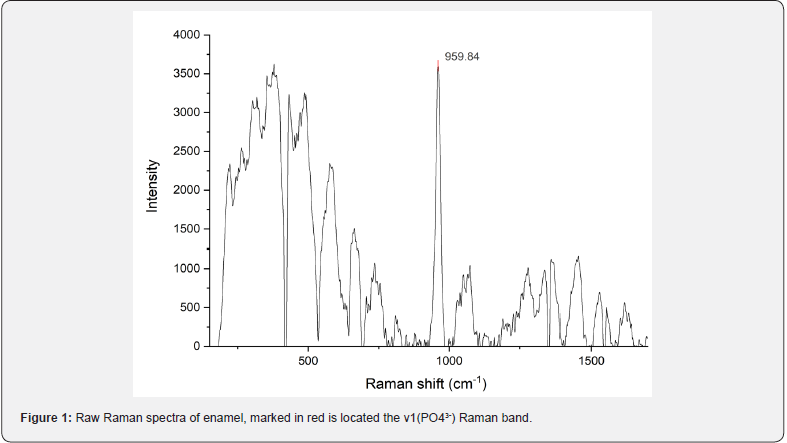
Whereas, the operating principle of Raman spectroscopy is based on the Raman scattering phenomenon; when the incident light interacts with matter, it causes the molecules in the analyte to scatter energy, which can gain or lose energy. This technique is extensively used to study crystal structures, meaning that peaks in Raman spectra have been more documented than those in FTIR spectra; therefore, they are more readily assigned to minerals [2]. Hence, Raman spectroscopy is well-suited for screening bone samples. For example, in Figure 1 the Raman peak corresponding to the hydroxyapatite symmetric stretching mode of vibration of phosphate ion v1(PO43-) is visible in the raw Raman spectra, this signal is important to obtain the CI of osseus tissue, in this case dental enamel.
Raman spectroscopy yields at least four important composition measurements that are components of bone quality, mineral-tomatrix ratio, carbonate-to phosphate ratio, mineral crystallinity, and the collagen cross-link; the advantages of the technique include its non-destructive and non-invasive characteristics [7- 8]. For other archaeometric analyses, Raman spectroscopy was used recently and, for the first time, complemented studies on age estimation [9].
Limitations in Raman spectroscopy include bone autofluorescence that interferes with the signal, causing broader peaks that overwhelm sharper but less intense Raman peaks [10], and variations in measurement techniques or sample preparation that can introduce discrepancies in the results obtained. Moreover, absolute measurements of Raman Band intensities are difficult; the usual metrics are band intensity ratios, with crystallinity being the major exception [8]. Currently, background fluorescence can be subtracted using polynomial curve-fitting techniques and sample preparation [11].
In general, these techniques are fast, non-destructive or micro-destructive in the FTIR case, require minimal to no sample preparation, offer high sensitivity and sensibility [12,13], some equipment is portable, ideal for in situ analysis
Conclusion
The study of human remains involves a balance between preserving the integrity of the body and scientific research to understand the past. Vibrational spectroscopies provide ideal non-destructive and non-time-consuming methods for assessing bone quality, so researchers can better choose the samples to be used when destructive analysis is required, and ensure accurate results. Respectful handling of human remains is a way to respect the past and present cultures while better understanding them.
Acknowledgments
We would like to thank BSc Claudia Consuelo Camargo Raya, M. in Sc. Paola Molina Sevilla (Departamento de Química de Radiaciones y Radioquímica, ICN, UNAM), Judith Ruiz González (Instituto de Investigaciones Antropológicas). ASC would like to thank project UNAM DGAPA-PAPIIT-IN205522.
Conflict of Interest
None.
References
- Shukla AK (2020) Spectroscopic Techniques for Archaeological and Cultural Heritage Research. IOP Publishing Ltd, Bristol, UK, pp. 1-139.
- King, CL, Tayles N, Gordon KC (2011) Re-Examining the Chemical Evaluation of Diagenesis in Human Bone Apatite. J Archaeol Sci 38(9): 2222-2230.
- Rehman I, Movasaghi Z, Rehman S (2013) Vibrational Spectroscopy for Tissue Analysis. CRC Press, Boca Raton, FL, USA, pp. 1-343.
- Urban MW (1993) Vibrational Spectroscopy of Molecules and Macromolecules on Surfaces. Wiley, & Sons, Ltd, New York, NY, USA, pp. 1-400.
- Pestle WJ, Brennan V, Sierra RL, Smith EK, Vesper BJ, et al. (2015) Hand-Held Raman Spectroscopy as a Pre-Screening Tool for Archaeological Bone. J Archaeol Sci 58: 113-120.
- Stuart B (2005) Infrared Spectroscopy. In: Kirk-Othmer Encyclopedia of Chemical Technology. John Wiley & Sons, Ltd, New York, NY, USA, pp. 1-20.
- Morris MD (2010) Raman Spectroscopy of Bone and Cartilage. In: Matousek P, Morris MD (Editors.), Emerging Raman Applications and Techniques in Biomedical and Pharmaceutical Fields. Springer, Heidelberg, Berlin, Germany, pp. 347-364.
- Morris MD, Mandair GS (2011) Raman Assessment of Bone Quality. Clin. Orthop 469(8): 2160-2169.
- Mandair GS, Morris MD (2015) Contributions of Raman Spectroscopy to the Understanding of Bone Strength. BoneKEy Rep 4: 620.
- Greco E, Gennaro AM, Piombino-MD, Costanzo D, et al. (2023) Dental Proteomic Analyses and Raman Spectroscopy for the Estimation of the Biological Sex and Age of Human Remains from the Greek Cemetery of San Giorgio Extra, Reggio Calabria (Italy). Microchem J 195: 109472.
- France CAM, Thomas DB, Doney CR, Madden O (2014) FT-Raman Spectroscopy as a Method for Screening Collagen Diagenesis in Bone. J Archaeol Sci 42: 346-355.
- Unal M, Ahmed R, Mahadevan-JA, Nyman JS (2021) Compositional Assessment of Bone by Raman Spectroscopy. Analyst 146(24): 7464-7490.
- Smith E, Dent G (2019) Modern Raman Spectroscopy: A Practical Approach. Second edition. John Wiley & Sons, Hoboken, New Jersey, USA, pp. 1-256.
- Matousek P, Morris MD (2010) Emerging Raman Applications and Techniques in Biomedical and Pharmaceutical Fields. Biological and Medical Physics, Biomedical Engineering; Springer, Heidelberg, Germany, pp. 1-481.

























