




 GJAA Home



Lessons Learned from Dr. Betty Faust An Applied Anthropology Researcher
Richard Smardon*
SUNY Distinguished Service Professor Emeritus, SUNY College of Environmental Science and Foresty, New York
Submission: December 01, 2023; Published: December 12, 2023
*Corresponding author: Richard Smardon, SUNY Distinguished Service Professor Emeritus, SUNY College of Environmental Science and Foresty, 1 Forestry Drive, Syracuse NY 13210, United States
How to cite this article: Richard Smardon*. Lessons Learned from Dr. Betty Faust An Applied Anthropology Researcher. Glob J Arch & Anthropol. 2023; 13(3): 555864. DOI: 10.19080/GJAA.2023.13.555864
Short Communication
I first met Betty Faust when she was working on her PhD in Anthropology at Syracuse University’s Maxwell School, and I was a faculty member at SUNY College of Environmental Science and Forestry (ESF) working both with landscape architecture and environmental science graduate students. We both attended the first international ecotourism conference in Merida Mexico in 1989. This conference was organized by a friend of mine, Jon Kusler, who organized a number of national and international conferences on water resource management. Because Betty had already done her dissertation field work in nearby Piche Campeche Mexico to the north of Merida- this helped lay the groundwork for later collaborative research activity in the Yucatan Peninsula. There was a follow up ecotourism conference in Miami in 1990 and the joint conference publication contained about four papers [1-4] by Betty on respecting traditional Mayan cultural ways and ethical behavior of visiting ecotourists. This is important at this time as ecologists, planners and National Geographic were promoting the “Ruta Maya” as a major region for ecotourism development alternative to the traditional Mexican tourism development of sun, surf, and sand In Cancun.
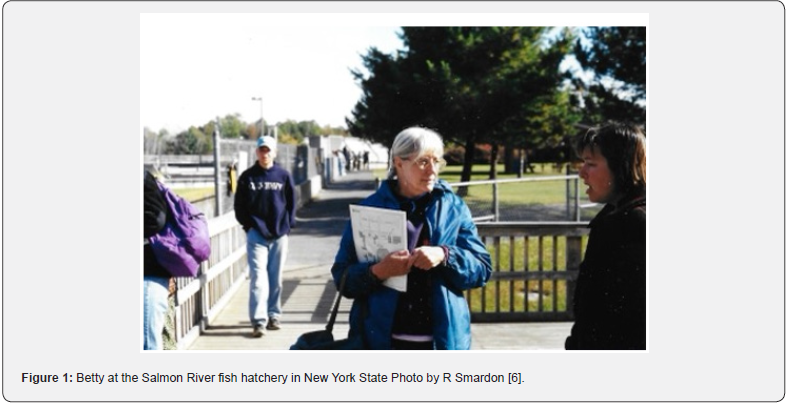
From 1990 to 1994 Betty was a new Assistant Professor with the Department of Sociology and Anthropology at Southern University in Ashland, Oregon. From 1995 to 1996 she was a Visiting Professor with a master’s degree program in Resource Use and Conservation in the Humid Tropics at the University of Yucatan on loan from Centro de Investigación y de Estudios Avanzados del Instituto Politécnico Nacional (CINVESTAV) in Merida Mexico. CINVESTAV Yucatan campus is located near the area of her PhD fieldwork in Piche Campeche where she spent a year living in a traditional Mayan community. It should be noted that CINVESTAV faculty engage in applied human ecology research and extension work with communities in Mexico. From 1994 to 2009 she became a Senior Researcher and Professor within the Department of Human Ecology at CINVESTAV, and this is the period that she conducted much of her human ecology field work and advised a number of master student’s thesis work. It was during this time that she produced a number of publications on rights, resources, culture, and conservation in the Yucatan [5] (Figure 1).
From 2000 to 2003 CINVESTAV allowed her to come to the SUNY College of Environmental Science and Forestry (SUNY ESF) in Syracuse New York as a visiting professor since we had a previous relationship with her from 1989. Her work at SUNY ESF Department of Environmental Studies included creation of a new college wide course in non-western civilization which used the book “Development and the Plumed Serpent: Technology and Maya Cosmology in the Tropical Forest of Campeche Mexico” [6], which she wrote from her dissertation work as the key textbook. She also worked with me on a speaker’s series entitled “Environmental Knowledge, Rights and Ethics; Co-managing with Communities” that turned into a special issue of Environmental Science and Policy [7,8].
After returning to work at CINVESTAV Merida- Betty worked on a number of projects including traditional Mayan ways that were more sustainable than more “modern” agricultural and water management plus addressing climate change. She also worked on the issues surrounding biosphere reserve designation management in southern Mexico. She hosted a symposium in Merida in 2005 at the International Applied Anthropology meeting. We later collaborated in turning the symposium papers into a special issue of Landscape and Urban Planning entitled “Biosphere Reserve Management in the Yucatan Peninsula Mexico; reserve Collaboration and Conflicts” [9-11]. Betty was very sensitive to the cultural impacts and management conflicts of creating biosphere reserves without acknowledging local indigenous culture of people still living within these biosphere reserves, which she wrote about [12]. These same issues plus our previous experience in Mexico from 1989 on allowed me to write a book chapter on issues revolving around management of the two major estuarine biosphere reserves in the Yucatan peninsula [13,14] (Figure 2).
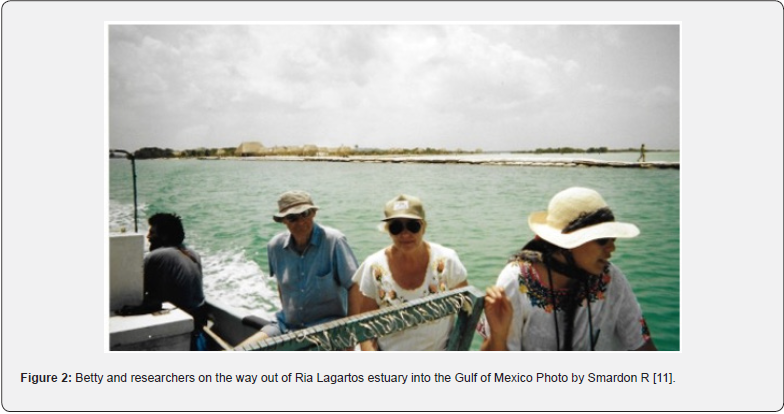
From 2005 to 2007 Betty Faust and I were project coordinators of “Enspire-Yucatan” -a project to form a multidisciplinary international research team through three exchange meetings and one pilot study/workshop in San Filipe within the Ria Lagartos estuary. This project involved a team of nine faculty and four graduate students from Syracuse University, SUNY ESF and CINVESTAV Merida. At the end of the project the nine faculty were involved in a joint field trip throughout a number of biosphere reserves in the Yucatan peninsula and ending with a multidisciplinary workshop in San Filipe just north of Cancun within the Ria Lagartos estuarine biosphere reserve. The focus of the workshop, in concert with CINVESTAV faculty and students, was to explore options for more sustainable livelihood development for both fisheries and ecotourism. All our carefully laid plans erupted when one of the SUNY ESF faculty told the local residents that their fishery operations were “unsustainable”. The local residents knew this, but it was not for “outsiders” to state. We got the workshop back on track, but Betty was livid with this individual because he was insensitive to the socio-cultural context. This was one of my many lessons learned from Betty about ethical responsibilities of those involved in culturally sensitive projects.
After 2009 she held a number of honorary positions including Honorary Professor at the Autonomous University of Campeche, Honorary Researcher Department of Natural Resources CINVESTAV Mexico, and Adjunct Professor with the Department of Environmental Studies at the SUNY College of Environmental Studies and Forestry. From 2016 to the present time, she is the founder and President of the Maya Canal Gardens Foundation, which is conducting research on Mayan traditional farming and water supply systems that can be utilized for sustainable food production in the face of climate change.
Professor Faust’s contribution to applied anthropology and Yucatan geographic region included original scholarship regarding Mayan traditional values and sustainable management practices, as well as the need for researchers and non-indigenous resource managers to recognize and appreciate such values and practices.
I learned many lessons from Betty Faust - especially about cultural sensitivity and respect for indigenous communities. Also, interdisciplinary teams of researchers need to be sensitive and respectful when working with such communities. Such lessons need to be passed on to others engaged in socio-ecological research and community outreach work..
References
- Faust BB (1991a) Guidelines for Culturally Appropriate Ecotourism Development in the Mayan Area. In: Kusler J (edt.), Ecotourism and Resource Conservation I: 222-223.
- Faust BB(1991b) Guidelines for Maya Participation in Ecotourism Planning. In: Kusler J (edt.), Ecotourism and Resource Conservation I: 224-226.
- Faust B (1991c) Maya Culture and Maya Participation in Ecotourism. In: Kusler J (edt.), Ecotourism and Resource Conservation I: 178-221.
- Faust BB, Sinton J (1991) ´Let’s Dynamite the Salt Factory!´: Social Conflicts in a Biosphere Reserve. In: Kusler J (edt.), Ecotourism and Resource Conservation II: 602-623.
- Faust BB (2004) The end of innocence: social consequences of overuse of timber in a Maya community. In: Faust BB, Anderson EN & Frazier J, (eds.), Rights, Resources, Culture and Conservation in the Yucatan Peninsula, Westport, CT: Praeger of Greenwood-Heinemann, now ABC-Clio, Santa Barbara, California, USA, pp. 131-161.
- Faust BB (1998) Development and the Plumed Serpent: Technology and Maya Cosmology in the Tropical Forest of Campeche Mexico. Praeger/Bloomsbury Publishing, New York.
- Faust BB, Smardon RC (2001) Introduction and Overview: Environmental Knowledge, Rights, and Ethics: Co-managing with Communities. Environmental Science and Policy 4(4/5): 147-151.
- Faust BB (2001) Maya Environmental Successes and Failures in the Yucatan Peninsula. Environmental Science and Policy 4(4/5): 153-369.
- Smardon R, Faust BB (2006) Special Edition: Biosphere Reserve Management in the Yucatan Peninsula, Mexico: Resources, Collaborations and Conflicts. Landscape and Urban Planning 74(3/4): 159.
- Smardon R, Faust BB (2006) Introduction to Biosphere Reserve Management in the Yucatan Peninsula, Mexico: Resources, Collaborations and Conflicts. Landscape and Urban Planning 74: 160-192.
- Eastmond A, Faust BB (2006) "Farmers, Fires and Forests", Landscape and Urban Planning 74(3-4): 267-284. (Special Edition, Biosphere Reserve Management in the Yucatan Peninsula, Mexico: Resources, Collaborations and Conflicts, electronic version on line 2005). ISSN: 0169-2046.
- Berlanga-Cano M, Faust BB (2007) ´We Thought We Wanted a Reserve´: One Community’s Disillusionment with Government Conservation Management, in a special edition edited by J. Igoe and D. Brockington. Conservation and Society 5(4): 450-477.
- Smardon RC (2009) Estuaries at the Edge, Yucatan Peninsula Mexico. In: Smardon RC (edt.), Sustaining the Worlds Wetlands: Setting Policy and Resolving Conflicts, 8th Chapter, Springer Press, Dordrecht, Hedidleberg, London & New York, pp. 211-266.
- Faust BB, Anaya A, Giovaninni H (2012) Reclaiming the Past to Respond to Climate Change: Mayan Farmers and Ancient Agricultural Techniques in the Yucatan Peninsula of Mexico. In: Castro AP, Taylor D, & Brokensha DW, (eds.), Climate Change and Threatened Communities: Vulnerability, Capacity, and Action, pp. 139-151.

























