




 ECOA Home



Is Unwavering Vigilance Time of American Bison in Hunted and Protected Populations Influenced by Large Boday Size?
Ronald J Sarno1*, Andea N Sarno2, Michael R Varrone3 and Melissa M Grigione4
1Department of Biology, Hofstra University, 130 Gittleson Hall, Hempstead, New York, USA
2North Salem High School, 230 June Rd, North Salem, New York, USA
3Medical University of South Carolina, 169 Ashley Avenue, Charleston, South Carolina, USA
4Department of Biology, Pace University, 861 Bedford Road, Pleasantville, New York, USA
Submission: June 05, 2026;Published: June 19, 2026
*Corresponding author: Ronald J Sarno, Department of Biology, Hofstra University, 130 Gittleson Hall, Hempstead, New York, USA
How to cite this article: Ronald J S, Andea N S, Michael R V, Melissa M G. Is Unwavering Vigilance Time of American Bison in Hunted and Protected 002 Populations Influenced by Large Boday Size?. Ecol Conserv Sci. 2026; 5(2): 555660. DOI:10.19080/ECOA.2026.05.555660
Abstract
In areas devoid of carnivores, a frequent claim is that human hunters exert equal influence on prey behavior (i.e., there is functionally redundancy) as non-human predators. If this is true, then species that are hunted by humans and non-human predators should fear both equally. Yet, prey species exhibit stronger reactions to human predators than to native carnivores. Given that vigilance - the interruption of some behavior to visually survey surroundings - is generally elevated in wildlife populations that are hunted by humans, then vigilance in prey species hunted by humans should exceed that in populations hunted by native carnivores. Therefore, the primary objective of our research was to compare vigilance time of bison in protected and hunted populations. Data were collected from 14 study sites in South Dakota, North Dakota, and Montana during the mating season (a period of heightened vigilance) over a period of 4 years. The only statistically significant effect in the logistic regression model was for females; adult female bison were vigilant about 25% longer (n = 38 seconds) than adult males. In the gamma portion of the model (i.e., a two-parameter continuous probability distribution used to model variables that are always positive and skewed), number of vehicles/days was associated with a significant reduction in vigilance time. In contrast, human hunting was not associated with a change in vigilance time between hunted and non-hunted bison. Additionally, observations from two bison populations with large carnivores indicate that vigilance time in these populations was essentially equal to those without predators and with/without human hunting. Although differences in vigilance between hunted and non-hunted bison were trivial, other evidence indicates that maybe the consequences of human hunting are not. On 26 field days across 6 populations (hunted > 4 months/yr) we observed > 90%, if not all, bison moving together throughout the day. This phenomenon was not observed in populations hunted < 4 months/yr. Basing inferences solely on vigilance, it appears that bison vigilance is equal in hunted and non-hunted populations, including those with natural predators. Clearly more work is necessary to examine the potential impact of human hunting on the behavior and ecology of American bison.
Keywords: Bison; Hunting; Vigilance; Predation; Vocalizations
Introduction
In a world of declining large carnivores, can human hunters serve as functional surrogates? Berger [1], Smith et al. [2]. In other words, do human hunters exert the same influence on prey behavior as large, dangerous predators? If so, then potential prey (i.e., ungulates) of large carnivores and humans should fear both equally and thus exhibit similar behavioral responses to both. The available data suggest, however, that vigilance tends to increase when ungulates are hunted by humans compared to carnivores. For example, Roe deer (Capreolus capreolus) spent more time vigilant during the hunting season than during the non-hunting season Benhaiem et al. [3]; Red deer (Cervus elaphus) also showed increased vigilance during the hunting season Jayakody et al. [4], as well as outside of protected areas and reserves where hunting was allowed Proudman et al. [5]. Additionally, Impala (Aepyceros melampus), Mediterranean mouflon (Ovis gmelini musimonx; Ovis sp.), Fallow Deer (Dama dama), Blue Sheep (Bharal: Pseudois nayaur), and wild boar (Sus scrofa) all demonstrated higher vigilance in areas exposed to human hunting Matson, et al. [6], Benhaiem et al. [3]. Impalas also increased vigilance time in areas with elevated hunting frequency than in adjacent areas with reduced hunting frequency Matson et al. [6].
Sarno et al. [7] reported that the proportion of vigilant bison in groups was equivalent in hunted vs non-hunted populations. However, individual vigilance time may differ due to size, age, and reproductive status, among animals in the same population Berger and Cunningham [8], Laundré et al. [9], Hernández & Laundré [10]. Furthermore, additional costs of vigilance Lima & Dill [11], Lima [12], Matson et al., [6], Benhaiem et al. [3], Pecorella et al. [13] including time away from feeding and other social activities, likely limit vigilance time. Additionally, because bison exhibit strong constitutive defenses (i.e., large and hard to kill), they may not prioritize vigilance regardless of the level of predation risk, especially from a human predator located 100-200 m away.
Plains bison (Bison bison) exhibit a definable herd structure in which cows, calves, and immature males form transient mixed-sex and age groups. Mature bulls form smaller all-male groups or remain solitary for much of the year Berger and Cunningham [14]. During the breeding season (rut) bison form large aggregations where mature bulls join mixed-sex and age groups. Males exhibit a linear dominance hierarchy, whereby larger, mature bulls are dominant to smaller, younger bulls Roden et al. [15]. Dominant males temporarily consort with cows prior to or during estrus and attempt to keep all other bulls away by engaging in vocalizations, threat displays, and fights Berger and Cunningham [14], RJ Sarno pers obs).
Therefore, our primary objective is to compare vigilance time of bison in protected and hunted populations. We define vigilance as an animal with its head raised at or above its shoulder while remaining stationary. Given large body size, we predict that vigilance time of bison in hunted and non-hunted populations will be equal. Furthermore, we predict that hunting pressure (measured as the number of hunt months/year and recent hunting history) will also not be associated with bison vigilance time. Although sample size is low, we will evaluate if human hunting is functionally redundant Berger [1], Smith et al., [2]) to native carnivores. If so, bison vigilance time should be equal in areas with/without hunting and with/without natural predators.
Materials and Methods
Study Sites
Data were collected from 14 study sites in South Dakota, North Dakota, and Montana. South Dakota study sites included Wind Cave National Park (WICA) (43.5724°N, 103.4416°W), Custer State Park (CSP) (43.7638°N, 103.3703°W), Badlands National Park (BNP) (43.8554°N, 102.3397°W), Pine Ridge Reservation (PRR) (43.2731°N, 102.7445°W), Rosebud Sioux Indian Reservation [(RSRH) (43.1875°N, 100.6257°W), and Sinte Gleska University (SGLU) (43.3049°N, 100.6417°W)], and three pastures on the Lower Brule Reservation [Big Game Unit (LBR-BGU) Cherry Ranch Unit (LBR-CRU), and Huston Ranch Unit (LBR-HRU) (44.08°N, 99.78°W)]. The Standing Rock Indian Reservation (2 pastures SRR-N, SRR-W) (46.0869°N, 100.6301°W) was in North Dakota. In Montana data were collected from The Flying D Ranch (FLY-D) (45.4991°N, 111.3194°W), Blackfeet Indian Reservation (BLKFTR; 48.6666° N, 112.9176° W) and National Bison Range (NBR) (47.32500°N 114.22583°W).
Study areas varied in elevation from 498 to 1612 m. All study populations were located within a mixed-grass prairie ecoregion. While study sites were relatively level, the landscape was undulating and at times bisected by steeply sloped drainages. Common grasses include little bluestem (Schizachyrium scoparium), blue grama (Bouteloua gracilis), big bluestem (Andropogon gerardii), western wheatgrass (Pascopyrum smithii Rydb.), buffalograss (Buchloe dactyloides), cheat grass (Bromus tectorum), and needle-and-thread grass (Stipa comata). Rocky Mountain juniper (Juniperus scopulorum), green ash (Fraxinus pennsylvanica), eastern cottonwood (Populus deltoides), Ponderosa pine (Pinus ponderosa), and white spruce (Picea glauca) were the most common forest types, and dominated the drier slopes, butte edges, and upper draws of the study areas National Park Service [16], Suttie et al [17], South Dakota Game Fish and Parks [18], Graham and Gingerich [19]. All study sites occurred within a semiarid climatic zone. Average yearly precipitation varied from 400mm (Badlands National Park, SD) to > 960 mm (FLY-D, MT), and most occurred between April and September. Mean yearly temperatures varied from a low of 6.1oC (FLY-D) to a high of 10.7oC (Custer State Park).
Hunting
Of the 14 sites, 4 were not hunted: BNP, NBR, SRR-WP and WICA. The remaining 10 sites were hunted. Bison were hunted at different frequencies per year at each site: 0 months/year (BNP, NBR, SRR-WP, WICA), 2 months/year (FLY-D), 3 months/year (SRR-N), 4 months/year (CSP, LBR-BGU, LBR-CRU), 5 months/year (LBR-HRU), 6 months/year (BLKFTR) or 12 months/year (PR-YB, RSRH, SGU-S). Recent hunting history differed by site and was coded within the prior year; populations that were never hunted (BNP, NBR, SRR-WP and WICA) were coded as a 0, other sites that were most recently hunted during the current month of data collection and for 12 months/year were coded as 12 (PR-YB, RSRH, SGU-S), two months prior to the current month of data collection were coded as 10 (LBR-HRU), 4.5 months prior to the current month of data collection (CSP) were coded as 8.5, 6 months prior to the current month (BLKFTR) were coded as 6, or > 7 months prior to the current month of data collection were coded as 5 (LBR-BGU, LBR-CRU, SRR-N).
Data Collection and Variables Description
Vigilance was defined as the proportion of the observation an adult bison kept its head at or above shoulder level while stationary. Adults were defined as animals greater than 1 year old (when marked) or by body size (when not marked). We measured the amount of time that a focal individual maintained vigilance and all focal observations lasted up to 10 minutes. Observations were made during the rut (July/August). Group size and composition were defined by the number of animals within 50 m of each other Sarno et al. [7]. We attempted to minimize pseudo-replication by identifying adults based on tag numbers and/or natural markings. When adults could not be distinguished by natural markings or ear tags, we visited different groups for each observation and focal individuals were selected haphazardly. We observed bison as close as we could safely approach them throughout the day (50 m), while attempting to avoid oversampling during any time of day. Bison did not appear to be bothered by the presence of our vehicle in any of the study sites as cows and calves routinely passed within 3 m of our parked vehicle. Bulls also passed by our parked vehicle within 3-5 m while bellowing and fighting other bulls as well as accompanying cows. Therefore, we do not believe that the data were influenced by our presence Sarno [7].
In total, we recorded data on 6 predictor variables across 3 levels of the data hierarchy. At the bottom level, we recorded focal-animal sex. At the middle level, we recorded group size for each group included in the study. At the highest level, we recorded the following population characteristics: hunting status, number of hunt months, recent hunting history, focal animal sex, bull: cow ratio, and average number of motor vehicles/day. To fit the model, the values of the following predictors were coded in the data as explained below. The predictors bull-cow ratio and group size were included in the model as numeric (continuous) predictors. Sex of focal animal was coded as “Female”, “Male” or “Unknown”. Hunting status was coded as either “Yes” for a hunted population or “No” for a non-hunted one. Recent hunting history of a bison population was coded as mentioned above.
Statistical Methodology
Unlike many ecological studies Creel et al. [20], Liley and Creel [21], Aho et al. [22], we did not formulate multiple competing models with the aim of comparing them based on an information criterion such as AIC to choose a “best” model. Instead, guided by biological rather than statistical considerations, we formulated a single statistical model relating to our response and predictor variables. This model reflected our specific biological hypotheses and allowed us to test each of these hypotheses within a unified framework Bolker [23]. Given that the response variable, vigilance, was expressed as a proportion of the observation, taking values in the bounded range [0,1], and to adjust for substantial zero-inflation in the outcome variable (percent of time vigilant), the probability of zero values was modeled using a logistic regression. Non-zero positive values were modeled with a gamma general linear moderation model (suitable for strictly positive continuous values). This two-part procedure approximates a hurdle model for continuous values. Included in the zero-inflation and in the gamma, model were effects for hunting recency, sex, group size, and average number of passing cars per day, and an interaction effect for sex and hunting recency. These predictors were regressed on proportion of observation time vigilant as the outcome variable. All data were analyzed using statsmodels package (version 0.14.5) in Python 3.11.13.
Results
Descriptive Statistics
In total, we observed 698 adult bison in 189 groups among 14 populations. Most bison (81.1%; n=587) were observed for 10 minutes. Among remaining bison, 12.6% (n=88) were observed between 5-9 minutes, and 3.3% (n=23) were observed for at least 3 minutes. Of the 14 populations, SRR-WP contained the smallest number of bison groups (n= 1) while FLY-D contained the largest number of bison groups (n= 39). Across the 189 groups, the number of bison per group ranged from 1 to 36.
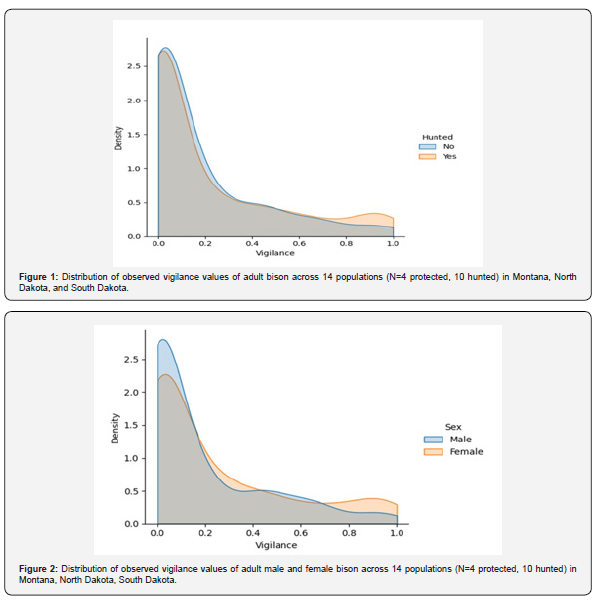
The distributions of observed values of vigilance for the 180 non-hunted bison and 518 hunted bison looked similar in shape (Figure 1), with most of the observations concentrated at the lower end of the [0%, 100%] range. Among non-hunted bison, 36.1% (n=65) were not vigilant (i.e., vigilance = 0%), 1.1% (n=2) were vigilant for 10 minutes; the remaining 61.9% (n=113) exhibited different levels of vigilance over the observation period (i.e., 0% < vigilance < 100%). Among hunted bison, 39.4% (n=204) were not vigilant, 1.7% (n=9) were vigilant for 10 minutes, while the remaining 58.9% (n=213) displayed varying levels of vigilance. Mean vigilance was 17.5% for non-hunted bison and 21.3% for hunted bison. Converting these proportions to seconds per 10-minute observation period, on average, non-hunted bison spent 105 seconds and hunted bison 128 seconds being vigilant. Consequently, hunted bison were vigilant 4% longer (n= 23 seconds) than non-hunted bison over the course of 10 minutes.
Model Results
The only statistically significant effect in the logistic regression model (predicting zero values for vigilance) was for females (b = 0.7419, p = 0.021, 95% CI = [0.110, 1.374]). Female bison exhibited longer vigilance time than male bison (Figure 2, Table 1). In the gamma portion of the model, number cars/day showed a significant negative effect on the percentage of observation time vigilant (b = -0.0014, p < 0.001, 95% CI = [-0.002, -0.001]) (Table 2); all other effects were non-significant. The model had a pseudo-r-squared value of 0.07, indicating the model explained approximately 7% of the variance in vigilance (Table 1). A model without the interaction effect (female sex * recent hunting history) showed a similar pattern of results (Table 2).
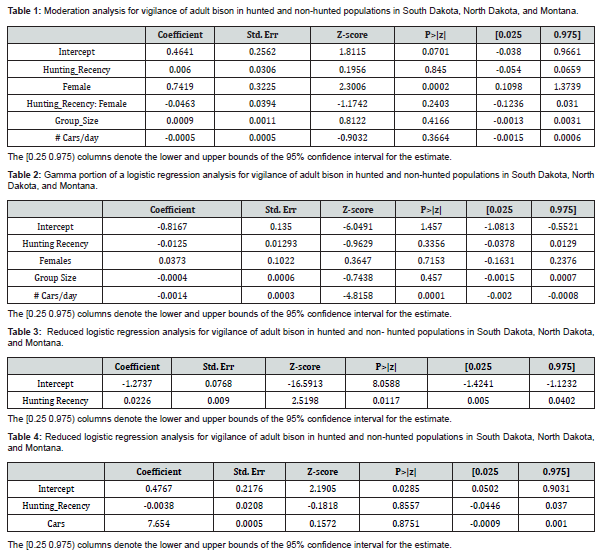
To probe further the influence of the inclusion of different main effects, namely, the highly correlated hunting recency and cars/day variables (Pearson r = -0.64), a hierarchical model building process was conducted.
This process included running reduced models with
a) only hunting recency as a predictor
b) only hunting recency and cars/day as predictors.
In model a) (when only hunting recency was included as a predictor), hunting recency had a significant positive association with vigilance (b = 0.0226, p < 0.001, 95% CI = [0.005, 0.040]) in the gamma part of the model, but not the zero-inflation model (Table 3); however, on adding cars as a predictor (model b) the hunting recency effect was no longer significant (Table 4).
Discussion
We investigated vigilance (i.e., proportion of observation time a focal bison was vigilant) of bison in non-hunted and hunted populations as well as among hunted populations that were subjected to different hunting pressure. The proportion of observation time a focal bison was vigilant was similar regardless of hunting pressure. Hunted bison were vigilant only 4% longer (n= 23 seconds) than non-hunted bison over the course of 10 minutes.
Increased vigilance in ungulates appears to be universally associated with human hunting Matson et al. [6], Podgórski et al. [24]. For example, Roe deer (Capreolus capreolus) exhibited increased vigilance during the day (hunters active) compared to night (hunters not active) and spent more time vigilant during the hunting season than outside of it Benhaiem et al. [3], Popova et al. [25]. During the hunting season, overall vigilance of Red Deer (Cervus elaphus) was higher than the non-hunting season Jayakody et al. [4]. Impala ((Aepyceros melampus), greater kudu (Tragelaphus strepsiceros), and sable antelope (Hippotragus niger) were also more vigilant in a hunted area compared to an adjacent national park Crosmary et al. [26].
Although it has been hypothesized that vigilance will be inversely associated with group size, we did not see this in our study. Furthermore, the relationship between the two is not so clear. While Siberian Ibex (Capra sibirica) and Tibetan Wild Ass (Equus Kiang) show decreasing vigilance with increasing group size, bison, elk (Cervus elaphus), zebra (Equus quagga), wildebeest (Connochaetes taurinus), Grant’s gazelle (Nanger granti), impala, and giraffe (Giraffa camelopardalis) all demonstrate somewhat complex associations between vigilance and group size. Clearly, in social species there are factors- other than group size, that influence vigilance behavior Childress and Lung [27], Creel et al. [28], Han et al. [29], Wang et al. [30].
Female bison were more vigilant than males in our study. Laundré et al. [9] reported the same trend. In fact, they reported that adult females (regardless of reproductive status) increased vigilance, while adult males were least vigilant. Among sexually dimorphic ungulates, females are generally more vigilant than males because they are smaller and prone to greater predation risk Clutton-Brock et al. [31], Main et al. [32]. Although this trend would seem to be expected, it is not always the case Shorrocks and Cokayne [33], Dalmau et al. [34]. Depending on the time of year, male Li and Jiang [35] or female Przewalski’s gazelle (Procapra przewalskii) can be most vigilant. During the birth season, females of various ungulate species with young are more vigilant because they have offspring Ferretti et al. [36], Beauchamp [37]. Conversely, during rut, male-male competition for access to mates requires elevated vigilance to survey potential rivals Li and Jiang [35].
It can be hypothesized that the risk of predation by human predators could induce stronger reactions by ungulate prey than by large carnivores Proffitt et al. [38], Ciuti et al. [39]. Indeed, inducible defenses (i.e., responses activated through a previous encounter with a predator that improves ability to thwart subsequent attacks), like vigilance, therefore may be strongest when humans behave as functional predators Palumbi [40], Ordiz et al. [41], Clinchy et al. [42].
In our study, bison did not alter vigilance substantially, regardless if, or how often, they were hunted by people. While these results contradict some previous work Matson et al. [6], Benoist et al. [43], Podgórski et al. [24], Jayakody et al. [4], Benhaiem et al. [3], Popova et al. [25], observations of bison in areas with and without natural predators may provide some insight. While female bison increased vigilance in areas with wolves, males generally showed no response Laundré et al. [9]. Furthermore, our data (not included in this study), from two bison populations with wolves and/or grizzly bears indicate that vigilance was essentially equal between these populations and those without predators and with/without human hunting. Berger and Cunningham [8] also reported that in an area with four sympatric native North American ungulates ([bison, pronghorn antelope (Antilocapra americana), Bighorn sheep (Ovis canadensis), and mule deer (Odocoileus hemionus), smaller-bodied ungulates were more vigilant than larger-bodied ones. They also reported that bison vigilance was not altered in areas with wolves (Canis lupus).
Given that body mass accounts for interspecifc differences in vigilance times - and bison were least vigilant Berger and Cunningham [8], perhaps it should not be surprising that bison did not elevate vigilance when stalked by human hunters in our study. Strong constitutive defenses (i.e., large and hard to kill) coupled with the considerable distance from which human hunting occurs may interact to suppress inducible defenses Tollrian and Harvell [44]. Another feature of bison that may dampen differential reactions to human hunters and carnivores is feeding ecology. Vigilance is costly due to associated reductions in feeding time Jennings & Evans [45], Underwood [46], Berger and Cunningham [8], Lima [12], Abramsky et al. [47], Fortin et al. [48] as animals need to balance antipredator behavior and foraging efforts across varying levels of risk Lima and Bednekoff [49]. Because bison need to satisfy large daily energy requirements, they may be particularly limited with respect to how much they can increase vigilance.
Although hunted bison were about 4% more vigilant/hr than non-hunted bison, is this seemingly trivial difference trivial? Other evidence indicates maybe not. On 26 field days across 6 populations - that were hunted > 4 months/yr - we observed > 90%, if not all, bison moving together throughout the day. This phenomenon was not observed in populations hunted < 4 months/yr. Hunters used motor vehicles (pickup trucks and ATV’s), so bison had temporary refuge during hunting events even in heterogeneous landscapes. Even non-hunting days when bison spotted our vehicle - even from several hundred yards away - they often fled. Reduced reproductive output resulting from chronic predation risk and elevated stress is possible Pauli and Buskirk [50], French et al. [51], Schmidt and Kuijper [52]. Based on these initial data that we have gathered from herd managers and park biologists, calving rate of bison in year-round hunted populations varies between 20-56%; calving rate in populations that are hunted < 6 months/year is 70-90%. Nutrient deficiencies Corah and Ives [53] may also depress bison reproduction. Regardless of the cause, the disparity in calving rates between these populations requires more scrutiny. We are assessing fecal-glucocorticoid levels to investigate stress in populations subjected to different hunting pressures. Clearly, more work is necessary to illuminate changes in bison behavior and ecology in populations where they are hunted.
Acknowledgements
We thank the administration at Badlands National Park (Permit #: BADL-2019-SCI-0008), Custer State Park (Permit #: SDCL 41-6-32), Lower Brule Reservation, Pine Ridge Reservation (Oglala Lakota College [OLC], Oglala Sioux Parks and Recreation Association [OSPRA]), Sinte Gleska University (Rosebud Sioux Reservation), Standing Rock Reservation, Turner Enterprises, Inc. (Flying-D Ranch), Theodore Roosevelt National Park (Permit #: THRO-2021-SCI-0001), and Wind Cave National Park (Permit #: WICA-2019-SCI-0005) [71-73]. Michael Thompson provided invaluable assistance in the field and insights about bison on the Pine Ridge Reservation. Eddie Childers went out of his way to accommodate my time in Badlands National Park. Greg Schroeder and Angela Jarding issued permits and answered all my questions in Wind Cave. Mark Hendrix was of great assistance while working in Custer State Park. Phil Baird – provost at Sinte Gleska University was one reason why I was successful on the Rosebud Reservation. Sidney Baily – herd manager on Standing Rock, was of great help. He answered numerous questions on numerous occasions. Carter Kruse and Danny Johnson of Turner Enterprises, Inc. permitted access to the FLY-D. Danny offered data, enthusiastically showed me around, and answered my numerous questions. Ervin Carlson, Director of the Blackfeet Buffalo Program on the Blackfeet Indian Reservation provided assistance during my time working on the reservation.
References
- Berger J (2005) Hunting by carnivores and humans: Does functional redundancy occur, and does it matter? In: Ray JC, Redford KH, Steneck RS, Berger J, editors. Large Carnivores and the conservation of biodiversity. Island Press, USA.
- Smith JA, Suraci JP, Clinchy M, Crawford A, Roberts D, et al. (2017) Fear of the human ‘super predator ‘reduces feeding time in large carnivores. Proc Biol Sci 284(1857): 20170433.
- Benhaiem S, Delon M, Lourtet B, Cargnelutti B, Aulagnier S (2008) Hunting increases vigilance levels in roe deer and modifies feeding site selection. Animal Behaviour 76(3): 611-618.
- Jayakody S, Sibbald AM, Gordon IJ, Lambin X (2008) Red deer Cervus elaphus vigilance behaviour differs with habitat and type of human disturbance. Wildlife Biology 14(1): 81-91.
- Proudman NA, Churski M, Bubnicki JW, Nilsson JA, Kuijper DPJ (2021) Red deer allocate vigilance differently in response to spatio-temporal patterns of risk from human hunters and wolves. Wildl Res 48 (2): 163-174.
- Matson TK, Goldizen AW, Putland DA (2005) Factors affecting the vigilance and flight behaviour of impalas: research article. South African Journal of Wildlife Research 35(1).
- Sarno RJ, Grigione MM, Higa A, Childers E, Ecoffey T (2017) The association between continual, year-round hunting and bellowing rate of bison bulls during the rut. PeerJ 5: e3153.
- Berger J, Cunningham C (1988) Size-related effects on search times in North American grassland female ungulates. Ecology 69(1): 177-183.
- Laundré JW, Hernández L, Altendorf KB (2001) Wolves, elk, and bison: reestablishing the” landscape of fear” in Yellowstone National Park, USA. Canadian Journal of Zoology 79(8): 1401-1409.
- Hernández L, Laundré JW (2005) Foraging in the ‘landscape of fear ‘and its implications for habitat use and diet quality of elk Cervus elaphus and bison Bison bison. Wildlife Biology 11(3): 215-220.
- Lima SL, Dill LM (1990) Behavioral decisions made under the risk of predation: a review and prospectus. Canadian Journal of Zoology 68(4).
- Lima SL (1998) Stress and Decision Making under the Risk of Predation: Recent Developments from Behavioral, Reproductive, and Ecological Perspectives. Advances in the Study of Behavior 68(4).
- Pecorella I, Ferretti F, Sforzi A, Macchi E (2016) Effects of culling on vigilance behaviour and endogenous stress response of female fallow deer. Wildlife Research 43(3): 189-196.
- Berger J, Cunningham C (1994) Bison: mating and conservation in small populations. Columbia University Press, USA.
- Roden C, Vervaecke H, Van Elsacker L (2005) Dominance, age and weight in American bison males (Bison bison) during non-rut in semi-natural conditions. Applied Animal Behaviour Science 92(1-2): 169-177.
- National Park Service (2003) Badlands National Park: Pennington, Jackson and Shannon Counties, South Dakota. Integrated weed management plan and environmental assessment. South Dakota: National Park Service, Interior, USA.
- Suttie JM, Reynolds SG, Batello C (2005) Grasslands of the World. Food & Agriculture Org.
- (2010) South Dakota Game Fish and Parks. Custer State Park Resource Management Plan 2010-2025.
- Graham T, Gingerich J (2013) Oglala Sioux parks and recreation authority: buffalo expansion feasibility study. Montana: Bozeman.
- Creel S, Winnie Jr J, Maxwell B, Hamlin K, Creel M (2005) Elk alter habitat selection as an antipredator response to wolves. Ecology 86(12): 3387-3397.
- Liley S, Creel S (2008) What best explains vigilance in elk: characteristics of prey, predators, or the environment? Behavioral Ecology 19 (2): 245-254.
- Aho K, Derryberry D, Peterson T (2014) Model selection for ecologists: the worldviews of AIC and BIC. Ecology 95 (3): 631-636.
- Bolker BM (2024) Multimodel approaches are not the best way to understand multifactorial systems. Entropy 26(6): 506.
- Podgórski T, De Jong S, Bubnicki JW, Kuijper DP, Churski M (2016) Drivers of synchronized vigilance in wild boar groups. Behavioral Ecology 27(4): 1097-1103.
- Popova E, Doykin N, Zlatanov V, Zlatanova D (2016) Vigilance behaviour in roe deer (Capreolus capreolus L.): preliminary data for the role of hunting pressure in NP Vitosha, Bulgaria. Annuaire de l’Université de Sofia “St Kliment Ohridski 101: 23-32.
- Crosmary WG, Valeix M, Fritz H, Madzikanda H, Côté SD (2012) African ungulates and their drinking problems: hunting and predation risks constrain access to water. Animal Behaviour 83 (1): 145-153.
- Childress MJ, Lung MA (2003) Predation risk, gender and the group size effect: does elk vigilance depend upon the behaviour of conspecifics?. Animal behaviour 66(2): 389-398.
- Creel S, Schuette P, Christianson D (2014) Effects of predation risk on group size, vigilance, and foraging behavior in an African ungulate community. Behavioral Ecology 25(4): 773-784.
- Han L, Blank D, Wang M, Yang W (2020) Vigilance behaviour in Siberian ibex (Capra sibirica): Effect of group size, group type, sex and age. Behavioural processes 170: 104021.
- Wang X, Yang L, Zhao Y, Yu C, Li Z (2021) The group size effect and synchronization of vigilance in the Tibetan wild ass. Current Zoology 67(1): 11-16.
- Clutton-Brock TH, Guinness FE, Albon SD (1982) Red deer: behavior and ecology of two sexes. University of Chicago press, USA.
- Main MB, Weckerly FW, Bleich VC (1996) Sexual segregation in ungulates: new directions for research. Journal of Mammalogy 77 (2): 449-461.
- Shorrocks B, Cokayne A (2005) Vigilance and group size in impala (Aepyceros melampus Lichtenstein): a study in Nairobi National Park, Kenya. African Journal of Ecology 43 (2): 91-96.
- Dalmau A, Ferret A, Manteca X (2010) Vigilance behavior of Pyrenean chamois Rupicapra pyrenaica pyrenaica: effect of sex and position in the herd. Current zoology 56 (2): 232-237.
- Li Z, Jiang Z (2008) Group size effect on vigilance: evidence from Tibetan gazelle in Upper Buha River, Qinghai-Tibet Plateau. Behavioural Processes 78 (1): 25-28.
- Ferretti F, Costa A, Corazza M, Pietrocini V, Cesaretti G, et al. (2014) Males are faster foragers than females: intersexual differences of foraging behaviour in the Apennine chamois. Behavioral Ecology and Sociobiology 68(8): 1335-1344.
- Beauchamp G (2015) Animal vigilance: monitoring predators and competitors. Academic Press, USA.
- Proffitt KM, Grigg JL, Hamlin KL, Garrott RA (2009) Contrasting effects of wolves and human hunters on elk behavioral responses to predation risk. The Journal of Wildlife Management 73(3): 345-356.
- Ciuti S, Muhly TB, Paton DG, McDevitt AD, Musiani M (2012) Human selection of elk behavioural traits in a landscape of fear. Proc Biol Sci 279: 4407-4416.
- Palumbi SR (2001) Humans as the world’s greatest evolutionary force. Science 293(5536): 1786-1790.
- Ordiz A, Støen OG, Sæbø S, Sahlén V, Pedersen BE (2013) Lasting behavioural responses of brown bears to experimental encounters with humans. Journal of Applied Ecology 50(2): 306-314.
- Clinchy M, Zanette LY, Roberts D, Suraci JP, Buesching CD, et al. (2016) Fear of the human “super predator” far exceeds the fear of large carnivores in a model mesocarnivore. Behavioral Ecology 27(6): 1826-1832.
- Benoist S, Garel M, Cugnasse JM, Blanchard P (2013) Human Disturbances, Habitat Characteristics and Social Environment Generate Sex-Specific Responses in Vigilance of Mediterranean Mouflon. PLoS One 8(12): e82960.
- Tollrian R, Harvell CD (Eds.) (1999) The ecology and evolution of inducible defenses. Princeton university press, USA.
- Jennings T, Evans SM (1980) Influence of position in the flock and flock size on vigilance in the starling, Sturnus vulgaris. Animal Behaviour.
- Underwood R (1982) Vigilance behaviour in grazing African antelopes. Behaviour 79(2-4): 81-107.
- Abramsky Z, Rosenzweig ML, Subach A (2002) The costs of apprehensive foraging. Ecology 83(5): 1330-1340.
- Fortin D, Boyce MS, Merrill EH, Fryxell JM (2004) Foraging costs of vigilance in large mammalian herbivores. Oikos 107(1): 172-180.
- Lima SL, Bednekoff PA (1999) Temporal variation in danger drives antipredator behavior: the predation risk allocation hypothesis. Am Nat 153(6): 649-659.
- Pauli JN, Buskirk SW (2007) Risk-disturbance overrides density dependence in a hunted colonial rodent, the black-tailed prairie dog Cynomys ludovicianus. Journal of Applied Ecology 44(6): 1219-1230.
- French SS, González-Suárez M, Young JK, Durham S, Gerber LR (2011) Human Disturbance Influences Reproductive Success and Growth Rate in California Sea Lions (Zalophus californianus). PLoS ONE 6(3): e17686.
- Schmidt K, Kuijper DP (2015) A “death trap” in the landscape of fear. Mammal Research 60: 275-284.
- Corah LR, Ives S (1991) The effects of essential trace minerals on reproduction in beef cattle. Vet Clin North Am Food Anim Pract 7(1): 41-57.

























