




 ECOA Home



The Role of Abandoned Vineyards in Nature Conservation: A Case Study from The Eger Region (Ne Hungary)
Tamás Misik1* and Dóra Misik-Bartók2
1 Eszterházy Károly Catholic University, Department of Environmental Sciences and Landscape Ecology, Hungary
2 Government Office of Heves County, District Office of Eger Department of Public Health, Hungary
Submission: May 27, 2026;Published: june 04, 2026
*Corresponding author: Tamás Misik, Eszterházy Károly Catholic University, Department of Environmental Sciences and Landscape Ecology, Hungary
How to cite this article: Tamás M, Dóra Misik-B. The Role of Abandoned Vineyards in Nature Conservation: A Case Study from The Eger Region (Ne Hungary). Ecol Conserv Sci. 2026; 5(2): 555659. DOI:10.19080/ECOA.2026.05.555659
Abstract
Vineyards have been heavily modified habitats by intensive farming for centuries; however, following successive abandonments, they have become carriers of unique botanical values. During our initial field surveys conducted in the Galagonyás Valley on the outskirts between 2007 and 2010, several individuals of protected plant species were identified. The relevance of the original survey by Kárász and Varga in 2002 was prompted by the proposed expansion of a landfill operating near Eger, Hungary. The authors’ primary conclusion was that the indicated botanical and faunal values did not preclude the expansion of the landfill in the Galagonyás Valley. Ultimately, the construction of the depository was not realized. A few decades ago, terraced viticulture dominated the southwest slopes of the valley, while after its abandonment, natural succession processes started. The most frequent plant species under nature conservation protection are the following: round-headed leek (Allium sphaerocephalon L), Hungarian leopard’s bane (Doronicum hungaricum Rchb.f), and lady orchid (Orchis purpurea Huds). The mentioned processes resulted in the formation of close-to-natural vegetation, also in the once-cultivated areas. The valley also proves that vegetation with natural values and near-natural conditions can develop relatively quickly on the site of once intensively cultivated areas.
Keywords: Vineyards, Protected Plant Species, Nature Conservation, Galagonyás Valley
Introduction
Traditional viticulture was part of a multifunctional agricultural system including low-input grasslands and fruit tree individuals, resulting in high functional biodiversity [1]. In the last decades, agricultural intensification has deep impact on biodiversity with possible cascade effects on ecosystem functions and service delivery [2]. Vineyards are among the most intensively farmed agricultural ecosystems, typically involving the use of pesticides, soil tillage, and landscape simplification [3]. On the other hand, the abandonment of vineyards is often associated with the disappearance of the small, sedentary fauna of the plains [4]. In the last decades, many vineyards were abandoned and overgrown with shrubs and trees because the slopes were too steep or there were too many rocky outcrops in the vineyards for them to be profitable [5,6].
The study also notes that a portion of the protected plants appeared on the sites of formerly intensively cultivated vineyards that had been abandoned for several decades. Extensive domestic literature addresses the landscape changes of vineyard hills, as well as the botanical significance and historical landscape transformations of abandoned viticultural areas. The work of Malatinszky and Novák [7] presents the land-use history and flora of abandoned vineyards in the vicinity of two settlements in the Karancs Valley. Based on investigations conducted in 2019-2020, they identified 7 protected species; furthermore, based on the Simon-type nature conservation value categories for vascular plants, the proportion of species indicating natural conditions exceeded those indicating degradation.
The publication by Dedák and Sulyán [8] describes landscape changes observed in the vineyard hills of several settlements in the Cserhát region. By the present day, viticulture has been abandoned across all six sampling areas. During the surveys, a total of 12 protected taxa were described. A consistently characteristic feature of the post-abandonment processes is the intensive encroachment of woody species. Since the landscape is a potential climate-zonal habitat for Turkey oak-sessile oak forests, the process of afforestation is natural; however, from a nature conservation perspective, it is not necessarily positive.
Similarly, floristic data from abandoned vineyards in the Cserhát are reported in the 2014 paper by Malatinszky et al [9]. This publication compiles protected and rare plant species from seven micro-regions of the Cserhát, based on seven years of investigation. A total of 35 protected species were found, some of which were new to the Central Cserhát region. In 2009, Mravcsik and colleagues conducted botanical and landscape history research in the outskirts of five settlements in the Northern Cserhát across 12 areas withdrawn from viticulture [10]. Their work described a total of 12 protected vascular plant species. In his 2022 article, Számel discusses the results of botanical and land-use history research in abandoned vineyards of the Balaton Uplands. He identified a total of 32 protected plant species across 11 vineyard areas. The vegetation of the abandoned vineyard parcels was characterized by near-natural conditions, and successional processes were underway to varying degrees in all locations.
The publication by Oszkocsil [11] describes the landscape changes of the Putnok vineyard hill, establishing that in vineyards abandoned for decades, the colonization of vegetation and the closing of the sward is slow but continuous. As a result, nine protected plant species were described from the sample areas. In the Putnok Hills, near Alsószuha, an increasing number of vineyards have been abandoned since 1985. Stefán [12] established that while the resulting secondary habitats can be classified as degraded, they still provide a home for eight protected plant species. Novák et al. [13] investigated changes in soil and vegetation on abandoned vineyards of Nagy-hegy in Tokaj, part of the Tokaj-Hegyalja wine region; they recorded 15 protected species across 12 sample plots.
Biró et al. [14] presented the floristic values and landscape history changes of the Vergyálom vineyard in the northeastern part of the Zala Hills. In the four grassland patches studied in detail, 12 protected species were found. In Hungary, there are also examples of strictly protected plant species of community importance inhabiting abandoned vineyards and/or orchards. Out of the five domestic populations of the Adriatic lizard orchid (Himantoglossum adriaticum H. Baumann), four locations were already recorded as vineyards or orchards during the First Military Survey (1783-84). The species occurs on the sites of former vineyards, particularly in the Bakony and the Kőszeg Mountains [15].
Our study serves as a supplement to the scientific article by Kárász and Varga [16]; the plant species list that they identified is very similar to our recorded protected plants. In this study, we present the protected plant species of the area, their precise distribution, population sizes, and specific habitats. The occurrence of round-headed leek (Allium sphaerocephalon L.) and lady orchid (Orchis purpurea Huds.) in the Galagonyás Valley was detailed in our previous study [17]. Vineyards, which developed on the outskirts of many of our hilly settlements and became dominant landscape elements, have been habitats heavily modified by intensive farming for centuries; however, following successive abandonments, they have become carriers of unique botanical values in many places [10,14]. The nature conservation significance of the area is further demonstrated by emphasizing floristic data specifically regarding abandoned vineyard areas and the successional processes occurring therein. Furthermore, we examine the extent to which the protected species found by us correspond with the protected taxa listed in the Hungarian literature.
Materials and Methods
The study area belongs to the Bükkalja region, specifically the Egri-Bükkalja micro-region [18]. The Galagonyás Valley is located on the southern border of Eger, between the hills named Nagy-Galagonyás and Kis-Galagonyás. Several intermittent springs are located on the valley floor, feeding the small stream winding through the valleys. The precise GPS coordinates of the lowest-lying central part of the study area are: N 47°52’23” and E 20°22’11”. The habitat is dominated by loose, lime-rich loess soil cover and rhyolite tuff. In the valley, drier and more humid habitat patches with better water supply and varying light exposure follow one another. Further relevant information regarding viticulture in the valley was collected based on official documents found in the Heves County Archives of the National Archives of Hungary. The botanical values of the valley were monitored annually between 2007 and 2010 during the spring and summer aspects. The locations of the discovered protected plant species were recorded using photographs and GPS coordinates, followed by the recording of their precise individual numbers, flowering periods, and average sizes.
Among the map collections of the 18th and 19th centuries, the First Military Survey (1782-1785) at a scale of 1:28,800, the Second Military Survey (1819-1869) at 1:28,800, and the Third Military Survey (1869-1887) at a scale of 1:25,000 digitized sheets provided information regarding the land use of previous centuries. Among the more significant military maps of the 20th century, we examined the sheets of the Fourth Military Survey (1941) and the “New Survey” (1953-1959), both at a scale of 1:25,000. Based on these sources, continuous viticulture has been practiced across almost the entire area of the valley since the mid-1780s [19]. It is worth noting that in certain map collections, areas under vine cultivation are difficult to identify or were not clearly distinguished from smaller-scale orchards [20].
Results
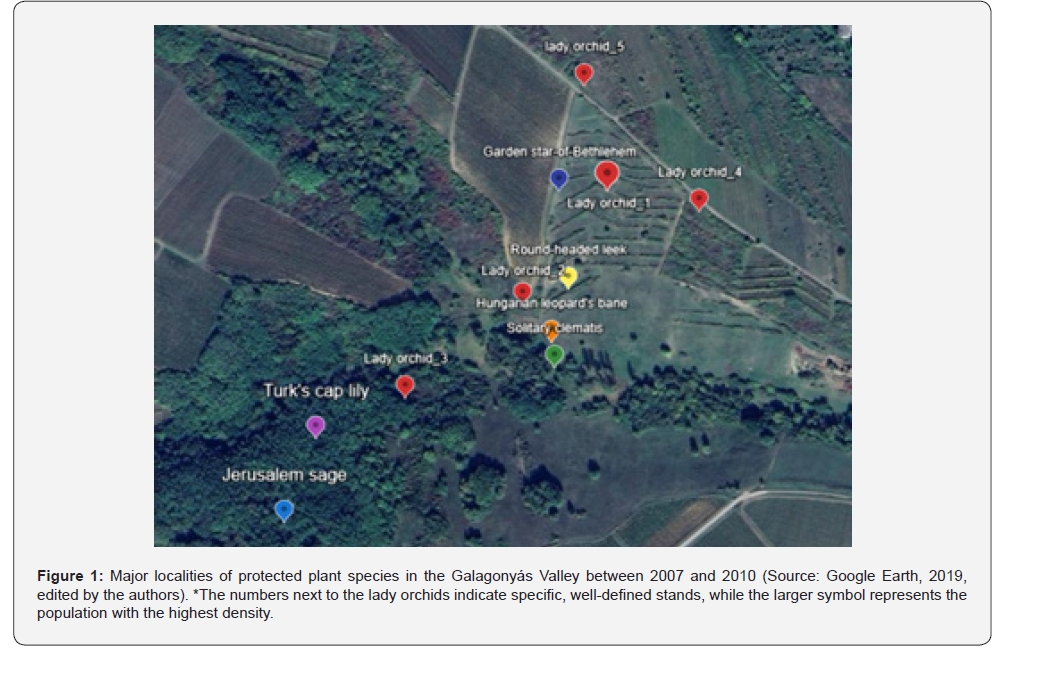
Nearly 15 years after the investigations conducted by Kárász and Varga [16] in the valley, we relocated all species described by them, except the Hungarian iris (Iris variegata). Furthermore, we discovered the round-headed leek, the lady orchid, and the Garden star-of-Bethlehem (Ornithogalum brevistylum Wolfner) as new protected plants (Table 1). Our first visit to the study area took place on April 13, 2007. The protected plant species discovered during this first occasion and in subsequent years are detailed in the following paragraphs. The precise spatial distribution of individuals for each species within the area is presented in (Figure 1). The entire study area is in various stages of grassland restoration and afforestation.
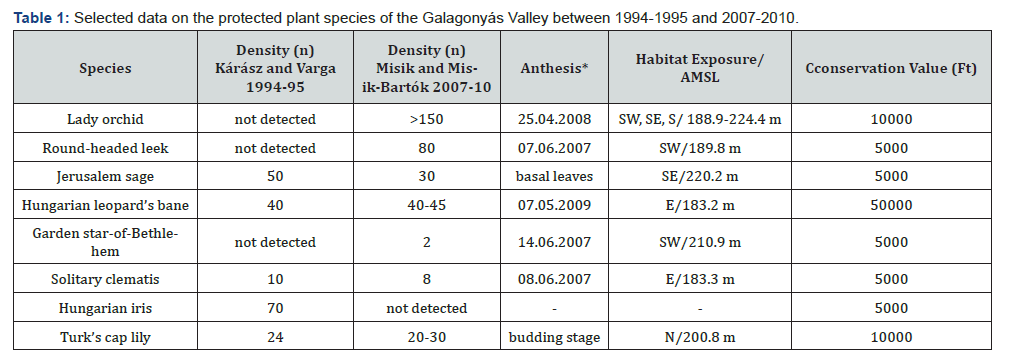
*The dates indicated refer to the earliest recorded observations of the first individuals in anthesis.
The round-headed leek flourished in a well-defined strip with a basal area of 2.0 m × 0.7 m on June 7, 2007. It was found on a southwest-facing slope in a slope-grassland dominated by various grass species, which developed on rhyolite tuff at the site of a formerly terraced, now completely abandoned vineyard, specifically on the side of the last terrace near the valley floor. Out of approximately 80 individuals, 57 specimens were in bloom; the larger specimens reached heights of 50.0-60.0 cm. During subsequent years of fieldwork, we did not find flowering individuals of this protected leek species, or our visits did not coincide with the flowering aspect.
Lady orchid was found on the sites of abandoned vineyards, along former vineyard terraces, at the edges of more humid meadows next to the stream running through the valley, in the undergrowth of black locust stands, as well as beneath shrubs composed of common dogwood (Cornus sanguinea L.), blackthorn (Prunus spinosa L.), or dog-rose (Rosa canina L.). The vast majority of the specimens found (> 80%) flowered every year. Interestingly, the largest individuals were found on the southeastern side, in the undergrowth of small black locust (Robinia pseudoacacia L.) patches. These reached heights of 62.0- 80.0 cm. The largest population of the lady orchid was discovered in a secondary mesophilous slope-grassland formed on the site of a terraced, abandoned vineyard (Figure 1). The total population of lady orchids in the Galagonyás Valley has a higher density than the one living on the southwestern forest-steppe slopes of Nagy- Eged Hill. Furthermore, the number of color variants (lusus) of this protected plant is remarkably high. In 2010, several flowering specimens of the orchid were also discovered between stillproductive vine rows located northeast of the abandoned terraced slope.
Specimens of the Turk’s cap lily (Lilium martagon L.) in the budding stage were found in the southwestern area of the valley, directly along the stream running across the valley floor, in a moist and shaded habitat with thick soil cover. The individuals of this bulbous perennial were, on average, 30.0-40.0 cm tall and well-developed. The species thrives with high population density within an area of only a few square meters, in the undergrowth of a humid willow-poplar gallery forest interspersed with black locust.
A population of tuberous Jerusalem sage (Phlomis tuberosa L. Moench), consisting of 32 individuals, was discovered by its characteristic basal leaves in April 2009 at the end of a connecting side valley, in an open, calciphilous slope-grassland habitat. Due to the typical June-July flowering period, elongated flowering shoots were not yet visible at that time. The average height of the shoots measured in early autumn fell between 76.0 and 90.0 cm.
A solitary, well-developed specimen of the garden star-of- Bethlehem grew on the terraced, abandoned vineyard area that also serves as a habitat for the lady orchid and the round-headed leek. A mesophilous grassland has developed here, at the edge of which the large-sized individual was found. The flowering specimen grew at the margin of the dirt road leading to the valley floor, significantly higher up compared to the leeks. Another specimen developed along the same dirt road, in a section closer to the stream at the valley floor.
Discussion
The nature conservation and floristic significance of the protected plants identified in the valley can be evaluated in light of the number of habitats and population sizes previously described in the region.
Until 2001, there were no recorded observations of the round-headed leek from the Eger area [21]. Schmotzer [22] subsequently described its presence in the Eger region from Áfrika-tető, Császár-domb, Mész-hegy, Nagy-Czakó, and Tornyostető. The author specifically highlighted the significant expansion of data originating from the 1997-2014 period. According to Vojtkó [21], the lady orchid has been recorded at the following locations: Bajusz, Bikk-bérc, Kis-Tiba, Nagy-Eged (where a stable, robust population exists on the SW-facing forest-steppe slopes), and Nagy-Tiba; and in Eger-Felnémet at Öreg-hegy, Pap-hegy, and Pirittyó-tető. Regarding the Bükkalja region, it was described from Almagyar-dűlő, Mész-hegy, Bajusz-valley, and Kavicsos-tető, while in the vicinity of Felnémet, it was reported from Tó-lápa [23].
Stable populations of the Hungarian leopard’s bane (Doronicum hungaricum Rchb.f.) are known from the summit of Nagy-Eged Hill, among other sites. In the Eger area, the species has been reported from Bajusz, Mész-hegy, “Rókafarm,” Aranybikatető, Cakó-tető, and Pajados. In the vicinity of Eger-Felnémet, it has been recorded from Gazsi-lápa, Ostoros Valley, and Pincesor [21]. Between 1996 and 2001, it was found near Eger in Cigléddűlő, notably within a black locust stand [23]. Schmotzer [22] indicated Áfrika-tető, Császár-domb, Kis-Ecsér, and Nyergest near Eger as new data points for the Bükkalja area.
Solitary clematis (Clematis integrifolia L.) has been reported near Eger from Bajusz, Les-rét, Gazsi-lápa, Merengő, Ostorosvalley, and areas along the railway embankment [21]. The work of Pifkó and Barina [23] mentions it south of Pünkösd-hegy in Eger, and from the Birka and Tó-lápa habitats near Eger-Felnémet. The Turk’s cap lily has been reported near Eger from Bikk-bérc, Kerékkötő-lápa, Bajusz-valley, Nagy-Eged, Nagy-Tiba, Ostorosvalley, and Szőlőcske-valley, while in the Eger-Felnémet area, it was recorded from Berva-bérc, Berva-valley, and Fehér-hegy [21]. Pifkó and Barina [23] provided the following localities: Bajusz at Eger, and the oak forests of Birka, Gazsi-lápa, and Tó-lápa at Eger- Felnémet.
Numerous localities of the tuberous Jerusalem sage are known in the Eger region: Bajusz, Cigléd-oldal, Csomós-tanya, Mész-hegy, Nagy-Eged, Nagy-rétek, Nagy-Tiba, Olajosokútja, and Vécseyvalley [21]. As early as 1997, Schmotzer’s [24] study reported the occurrence of five individuals at the base of Mész-hegy. Pifkó and Barina [23] published several additional records from the Bükkalja region: in the Eger area, Almagyar-domb, Kavicsos-tető, Kerékkötő-laposa, Nagy-Orbán-valley, south of Pünkösd-hill, Sík-hegy, and between Sík-hegy and Pajados-hegy; and in Eger- Felnémet, Birka, Gazsi-lápa, and Tó-lápa. Further floristic data for the plant from the studied micro-region were published by Schmotzer [22], including several sites around Eger: Áfrika-tető, Agárdi-hegy, Ibolyás-tető, Kerek-domb, Kis-Kocs, Mész-völgy, Nádas, Somos, Szarkás-tető, Szépasszony-valley, and Új-fogás.
The garden star-of-Bethlehem can be considered a widespread species in the Bükkalja area. In the monograph titled The Flora of the Bükk Mountains [21], localities near Eger such as Bajusz, Cigléd-oldal, and Nagy-rétek are listed. According to a personal communication by Vojtkó, the plant is very common in certain years, for instance, along the main road connecting Andornaktálya and Mezőkövesd. This observation is confirmed by Schmotzer’s [22] publication. Near Eger, literature records are known from Almagyar-dűlő, Bajusz-valley, Fertő-dűlő, and Nagy-Pajadosdűlő, while from the Eger-Felnémet region, records from Birka and Tó-lápa exist [23]. According to Schmotzer [22], it is also a widespread plant in the region, including sites such as Barátok- Pap-hegy, Felnémet (cemetery garden), Hajdú-hegy, Ibolyás-tető, Kolompos, Közép-hegy-dűlő, Rácz-hegy, and Rossz-kálló.
Among the species mentioned in the literature, the lady orchid, the garden star-of-Bethlehem, and the round-headed leek were all found in the Galagonyás Valley, specifically in a section that was under viticulture decades ago. The lady orchid has been reported from the outskirts of five settlements in the Northern Cserhát [10], from the Vergyálom vineyard in the Zala Hills [14], from the vineyards of the Cserhát region [8,9], from the Alsószuha vineyard in the Putnok Hills [25], and from the Balaton Uplands [26]. The garden star-of-Bethlehem has also been described from the Cserhát [8,9], the Alsószuha vineyard [25], the Karancs Valley within the administrative boundaries of Karancsberény and Karancslapujtő [9], the Putnok Hills from abandoned vineyards near Dövény [27], and with low density from the Balaton Uplands [26]. Round-headed leek was found in fewer locations and generally in smaller numbers. The literature analyzed by us reports it only from abandoned vineyards in the Balaton Uplands [26] and from Nagy-hegy in Tokaj [23].
Conclusion
From a botanical perspective, the greatest value of the valley is represented by the high-density and morphologically diverse population of lady orchids, as well as the discovery of the roundheaded leek in 2007. The presence of the latter species is of great significance because it is uncommon in both the Bükk Mountains and the Eger region. The importance of these two species is further enhanced by the fact that they, along with a solitary individual of the garden star-of-Bethlehem, were found in abandoned vineyards. Furthermore, the lady orchid also appeared among existing, albeit weedy, vine rows. In recent years, numerous individuals of the lady orchid have emerged from different plant communities in the valley; however, despite targeted searches, no individuals of the round-headed leek were found between 2008 and 2010. It can be concluded that botanical changes and successional processes, which are closely linked to shifts in land use, have enabled the establishment or survival of rare plant species and, in the case of the lady orchid, even their dynamic spread. It can be stated that abandoned vineyards may harbor valuable, semi-natural habitats.
References
- Stefanucci S, Graça A, Novello V, Belda I, Carlos C, et al. (2018) Functional biodiversity in the vineyard. OIV publications, 1st Edition, Paris, France. ISBN 979-10-91799-93-5, p. 7-49.
- Trivellone V, Schoenenberger N, Bellosi B, Jermini M, de Bello F, et al. (2014) Indicators for taxonomic and functional aspects of biodiversity in the vineyard agroecosystem of Southern Switzerland. Biological Conservation 170: 103-109.
- Nichols E, Larsen T, Spector S, Davis AL, Escobar F, et al. (2007) Global dung beetle response to tropical forest modification and fragmentation: a quantitative literature review and meta-analysis. Biological Conservation 137: 1-19.
- Guittet M, Sibe V, Gaudin JC (2011) Les vignobles: de nouveaux réservoirs de biodiversité. Pratiques agricoles de réfé Faune sauvage 291: 34-42.
- Schumacher KP (2006) Landschaftswandel im Kaiserstuhl seit 1770 - Analyse und Bilanzierung. Culterra 47: 1-210.
- Veith M, Bonn S, Sander U, Albrech J, Poschlod P (2012) Nachhaltige Entwicklung xerothermer Hanglagen am Beispiel desMittelrheintals. Naturschutz und Biologische Vielfalt 121: 1-357.
- Malatinszky Á, Novák E (2022) Land-use history and vegetation of abandoned vineyards in the Karancs Valley. Tájökológiai Lapok 20(1): 57-71.
- Dedák D, Sulyán P (2014). Landscape changes in the vineyards of Cserhát settlements. Tájökológiai Lapok 12(2): 363-381.
- Malatinszky Á, Mravcsik Z, Dedák D (2014) Floristic data from abandoned vineyards of the Cserhát Mts. Kitaibelia 19(2): 260-266.
- Mravcsik Z, Harmos K, Malatinszky Á (2009) Botanical and landscape history studies of abandoned vineyards in the Northern Cserhá Tájökológiai Lapok 7(2): 473-484.
- Oszkocsil Z (2014) Landscape changes of the Putnok vineyard. Tájökológiai Lapok 12(2): 313-326.
- Stefán E (2018) Landscape history and botanical study of the Alsószuha vineyard. Botanikai Közlemények 105(1): 129-142.
- Novák TJ, Incze J, Spohn M, Glina B, Giani L (2014) Soil and vegetation transformation in abandoned vineyards of the Tokaj Nagy-Hill, Hungary. Catena 123: 88-98.
- Biró É, Óvári M, Varga A, Bódis J (2012) Landscape history and floristic values of the Vergyálom vineyard (Zala County). Természetvédelmi Közlemények 18: 58-66.
- Bódis J (2017) Hungarian populations of the Adriatic Lizard Orchid (Himantoglossum adriaticum) and the history of land use at their localities. Kitaibelia 22(1): 84-94.
- Kárász I, Varga J (2002) Nature conservation assessment of the Galagonyás Valley. Acta Academiae Paedagogicae Agriensis 23(1): 65-82.
- Misik T, Misik-Bartók D (2022) New localities of protected plant species, the lady orchid and the round-headed leek in the Eger region, Hungary. In: XVII. Carpathian Basin Environmental Science Conference (pp. 39-40). Kolozsvár, Ábel Kiadó.
- Marosi S, Somogyi S (1990) Inventory of Micro-regions of Hungary I-II. [Magyarország kistájainak katasztere I-II]. MTA Geographical Research Institute, Budapest.
- Arcanum Adatbázis Kft (2024) Military Surveys. http://maps.arcanum.com/map/ (Accessed: 11 December 2023).
- Nagy D (2004) Possibilities for the reconstruction of historical land use and land cover using archival maps. Ecological Institute for Sustainable Development Foundation, Miskolc p. 40.
- Vojtkó A (2001) The Flora of the Bükk Mountains. Sorbus Kiadó, Eger.
- Schmotzer A (2015) Ceratocephala testiculata (Crantz) Roth and further data on the flora of Bü Kitaibelia 20(1): 81-142.
- Pifkó D, Barina Z (2004) Data on the flora of Bü Kitaibelia 9(1): 151-164.
- Schmotzer A (1997) Floristic data from the Southern and Northern Bükk Mts. Kitaibelia 2: 71-74.
- Stefanucci S, Graça A, Novello V, Belda I, Carlos C, et al. (2018) Functional biodiversity in the vineyard. OIV publications, 1st Edition, Paris, France. ISBN 979-10-91799-93-5, p. 7-49.
- Számel R (2022) Botanical and land-use history research in abandoned vineyards of the Balaton Uplands. Tájökológiai Lapok 20(1): 161-187.
- Malatinszky Á (2007) Recent results of the floristic research in the Putnok Hills. Kitaibelia 12(1): 124-132.

























