




 ECOA Home



First record of Blind worm Lizards Amphisbaenia vermicularis in Syrian coast
Mohamad Galiya and Ranim Othman*
Department of Zoology, Faculty of Sciences, Lattakia University, Lattakia, Syria
Submission: December 10, 2025;Published: January 06, 2026
*Corresponding author: Ranim Othman, Department of Zoology, Faculty of Sciences, Lattakia University, Lattakia, Syria.
How to cite this article: Mohamad G, Ranim O. First record of Blind worm Lizards Amphisbaenia vermicularis in Syrian coast. Ecol Conserv Sci. 2025; 002 5(2): 555658. DOI:10.19080/ECOA.2026.05.555658
Abstract
In Syria, the recording and classification of Reptiles are included in the Syrian National Program of Biodiversity, which began more than thirty years ago. It emphasizes the local animals and vegetation for the living species. Through this research, the existence of the blind worm lizard (Amphisbaenia vermicularis) was recorded for the first time on the Syrian coast (Lattakia, Tartous). The blind worm lizard has a worm-like body covered with horny skin scales, and its colour is brown, changing according to the colour of the soil. The length is between 13-20cm. The mouth is ventral, the jaws bear conical teeth, and a forked tongue with a scaly surface. The eyes are absent, the tail is short, and the cloaca is transversely cleft. Some morphological and taxonomic characters of the local blind worm were studied in comparison with those found in characterization studies.
Keywords: Amphisbaenia vermicularis; biodiversity; New record; Reptiles; Syrian coast
Introduction
Reptiles are classified as cold-blooded animals (exothermic), as their vital activity (movement, feeding, reproduction, etc.) is linked to the temperature of the surrounding environment. It is of great environmental importance as it constitutes one of the essential links in the food chains of ecosystems (Snakes, Crocodiles, Turtles, Lizards, etc.) [1,2] and in controlling the number of Rodents, Molluscs, and Insects and thus achieving the ecological balance of these groups. Lizards are a thriving and diverse group adapted to walk or run, climb, swim, and burrow, and are distinguished from snakes by having two pairs of legs (some are legless), fused halves of the lower jaw, movable eyelids, external ears, and the absence of venomous fangs [3,4]. Amphisbaenids are limbless reptiles with worm-like appearance, reduced eyes, and fossorial habits [5]. These animals are adapted to live most of their lives underground [6-9], using their specialized, highly resistant, bony heads to dig [6].
Amphisbaenas are a small group of tropical, legless, burrowing lizards with eyes and ears hidden under the skin. Scientific references [10-12] indicate the presence of about 140 species of worm lizards spread throughout the world and they belong to two families, and 23 genera, most of which are found in South America, Mexico, Africa and western Asia, and one in southern Europe and southeastern America.
Objective of the Study
The research aims to:
1.List and classify local Blind worm lizards on the Syrian coast.
2.Shed light on the biodiversity of Reptiles on the Syrian coast environmentally and taxonomically.
Material and Methods
To detect local Reptiles (worm lizards), we conducted periodic field trips during the summer months (May to August) of the years 2000-2024 in Lattakia Governorate (Baksa, Qanjara, Forestry Institute), Tartous (Qadmus, Al-Dreikish) and using hand nets and digging tools, the local Blind worm lizard was found. Morphological measurements were taken for the caught individuals of these lizards (such as total length, head length, tail length, body diameter, etc.) and then they were described (colour, general shape, skin formations) and photographed and classified according to scientific references [2,10,12,13] and preserved by the wet method in a 7% formaldhyd solution.
Results and Discussion
The presence of the blind worm lizard Amphisbaenia vermicularis was recorded on the Syrian coast (Latakia-Tartous) during the research period.
Taxonomic position of the Blind worm lizard:
Class: Reptilia
Order: Squamata
Family: Amphisbaenidae
Genus: Amphisbaenia
Species: Blind worm lizard A.vermicularis Wagler 1824
Morphological characteristics of the Blind worm lizard:
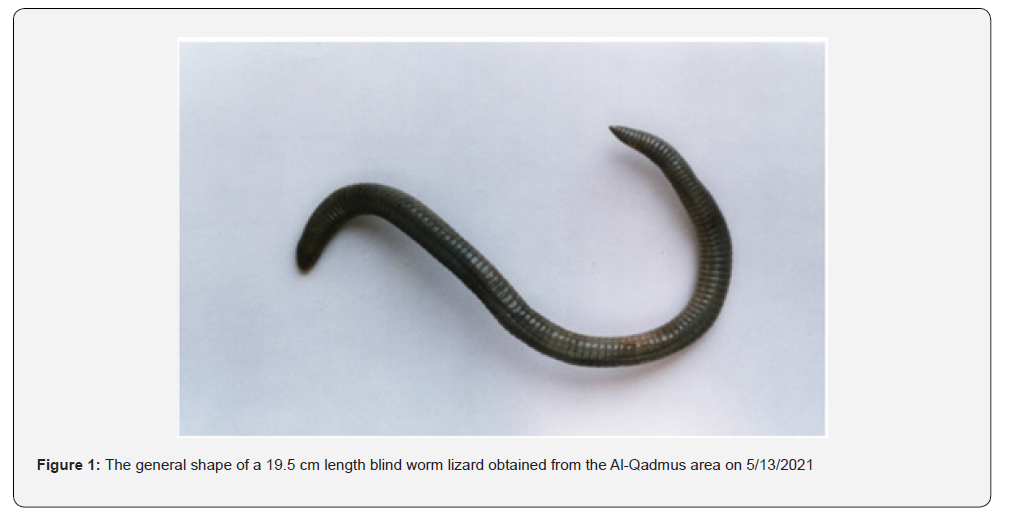
Its individuals are characterized by being worm-shaped, dark brown to light brown, with a slender, cylindrical, worm-like body of the worm lizard (bipedal), covered with a horny layer, and surrounded by narrow circular rings, which appear in the form of elongated warts (Figure 1). As a result, each skin ring is divided into shapes (triangular or square pieces that resemble scales in their external appearance, and its skin applies freely to the body, forming a movable gelatinous sac that can gather in the form of folds along the trunk rings that surround it [4,11].
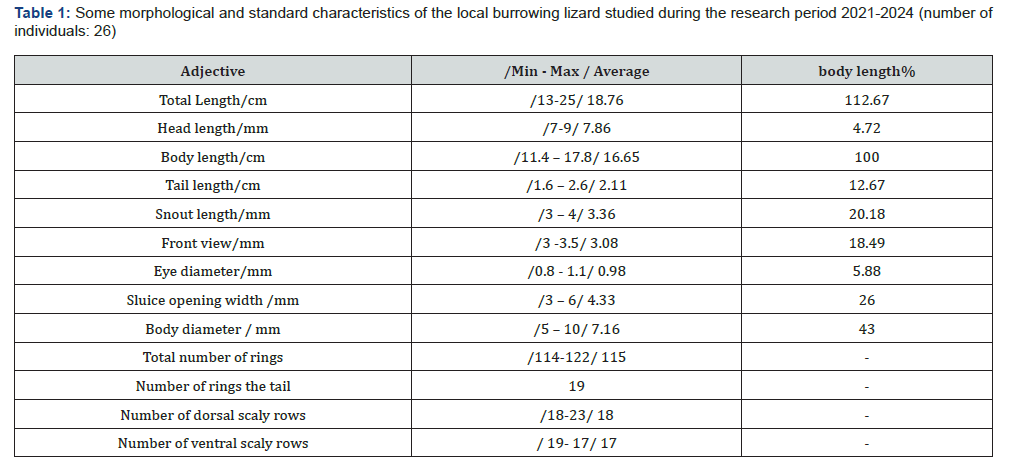
Morphological and standard characteristics of the Blind worm lizard
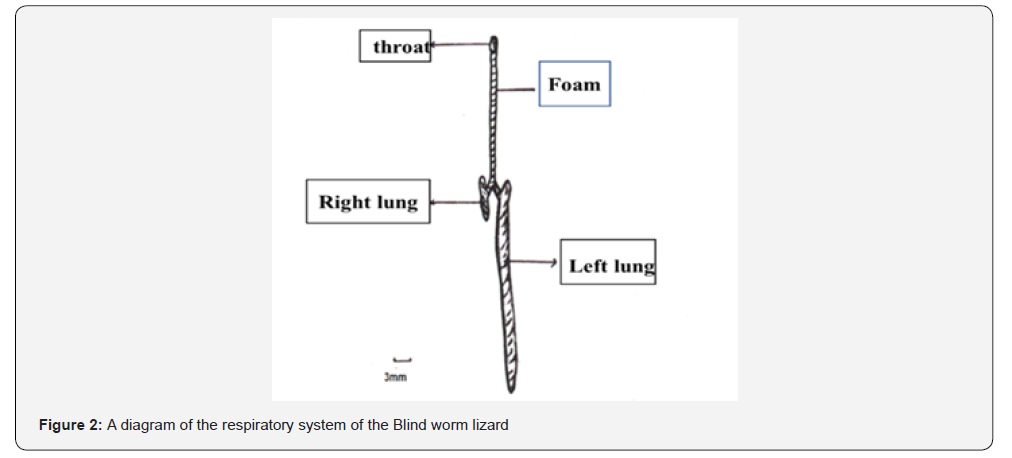
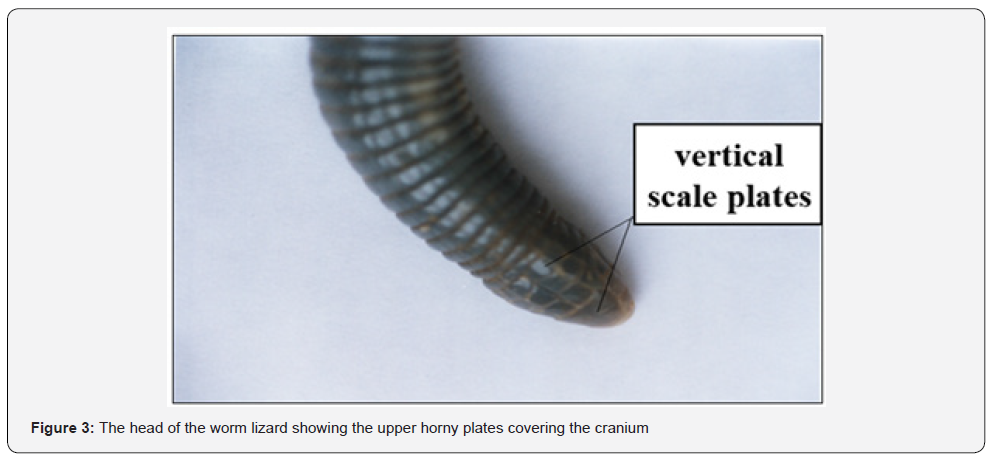
The lengths of the studied individuals ranged between 13- 25cm and the tail length between 1.6-2.4cm (Table 1). This lizard is characterized by a strong of the skull ossification, without temporal arches or the supporting bones characteristic of lizards [13]. It differs from other lizards by the presence of a permanent dentary tooth that does not fall out after hatching or with age and by the development of a single growing lung, the left lung. At the same time, the right one is reduced, which is what we observe in snakes and legless lizards (Figure 2).The head has scaly plates which help in digging and serve as taxonomic character. Specialized scientific research has shown that the shape of the head with specialized neck muscles is an ideal device for digging in the different soils in which the worm lizard lives (Figure 3).
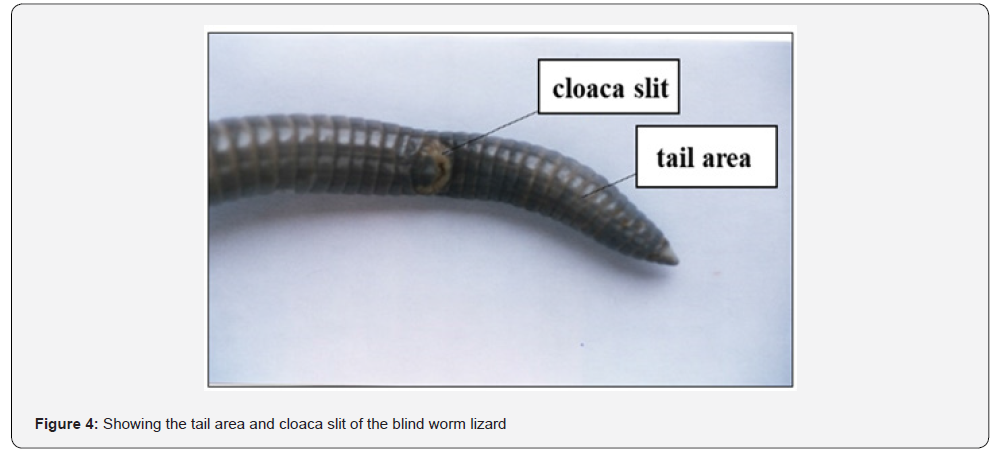
The back of the Blind worm lizard turns into a 1.6-2.6cm pointed tail that constitutes 12.67% of the body length (Table 1, Figure 4). This relative change is functional when the animal is exposed to a predator, as it quickly raises its tail upwards to distract the predator from the head, which remains motionless at the bottom. Therefore, some indigenous people of some countries call this animal the two-headed snake (Figure 1).
Vital characteristics of the Blind worm lizard
• Movement: The large number of transverse rings that surrounding the entire body of the Blind worm lizard gives it a remarkable resemblance to earthworms, especially when moving. Their number reached about 115 rings (Table 1). Therefore, the presence of rings along the body (Figure 1) enables the animal to move quickly by compressing the rings and spacing them out, which gives the image as if the animal is elongating and shrinking in length, as is the case with earthworms when crawling. Through this type of movement, the worm lizard can move in the opposite direction as well [11], hence its name as a bidirectional mover, as it is a distinctive feature that enables this animal to move in narrow passages that it makes itself underground, as it does not allow the body to rotate in them.
• Sense organs: As is the case with many of the present reptiles, the eyes of this animal (the worm lizard) are hidden under the skin and appear through the scales that cover them in the form of a small dark spot (Figure 3). Thus, the animal can distinguish light from darkness and the general outlines of the things surrounding it. The organs of smell, touch, and taste are also significantly developed, as is the chemical sense, which contributes partially to detecting prey (various invertebrates in the soil) even through a not-very-large thickness in the soil.
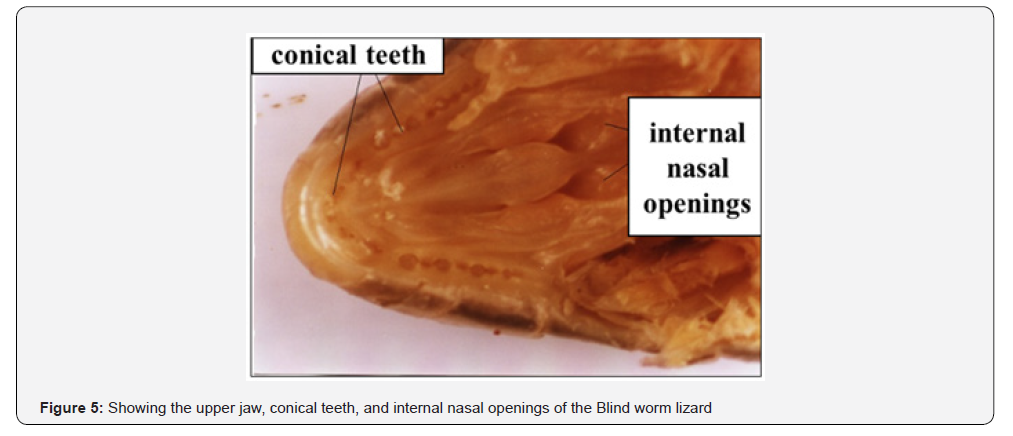
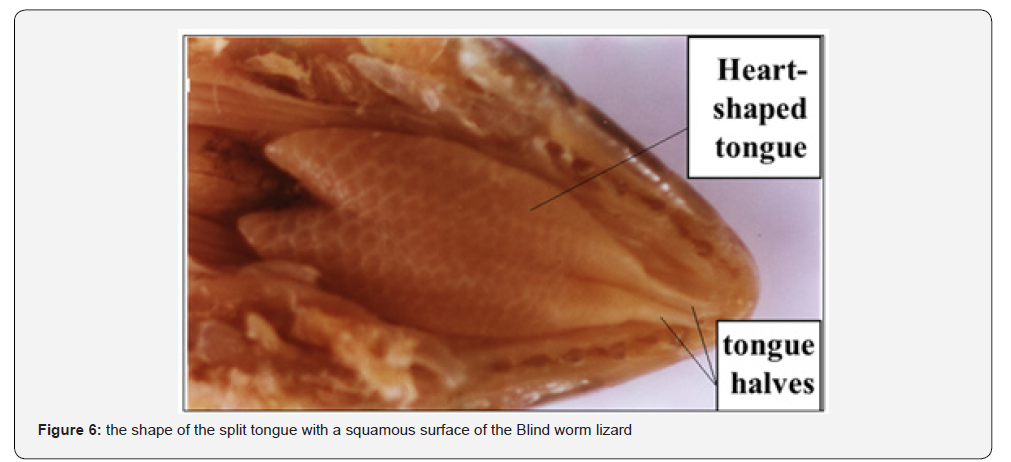
• Nutrition: This animal is highly specialized for underground life, as it spends most of its life underground in the nests of ants and termites that it feeds on, and it rarely appears on the surface of the soil [4]. This Blind worm lizard has conical teeth of varying sizes on both jaws (Figure 5), as well as a tongue that is split in the front and wide at its base, and on which there are cuts resembling the scales that cover the body of reptiles (Figure 6).
• Reproduction: Most worm lizards lay 2-6 round eggs covered with a thin or semi-transparent shell. They lay them in bee nests. They lay them in bee nests, and sometimes the eggs are found next to the female who laid them which prompts to speculate that a caring for offspring have existed [11].
Conclusion and Future Scope
• The Syrian fauna is rich in biodiversity, and Reptiles
occupy an advanced position.
• The blind worm lizard Amphishaenia vermicularis
Wagler1824 was recorded for the first time on the Syrian coast.
• The morphological and anatomical taxonomic criteria
of the local Blind worm lizard are consistent with those found in
scientific references.
Author’s statements
Acknowledgements
The authors would like to thank the administration of Tishreen University, Lattakia, Syria for providing financial and logistical support for this work, and the editor-in-chief and reviewers for their constructive comments.
Authors’ Contributions
Both authors contributed to the study conception and design. Material preparation, data collection and analysis were performed by Ranim Mohamad Othman, Mohamad Younis Galiya. The first draft of the manuscript was written by Ranim Mohammad Othman and all authors commented on previous versions of the manuscript. Both authors read and approved the final manuscript.
References
- Karroum M (1980) Al-Wajeez in Animal Classification First Edition, Directorate of University Books and Publications, University of Aleppo, Syria pp. 670.
- Disi A and Bohme W (1996) Zoogeography of the amphibians and reptiles of Syria, with additional new records. Herpetozoa 9( ½): 63-70.
- Zug GR (1993) Herpetology: An Introductory Biology of Amphibians and Reptiles, Second edition, Academic press Sandiego PP. 527.
- Hickman CP, Roberts LS, Hickman FM (1984) Integrated principles of zoology, Mosby college Publishing, ST.Louis, Toronto, Santa Clara PP. 578-599.
- Barros FJDD, Hohl LDSL, Barbosa OR (2008) Excavatory cycle of Leposternon microcephalum Wagler, 1824 (Reptilia, Amphisbaenia). International Journal of Morphology 26(2): 411-414.
- Gans (1978) The characteristics and affinities of the Amphisbaenia. ZSL 34(4): 347-416.
- Kearney M, Stuart BL (2004) Repeated evolution of limblessness and digging heads in worm lizards revealed by DNA from old bones. Proc Biol Sci 271(1549): 1677-1683.
- Bernarde PS (2012) Anfíbios e Répteis - Introdução ao estudo da Herpetofauna Brasileira, First Edition, São Paulo, Brazil, PP. 320.
- Vitt LJ, Caldwell JP (2013) Herpetology: an Introductory Biology of Amphibians and Reptiles, Fourth Edition, San Diego California, USA Academic Press.
- Ananjeva NB, Borkin LY, Darevsky IS, Orlov NL (1988) Dictionary of animal names in five languages Amphibians and Reptiles. Russky Yazyk Publishers, Moscow PP. 560.
- Sokolov VE (1988) Dictionary of Animal Names in Five Languages: Amphibians and Reptiles. Russky Yazyk Publishers Moscow 1: 4.
- Darefsky IS, Love NL (1988) Rare and decreasing animals (Amphibians and Reptiles). High school, Moscow PP. 463.
- Webb JE, Wallwork JA, Elgood JH (1978) Guide to Living Reptiles ,First Edition, Red Globe Press, London PP. 172.

























