




 ECOA Home



High Quality and Sustainable Development of Soil and Water Conservation
Zhongsheng Guo*
Institute of Soil and Water Conservation, Northwestern A&F University, Chinese Academy of Sciences and Ministry of education, Yangling, China
Submission: August 10, 2024; Published: September 03, 2024
*Corresponding author: Zhongsheng Guo, Institute of Soil and Water Conservation, Northwestern A&F University, Chinese Academy of Sciences and Ministry of education, Yangling, China
How to cite this article: Zhongsheng Guo*. High Quality and Sustainable Development of Soil and Water Conservation. Ecol Conserv Sci. 2024; 4(4): 555641. DOI:10.19080/ECOA.2024.04.555641
Abstract
Water and soil loss influences the soil and water resources of terrestrial ecosystem, ecological environment and ultimately the quality of life and high-quality development. China is the most serious soil erosion country in the world, especially in the Loess Plateau. After years of efforts, soil and water conservation in China has developed rapidly, and the surface runoff and soil loss in soil and water loss areas have decreased rapidly. However, with the increase in population and economic development, people’s living standards have been gradually improved, and higher requirements for soil and water conservation was put forward. However, the soil and water protection benefits cannot meet the needs of people’s good life for soil and water protection in the new era. In order to solve the problem, the high quality and sustainable management of soil and water conservation has been put forward. The results shows that the new and higher goal of soil and water conservation is to carry out the high quality and sustainable development of soil and water conservation, and obtain the maximum effect to meet the growing needs of people for soil and water protection and for a better life in the new era. The theoretical basis for high quality and sustainable development of soil and water conservation is the new theory of soil and water conservation. It includes that the soil and water loss is the process of transferring soil and water resources from one place to another; the impact of soil and water loss on the high-quality development of society includes positive and negative aspects; Soil and water conservation refer to use some methods or measures to reduce soil erosion to soil allowable loss. At the same time, make efficient use of the soil and water resources and minimize the loss of life and property; The high quality and sustainable management of soil and water conservation measures must be made to obtain the maximum effect and develop the economy and raise people’s income and meet the need of people’s requirements for soil and water conservation for a better life. The practice proof the theory is good.
Keywords: Soil and water loss; Soil and water conservation; Food and ecological security; Environment; Soil and water conservation measure; Most optimum distribution of resources; High quality and sustainable development
Abbreviations: ITTO: International Tropical Timber Organization; IUCN: International Union for the Conservation of Nature
Introduction
Water and Soil Loss affects the carbon and nitrogen cycle of terrestrial ecosystem, ecosystem products and services, environment, the ecological environment and economic development, and ultimately the quality of life and sustainable development of the public. The science of soil and water conservation is a science advancing with The Times. Over the past hundred years, great progress has been made in the work of soil and water conservation in China with the unremitting efforts of the vast number of soil and water conservation workers. For example, the concept of cover degree and cover rate of water conservation forest has been distinguished Guo [1]; Guo & Den [2]. Vegetation degree of cover refers to the percentage of the vertical projection area of vegetation canopy branches and leaves in the nutrient area, while vegetation cover ratio refers to the percentage of the total land area of grassland and woodland area that meet certain requirements in a region or a country Guo [3]. The cover degree includes the effective cover degree , critical degree and Potential coverage Guo [4,5]. The establishment of a large area of soil and water conservation vegetation in the area of soil erosion and the establishment of large-scale soil conservation projects such as water conservation forest (or vegetation), wind-proof and sand forest and water source conservation forest construction standards and their construction scale, the effective coverage rate of wind-proof sand forest, the effective coverage degree of water conservation forest and the effective coverage rate of water conservation forest Guo [6,7,1,3,8]; Guo [4,5,9]; Guo & Den [2] the theory of soil water resources utilization limit by plants and the soil water vegetation bearing capacity Guo [10,11] There are a large area of soil conservation vegetation in soil and water loss regions.
However, due to the lag of theoretical research of soil and water conservation, the construction standards of Soil and water conservation engineering measures and vegetation measures are low, the spatial allocation of soil and water conservation measures is unreasonable, the work of soil and water conservation pay more importance to quantity than quality, and the efficiency of soil and water conservation is low, which cannot meet the needs of highquality and sustainable development of soil and water conservation in the new era. Such incidents as drought, forest fires, extreme weather and precipitation, hurricanes and flash floods will lead to widespread erosion of soil and water conservation vegetation, collapse of dams and other accidental incidents, resulting in serious soil erosion, destruction of farmland, villages, roads and vehicles, which affect transportation, food and ecological security. And the cost to the country and society is billions of dollars every year. In order to overcome these difficulties and promote the high-quality development of soil and water conservation in the new era to meet the requirements of the public for soil and water conservation in the new era, it is necessary to make a new goal of soil and water conservation and develop a new theory of soil and water conservation. Through Comprehensive analysis of relevant literature, the new goal and theory of soil and water conservation were put forward Guo [12] .In order to carry out high quality and sustainable development of soil and water conservation, we have to make higher goal, new theory, method and practical effects of soil and water conservation and get the maximum effect in new time. This paper aims to introduce the new objectives, theory, method and practical effects of soil and water conservation in the new period.
Research method
Since 1982, author started to research Soil and Water Conservation and mad great achievement. In the summer of 2019, the author was invited to teach the course of Soil and Water Conservation and Ecological Security to students majoring in Soil and Forestry Conservation and Desertification Control in Northwest A&F University, China. Due to the lack of suitable teaching materials and the need to cultivate the literature reading ability of graduate students, I arranged my graduate student Mr. Wang to sort out and analyze the literature on soil erosion and soil conservation in the past 100 years, and initially proposed the new theory of soil and water conservation, which have published in 2020 Guo [12]. Then, the literature on soil and water conservation from 2020 to 2023 has been collected and analyzed to improve and verificate the theory.
Results
The new goal of soil and water conservation
Since 1875, the Industrial revolution brought about the allround development of economy and society, but also cause the severe problem of environmental pollution. In 1972, D. L. Meadows put forward the concept of limits of growth that clarified the importance of resources and the relationship between resources and population, showing that the consequences of unlimited growth on the resource-limited planet, which put the foundation for sustainable development. The International Union for the Conservation of Nature (IUCN) propose the concept of sustainable development in 1980. In 1987, the United Nations World Commission on Environment and Development clearly defined sustainable development. After then, sustainable development thought has gradually been accepted worldwide, and many countries have started to carry out sustainable development strategies. International Tropical Timber Organization (ITTO) took the lead in developing guidelines for the sustainable operation of tropical forests in 1990.
In 1992, the central issue of the United Nations Conference on Environment and Development, held in Rio de Janeiro, Brazil, was sustainable development, which emphasized that sustainable forest development was an important component of sustainable economic development. In 1992, the Chinese government submitted its report on China’s environment and development to the United Nations Conference on Environment and Development, which laid out the basic position and views on China’s sustainable development. In 1994, the Chinese Government made it clear that it would implement a strategy for sustainable development in its economic and social development. In 2017, China carried out high-quality development. In order to meet the need of highquality development, we have to make a new and higher goal of soil and water conservation, the high-quality and sustainable development of soil and water conservation should be a new goal to meet the growing need of people for soil and water conservation from traditional goal of reducing soil and water loss Guo [13].
New theory of soil and water conservation
In order to obtain the high-quality and sustainable development of soil and water conservation, we have to make a new theory of soil and water conservation to guide the soil and water conservation practice in the new era to meet the growing need of people for the soil and water conservation and better life. The new theory of soil and water conservation as following:
Soil and Water Loss
The term Soil and Water Loss is a natural phenomenon, originated in China as a technical term in the early 20th century Guan [14]. The term was applied to the Northwestern Loess Plateau of China in early 20th century. The forces forming soil and water are called Soil and Water Loss external forces. Soil and Water Loss external forces include water, wind and temperature (freeze-thaw), etc. The term erosion has long been used in geology, mostly to express the formation of external force flattening, and soil erosion first appeared in the book written by Kozmunk in 1909. It was then widely used and was introduced into China in the 1930s. Soil erosion refers to the whole process of soil and its parent material, as well as the destruction, stripping, transport and deposition of surface components of the land under external forces such as hydraulic, wind, freeze-thaw and gravity Guan [14]. Water power is the force produced by the flow of water; a wind is the magnitude of the force the wind exerts on an object. Temperature is the sign of the average translational kinetic energy of the molecular motion, and temperature is the collective expression of the molecular thermal motion.
At present, people’s understanding of water and soil loss is not uniform. It has been argued that soil erosion refers to “the destruction and loss of soil and water resources and land productivity under the action of external forces, including surface erosion and soil erosion; most believe that water and soil loss is equivalent to soil erosion, i.e. soil erosion by hydraulic erosion, wind erosion or gravity erosion, resulting in soil dispersion, transport and accumulation processes. Now, we enter a new period. In order to promote the high quality and sustainable development of soil and water conservation in the new period, we should first unify the understanding of water and soil loss. The authors believe that water and soil loss is the process of soil and water resources transferring from one place to another, which includes generalized soil erosion and narrow sense soil erosion. Generalized water and soil loss refers to the process of carbon and nitrogen circle, land productivity and ecological environment change caused by the transfer of soil and water resources induced by external forces. Water and soil loss in narrow sense is equivalent to soil erosion Guo [12].
Consequences of soil and water loss
Water and soil loss has obvious consequences, which have positive and negative effects on high quality and sustainable development as follows:
Water and soil loss leads to the decline or even loss of soil fertility and land productivity in water and soil loss region: The term soil fertility is the capability of soil to support plant production in agricultural contexts Chen et al. [15]. Serious Water and soil loss will affect carbon cycle and nitrogen cycle in agriculture ecological system and result in surface soil thinning of fertile soil in water and soil loss region, decrease of cultivated land area, decrease of soil fertility and decrease of crop yield Walka et al. [16].
Soil and water loss influence people’s daily transportation: Water and soil loss silts up rivers, lakes and reservoirs, destroys roads and farm land, destruct the village, and large amounts of sediment deposit in the lower reaches of rivers and estuaries, forming an alluvial plain and expanding the land area, see Figure 1, which influence people’s daily transportation. Floods, landslides, mudslides and other serious soil erosion siltation channels, lakes, reservoirs.

Water and soil loss pollution water quality and affects ecological balance: Water and soil loss accelerates non-point source pollution. In the event of heavy rain, strong surface runoff will pile up the surface garbage into the river, seriously affecting the water quality of the river. A typical example is the fact that the water quality of the Yangtze River is being polluted.
Typhoons, haze, dust and dust storms affect people’s health, travel and social activities: With the development of economy and society, people are more and more demanding on health and travel. Social activities are becoming more and more frequent, while typhoons, haze, dust-raising weather and dust storms affect flights and road traffic, and seriously affect people’s rapid travel and social activities.
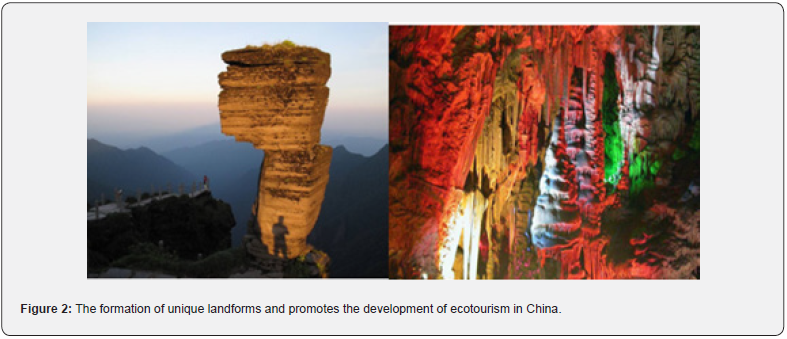
Water and soil loss accelerates the formation of unique landforms and promotes the development of ecotourism: Soil and rock through hydraulic, wind and freeze-thaw and other external forces of the joint action, forming a number of magic, wonderful natural landscape, which accelerates the development of environmental tourisam and get rid of poverty and become better off. For example, Keshiketeng stone array scenic spots in the northeast of Keshiketeng county, Danxia natural scenic spots located in Yulin city and zhashui cave located in the Qinling Mountain and so on. Zhashui cave is the result of long-term dissolution of groundwater. Calcium carbonate in limestone forms micro-soluble calcium bicarbonate under the action of H2O and CO2. Because the limestone layer contains different lime quality and different erosion degree, it is gradually dissolved and divided into non-dependent, diverse, steep and beautiful peaks and cave with strange landscape, which promotes eco-tourism and local economic development. Hukou waterfall is still Hukou waterfall but now has become a tourist hot spot (Figure 2).
Water and soil loss forms silt plain and expands land area in estuary area: A large amount of sediment deposits in the estuary area, forming a silt plain and expanding the land area with increasing time, which increase nitrogen density in soil, soil fertility , land product and CO2 fixation. For example, the Chongming Island at the mouth of the Yangtze River basin and the Huanghe Delta at the mouth of Yellow River. At first, the Chongming Island was just a small sand dune, and as the sands hit and settled, the sand dunes grew larger and became an island where fishermen lived. Soil and water conservation workers should broaden their horizons, make best use of the advantages of water and soil loss and bypass the disadvantages of water and soil loss to meet the requirements of rapid and high quality economic and social development, especially to strengthen the prediction, prediction and prevention of serious soil erosion phenomena caused by typhoons, haze caused by strong winds, dust-raising weather and sandstorms Guo [12].
Soil and water conservation
It is pointed out in the Encyclopedia of Water Conservancy of China Soil and Water Conservation: soil and water conservation are the cause of preventing soil and water loss, protecting, improving and rationally utilizing soil and water resources, maintaining and improving land productivity, so as to give full play to the ecological, economic and social benefits of soil and water resources and establish a good ecological environment. Although this definition has played an important role in the past, it cannot meet the increasing needs of the public for soil and water conservation in the new era. In order to achieve high-quality and sustainable development of soil and water conservation, the author believes that soil and water conservation should be defined as the use of some methods or measures to reduce soil loss, so that the amount of soil loss is reduced to the allowable amount of soil loss or the tolerance of soil loss.
Soil and water conservation refers to the use of certain measures and technologies to reduce the loss of soil and water to a certain goal, soil allowable loss, increasing land productivity and improving the environment. At same time, the soil and water resources in the process of water and soil loss is make efficient use of to ensure the safety of the ecosystem, life and property and increase the ecological, economic and social benefits of the ecosystem and provide high-quality products and services for social development, minimize the life and property and achieve high-quality and sustainable development of Soil and water conservation. Soil and water conservation measures can effectively conserve soil and water Zhao et al. [17]. Soil and water conservation measures include soil and water conservation engineering measures, soil and water conservation farming measures and biological measures for soil and water conservation. Other soil and water conservation measures, such as wind power and solar power generation, are also included to reduce nearsurface wind speed and temperature, and facilitate the growth of soil and water conservation vegetation, see Figure 3 Guo [12]. In the restoration of vegetation, natural forces can be used to restore vegetation in no man’s land; however, in areas where there is a population, artificial measures should be used to restore vegetation in order to make the goods and services vegetation ecosystem give to meet the needs of human production and life.

Over the past hundred years, with the unremitting efforts of the vast number of soil and water conservation workers, China has made great progress in its work on soil and water conservation. A large area of soil and water conservation vegetation has been established in water and soil loss areas, and a large number of reservoirs have been built; some water and soil conservation measures such as water and soil conservation projects such as dams or levees have been set up along the rivers of the Yellow River and other soil erosion areas, which have made great progress in controlling water and soil loss below the allowable amount of soil erosion and promoting regional economic development. However, due to the lag of theoretical research on soil and water conservation, the construction standard of soil and water conservation measures is low and imperfect, and the spatial allocation of soil and water conservation measures is unreasonable. For example, silt storage dam for farmland building has played an important role in preventing floods, consolidating the return of farmland to forests (grass), safeguarding ecological security and food security, promoting the development of economy and social stability and so on. However, in the construction of silt storage dam, the problems of low quality of construction, serious disease-risk dam, poor management of reconstruction and so on, especially the large number of small dams, have not been paid enough attention to Fu & Zhang [18]. Therefore, it is urgent to strengthen the study of soil allowable loss on different underlying surfaces, formulate high quality and strict standards for soil and water conservation engineering and vegetation construction, and carry out spatial optimal allocation to obtain maximum soil and water conservation efficiency. The space optimal configuration is expressed by the spatial optimal configuration coefficient. Spatial optimal allocation coefficient means that in a water and soil loss area or watershed, soil and water conservation funds or measures may have different allocation methods, and different allocation methods bring different soil and water conservation efficiency, which is different surface runoff and soil loss. The optimal allocation of space refers to the allocation that bring maximum soil and water conservation efficiency.
High quality and Sustainable management of soil and water conservation
In the field of soil and water conservation, it is necessary to implement the high quality and sustainable management of soil and water conservation measures in order to get the maximum effect of soil and water conservation and realize the high quality and sustainable development of soil and water conservation. For soil and water conservation engineering measures, it is necessary to increase the design standards of Road, Bridge and dam in the water and soil loss region according to maximum scouring force and erosive force of flood and formulate corresponding emergency plans to prevent the occurrence of dam break and dam break caused by hurricanes, tsunamis and heavy rain caused by extreme weather. For example, in August 2019, affected by Typhoon No.9” Liqima “, heavy rain occurred in Weifang, Binzhou and other places, Shandong Province, China. The heavy rain caused floods and destroyed a large number of agricultural production measures, grain fields, road and bridge culverts, housing and public buildings. The disaster caused widespread concern in the community.
In the early morning of august 20th, 2019, due to heavy rainfall, a huge debris flow broke out in the yazigou valley, less than 300 meters from the dam of Wolonglongtan hydropower station in Sichuan, China. At that time, the staff on duty found that the dam water level rose, the water level difference before and after the barrier quickly increased, immediately stopped to avoid the peak, open the floodgate. When the opening of the three sluices is less than 1 meter, the swift and violent debris flow will break down the power transmission line of the working power supply, resulting in the interruption of the power supply of the sluice, the flood sluice cannot continue to rise, resulting in the rapid rise of water level and the occurrence of flood dam events. For the biological measures of soil and water conservation, according to the vegetation carrying capacity, mainly including spatial vegetation carrying capacity, soil water vegetation carrying capacity and Soil nutrient vegetation carrying capacity Guo [19-21], it is easy to adjust and control the plant resources relationship in good time to realize the sustainable utilization of natural resources and the high quality and sustainable development of soil and water conservation measures.
Practices of the high quality and sustainable development of soil and water conservation
The high quality and sustainable development of soil and water conservation should made on the new theory of soil and water conservation. Because the large area of soil and water loss area is big, and people’s understanding level of soil and water conservation is uneven, there are two completely different effects in practice. In the area where the new theory of soil and water conservation is practiced and late March to low April or early May), the rapid spraying of antifreeze or covering measures were adopted to reduce or even eliminate the harm of low temperature frost. Before and after May 20, spray 2000 times of high efficiency and low toxicity cyhalothrin to control solid insect harm; If long-term severe drought occurs in the critical period of plant water relationship regulation and the conservation density exceeds the vegetation carrying capacity of soil water, the plant water relationship in the critical period of plant water relationship regulation can be regulated by pruning according to the appropriate leaf amount in the period of soil water vegetation carrying capacity, and then the vegetative growth and reproductive growth relationship should be regulated in the period of period of plant resources relation regulation according to the suitable amount of leaf when plant density is equal to carrying capacity, and the relationship between leaf amount and quality fruit to obtain maximum output and economic benefits. Since the establishment of the National high-quality red plum Apricot Demonstration Base in 2017, the research, demonstration and promotion of high-quality production methods of red plum apricot have been accelerated.
In spring, the cropping of Caragana (Caragana Korshinskii) shrubland on hillside soil and water conservation should be carried out to ensure that the canopy coverage is not lower than the construction standard of soil and water conservation vegetation of 60%, and the soil water consumption in dry season should be reduced as far as possible under the premise of meeting the requirements of water and water conservation efficiency. In the growing season, when soil water resources fall to the limit of soil water resources utilization within the range of maximum infiltration depth, the plant water relationship enters the critical period of plant water relationship regulation, and the end of the critical period of plant water relationship regulation is when the plant water relationship regulation fails. If the conservation density exceeds the vegetation carrying capacity of soil water in the critical period of plant water relationship regulation, timely regulation of plant water relationship can ensure normal plant growth to prevent early deciduous leaves of Caragana and the disappearance of canopy intercession due to drought and continuously obtain the maximum efficiency of soil and water conservation.
Gaoxigou Village, Mizhi County in the hilly and gully region of the loess Plateau in northern Shaanxi Province, China, has built a barren mountain gully with broken surface, serious soil and water loss and barren land into terraced hilltops. The “small South of Northern Shaanxi” with pine and cypress in the high mountains, the soil loss is lower than the allowable soil loss. At the same time, the soil and water resources are efficiently used. Ecological tourism has been carried out and diversified management methods have been adopted. The per capita income in 2020 is 18,851 yuan, far exceeding the average level of the county (5,834 yuan), which has become a typical example of highquality sustainable development of soil and water conservation in the area. The government of Hangjin Banner uses the main trunk canal of the south bank of the Yellow River to draw water, and builds diversion gates, diversion canals, ecological levees and sluice gates to connect with the main trunk canal, forming a water cycle pattern in which water is diverted from the Yellow River and the artefact flows into the Kubuqi Desert and the backward water flows into the Yellow River. By introducing water from the Yellow River into the desert, it has reduced runoff, sediment and siltation in the middle and lower reaches of the Yellow River and diverted more than 200 million cubic meters of water in total, forming nearly 20 square kilometers of water surface and nearly 60 square kilometers of ecological wetland in the Kubuqi Desert. Plants grow well and some water birds come to live here, turning the desert into an oasis, which has attracted the attention of various countries. Developing ecological tourism has achieved good economic benefits. The diversion of water to control desertification has been imitated by countries around the world.
State Power Investment Group Beijing Electric Power Co., Ltd. innovatively proposed the concept of “photovoltaic sand control and ecological restoration”. The Administrative committee of Dengkou Industrial Park in Bayannur City, Inner Mongolia Autonomous Region cooperated with State Power Investment in “photovoltaic sand control” to build the Dengkou photovoltaic sand control project. It not only attenuates solar exposure and reduces near-surface wind speed, promotes the growth of plants under solar panels, and achieves excellent sand control effect, but also sequestration carbon, obtaining green and clean energy, and improving economic benefits. It has been popularized in Gansu, Ningxia, Tibet, Xinjiang and other places. Build wind power stations in tuyere areas to reduce wind and sand damage. In soil and water loss areas, high-standard farmland should be established according to landform and surface runoff erosion intensity. Construction of high-standard buildings and soil and water conservation projects can not only effectively avoid the harm of soil and water loss, but also obtain good ecological, economic and social benefits. For example, Hani rice terraces have been maintained for thousands of years.
Guanyin Pavilion in Hubei Ezhou, which has stood on the Yangtze River for hundreds of years, and Dujiangyan Dam and modern three gorges Dam, which have continuously given full play to the effects of soil and water conservation for 2,000 years, have integrated the comprehensive benefits of flood control, irrigation, water transportation and social water use. In areas without the guidance of the new theory of soil and water conservation and the implementation of high-quality sustainable management, once encountered hurricanes, sandstorms and rainstorms, there will be serious dam collapse, dam collapse, flood destroyed houses, roads and farmland, and other serious events affecting highquality sustainable development, resulting in the destruction of houses, roads, levees and storage DAMS, and the abandonment of cars, see Figure 4 . Casualties and other serious events, such as the severe flood disaster in many European countries, the United States and China’s Henan, Shanxi and Shaanxi provinces in 2021, and Heilongjiang, Jilin, Liaoning, Beijing, Hebei and Tianjing, China in 2023.

Conclusion
At present, Chinese economic and social development of our country has entered a new period of high quality and sustainable development, and the social wealth has been improved unprecedentedly. In the new period, the public has put forward higher demands on the work of soil and water conservation and environment, which requires the protection of air quality, life, property and health, and ensures the safety of food and ecology, ecology and transportation, so the work of soil and water conservation has entered a new stage Li et al. [22]. In order to ensure the safety of people’s lives and property and meet the needs of people’s happy life in the new era, we are required to raise the level of understanding, dialectically and comprehensively view the consequences of soil erosion, take timely and effective measures to deal with serious soil erosion caused by sudden events such as mountain torrents, hurricanes, sandstorms and other serious accidents that affect the safety of public life and property. To ensure the sustainable use of natural resources, high-quality and sustainable development of forest vegetation and agricultural high-quality development in soil and water loss regions. Coordinate and promote comprehensive prevention and control of non-point source pollution, restoration of degraded ecosystems and improvement of living environment in soil erosion areas, and realize the concept of co-construction and co-treatment to achieve green mountains and blue waters and achieve rural revitalization and build a beautiful China, to meet people’s yearning for a better life [23,24].
To meet the needs of increasing people’s living standards for soil and water conservation in the new era, we must bases on the new theory of soil and water conservation and unify understanding of water and soil loss, and fully recognize the consequences of soil and water conservation, and then take advantage of water and soil loss, giving priority to the allowable soil loss, make the most of soil and water resources and determine high standards of soil and water conservation measures after taking into account air quality and soil pollution according to local conditions, and make a rational distribution of soil and water conservation measures when carrying out to ensure the sustainable utilization of natural resources in water and soil loss areas and the safety of ecosystems in order to realize the high quality and sustainable management of soil and water conservation projects and biological measures.
In the future, it is necessary to strengthen basic research such as the relationship between different soil and water conservation projects and biological measures and soil allowable loss in different soil and water loss area and air quality and soil pollution degree, largen the scope of soil and water conservation measures and strengthen the early warning research on risks such as mountain flood, landslide and debris flow caused by natural disasters such as typhoons and tsunamis in soil erosion area, and formulate high standard soil and water conservation measures on the basis of this research, and carry out spatial optimization of soil and water conservation measures to ensure the high-efficiency use of soil and water resources in soil erosion area and the safety of food and environment, obtain the maximum efficiency of soil and water conservation and realize the high-quality and sustainable development of soil and water conservation to meet the needs of the public for food, ecological security, road unblocked and ecotourism and provide theoretical basis and scientific and technological support for high quality and sustainable development.
References
- Guo ZS (1998a) Difference and relationship between vegetation cover degree and cover Rate. Journal of Soil erosion and Soil and Water Conservation 4(5): 119-119.
- Guo ZS, Den JM (2009) Review on effective coverage rate of soil and water conservation forest, Soil and Water Conservation in China 4: 29-31.
- Guo ZS (1998b) Area mergement and functional conversion coefficient among different forest category. Forestry Science and Technology Newsletter 4: 21-22.
- Guo ZS (2000a) Three Cover degree in Soil and Water Conservation Vegetation Construction: Potential Cover degree, Effective Cover degree and Critical Cover degree. Soil and Water Conservation in China (4): 30-31.
- Guo ZS (2000b) There are three coverage degrees in vegetation construction for soil and water conservation: potential coverage, effective coverage and critical coverage Bulletin of Soil and Water Conservation 20(4): 30-31.
- Guo ZS (1996) Research on the Effective Cover rate and Its Determination Method for Soil and Water Conservation Forest. 2(3): 67-72.
- Guo ZS (1997) Preliminary study on effective cover rate of soil and water conservation forest. Journal of Northwestern Forestry College 12(1): 97-100.
- Guo ZS (1999) Three Major Problems in Forest and Grass Plantation Construction in Loess Plateau, Journal of Soil erosion and Soil and Water Conservation 5(5): 72-75.
- Guo ZS (2000c) Target and quality Criterion of vegetation construction for soil and water conservation in Loess Plateau Bulletin of Soil and Water Conservation 20(7): 53-58.
- Guo ZS (2014) Theory and practice of soil water carrying capacity for vegetation. Chinese Science Press 1: 216-241.
- Guo ZS (2022) High-Quality and Sustainable Management of Water and Soil Conservation Project. Journal of Business & Economic Management 10: 57-63.
- Guo Z (2020a) New Theory of Soil and Water Conservation. J Biomed Res Environ Sci 1(4): 064-069.
- Guo ZS (2022) New Theory of Soil and Water Conservation. Soil and Water Conservation 10(2): 13-20.
- Guan JW (1996) Principles of soil and water conservation. Beijing China: China Forestry Press pp: 1-3.
- Chen S, Lin B, Li Y, Zhou S (2020) Spatial and temporal changes of soil properties and soil fertility evaluation in a large grain-production area of subtropical plain, China. Geoderma 357(1): 113937.
- Wolka K, Mulder J, Biazin B (2018) Effects of soil and water conservation techniques on crop yield, runoff and soil loss in Sub-Saharan Africa: A review, Agricultural Water Management 207: 67-79.
- Zhao J, Yang Z, Gerard (2019) Soil and water conservation measures reduce soil and water losses in China but not down to background levels: Evidence from erosion plot data, Geoderma 337: 729-741.
- Fu WT, Zhang XY (2019) Suggestions for dam construction and risk control in Loess Plateau were paid attention. China Science Newspaper.
- Guo Z (2019) Rice carrying capacity and sustainable produce of rice in resources-limited regions. Int J Agric Sc Food Technol 5(1): 054-057.
- Guo Z (2020b) Estimating Method of Maximum Infiltration Depth and Soil Water Supply. Sci Rep 10: 9726.
- Guo ZS (2021) Soil Water Carrying Capacity for Vegetation. land degradation development.
- Li m, Zhang CY, Wang HY (2019) Study on Soil and Water Conservation Stage in Loess Plateau, Study on Soil and Water Conservation Stage in Loess Plateau SWCC 2: 1-4.
- Mideksa B, Muluken G, Eric N (2023) The impact of soil and water conservation practices on food security in eastern Ethiopia. A propensity score matching approach. Agricultural Water Management 289: 108510.
- Cao BS, Zhu CX, Gao JX (2019) Ecological security assessment method and its application. Journal of Ecology and Rural Environment 35(8): 953-963.

























