




 ECOA Home



Evaluation of the Efficiency and Acceptance of Biosoap in Different Domestic Applications
Scott Danniela1*, Waite Carolina1; De Sena André Pedral1, Baptista Neto José Antonio1 and Da Silva Eduardo Camilo2
1Federal Fluminense University - DOT- Postgraduate Stricto Sensu Doctoral Student in Ocean and Earth Dynamics, Av. General Milton Tavares de Souza, s/o, 4th Floor , Red Beach Campus, Niterói, RJ, Brazil
2Federal Fluminense University, PPGAd /UFF - Postgraduate Program in Administration, Av. General Milton Tavares de Souza, s/n, 4th Floor, Campus da Praia Vermelha, Niterói, RJ, Brazil
Submission: May 15, 2024;Published: June 26, 2024
*Corresponding author: Scott Danniela, Federal Fluminense University - DOT- Postgraduate Stricto Sensu Doctoral Student in Ocean and Earth Dynamics, Av. General Milton Tavares de Souza, s/o, 4th Floor , Red Beach Campus, Niterói, RJ, Brazil
How to cite this article: Scott Danniela*, Waite Carolina; De Sena André Pedral, Baptista Neto José Antonio and Da Silva Eduardo Camilo. Evaluation of the Efficiency and Acceptance of Biosoap in Different Domestic Applications. Ecol Conserv Sci. 2024; 4(3): 555637. DOI:10.19080/ECOA.2024.04.555637
Abstract
This study investigates the integration of effective microorganisms (EM) into soap production, aiming to enhance the biodegradation of organic compounds in effluents while adhering to global sustainability and regulatory standards. Originating from the historical evolution of soap making, which has seen transitions from ancient practices to modern chemical processes, this research highlights the environmental impact of synthetic surfactants and explores biosurfactants as sustainable alternatives. We conducted a methodological evaluation involving eleven volunteers who tested different types of Biosoap, including Coconut bar, Liquid Coconut, and Reused Oil variants. The results showed positive feedback on the soap’s effectiveness in cleaning and skin care, with notable benefits in hydration and potential wound healing. Additionally, improvements were observed in the functioning of household grease traps and septic systems, suggesting that the use of EM-enhanced Biosoap could lead to significant environmental benefits. The findings support the potential of Biosoap not only as a cleaning agent but also as a therapeutic skin care product, encouraging further research with a larger sample size to substantiate these preliminary results and fully explore the ecological and dermatological benefits.
Keywords: Biosoap; Effective Microorganisms; Microencapsulation; Biodegradability; Wastewater Treatment; Environmental sustainability; Saponification; Eco-friendly Detergents
Abbreviations: EM: Effective Microorganisms; UFC: Colony Forming Unit; BOD: Biochemical oxygen demand; COD: Chemical Oxygen Demand
Introduction
The historical development of soap can be traced back to accidental discoveries and ancient formulations. Initially observed by Roman washerwomen around 1000 BC, the beneficial properties of mixing animal fats with wood ash were later refined by the Phoenicians around 600 BC into a basic form of soap. Despite the evolution of soap ingredients and manufacturing processes, the core concept of saponification has remained relatively constant. The global increase in soap consumption brought about by lifestyle changes and industrial advances led to environmental concerns, especially with synthetic surfactants derived from petroleum. These concerns have spurred developments in green chemistry and the exploration of biosurfactants as sustainable alternatives due to their environmental benefits. The present study explores the innovative use of effective microorganisms (EM) in soap production, aiming to enhance the biodegradation of organic compounds in effluents and align with global sustainability and regulatory standards. This approach not only improves the ecological profile of soaps but also enhances their functional benefits in various applications [1-4].
Methodology
The study involved distributing four types of Biosoap to eleven volunteers, subsequently asking for their impressions and observations regarding the product’s effectiveness. The types of Biosoap tested included: Coconut Bar (white), Liquid Coconut (white), Liquid reused oil and Reused oil in bar (blue).
Results
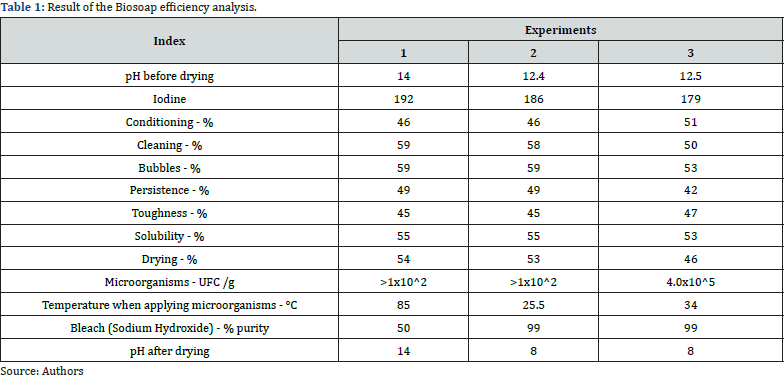
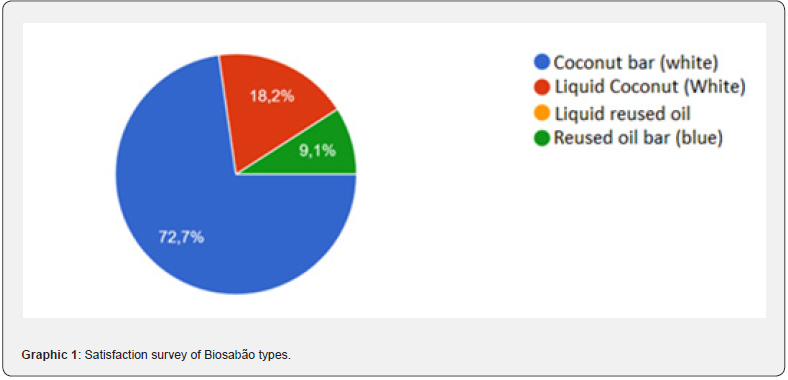
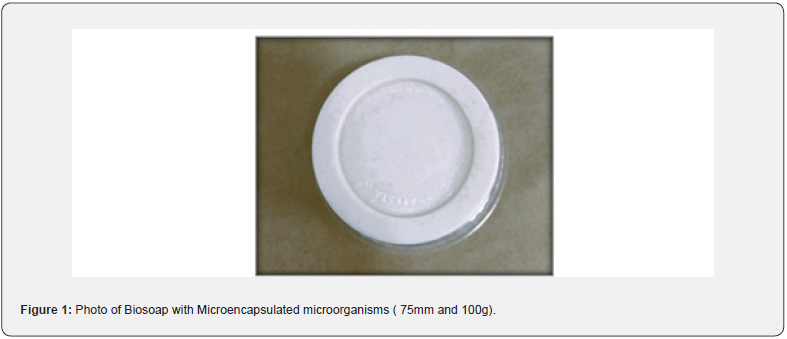
A new test was carried out with a microencapsulated product, the result was satisfactory in visual appearance (Figure 1). In analysis, Biosoap presented good quality in terms of cleaning agent parameters and mainly the concentration of viable cells (Table 1) for inoculation of the treatment system of a singlefamily residence. The satisfaction survey with eleven volunteers, had the following usage percentages: Coconut bar (white) with 75%, Liquid coconut (white) with 16.7% and Reused oil in bar (blue) with 8.3%, Graph 1. The general perception of users was positive, highlighting its effectiveness in cleaning dishes and clothes, as well as benefits for the skin. Specific observations included improved skin hydration and appearance when using coconut bar soap, greater effectiveness in removing food residue from dishes, and the perception of softer, hypoallergenic clothing. [11,12]. Furthermore, some participants reported improvements in the functioning of the grease trap, with reduced odors and less frequency of fat accumulation. Others mentioned improvements to septic tank and sink systems, including reducing odors and clogging [13].
Discussion
The results indicate a strong acceptance of Biosoap in different forms, mainly in the coconut bar and reused oil versions [14-19]. Particularly notable was the reported benefits for the skin, including improved hydration, radiance and even wound healing. This observation is crucial as it suggests that Biosoap may have beneficial properties not only as a cleansing agent, but also as a potential adjuvant treatment for the skin, especially in cases of dry or damaged skin [20-24]. Furthermore, participants reported improvements in the functioning of the grease trap, with reduced odors and less frequency of fat accumulation [25-27]. Others mentioned improvements to septic tank and sink systems, including reducing odors and clogging [28].
Acknowledgment
This preliminary study demonstrates the effectiveness and acceptance of Biosoap by users in multiple domestic applications, justifying future investigations with a larger sample to validate these results on a broader scale. The perceived efficacy in improving skin condition and wound healing potential particularly highlights Biosoap as a product of interest for future dermatological studies.
References
- Dantas Filho, Francisco F, Silva GN, Costa AS (2017) Teaching-learning process of the concepts of acids and bases with the inclusion of experimentation using the theme of ecological soap. Holos 2: 161-173.
- Felipe Lorena O, Dias Sandra C (2017) Synthetic surfactants and biosurfactants: advantages and disadvantages. Química Nova - São Paulo-SP, BR 39(3): 228-236.
- Hasan F, Shah AA, Hameed A (2006) Industrial applications of microbial lipases. Enzymatic and microbial technology 39(2): 235-251.
- Anvisa (1999) Technical regulation for establishing the identity and quality of vegetable oils and fats, Official Gazette of the Federative Republic of Brazil, Brasília.
- Altschul Stephen F, Lipman David J (1990) Protein database searches multiple alignments. Proc Natl Acad Sci 87(14): 5509-5513.
- Anvisa (2008) Guide to quality control of cosmetic products - An approach to physical and chemical tests. Brasília p: 18-121.
- Baker Ija, Drummond CJ, Furlong DN, Grieser F (2004) Surfactant biodegradation: sugar-based surfactants compared to other surfactants. Handbook of Detergents - Part B: Environmental Impact 28: 739-760.
- Chimello CM, Bruza FB, Ramos MJ, Silva RCS, Kremer CK (2012) Study on the choice of the type of detergent used by consumers in Italia. Online Environmental Sciences Magazine 8(1): 60-61.
- Cock Peter J (2009) Bio Python: Freely available Python tools for computational molecular biology and bioinformatics. Bioinformatics 25(11): 14-22.
- Desantis Todd Z (2006) Green genes, a chimera-verified 16S rRNA gene database and ARB-compatible workbench. Appl Environ Microbiol 72(7): 5069-5072.
- Ghanbarzadeh M, Golmoradizadeh A, Homaei A (2018) Carrageenans and carrageenases: Versatile polysaccharides and promising marine enzymes. Phytochemistry Reviews 17(3): 535-571.
- Gurevich A (2013) Quast: quality assessment tool for genome assemblies. Bioinformatics 29(8): 1072-1075.
- Hlordzi V (2020) The use of Bacillus species in maintenance of water quality in aquaculture: A review. Aquaculture Reports 18: 100-503.
- Laurenti E, Garcia S (2013) Efficiency of natural and commercial encapsulating materials in controlled release of encapsulated probiotics. Brazilian Journal of Food Technology 16: 107-115.
- Machado T (2018) Production of bacterial biosurfactants in soils using bioaugmentation and bio stimulation.
- Masella AP (2012) P and A seq: paired assembler for lighting sequences. BMC Bioinformatics 13: 1-7.
- Martins S, Biral P (2019) Natural Saboaria, cold saponification, Cold Process, Bahia, Brazil ©
- Melo Itamar S (2008) Environmental microbiology. ed. rev. amp. - Jaguariúna: Embrapa Meio Ambiente 647: 2008.
- Mulligan CN, Sharma SK, Mudhoo A, Makhijani K (2002) Green chemistry and biosurfactant research. Biosurfactants: Research Trends and Applications Ch 1: 1-30.
- Oliveira Hugo M (2021) Reduction of organic matter with application of Bacillus subtilis and B. licheniformis in sediments from a polyculture nursery of Litopenaeus vannamei with Oreochromis niloticus.
- Osadebe AU, Chinelo A, Onyiliogwu B, Suleiman M (2018) Microbial Degradation of Anionic Surfactants from Laundry Detergents Commonly Discharged into a Riverine Ecosystem. Department of Microbiology, University of Port Harcourt, Choba, Nigeria
- Peanparkdee M; Iwamoto S, Yamauchi R (2016) Microencapsulation: a review of applications in the food and pharmaceutical industries. Reviews in Agricultural Science 4: 56-65.
- Penteado JCP, Seoud OA, Carvalho LRF (2006) Linear alkylbenzene sulfonate: an environmental and analytical approach. New Chemistry 29(5): 1038-1046.
- Phipson B; Smyth GK (2010) Permutation P-values should never be zero: calculating exact P-values when permutations are drawn at random. Statistical applications in genetics and molecular biology 9(1).
- Sanchez D, Jose G, Henry L, Charles A (2012) Degradation of Aldrin by Bacillus licheniformis, isolated from water and sediments of Ciénaga Grande, Santa Marta, Colombia. Acta biol. Columbus. 17(1): 67-76.
- Steemers FJ, Gunderson KL (2007) Whole Genome Genotyping Technologies on the Bead. Array Platform. Biotechnol 2(1): 41-49.
- Wrobel M (1994) Bioremediation of Heavy Metals by the Genus Bacillus. Int J Environ Res Public Health 20(6): 4964.
- Favaro-Trindade CS (2016) Encapsulation of active/bioactive/probiotic agents. In: Edible Films and Coatings. CRC Press p: 363-367.

























