




 ECOA Home



Rediscovered only to be Almost Exterminated Again - The Story of Tomares nogelii dobrogensis (Nogel’s Hairstreak) a Charismatic Butterfly Endemic to Europe
Laszlo Rakosy1,2, Cosmin Ovidiu Manci3, Claudia Maria Covaciu4 and Demetra Rakosy5*
1Department of Taxonomy and Ecology, Babes-Bolyai University, Cluj-Napoca, Romania
2Department of Forestry and Environmental Protection, Stefan cel Mare University, Romania
3Oceanographic Exploration and Marine Environment Protection Society, Constanta, Romania
4Department of Biology, Alexandru Ioan Cuza, University, Iasi, Romania
5Braunschweig, Germany
Submission: May 24, 2024; Published: June 12, 2024
*Corresponding author: Demetra Rakosy, Braunschweig, Germany
How to cite this article: Laszlo Rakosy, Cosmin Ovidiu Manci, Claudia Maria Covaciu and Demetra Rakosy. Rediscovered only to be Almost Exterminated Again - The Story of Tomares nogelii dobrogensis (Nogel’s Hairstreak) a Charismatic Butterfly Endemic to Europe. Ecol Conserv Sci. 2024; 4(3): 555636. DOI:10.19080/ECOA.2024.04.555636
Abstract
Tomares nogelii, a butterfly considered extinct in the European Union (EU) until its rediscovery in 2014, has recently been found in southeastern Romania. These populations belong to the western endemic subspecies, T. nogelii dobrogensis. In this study, we provide a comprehensive description of this subspecies, detailing its life history traits and emphasizing the crucial conservation measures needed to ensure its survival. Despite its rarity and charisma, the species faces a significant threats from collectors and butterfly traders eager to obtain specimens. Despite efforts to keep the precise locations of the populations confidential, collectors and traders have managed to locate them. This influx of collectors poses a grave risk of over-sampling, potentially leading to the extinction of the species. To safeguard the species from extinction, we propose the establishment of a forest reserve where dedicated forestry staff can monitor and protect these vulnerable populations. Additionally, we advocate for collaboration among lepidopterists from Romania and other European countries to continue the search for new populations within the Dobruja region. By collectively striving to protect and conserve this species, we can work towards ensuring its long-term survival.
Keywords: Lycaenidae; Europe; Romania; Dobruja; Extinction; Rediscovery; Conservation; Red List
Introduction
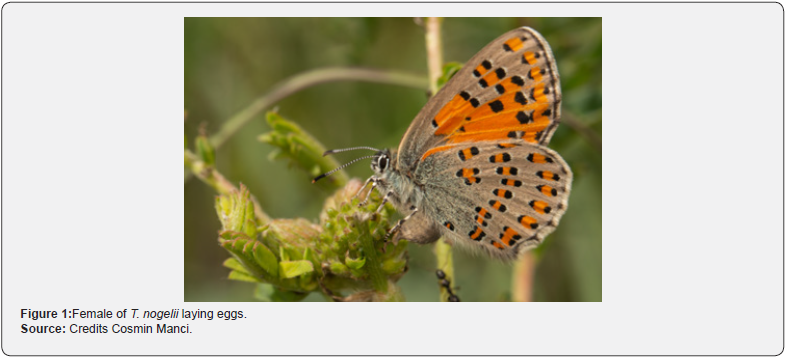
Almost a third of European butterflies have registered a decline in their population sizes, with about 9% of the species being threatened, and a further 10% considered near threatened [1]. One of the two species considered to be regionally extinct is Tomares nogelii (Herrich-Schäffer, [1851]) with the common name Nogel’s Hairstreak. This charismatic Lycaenidae (Gossamer-winged butterfly family) is one of the rarest butterfly species in Europe (Figure 1). Its distribution is restricted to south-eastern Romania, Moldavia, Ukraine and the Crimean Peninsula [2-5]. Outside of Eastern Europe the fragmented range of this Ponto-Mediterranean species extends to Anatolia [6,7] Azerbaijan, Lebanon and Syria [8]. Tomares nogelii was first reported from Romania in 1866 by Josef Mann [9]. His finding was based on a single population from the Tulcea area in Dobruja. Three decades later Caradja [10] describes the population from Dobruja. as a separate subspecies, using the name “dobrogensis”. After the description, the species is no longer recorded in Romania until 1960 [11]. Around 1960, a new population was discovered in the Gârboavele forest, near the city of Galați. In the time period 1960-1975, several hundreds of specimens were collected from this single, very restricted and isolated population of T. nogelii dobrogensis. Sometimes a single person would collect more than 40 specimens per day for their collection [12].
In addition to the pressure exerted on the population through oversampling by collectors, the partial removal of the larval food plant, Astragalus ponticus Pall., by grazing in the forest and the intensive use of glades as picnic areas by tourists contributed to the species decline. A final contributing factor was the increased use of pesticides to control forest and agricultural pests between 1960 and 1989. All these factors together certainly led to the eradication of the small T. nogelii dobrogensis population from the Galați area.
After 1989, Lepidopterologists often searched for the species in the Gârboavele forest, but without success [13,14]. Due to the lack of new records from Romania after 1980, the species was considered to be extinct in the EU [1]. The present paper describes the process which led to the rediscovery of the species, its current status and proposes conservation measures which should be set in place to prevent the history of T. nogelii dobrogensis to repeat itself.
Methods and Species Characterization
After 1990, the first author conducted a systematic, resource orientated, search for the species in N Dobruja. These searches were conducted yearly, during the flight period of the imagines. Given the large extent of the search area, different sections were visited every year. After 2010C. Manci joined the search, allowing for a better coverage of the search area. In the following we present an overview of the species characteristics, taxonomy and life history traits.
Diagnosis
Among the 130 European Lycaenidae species [15], T. nogelii unmistakable. Dominant are specimens with a reddish-brown spot on the upper side of the fore and hind wings, which varies in size and shape (Figure 2). The individual variability of the imago is, however, considerable in both males and females [5]. Specimens with ash-brown forewings and hindwing upper side without a reddish-brown spot are not uncommon. Albinism has also been observed in a specimen recorded from N Dobruja (Tulcea Country) [14]. Morphologically the subspecies is not significantly different from the nominal taxon, from which, however, it is geographically isolated.
Taxonomy
Based on morphological traits Hesselbarth et al. [6] treat the three known subspecies, ssp. obscura (Rühl, [1893]), ssp. dobrogensis Caradja [10] and ssp. montana (Schwingenschuss, 1938) as synonyms of the nominotypical subspecies. However, by using barcoding of nuclear DNA sequences, Nazari & ten Hagen [16] analyzed various representative populations of the genus Tomares, (including T. nogelii) across Europe and confirmed the distinct status of Tomares nogelii ssp. dobrogensis. The subspecies was thereby confirmed to occur from eastern Romania, Moldavia, to Ukraine (including Crimea). Based on minute morphological considerations, its isolated distribution area and the results of the comparative genetic studies, we support the maintenance of the ssp. dobrogensis.
Life history traits
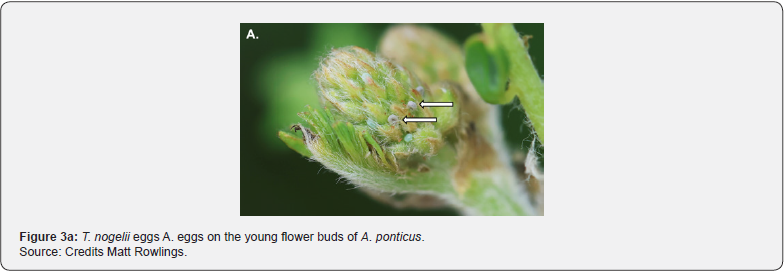
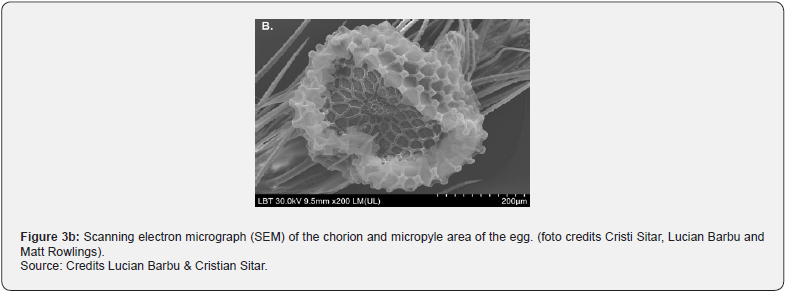
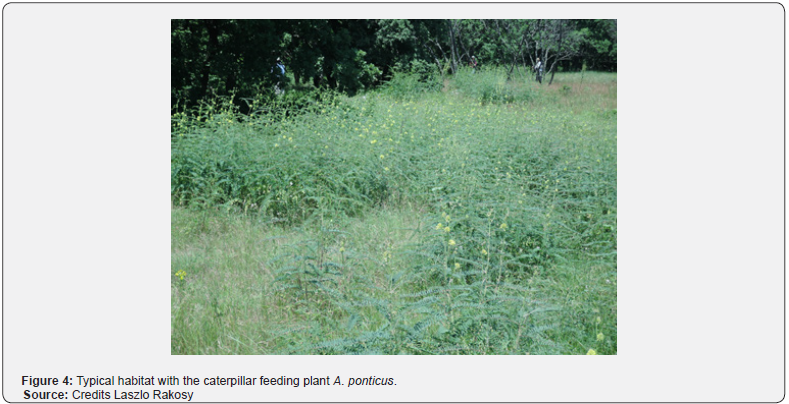
In Romania the butterfly larvae are monophagous, feeding exclusively on Astragalus ponticus, a rare plant only found in few places in northern Dobruja (Figure 2). The butterflies fly for 15- 20 days at the beginning of June. The females lay their eggs on the flower buds, less frequently on the leaves of A. ponticus, in June (Figure 3). The egg is very well camouflaged between the flower buds, making it difficult to find. Once emerging from the eggs, the larvae feed on buds, flowers and immature fruits of A. ponticus. In July the larvae pupate in the soil in a loose web at the base of the host plant. The species hibernates as a pupa. The larvae are visited by ants, but are not dependent on myrmecophily. The imagines do not disperse too far from the host plant, on which they also prefer to feed as adults, replying on its nectar. Occasionally they will also visit flowers of other plants such as Salvia spp., Ajuga spp., Potentilla spp. Veronica spp., Euphorbia spp. The preferred habitat of T. nogelii dobrogensis consists of forest steppe clearings on calcareous soil in or on the edge of oak forests with A. ponticus (Figure 4). Not much else is known about the species, its biology and ecology having not yet been sufficiently studied [17,6,13]. The preadult stages from the Crimean Peninsula were illustrated by Bury & Savchuk [17]. Çalirkan &Yıldız [18] discusses the correlation between the distribution of the species and subspecies of the genus Tomares and larval food plants, i.e., Astragalus species in Turkey.
Results and Discussion
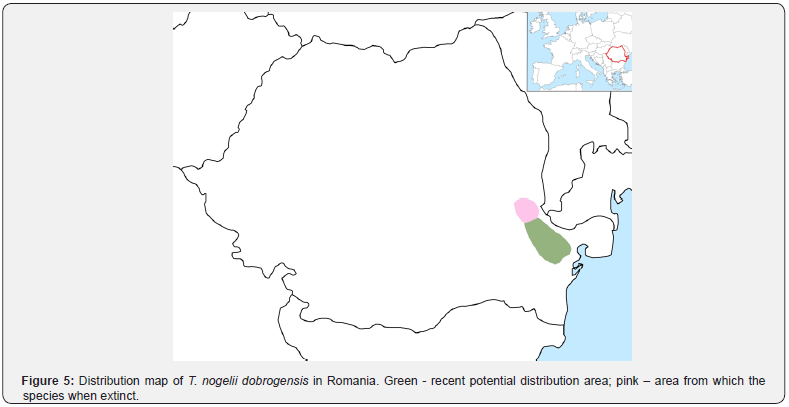
It was not until 2014, 14 years after the search for this species began, that a first specimen was recorded on the edge of the Macin Mountains [13]. Following further targeted investigations in the area, we managed to identify a vigorous population in the glades of the silvo-steppe forests in northern Dobruja [13] (Figure 5). Subsequently, in 2020 C. Manci discovered another colony, not far from the one discovered in 2014. Searches for further populations of this butterfly in N-Dobrogea, based on information about the occurrence of the larval food plant, have so far been unsuccessful.
The development of T. nogelii dobrogensis populations in Romania
After the discovery of the two viable colonies of T. nogelii dobrogensis in northern Dobruja, the authors checked and monitored their status almost annually. If the population discovered in 2020 had a sufficient number of specimens every year to ensure its maintenance for a long period of time, the one discovered in 2014 went into a strong and inexplicable decline. Although the population size and vitality of the larval feeding plant, i.e. A. ponticus, remained in good to very good condition, we were unable to detect any more specimens of T. nogelii dobrogensis at this site after 2017. This pattern coincided with a very low number of species and specimens of other Lepidoptera at the site (in particular nocturnal species sampled using light traps). Consequently, we considered the possibility that insecticides had been used to contain the infestation with Lymantria dispar or other so-called forest pests.
Threats
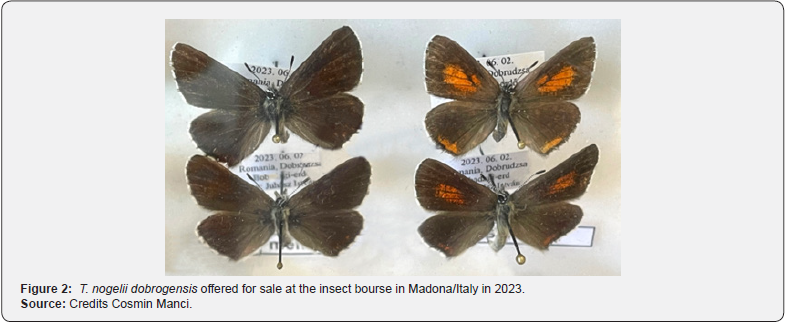
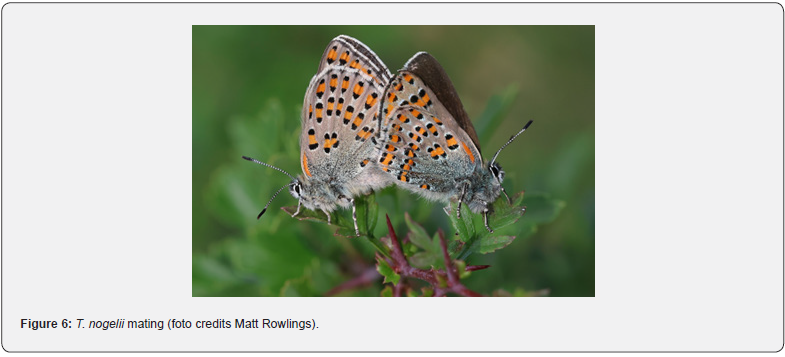
The known population(s) from Northern Dobruja are seriously endangered by the attractiveness of the species to collectors and especially to rare insect traders. While the location remains undisclosed to specialists or the public through publications, collectors have acquired this information from the limited pool of researchers who knew the whereabouts of these populations. As a consequence, only a few years after its rediscovery, specimens of T. nogelii dobrogensis were found at insect markets (exchanges) abroad (Figure 6). Other collectors sold specimens online. The fame of the butterfly, its attractiveness and the presence of unethical collectors, contribute massively to the reduction of the number of individuals, potentially leading to the extinction of this last known population in Romania and the EU. In addition to the direct negative impact of oversampling, colonies of T. nogelii dobrogensis can also be affected by forest grazing or by the closure of clearings through natural succession of scrub. The planting of tree seedlings in clearings is another risk factor for T. nogelii colonies. The threats posed by inappropriate management strategies is exacerbated by the fact that the presence of the butterfly and its Red List status is often not known to forestry staff tasked with the management of the species habitat. Further potential threats are fires (particularly between June and September) and the use of pesticides (used to control invertebrate species viewed as forest pests). Pesticide exposure may also occur through drift from intensively managed agricultural fields in the region (facilitated by the local climate).
Protection and conservation measures
The European and the Romanian Red List of Butterflies [1,19,20] lists the species as locally extinct and critically endangered, respectively. In Romania, T. nogelii is protected through the Government emergency ordinance No. 57/2007, on the regime of protected natural areas, conservation of natural habitats, wild flora and fauna, approved with amendments by Law no. 49/2011 and subsequently modified by legislation, annex 4B. However, the effects of this legislation are currently very limited. On-site controls are rare and ineffective. On some of the rare occasions where these took place, forestry staff found rented cars on the perimeter with butterfly nets and insect collection materials inside. It is evident, from these and other anecdotal evidence, that the only way to maintain viable populations of this species is to place its habitat under stricter protection. We therefore propose that the two sites where the habitat is suitable for T. nogelii should be protected as areas of forestry interest, so called forest nature reserves, managed by the local forestry office. Forest nature reserves are protected areas of national interest that correspond to IUCN category IV protected areas.
This will ensure the obligation of forestry staff to actively monitor the habitat of T. nogelii and thus reduce the risk of oversampling and habitat destruction. The creation of a protected area is essential, given that our attempts to keep the locations of the two sites secret have been undermined. The solution to stop the pseudo-scientific collections and activities targeting the endemic taxon T. nogelii dobrogensis came from the local Forestry Office, which is calling for the establishment of a forest nature reserve dedicated to this species, managed by forestry staff under the guidance of entomological specialists. Designating a special conservation area for T. nogelii dobrogensis would ensure more effective protection and increase the frequency of patrolling by foresters in the area. Further research is needed in the forests of Northern Dobrujea to identify possible new populations of T. nogelii. For known populations/colonies, monitoring of population numbers and annual dynamics are indispensable objectives for the maintenance of the taxon. Once new population are found, these should be also placed under protection, while also ensuring that the connectivity between populations is maintained.
Proposal for a protected area to save the last known population of the endemic subspecies T. nogelii dobrogensis
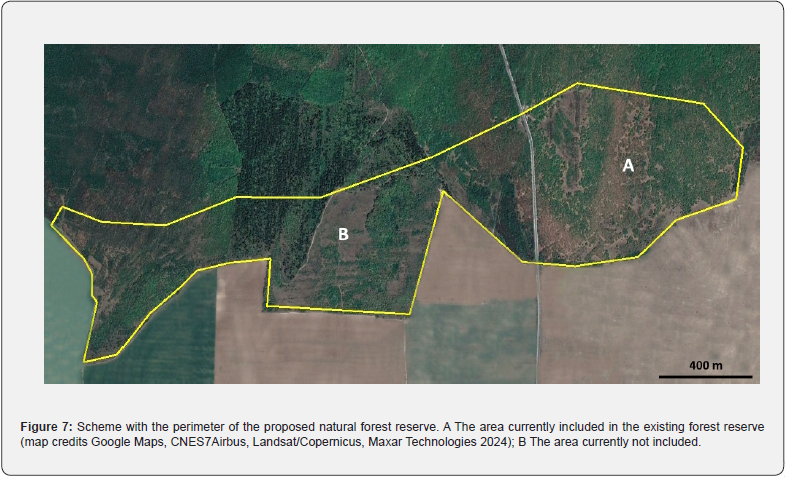
For the protection and conservation of T. nogelii dobrogensis we propose the delimitation of a perimeter of about 30 ha including the two known colonies from Tulcea County (Figure 7). This perimeter should acquire the status of a forest nature reserve, under the administration of the local Forestry Office. It should be mentioned that the entire forest is part of a Natura 2000 site, where there is already a forest reserve, but this only covers part of the area we are proposing for the new reserve (Figure 7). For the protection and conservation of the two known colonies, it is necessary to include both areas in the forest reserve. (in fact the first rediscovered population of T. nogelii dobrogensis, which disappeared after 2017 was located in the Natura 2000 site).
Reasons for the establishment of a scientific forest reserve
The establishment of a forest reserve dedicated to the endemic taxon T. nogelii dobrogensis would ensure:
a) Protection and conservation of the endemic taxon T. nogelii dobrogensis in the only and last known site in the EU.
b) The placement of the populations under protection could be used for population ecology studies, studies which are essential for the elaboration of targeted protection and conservation measures for this endemic taxon.
c) Protection and conservation of plant and animal species in the perimeter, some of which are of European and/or national interest. We mention here the plants Asyneuma anthericoides, Cephalantera rubra, Cerinthe auriculata, Platanthera bifolia, P. chlorantha, Himantoglossum jankae, Limodorum abortivum, Nectaroscordum siculum ssp. bulgaricum, Neottia nidus-avis, Orchis purpurea, O. morio, O. simia, Anacamptis pyramidalis, Astragalus ponticus, Psephellus marschalliana, Cyanus thirkei, Dianthus pseudarmeria, Crocus danubiensis, Galanthus plicatus, Globularia punctata, Paeonia peregrina, etc. [21].
d) Among the insect species found in this area and protected by the EU Directive are: Cerambyx cardo, Lucanus cervus, Morimus funereus, Rosalia alpina, Bolbelasmus unicornis, Catopta thrips, Hyles hippophaes, Euphydryas maturna opulenta, Pseudophilotes bavius, Zerynthia polyxena, Saga pedo.
In addition, there are many other rare species such as Bradyporus dasypus, many species of moths and butterflies and other invertebrates and vertebrates.
Conclusion
The butterfly, T. nogelii butterfly was thought to be extinct in the EU, but was rediscovered in northern Dobruja, where it was first recorded over 100 years ago. The populations in Eastern Europe are assigned to ssp. dobrogensis (Caradja). Although the exact location of the two known colonies was not published and known only to a few specialists, collectors and butterfly dealers found out the coordinates of the colonies and collected a considerable number of specimens, some of which were offered for sale at insect fairs. In addition, one of the colonies is heavily affected by intensive pest control measures relying on insecticides dropped from airplanes. To save the tax on at its only known site in the EU, we propose to establish a forest nature reserve managed by local forestry officials under the scientific coordination of a team of experts.
Acknowledgment
We would like to thank the forestry staff and especially the forester Romeo Enescu for his constant involvement in the preparation of the documents necessary for the establishment of the protected area. We also acknowledge the support of our colleagues Dr. Cristian Sitar and Dr. Lucian Barbu who provided the SEM photograph of the egg of T. nogelii and of Matt Rowlings for the two photographs/pictures made available to the authors.
We would also like to thank Andrei Crisan for his help with preparing the images included in this manuscript.
References
- Van Swaay C, Cuttelod A, Collins S, Maes D, López Munguira ML, Šašić M, et al. (2010) European Red List of Butterflies. Publications Office of the European Union, Luxembourg pp: 47.
- Efetov KA (1987) Nymphalis Xanthomelas (Esp.) Tomares nogeli (sic) (H.-S.) and Polyommatus amandus (Schn.) (Lepidoptera, Rhopalocera) in the Crimea. Vestnik Zoology 6: 51.
- Nekrutenko Y (1985) The Butterflies of the Crimea. Naukova Dumka, Kiev pp: 152.
- Rakosy L (2024) A Field Guide to the Butterflies of Romania (Pelagic Identification Guides). Pelagic, London pp: 376.
- Tshikolovets VV (2011) Butterflies of Europe & the Mediterranean area - Tshikolovets Publications, Pardubice pp: 544.
- Hesselbarth G, Van Oorscholt H, Wagener S (1995) The butterflies of Turkey taking into account the neighboring countries. Vol. 1. Wagener, Bocholt.
- Kovanci BO, Gencer SN, Kovanci B (2009) Lycaenid butterflies (Lepidoptera: Lycaenidae) of northwestern Turkey with notes on their ecology and current status. Revista Colombiana de Entomología 35 (2): 275-282.
- Tuzov VK, Bogdanov PV, Churkin SV, Dantchenko AV, Devyankin AL (2000) Guide to the Butterflies of Russia and Adjacent Territoires (Lepidoptera, Rhopalocera) Vol. 2. Pensoft, Sofia- Moscow pp: 580.
- Mann J (1866) Enumeration of the butterflies collected in Dobruja in 1865. Proceedings of the Zoological and Botanical Society in Vienna 16: 1-40.
- Caradja A (1895) The Great Butterflies of the Kingdom of Romania. Deutsche Entomologische Zeitschrift Iris, Dresden. 8: 1-102.
- Olaru V, Nemes I (1968) Contributions to the study of Lepidoptera in the Gârboavele Forest (II). Lucr.Șt. Inst. Pedag. Galați 2: 167-177.
- Marcu A, Rákosy L (2002) Checklist of the "Dr. Vladimir Olaru" Lepidoptera Collection of the Galati Natural Science Museum. The Romanian Lepidopterological Society. Cluj-Napoca pp: 172.
- Rákosy L, Craioveanu C (2016) Redescovering Tomares nogelii dobrogensis Caradja, 1895 in Romania. Entomologica romanica 19: 13-16.
- Cuvelier S (2022) La diversité entomologique de la Roumanie (voyage en juin 2022) Quel avenir ? (Lepidoptera, Papilionoidea). Lépidoptères - Revue des Lépidoptèristes de France 31(81): 76-84.
- Wiemers M, Balletto E, Dincă V, Fric ZF, Lamas G, et al. (2018) An updated checklist of the European Butterflies (Lepidoptera, Papilionoidea). ZooKeys 811: 9-45.
- Nazari V, Hagen W (2020) Molecular taxonomy of Tomares hairstreaks (Lepidoptera, Lycaenidae, Theclinae). German Entomological Journal 67 (1): 19-33.
- Bury J, Savchuk V (2015) New data on the biology of ten lycaenid butterflies (Lepidoptera: Lycaenidae) of the genera Tomares Rambur, 1840, Pseudophilotes Beuret, 1958, Polyommatus Latreille, 1804, and Plebejus Kluk, 1780 from the Crimea and their attending ants (Hymenoptera: Formicidae). Acta entomologica silesiana 23: 1-16.
- Çalişkan SS, Yıldız F (2023) The relationship between distribution of the genera Tomares Rambur, 1840 and the distribution of the larval host plant Astragalus L. (Turkey) (Lepidoptera: Lycaenidae). SHILAP Journal of Lepidopterology 51(203): 447-454.
- Rákosy L 2003 Red List of the butterflies of Romania. Bul inf Soc Lipid rom 13(1-4): 9-26.
- Rákosy L, Corduneanu C, Crișan A, Dincă V, Kovacs S (2021) Red List of Lepidoptera of Romania. Cluj University Press pp: 187.
- Petrescu M (2007) Dobrogea and the Danube Delta, Flora and Habitat Conservation, Tulcea pp: 355.

























