




 ECOA Home



Influences of Various Organic Fertilizer on the Vegetative Growth of Pumpkin (Telefairia Occidentalis) in Anyigba, Kogi, State Nigeria
Musa, MA1, Lamidi K2, Haruna NA3 and Adamu AT4*
1,2Department of Crop Production, Prince Abubakar Audu University, PMB 1008 Anyigba, Kogi State, Nigeria
3Centre for Agriculture Mechanization (NCAM) Ilorin kwara, Nigeria
4Department of Animal Production, Prince Abubakar Audu University, PMB 1008 Anyigba, Kogi State Nigeria
Submission: October 09, 2023;Published: November 27, 2023
*Corresponding author: Adamu AT , Department of Animal Production, Prince Abubakar Audu University, PMB 1008 Anyigba, Kogi State, Nigeria. Email id: adamu.mm@ksu.edu.ng
How to cite this article: Musa, MA, Lamidi K, Haruna NA, Adamu AT. Influences of Various Organic Fertilizer on the Vegetative Growth of Pumpkin (Telefairia Occidentalis) in Anyigba, Kogi, State Nigeria. Ecol Conserv Sci. 2023; 3(5): 555621. DOI:10.19080/ECOA.2023.03.555621
Abstract
The experiment was conducted in an open field in front of the green house of the Faculty of Agriculture Kogi State University, Anyigba. The main objectives are to evaluate the effect of types of organic manure on the growth and yield of fluted pumpkin (Telfaria occidentalis). The experimental plots was measured at 14.5 m × 15 m. A Randomized Complete Block Design (RCBD) with eight (8) treatments and three (3) replicates making a total of 24 plots and rates were Poultry Manure (20 t/ha), cow dung (20 t/ha), Goat droppings (20 t/ha) and Palm Bunch (20 t/ha), respectively The parameter measured were vine length (cm), Number of leaf, Number of branches, Stem girth (cm) and fresh weight of leaves (g). The results revealed that cow dung showed the best performance by producing the highest although the vegetative growth of fluted pumpkin (Telfaria occidentalis) longest vines with mean value of 94.00 cm, 153.00 cm and 156.50 cm. highest number of branches, with mean value of 20.50, 28.00 and 27.50, highest number of leaves with mean value of 86.00, 94.00 and 95.00, wildest stem girth with mean value of 1.03cm 1.01cm and 1.04cm Cow dung exhibited the highest fresh weight of leaves with mean value of 96.15g while Goat Manure and control plots displayed the least mean values. The results clearly demonstrate a significant variance between treatments with cow dung manure being the most productive among those investigated. Hence it is highly recommended for farmers in Anyigba.
Keywords: Vegetable; Organic; Nutrient; Sources; Soil
Abbreviations: ADP: Agricultural Development Project; RCBD: Randomized Complete Block Design; WAP: Weeks After Planning; STAR: Statistical Tools for Agricultural Research
Introduction
The fluted pumpkin (T. occidentalis), also referred to as “Ugwu” by the Igbo people of eastern Nigeria, is a creeping leafy vegetable with huge lobed leaves and long twisting tendrils Ibironke [1]. The vegetable is commercially lucrative and grown throughout West Africa’s lowland humid tropics (Sierra Leone, Ghana, and Nigeria being the leading producers) Duling [2]. In Nigeria, the leaves, flowers and seeds are consumed locally as vegetables by humans and fodder for livestock Idem [3] Nitrogen is necessary for healthy vegetation and is best provided as manure Hasnain [4]. Fluted pumpkins are harvested 120–150 days after planting Annih [5]. T. occidentalis seeds and leaves are consumed because they are healthy sources of lipids, vitamins, fiber, and minerals such as iron, potassium, phosphorus, and mineral salt Obembe [6]. Additionally, T. occidentalis bio accumulates a few secondary metabolites, including phytate, oxalate, nitrate, and cyanogenic glycoside, which, in high concentrations, can be toxic to humans and animals Parwez [7]. For instance, the chelators oxalate and phytate decrease the bioavailability of various mineral elements. Kidney stones are caused by oxalate in combination with calcium Petroski [8]. Organic nutrient sources are specifically derived from plant and animal origins FAO[9]. They include plant residues, animal wastes and bio fertilizers. In this era where climate change and the COVID-19 pandemic has impacted agricultural production and the financial capabilities of all workforces including farmers, farmers could use organic fertilizers available to them for soil fertility purposes because they are cheaper and more environmentally friendly when they are locally available Adejobi [10]. Organic fertilizers include poultry manure, cattle manure, green manure (often legumes), field crop residues, palm kernel cake, among others. Bio fertilizers are products containing single micro-organisms or combinations of them which when applied help fix atmospheric N, solubilize nutrients, mobilize nutrients, or secrete growth promoting substances to aid crop growth. These products do not supply nutrients themselves but enhance the activities of soil microbes to make more nutrients available to crops. They are categorized into N-fixing bio fertilizers, phosphorus solubilizing bio fertilizers, composting accelerators and plant growth promoting rhizobacteria FAO [9]. Most of the plant and animal residues are often by-products and nuisance to the environment. Using them as nutrient sources would help reduce waste and greenhouse gas emission. In line with the foregoing an alternative source of crop nutrition such as by the use of organic manure can be considered to restore and maintain the soil nutrient status for improved crop productivity organic manure application can be considered as an option provided it is applied at the right rate and time. Thus, the research will determine the growth and yield of fluted pumpkin (Telfaria occidentalis) as influenced by organic fertilizers.

Materials and Methods
Experimental Site
The experiment was conducted in an open field in front of the green house of the faculty of Agriculture, Prince Abubakar Audu University, Anyigba, The location is at Latitude 7°6ᶦ N and Longitude7°43ᶦ E. The field experiment consists of a variety of fluted pumpkin (Telfaria occidentalis) was gotten from Agricultural Development Project (ADP) Anyigba, Kogi State. The organic manures poultry manure, cow dung, Goat droppings and Palm Bunch was obtained from the Animal Research Farm Prince Abubakar Audu University
Treatments and Experimental Design
The experimental plots was measured at 14.5 m × 15 m. A Randomized Complete Block Design (RCBD) with eight (8) treatments and three (3) replicates making a total of 24 plots was obtained for the experiment and treatments was applied per plots by means of randomization to avoid bias. Rates were Poultry Manure (20 t/ha), cow dung (20 t/ha), Goat droppings (20 t/ha) and Palm Bunch (20 t/ha), respectively.
oil Analysis
The composite soil samples was collected to a depth of 0 - 15cm was air dried, crushed and sieved with 2mm mesh in order to assess the physic-chemical properties of the soil.
Cultural Practices
All organic manure was incorporated two weeks prior to sowing to allow for proper decomposition in the soil. The fluted pumpkin (Telfaria occidentalis) seed was sown directly on the plots. Watering was done with the help of a watering can in the absence of rainfall for good and robust production till harvesting period. Weeding was done manually using hand at two weeks intervals on the experimental plot throughout the period of the experiment. Staking was done by setting up series of twine between to keep all of the leaves of the ground. Harvesting was done by cutting off the Leaves from the allocated plots of the matured state and labeling was done for ease of identification Data was collected from five (5) plants for the vegetative parameters respectively.
Parameters
Vine length (cm)
This was carried out three (3) times at 6, 9 and 12 Weeks after planting with the aid of a measuring tape. The length of the vines in all the treatments was measured and tabulated against the different replications for which they represented.
Number of Branches per plant
Number of Branches per plant was determined by physical counting at 6, 9 and 12 Weeks after Planting.
Number of leaves per plant
Number of Leaves per plant was determined by counting the number of leaves per plant at 6, 9 and 12 Weeks after planting.
Stem girth (cm)
The girth of each stem was measured per plant with a Verneer caliper and recorded at 3 weeks interval to maturity stage at 6, 9 and 12 Weeks after Planting
Fresh weight of leaves
This was determined by weighing each of the bulked harvested leaves per plot using the sensitive scale (electronic scale machine) in the laboratory at 12 weeks after planting.
Data Analysis
Data collected was subjected to analysis of variance (ANOVA) for Randomized Complete Block Design (RCBD) and significantly different means were separated using FSLD at P ≥ 0.005 using Statistical Tools for Agricultural Research (STAR, 2013).
Results and Discussion
Physico-Chemical Analysis Results
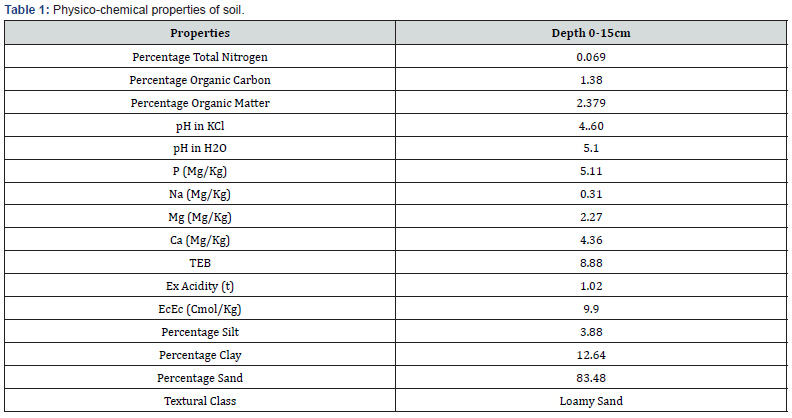
Based on the result presented in Table 1, it can be inferred that the soil possesses both chemical and physical properties. The utilization of a textural triangle reveals that this soil is classified as sandy loam. Additionally, with total nitrogen of 0.07 %, organic carbon 1.38 while, organic matter is 2.38. pH in H2O suggests slight acidity with mean value of (5.10) an advantageous quality for cultivating vegetable crops.
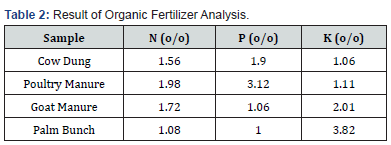
Result of Fertilizer Analysis
Table 2 reveals that poultry manure exhibits a superior nitrogen content in comparison to other organic fertilizers, with a percentage composition of Total Nitrogen (%N) and Available phosphorous (ppm) (1.98 and 3.12). Notably, palm bunch boasts the highest potassium content among the studied organic fertilizers at 3.82%.
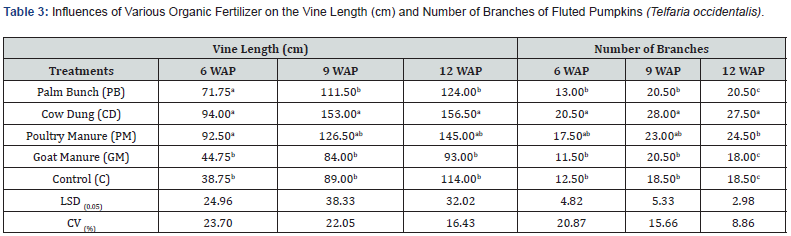
Influences of Various Organic Fertilizer on the Vine Length (cm) and Number of Branches of Fluted Pumpkins (Telfaria occidentalis)
Table 3 indicates that the utilization of organic manure had a significant effect (p≤0.05) on vine length at 6, 9, and 12 WAP. Specifically, plants treated with cow dung exhibited the longest vines with mean value of 94.00 cm, 153.00 cm, and 156.50 cm; however, this was not significantly different from the vine length of those treated with poultry manure with mean value of 92.50 cm, 126.50 cm and 145.00cm. Throughout the experiment period (i.e., at 6, 9, and 12WAP), Notably, while control plots produced plants with shorter vines after 6 weeks after planting of growth than other treatments did with mean value of 38.75cm; goat manure resulted in shorter vine lengths at both 9 and 12 week weeks after planting with mean value of 84.00cm and 93.00cm marks. Table 3 reveals that the application of organic manure had a significant (p≤0.05) impact on the number of branches in pumpkin leaves at 6, 9, and 12 WAP. Plots treated with Cow dung produced plants with the highest number of branches, with mean value of 20.50, 28.00 and 27.50. However was not significantly different from those treated with Poultry Manure at 6 and 9 WAP with mean values of 17.50 and 23.00. Notably, the lowest number of branches occurred in plots treated with Goat Manure at both 6 and 12WAP with mean values of 11.50 and 18.00. While control plots exhibited their lowest branch count at only 12 WAP with mean value of 18.50.
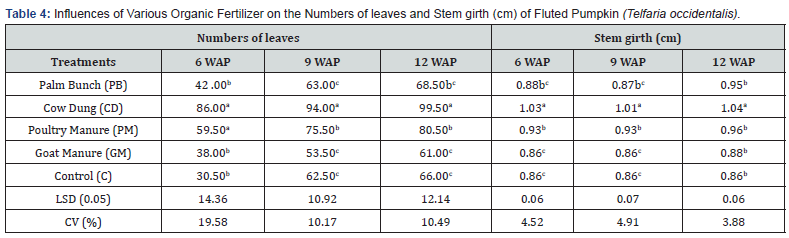
Influences of Various Organic Fertilizer on the Numbers of leaves and Stem girth (cm) of Fluted Pumpkin (Telfaria occidentalis)
Table 4, shows that the quantity of pumpkin leaves was significantly impacted by organic manure application, based on the results obtained at 6, 9 and 12 weeks after planting (WAP). Plots treated with Cow dung yielded with the highest number of leaves with mean value of 86.00, 94.00 and 95.00, however differed significantly from all other treatments except Poultry Manure at 6 WAP. The control plots had plants with the lowest number of leaves at 6 WAP, with mean value of 30.50 while plots treated with Goat Manure produced plants with a lower number of leaves compared to others at both 9 and 12 WAP with mean value of 53.50 and 61.00. Respectively. The results from Table 4 indicate that the stem girth of pumpkin leaf was significantly influenced (p≤ 0.05) by the use of organic manure at 6, 9 and 12WAP. Specifically, plots treated with Cow dung exhibited the highest stem girth diameter with mean value of 1.03cm 1.01cm and 1.04cm at week 6 9 and 12 WAP. Meanwhile, plants grown in plots treated with Goat Manure and control plots displayed the smallest plant girth diameter at both 6 and 9 WAP with mean value of 0.86cm n 0.86cm periods; however, control plots produced plants with the least plant girth diameter only at the final measurement point of 12 WAP with mean value of 0.86cm.
Influences of Various Organic Fertilizer on fresh Weight of Leaves of Fluted Pumpkin (Telfaria occidentalis)
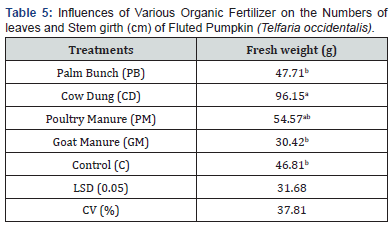
Table 5 illustrates that organic manure has a significant (p≤0.05) impact on the fresh weight of pumpkin leaves, as observed at 12 weeks after planting. Notably, plots treated with Cow dung exhibited the highest fresh weight of leaves with mean value of 96.15g, while those treated with Poultry Manure did not exhibit a statistically significant difference from plots treated with Palm bunch. However, it is worth noting goat manure gave the least mean value of 30.42g and was not statistically differ between the three sets of Manure-treated plots.
Discussion
Pre-planting soil analysis showed that the soil at the experimental site had a low soil nutrient status. The total value of nitrogen, phosphorus and potassium present in the test soil is a recorded level, which requires the application of soil amendments in the form of organic fertilizers. The increase in vine length, the number of branches and the number of leaves and a significant increase compared to the applied organic fertilizers (cattle, sheep and livestock manure) can be related to the increase in the N content of the applied fertilizers. Cow manure increases cell activity, increases cell proliferation, and increases vegetative growth. This result is in line with the results of Aderi [11] who found a significant effect of organic fertilizer level on some quantitative parameters of pumpkin. Similarly, Eifediyi and Remison (2013) observed that organic fertilizers can support the cropping system with better nutrition, which leads to the increase and yield of plants. Also, Olawale & Ojo [12] confirmed the increase in growth parameters and different types of fertilizers which may be due to the efficiency of the use of fertilizers applied to plants, increasing the presence of other nutrients such as P in applied fertilizers. Adapted from N. Olowoake, (2017) the improvement of growth parameters with the application of organic fertilizers confirms the results of Aminifard [13] and Agbo [14] observed a significant increase in the growth and yield of T. occidentalis and other vegetables with organic fertilizers applied. In addition to releasing nutrients to the soil, organic fertilizers have been shown to improve other soil chemistry and physical properties that increase plant growth and development Olowoake [15]. Nitrogen is the main component of nucleic acids and chlorophyll, while phosphorus is involved in many metabolic processes necessary for normal growth, such as photosynthesis. Potassium is also necessary for photosynthesis because it activates many enzymes involved in the photosynthesis process. These elements affect the stability of chlorophyll molecules, and these nutrients are also present in cattle and are released slowly during the growing season. Frank [16] reported that pumpkin and Tshilangane [17] reported similar findings [18-19].
Conclusion and Recommendation
The primary reason for applying organic manure to soil is to enhance its organic matter amendment and provide nutrients to crops. Organic manure remains a strong and effective option due to its non-harmful nature towards soil health, making it ideal in today’s polluted world where long-lasting effects are crucial for sustainability purposes. Therefore, this study aimed at determining the yield of fluted pumpkin (Telfaria occidentalis) as influenced by organic fertilizers which showed that cow dung significantly improved nutrient levels, as well as growth of Teleferic spp. Among all treatments applied, cow dung (organic manure) showed the best performance by producing the highest vegetative growth. The results clearly demonstrate a significant variance between treatments with 20 tons/ha of cow dung manure being the most productive among those investigated. Cow dung manure proves to be an efficient source of NPK and organic matter for telfaria production, hence it is highly recommended for farmers in Anyigba.
References
- Ibironke SI, Owotomo I (2019) Hematology and Comparative Study of Fluted Pumpkin Leave Vegetable and Seed Nutrients (Telfairia occidentalis). Arch Nutr Public Health 1: 1-6.
- Duling K, Sheehan P, Ong J (2019) Côte d’Ivoire; Cavendish Square Publishing, LLC: New York, USA.
- Idem NUA, Ikeh AO, Asikpo NS, Udoh, EI (2012) Effect of organic and inorganic fertilizer on growth and yield of fluted pumpkin (Telfaria occidentialis, Hook F.) in Uyo, Akwa Ibom State, Nigeria. Journal of Agriculture and Social Research 12(2): 74-84.
- Hasnain M, Chen J, Ahmed N, Memon S, Wang L (2020) The effects of fertilizer type and application time on soil properties, plant traits, yield and quality of tomato. Sustainability 12: 9065.
- Annih MG, Tatiana N, Kinge T, Mariette A, Kebei A (2020) Effect of animal manure on the incidence and severity of leaf spot disease of fluted pumpkin (Telfairia occidentalis) in Dschang, West Region of Cameroon. Am J Plant Sci 11: 1057.
- Obembe OM, Ojo D, Ileke K (2021) Effect of different drying methods and storage on proximate and mineral composition of fluted pumpkin leaf, (Telfairia occidentalis) Hook f. J. Hortic. Postharvest Res 4: 141-150.
- Parwez R, Naeem M, Aftab T, Ansari A, Gill S, et al. (2022) Heavy metal toxicity and underlying mechanisms for heavy metal tolerance in medicinal legumes. In Hazardous and Trace Materials in Soil and Plants; Elsevier: Amsterdam, the Netherlands pp: 141-177.
- Petroski W, Minich D (2020) Is there such a thing as “anti-nutrients”? A narrative review of perceived problematic plant compounds. Nutrients 12(10): 2929.
- FAO (2006) Plant nutrition for food security. A guide to integrated nutrient management.
- Adejobi KB, Fameye AO, Akenbi OSO, Adeosun SA, Nduka AB, et al. (2013) Potentials of cocoa pod husk ash as fertilizer and liming materials on nutrient uptake and growth performance of cocoa. Research Journal of Agriculture and Environmental Management 2(9): 243-251.
- Aderi OS, Udofia AC, Ndaeyo NU (2011) Influence of chicken manure rates and inorganic fertilizer formulations on some quantitative parameters of fluted pumpkin (Telfairia Occidentalis hook f.) Nigerian journal of Agriculture, Food and Environmen
- Olowoake AA, Ojo JA (2014) Effect of fertilizer types on the growth and yield of (Amaranthus caudatus) in Ilorin, Southern Guinea, Savanna Zone of Nigeria. Adv Agric.
- Aminifard MH, Aroiee H, Fatemi H, Ameri A, Karimpour S (2010) Responses of eggplant (Solanum melongena L.) to different rates of nitrogen under field conditions. J Cent Eur Agric 11(4): 453-45.
- Agbo CU, Chukwudi PU , Ogbu AN, (2012) Effects of rates and frequency of application of organic manure on gowth, yield and biochemical composition of Solanum melongena L. ( 'Ngwa Local') fruits. J Anim Plant Sci 14(2): 1952-1960.
- Olowoake AA (2014) Influence of organic, mineral and organ mineral fertilizers on growth, yield and soil properties in grain amaranth (Amaranthus cruentus L.) J Organics 1: 39-47.
- Frank OO, Paul OJ, Amhakhian SO (2020) Influence of combined application of cattle dung and NPK fertilizer on soil physico-chemical properties, growth, nutrient uptake and yield of fluted pumpkin (Telfairia occidentalis) in Anyigba, Kogi State, Nigeria. South Asian Research Journal of Agriculture and Fisheries 2(1): 1-14.
- Tshikalange B, Ololade O, Jonas, C, Bello ZA (2022) Effectiveness of cattle dung biogas digestate on spinach growth and nutrient uptake. Heliyon 8 (3): 91-95.
- Enujeke EC (2013) Growth and yield responses to five different rates of poultry manure in Asaba area of Delta state Nigeria. Int Res J Agric Sci Soil Sci 3 (11): 369-375.
- Olowoake AA (2017) Growth and nutrient uptake of maize (Zea mays L.) amended with compost-enriched palm Kernel cake. Ibadan J Agric Res 12: 23-32.

























