




 ECOA Home



Towards Greening Erosion Scars in Uyo Urban, Akwa Ibom State, Nigeria: A Panacea for Geomorphic Stabilization
Abraham CM*, Ansa IE, Ebong MS and Essien N
Department of Geography and Natural Resources Management, University of Uyo, Akwa Ibom State, Nigeria
Submission: June 08 , 2023;Published: October 02, 2023
*Corresponding author: Abraham CM, Department of Geography and Natural Resources Management, University of Uyo, Akwa Ibom State, Nigeria. Email id: mbuotisampson@gmail.com
How to cite this article: Abraham C, Ansa I, Ebong M, Essien N.Towards Greening Erosion Scars in Uyo Urban, Akwa Ibom State, Nigeria: A Panacea for Geomorphic Stabilization. Ecol Conserv Sci. 2023; 3(4): 555617.DOI:10.19080/ECOA.2023.03.555617
Abstract
Greening erosion scar environment is relevant to geomorphic stabilization. Uyo urban is seriously impacted by gully development. Many strategies have been devised to manage gully erosion. This study aim at introducing greening structures alongside engineering measures in gully control. Five gully sites were studied to assess the level of greening with vegetation and its relatedness for effective management. It was discovered that three of the gully sites were heavily protected with multi-structures making it excellent gully control strategies. Two hundred structured questionnaires were distributed to five communities that borders gully impacted sites to assess level of intrusion into the sites. It was found out that gullies with vegetation alignment and less intrusion protect engineering structures. At Brook Street and Victory Chapel Uniuyo gully sites protection with greenbelt around the gully edges with less intrusion provide excellent control measures. It was recommended that gully management must consider greening the edges permanently alongside engineering structures. Also, human intrusion in rehabilitated sites should be curtailed.
Keywords:Greening; Erosion; Scar; Geomorphic; Stabilization; Uyo Urban; Akwa Ibom State; Nigeria
Introduction
Greening the environment as ecological clothing is not new to earth scientist globally. Erosion is a geomorphic agency with disastrous consequences on lithospheric components. Abraham [1] and Stabultoughlu, Tarbolin and Pack (2003) posit that gullies are unstable channels formed at or close to valley heads, sides and floor. Gullies are enlarged rills with provocative geomorphic imbalance. Poesen [2] in his unique way defined gullies as “the process whereby runoff water accumulates and also receives in narrow channels and over short periods removes the soil from this narrow area to considerable depth”. Ehiorobo & Izinyon [3] assert that gully processes are difficult to control with alarming degradative scenario in which overtime, have eaten the equilibrating condition. Greening gully slopes in vulnerable environment with vegetation is imperative for environmental sustainability. Abraham, Wilcox, Banjo, and Nyetiobong (2018) asserted that erosion ravage sites with conspicuous gullies align with vegetation will reduce soil loss down slope drastically. In Sub-Saharan Africa with high rainfall intensity concentrated in rainy season (May - October) gully aid extension tremendously. Many agrarian societies depend solely on rainfed agriculture and skyrocketed large expanse of vegetation clearance. With high population concentration in many farming communities, geomorphic environment is provoked with small holders’ farm with continuous cropping pattern. Abraham [4] in a study on implications of gully development on agriculture in Akwa Ibom State, Nigeria linked this scenario to poor greening of erosion scars due to continuous cropping and farming in vulnerable zone.
Vegetation components are diverse based on the environmental factor of the region. This variability includes; trees, herbs, shrubs, grass, grouped under biological components in biosphere. Ansa and Asuquo (2018) emphasized slope afforestation to avoid degradation and intensification of gully scars. Udoumoh, Ahuchaogu, Ehiomogue, Sam [5] posit that greening prevents formation and expansion of gullies that is ravaging many towns and villages in South- South and South-Eastern Nigeria respectively. Erosion prone region with conspicuous scars are still put under cultivation despite incessant warning and the nature of the terrain with deformed geomorphic tendency. Where the vegetation is scarce and scanty, rills are inevitable with localized channels created when water concentrates into small rivulets down slope. Deforestation and agricultural intensification with conventional tillage equipment simultaneously deepen the rills to unbearable size with inter-rill erosion detaching vital soil properties leading to erosion scar collapse and retreat of geomorphic slope. Abraham [1], Essien & Essien [3], Udosen [6], and Udoumoh [5] soils in Uyo have high sand and low clay fragmentation with sandy-loam aggregate with unstable geomorphic imbalance tendency. The rate of gully development with visible geomorphic scar in impacted domain has come to stay in Akwa Ibom State and elsewhere. This geomorphic breakdown of equilibrating nature rapidly speeds up degradation of gully slopes.
Degraded gully sites with less vegetal cover are inadequate in obstructing the impact of raindrops on bare soil. In Southern Nigeria, Ofomata [7] has worked extensively on gully development and geomorphologically impacted terrain with rugged erosion scars in deforested slopes of 5 to 15% and 1% slope. On a 15% slope he recorded a total soil loss of 230 t/ha/yr from bare plots as against soil loss of 11.2 t/ha/yr on 1% slope. Density of vegetation varies between relief unit vis-à-vis plains, lowlands, land bordering river valleys and highland. Upland soils with less vegetal cover with highly friable soil components yield easily to erosive power and trigger gully development on slopes of about 5%. The highlands region provides aggressive concentrated runoff with bare vegetal cover that devours local measures. The dominant greening forest types in Akwa Ibom State include; salt water swamp, fresh water swamp and the tropical rain forest. With intensification in farming to meet teeming population, the native greeny vegetation environment has been completely degraded with secondary forest of oil palm, woody shrubs with grass components. Pocket of this forest is predominant around hamlets, watercourses, forest reserves, and various tree crop plantations Essien & Essien [3]. Increase in intensification in agricultural activities in the exposed region trigger soil erosion menace. Areas with bare vegetal cover lack intercepting mechanism from raindrop impact.
Sophisticated lifestyle due to modernization intensify infrastructural development such as roads, housing, culvert construction and industrialization deprive balance vegetation cover with more sliding, slumping, interrill, rill and gullying. Greening gully edges in recent times have been triggered by land use changes and human encroachment. In Anua-Eniong gully axis despite the severity of geomorphic embarrassment with conspicuous erosion scars for ages, fuel wood extraction, fodder collection, pocket of farmlands, and urban drain termination at School of Nursing and Midwifery, Anua Offot provoked geomorphic threshold Udosen [6] and Udoumoh [5]. Gully slopes without vegetation with copious rainfall scenario discharge water with provocative velocity have continued to deform equilibrating conditions with newly developed erosion scars respectively.
Statement of the Problem
Erosion studies over the years have been carried out by many researchers in Geography and allied discipline. Global research initiative reflects the problem associated with gully development and all its intricacies. This indicated the high level of degradative tendencies occasioned by gully erosion scar in geomorphologically deformed zones. A significant progress in greening has been achieved so far in vegetative cover domain could reduce the menace of gully development drastically. In gully ravaged zone in Uyo urban and elsewhere, these efforts have not been concerted enough to stop the menace has envisaged as many gully prone sites are left bare without any greening with vegetation. Incorporating trees permanently in gully rehabilitated sites is one of the biological measures devised to work alongside engineering structures. Over the years, many gully sites did not have full backing on this, hence the exposure of the gully flanks to rigorous weather condition continue to provoke the geomorphological balance of the area as Abraham [1], Li et al (2020) Wang [8,9] , Valentin [10], UNEP [11], Ugwu, Ude, Ehiomogue and Enyekawa [12] , Poesen [2] and Valentin observed. The nature and magnitude of gully scenario with inter-connected externalities are aggravated by anthropogenic activities such as clearing and burning of vegetal cover, deforestation and farming of gully slopes Ansa and Asuquo (2018). By this, clothing the exposed gully slope with vegetation will reduce erosion drastically.
Objectives of the Study
This study is aimed at evaluating greening of erosion scar in Uyo Urban, Akwa Ibom State, Nigeria: a panacea for geomorphic stabilization. The following specific objectives are in this study:
i. Find out rehabilitated gully sites in Uyo
ii. Ascertain the benefits of greening rehabilitated gully edges
iii. Assess the effectiveness of greening gully edges for geomorphic stabilization
Review of Related Literature
Erosion studies have come to stay because of catastrophic and hazardous ecological deformation lately. Many regions in the world are geomorphologically deformed with ad hoc terrain and rugged topography. The breakdown of geomorphic threshold with vegetation degradation in gully fringes, have shaved away greeny potential that bind the soil drastically [13-20]. The dislodgement of soil is faster were vegetation is scanty with excessive surface runoff. Abraham [1] opined that constant soil detachment with concentrated flow destroy vital soil cover that serve as blanket. Where the vegetation is severely degraded, the potential to bind the soil is limited. In South-Eastern Nigeria, 25,000 hectares of land are lost annually to erosion leaving scars of unprecedented dimension [21-33]. This is seen in unprecedented ecological amputation with dire consequences on environment. The intensification in agriculture and other land uses deprive the soil of vital vegetation. In Uyo urban, the notorious Uyo ravine encroachment hinders meaningful development in the eastern flanks with one sided environmental and socio-economic planning. Greater part of Uyo consists of erosional scars known as ravines. The number of scholars have studied Uyo ravine since 1921 with host communities notably, Anua Offot, Eniong Offot, Ekpri-Nsukara, Ikot Oko Idio, Ewet Offot, Afaha Oku, Ikot Obio Atai. Ikot Obong Edong, Nduetong Oku among others.
This encroachment is seen in the host communities as erosion has eaten into the fabric with geomorphic embarrassment. Uyo gullies right from inception, is a threat to urban development and the generation yet unborn will not spare us if we fold our arms without any concrete effort for rehabilitation. This impending catastrophe has drawn appeals for actions by media houses and research institutions [34,35]. The major activity in erosion process in the ravine consists of landslides, rill action, slumping, subsidence and sheet wash. There is a general distortion of the natural surface in the form of scours, irregular indentation and ad hoc topographic formation. Taking Uyo ravine into right perspective, numerous factors accounted for development and geomorphic expansion as, the nature of detachment of erosivity, the action of gravity on slope surface, intense rainfall, increasing human activity, the low resistance of soil component, poor vegetation cover and proximity of the present surface to already eroded surfaces. Physiography of Uyo urban is triggered by urbanization with severe human activities that rendered blanketing effect of vegetation impotent in protecting gully expansion and edges. This depends on heavy rainfall without protection from vegetation as well as large quantities of runoff water that excavate and detach soil material colloidal nature. During the past 30 years, Uyo have grown with inflocks of indigenous and migrant population exerting pressure on various geomorphic assets with resultant effect on ravine encroachment and vegetation degradation Abraham [4].
Method of Study
Study Area
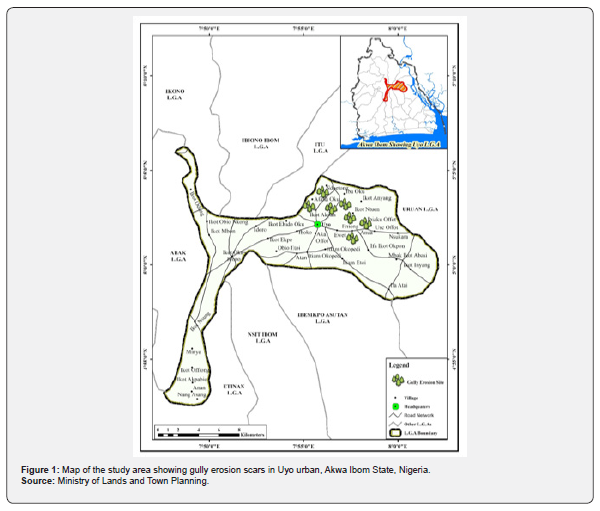
The study area is Uyo the capital of Akwa Ibom State, Nigeria. Uyo is located 50 021 N 70 561 and Latitude 70 471 N 80 031 E. It is bounded in the North by Itu, Ibiono and Ikono Local Government Area of Akwa Ibom State, in the South by Etinan, Nsit Ibom and Ibesikpo Asutan Local Government Area of Akwa Ibom State, in the West by Abak Local Government Area of Akwa Ibom State and in the East by Uruan Local Government Area of Akwa Ibom State. Uyo covers the total land area of 115km2 (44 sq ml). Uyo is made up of three residential clans, namely Oku (15 Villages), Etoi (22 Villages) and Offot (22 Villages).The aspect of geological structure, which is essential for planning are seriously impacted by gully encroachment into rocks and regolith. Structurally, Uyo Urban is underlain with coastal plain sand (Abraham, 2010). It is located within the low land coastal plain region of Nigeria resulting from gradational processes of the ages, with an average height of 61km above sea level. The northern and north-eastern areas where the 50km deep Ikpa Valley breaks the monopoly is geomorphologically deformed. Uyo and most of the state is humid, with tropical rainy type. It receives abundant rainfall with very high temperatures. Mean annual temperatures are between 260C and 280C while the mean annual rainfall ranges from 2500mm to 3200mm. The relative humidity is quite high all year round with mean values ranging between 75% and 95% (Figure 1).
Results And Findings
From field study undertaken between January 2022 and March 2023 in Eastern flank of Uyo urban, Akwa Ibom State, Nigeria, and some gully sites are left bare without any protective measures alongside engineering structures [36].
In Plate 1, Eka street gully rehabilitated site, engineering structures is not isolated from biological measures to have success that sustain the environment geomorphologically from degradative scenario occasioned by incessant gully erosion [37].
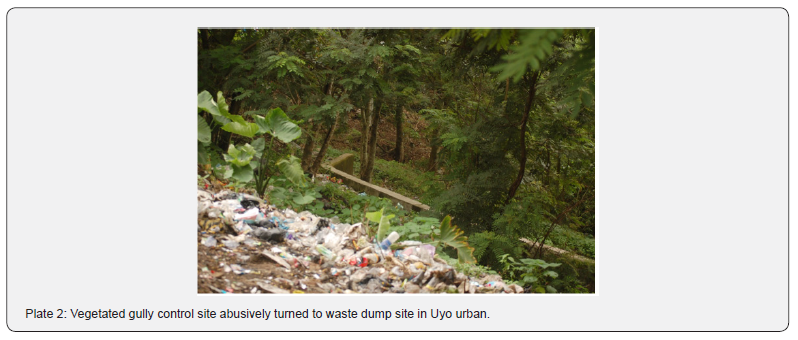
In Plate 2, this gully site is a clear indication of human encroachment into already impacted site now with re-growth of young plants to colonize the region. Many gully sites in Uyo urban are either put under cultivation with severe encroachment in form of waste dump and site for mentally deformed individual that is now terrorizing the residents.
In Plate 3, engineering structures put in place have been complimented with biological measures in the form of grass field with pocket of trees ranging from orange, quava, pear, tangerine, grape, coconut, and mango. Presently, greening this region has paid off into recreation sites of inestimable dimension. In the entire Akwa Ibom State, this rehabilitated gully site is now number one and serves as demonstration site and field laboratory for subsequent activities pertaining to gully control [38,39].
In Plate 4, there is total degradation of vegetation in gully affected zone. Presently, construction work is in progress with restriction of movement. The School of Nursing and Midwifery is affected greatly due to rapid encroachment by gullies into built up areas [39,40].
Plate 5 indicates ongoing rehabilitation measures put in place to halt gully extension. Vegetation is heavily impacted by advancing gullies. Hence, after engineering structure, greening the edges is the best option to reduce degradation and renewed extension.
In Plate 6a and 6b, the area is heavily cloth with greeny vegetal cover since completion of work in 2014. Presently, human encroachment has been monitored for excellence performance. Students are not allowed entry to increase density and sustainability.
In Plate 7, it has been observed that land use changes and complete human intervention in gully impacted site now rehabilitated can attract tourists as well as promote recreational activities in the region. This is a good site to behold because of effective ground surface improvement. Gradative tendencies have been drastically minimized with greenery by protecting surface hydrology, soil topography, and land use among others.



References
- Abraham CM (2001) The Effect of Gully Erosion and Land Degradation on Agricultural production in Obotme, in Ini Local Government Arean of Akwa Ibom State”, Research Report, PGD Environmental Education, University of Calabar, Calabar.
- Poesen JW, Vandaele K, Van Wesemael B (1996) Contribution of gully erosion to sediment production on cultivated lands and rangelands. Erosion and Sediment Yield: Global and Regional Perspectives.
- Essien OE, Essien IA (2012) Rainfall characteristics, runoff rate and the traffic flow on gully morphometric parameter growth and soil losses in sand-mined peri-urban,Uyo, Nigeria. Journal of Geology and Mining Research 7(3): 1307-1318.
- Abraham CM (2010) Implications of gully development on agricultural production in Akwa Ibom State, Department of Geography, University of Uyo.
- Udoumoh U, Fubara-Manuel I, Ehiomoge P, Ekpo A, Anana U (2018) Estimating Erodibility Factor in Soils of Uyo, South-South Nigeria. International Journal of Current Research and Academic Review (6): 23-38.
- Udosen CE (2013) Gully Erosion and Cities: An Unwanted Partnership. A paper presented at the Faculty of Social Sciences Seminar at CBN Hall, University of Uyo p.15.
- Ofomata GEK (2000) “Erosion in the rain forest of Nigeria” Paper presented at the annual conference of the Nigeria geographical Association, University of Nigeria, Nsukka.
- Wang ZQ, Liu BY, Wang XF, Xiao FG, Liu G (2009) Erosion effect on the productivity of black soil in northeast china. Sci. China Ser. D-Earth Sci. 52: 1005-1021.
- Wang YS, Wang NZ, Zhong YF, Gu GHM, Zhang HY (2013) The gully distribution characteristics cross-province in the black soil region of northeast china. Soil Water Conserv. China 10: 67-69.
- Valentin C, Poesen J, Young Li (2005) “Gully Erosion: Impacts, Factors and Control” Catena 63:132-153.
- UNEP (1997) Asia Pacific Environment Outlook, United Nations Environment Programmed (UNEP)-Environment Assessment Programme for Asia and Pacific, Asian Institute of Technology, Bangkok, Thailan.
- Ugwu EC, Ude VC, Ehiomogue P, Onyekawa FC (2016) Investigation of erodibility Indices of soils in Ikwuano Local Government Area of Abia State in South-Eastern Nigeria. International Journal of Curriculum Research, Academic Revolution 4(8): 102-110.
- Abraham CM (1998) Physical properties of soils under varying gully development environment. A case study of Obotme and Atamong areas of Akwa Ibom State, Unpublished M.Sc Thesis, Department of Geography. University of Uyo, Uyo.
- Abraham CM, Adams (2012) “Innovative gully management strategy in farmlands in Akwa Ibom State”. A paper presented at first world conference on Science and Technology University of Uyo.
- Abraham CM, Wilcox R (2014) Assessment of gully erosion menace and efforts at amelioration in Itu, Akwa Ibom State.
- Abdulfatai IA, Okunlola IA, Akande WG, Momoh LO, Ibrahim KO (2014) Review of Gully Erosion in Nigeria. Causes, Impacts and Possible Solutions. Journal of Geosciences and Geomatics 2(3): 125-129.
- Aliyu HI, Nura AY, Olufemi A (2017) Assessing the Socio-economic Impact of Gully Erosion in Chikun Local Government Area, Kaduna State. Nigeria Science World Journal 12(1)
- R Graves J, Morris, LK Deeks, RJ Rickson, JA Harrism et al. (2015) The total costs of soil degradation in England and Wales,” Ecological Economics 119: 399-413
- Burtons I, Kates RW, White GF (2011) The environment as Hazard pp: 3-6.
- Coulombo C, Palumbo G, Aucelli P, De Angelis A, Rosskopf CM (2010) Relationship between soil properties, erodibility and hillslope features on central Apennines, Southern Italy. 19th World Congress of Soil Science, Soil Solutions for a Changing World. Brisbane, Australia pp: 50.
- De Vente J, Poesen J (2005) Predicting soil erosion and sediment yield at the basin scale: scale issues and semi-quantitative models. Earth-Science Reviews 71(1): 95-125.
- E Aksoy, MS Dirim (2009) Soil mapping approach in GIS using landsat satellite imagery and DEM data. African Journal of Agricultural Research 4(11): 1295-1302.
- Effiong SI (2011) Gully erosion menace in Akwa Ibom State: Implications for sustainable environment and development. Accord 47(25, 603): 11.
- Egboka BCE, Nwankwor GI, Orajaka IP (2016) Implications of Palaeo-and-Neo-tectonics in gully erosionprone areas of southeastern Nigeria. Natural Hazards Journal 3(31): 219-232. H Kumar, P Pani (2013) Effects of soil erosion on agricultural productivity in semi-arid regions: the case of lower Chambal valley. Journal of Rural Development 32(2): 165-184.
- Igwe CA (2012) Erodibility in Relation to Water-dispersible Clay for Some Soils of Eastern Nigeria. University of Nigeria pp: 320.
- Istanbulluoglu E, Tarboton DG, Robert TP (2003) A sediment transport model for incision of gullies on steep topography. Water Resources Research 9(4): 1103.
- Kates RW (2012) National hazards in human Ecological prospects Hypothesis and models. Econ Geog 47: 438.
- KP Bhandari, J Aryal, R Darnsawasdi (2015) A geospatial approach to assessing soil erosion in a watershed by integrating socio-economic determinants and the RUSLE model. Natural Hazards 75(1): 321-342.
- Ofomata GEK (1975) Soil Erosion. Nigeria in Maps, Eastern States. Ethipoe Publishing House, Benin City, Nigeria pp: 331.
- Ofomata GEK (1985) Soil Erosion in Southeastern Nigeria: The View of a Geomorphologist, inaugural lecture series, University of Nigeria Nsukka.
- Onyegbule P (2015) “Geophysiographic factors of Agulu-Nanka gully Erosion Southeastern Nigeria” Seminar paper presented to Department of geography, Met and Environmental Management, Nnamdi Azikiwe university, Awka.
- Onyelowe K, Duc BV, Ubachukwu O, Maduabuchi M, Ogechi I (2017) Evaluating Community-based (CB) Gully Erosion (GE) Disaster Management at Amuzukwu for Sustainable Geotechnics; a review. Open Science Journal 2(4).
- Ou Y, Yan BX, Bai JH, Chen HS, Gao Y, et al. (2018) Identifying the damaged area of gully in black soil region of northeast china. Sci. Soil Water Conserv 16: 24-30.
- Panagos P, Standardi G, Borrelli P, Lugato E, Montanarella L (2018) Cost of agricultural productivity loss due to soil erosion in the European Union: from direct cost evaluation approaches to the use of macroeconomic models,” Land Degradation & Development 29(3): 47-488.
- Paudel P, Kafle G (2012) Assessment and prioritization of community soil and water conservation measures for adaptation to climate stresses in Makawanpur district of Nepal. Journal of Wetlands Ecology 6: 44-51.
- Issaka S, Ashraf MA (2017) Impact of soil erosion and degradation on water quality: a review, Geology, Ecology, and Landscapes 1(1): 1-11.
- Uwanuruochi AO, Nwachukwu OI (2012) Impact of erosion on selected soil structural indices of four Local Government Areas of Abia State, Nigeria. Pure and Applied Testing 8(2): 127-133.
- Wang YS, Wang NZ, Zhong YF, Gu GHM, Zhang HY (2013) The gully distribution characteristics cross-province in the black soil region of northeast china. Soil Water Conserv. China 10: 67-69.
- White AW, Bruce RRJR, Thomas AW, Langdale GW, Perkins HF (2015) Characterizing productivity of eroded soils in the Southern Piedmont Erosion and soil productivity. Am Soc of Agric Engrs St Joseph Michigan Publication 8: 83-95.
- Li W, Buitenwerf R, Chenquin RN (2020) Complex causes and consequences of rangeland greening in south America-multiple interacting natural and anthropogenic drivers and simultaneous ecosystem degradation and recovery trends. Geography and Sustainability 1: 4304-316.

























