




 ECOA Home



Estimation The Heavy Metal Contents of (Soil, Rock, Plant and Water) Samples Collected from Gandula Region (Libya)
Wesam FA Mohamed1, Hamad M Adess Hasan2*, Amany T Sroor3, Nadia Walley EL-Dine3, Samia M EL-Bahi3 and Jemila Mussa Ali4
1Faculty of Education, Omar Al- Mukhtar University, Libya
2Chemistry department, College of science Omar AL-Mukhtar University, Libya
3Faculty of Women for Arts, Science and Education, Physics Department, Ain Shams University, Libya
4Physics department, College of science Omar AL-mukhtar University, Libya
Submission: August 22, 2023;Published: September 06, 2023
*Corresponding author: Hamad M Adess Hasan, Chemistry department, College of science Omar AL-Mukhtar University, Libya. Email id: hamad.dr@omu.edu.ly
How to cite this article: Wesam FA Mohamed, Hamad M Adess Hasan, Amany T Sroor, Nadia Walley EL-Dine, Samia M EL-B, et al. Estimation The Heavy Metal Contents of (Soil, Rock, Plant and Water) Samples Collected from Gandula Region (Libya). Ecol Conserv Sci. 2023; 3(1): 555605 DOI:10.19080/ECOA.2023.03.555605
Abstract
This study was carried out on forty one samples collected from different locations at Gandula region (Libya). The samples included (soil, rock, plant and water samples) afferent elements were selected in this study including (Na, Ca, K, Cu, Fe, Zn, Mn and Pb). The obtained results showed high levels of Na and Ca in water samples with average concentration of (154.08 and 84.4 ppm), respectively, and the high average concentrations of potassium was recorded in the plant samples (10.83 ppm). On the other side the high concentrations of Cu was recorded in rock samples with average (1.03 ppm). The results also recorded that the high concentrations of iron (Fe) and manganese (Mn) were recorded in soil samples (65.76 and 2.97 ppm), whereas the average values of, Zn and Pb were (1.36 and 0.97 ppm), respectively, in water samples. Levels of heavy metal were lower than the reference doses recommended by USEPA (U.S. Environmental Protection Agency) and JECFA (Joint FAO/WHO Expert Committee on Food Additives).
Keywords: Anthropogenic; Natural Constituents; Gandula region; Fluctuated; Ferromagnesian
Abbreviations: USEPA: U.S. Environmental Protection Agency; JECFA: Joint FAO/WHO Expert Committee on Food Additives; WHO: World Health Organization
Introduction
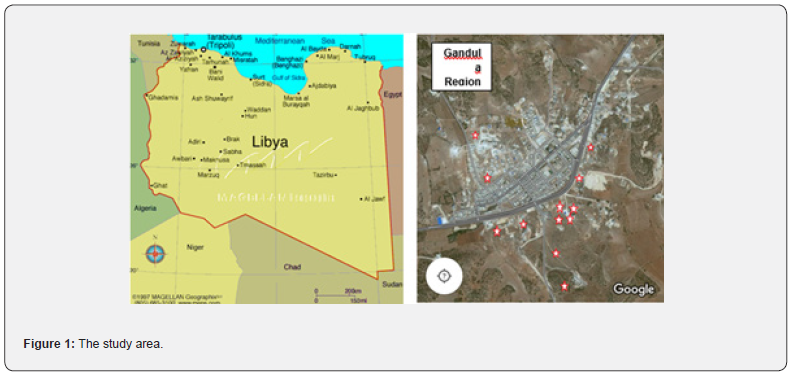
Heavy metals are produced from a variety of natural and anthropogenic sources, they are indeed an intrinsic natural constituents of our environment [1]. Heavy metals pollution may be produce from direct atmospheric deposition, geologic weathering or through the discharge of agricultural, or industrial waste products [2]. Several anthropogenic ones also contribute to metal concentrations in the environment and industrial beside the mechanical activities which raise natural concentrations causing serious environmental problems [3]. The major concern with the uptake plants of these contaminants from soil and presence in plant produce consumed by humans [4]. This aimed to estimate the level of heavy metals of some samples collected form Gandula region-Libya (Figure 1).
Material and Method
The samples were collected from different locations at Gandula region-Libya. The samples (soils, rocks and plants) were dried in oven at 70 Co for 2 h. The samples grinded and sieved by using a 200 mm mesh sieve, then transferred to 250 ml beaker .A 0.5 g of each samples were taken then in 50 mL Pyrex glass beakers, concentrated sulfuric acid were added in to each of the samples about 5 mL. The beakers containing each of the samples were placed on the heater for about 3h [5]. For the water samples, 5 mL of concentrated hydrogen peroxide was added to get rid of carbon. We moved the beaker from heater, then after cooling filtered by filter paper with added 100 mL water and placed to be measured [6]. The samples will be analysis by using flam photometer and atomic absorption to measure major elements and heavy metals respectively at central lab of faculty of science of Omer El-Mukthar University, El-Baida, Libya. Flame photometers designed for the determination of sodium (Na) and potassium (K) and calcium (Ca). Atomic absorption (AAS) using to measure (Cu, Fe, Zn, Mn and Pb) [7].
Results and Discussion
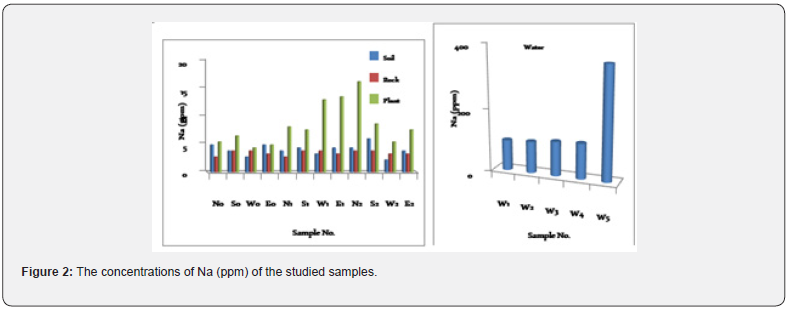
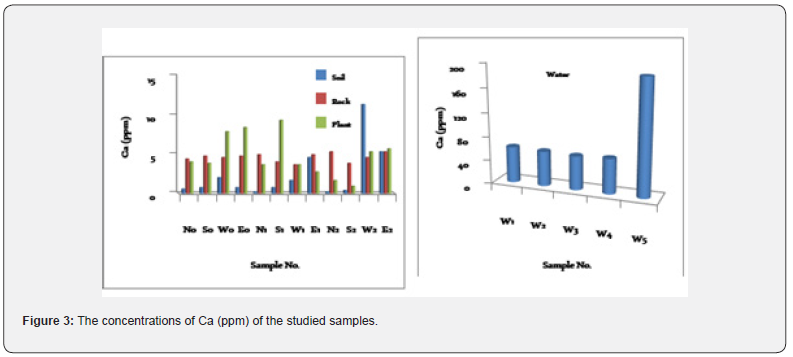
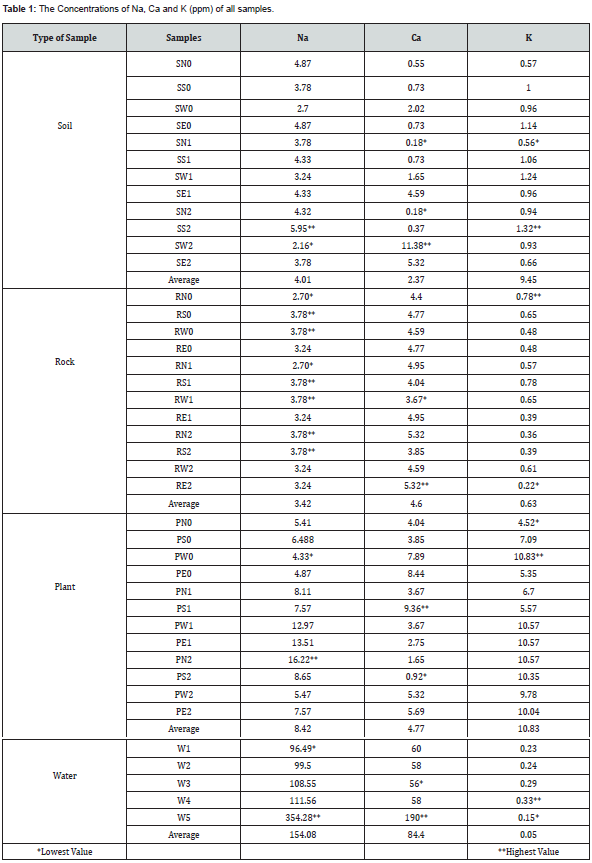
The obtained results of sodium (Na), calcium (Ca), and potassium (K) in the studied samples (soil, rock, plant and water) were shown in (Table 1). The results recorded that the concentrations of Na in soil samples were ranged between (2.16- 5.95 ppm), while the concentration of Ca were ranged between (0.18-11.38 ppm) and the concentrations of K were ranged between (0.56-1.32 ppm). On the other side concentrations of sodium in the rock samples were ranged between (2.7–3.78 ppm), while the concentrations of calcium were fluctuated in the range of (3.67-5.32 ppm), whereas the potassium concentrations were ranged between (0.22-0.78 ppm), as shown in (Table 1). Also, the results showed that the concentrations of sodium, calcium and potassium in plant samples were ranged as following: (4.33– 16.22 ppm), (0.92–9.35) ppm and (4.52–10.83 ppm), respectively, as shown in (Table 1). Meanwhile, the concentrations of the above elements ( sodium, calcium and potassium) in water samples were fluctuated in the ranges of (96.48- 354.28 ppm), (56-190 ppm) and (0.15-0.33 ppm) respectively, as shown in (Table 1). The variations of the contents of the studied elements are mainly attributed due to geological composition for the studied area which may be content ores as calcite or dolomite or/and others. In generally the levels are low comparing with permissible limit, The result recorded the highest concentrations of sodium (Na) and calcium (Ca) in water samples comparing to soil, rock, and plant samples, but the concentrations of potassium (K) in plant samples is higher than other samples (soil, rock and plant) [8] as shown in Figures 2-4.
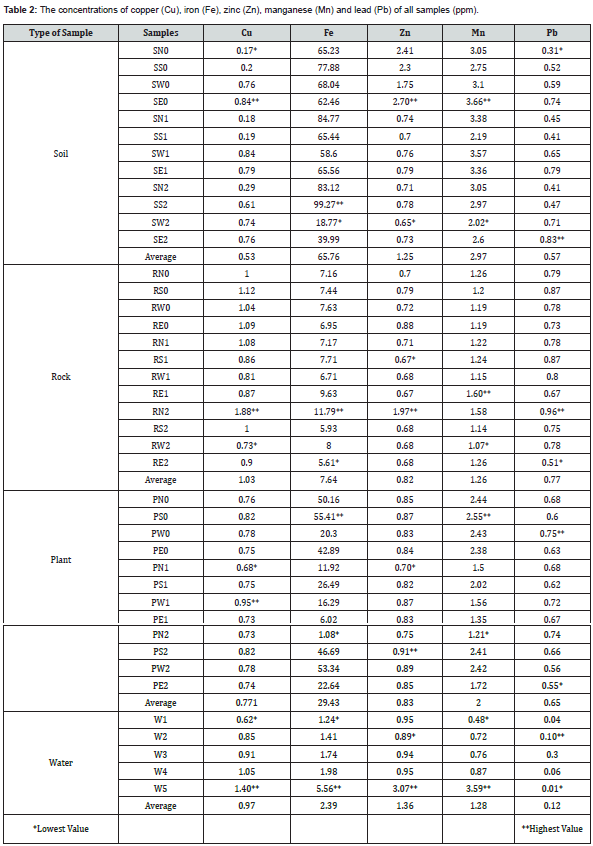
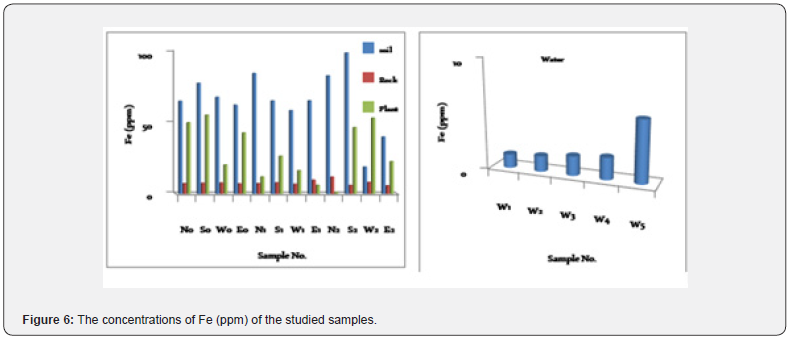
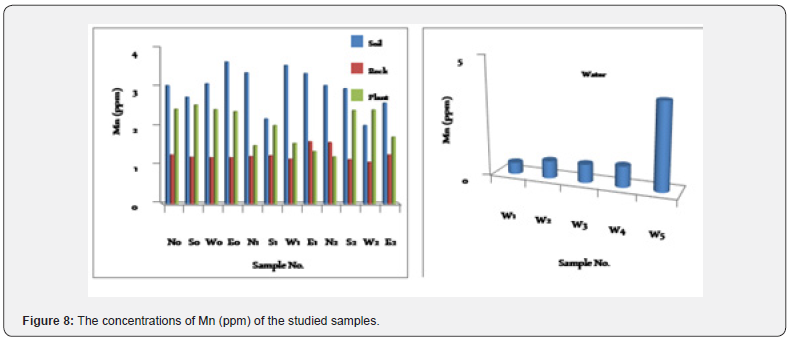
The results of heavy metals showed that the concentrations were fluctuated in the following ranges: (0.17- 0.84 ppm), (18.77- 99.27 ppm), ( 0.65- 2.7 ppm), (2.02- 3.66 ppm), and (0.31–0.83 ppm). For the metals of (copper, iron zinc, manganese and lead), respectively. The concentrations of the studied metals in rock samples were ranged as following : (0.73-1.88 ppm), (5.61-11.79 ppm), (0.67-1.97 ppm), (1.07-1.60 ppm), and (0.51-0.96 ppm) for (copper, iron, zinc, manganese and lead), respectively, as sowed in (Table 2). While the concentrations of (Cu, Fe, Zn, Mn and Pb) the plant samples were fluctuated as following : (0.68-0.95) ppm, (1.08-5.41 ppm), (0.70-0.91 ppm), (1.21-2.55 ppm) and (0.55- 0.75 ppm), respectively. As shown in (Table 2). On the other side, for water samples the concentrations of the studied heavy metals (Cu, Fe, Zn, Mn and Pb) were ranged as following: (0.62-1.4 ppm), (1.24-5.56 ppm), (0.89-3.07 ppm), (0.48-3.59 ppm) and (0.01- 0.10 ppm), respectively. As shown in (Table 2). And the results showed that the average concentrations of studied heavy metals are low comparing with the global composition reveals (Figures 5-7). Most heavy metals are toxic and their accumulation over time in bodies can cause several diseases. Prolonged exposure to heavy metals can lead to physical, neurological and muscular degenerative processes that may lead to Alzheimer’s disease and muscular dystrophy [9].
The average concentrations of copper and lead in rock samples are 1.36 ppm and 0.774 ppm higher than average concentrations of other samples composition (soil, plant and water), the highest average concentrations of iron and manganese are 65.761 ppm and 2.975 ppm for all studied samples in soil samples, and there is no indicating a natural case of metal pollution. While high concentrations of zinc presented 1.36 ppm in the water samples. The heavy metal concentrations of Cu, Fe, Zn, Mn and Pb, which consider to be a good indicators for no heavy metals be pollution caused by human activities, are characterized by lower concentrations than the WHO (World Health Organization) [10] have reported soil pollution by ultrabasic rocks, resulting in low concentrations of the previously mentioned elements (Cu, Fe, Zn, Mn and Pb) due to the weathering and dispersion of the parent materials, which these metals are predominant. The average concentrations of soil higher than composition values of Pb, Zn, and Cu in the studied soils can be ascribed to the ferromagnesian minerals of the rocks. In respect to the published mean metal values (Figure 8-9). The soils samples present is higher Fe values than all studied samples, but this is mainly attributed to the mineralization that occurs on the weathered surface of the serpentinites and peridotites, which are considered the parent rocks of the mineralization [11].
Conclusion
The aim of study evaluate the levels of heavy metal concentrations for environmental samples in Gandula region- Libya. the contents of the studied major elements in the all samples recorded the high value of Na and Ca in water samples, and high average concentrations of potassium was recorded in the plant samples. On the other side the high concentrations of Cu was recorded in rock samples. The results also recorded that the high concentrations of iron (Fe) and manganese (Mn) were recorded in soil samples, where the values of Zn was estimated in water samples, and the high concentrations of Pb were in plant samples. This study would help to reduce the risk to human health that originates from highway pollution. But, further extensive sampling is necessary to include similar study areas, and further research concerning contamination of environmental.




References
- Dawson EJ, Macklin MG (1998) Speciation of heavy metals in floodplain and flood sediments: a reconnaissance survey of the Aire Valley, Wet Yorlshire, Great Britain. Environ Geochem Health 20: 67-76.
- Namminga HN, Wilhm J (1976) Effects of high discharge and oil refinery cleanup operation on heavy metals in water and sediments in skeleton Creek. Proceedings of the Oklahoma Academy of Science 56: 133-138.
- Camusso M, Vigano L, Baitstrini R (1995) Bioaccumulation of trace metals in rainbow trout. Ecotox Environ Safe 31: 133-141.
- Bakidere S, Yaman M (2008) Determination of Lead, Cadmium and Copper in Road-Side Soil and Plants in Elazig Turkey. Environ Monit Assess 136: 401-410.
- Udo EJ, Ogunwale AJ, (1987) Laboratory Manual for the Analysis of the Soils, Plant and Water Samples. Department of Agronomy, University of Ibadan: Ibadan, Nigeria p: 70-76.
- Kakulu SE, Jacob JO (2006) Comparison of digestion methods for Trace metal Determination in moss samples. Proceeding of the 1st National Conference.
- García R, Báez AP (2012) Atomic Absorption Spectrometry (AAS), Atomic Absorption Spectroscopy.
- Pasławski P, Migaszewski ZM (2006) The Quality of Element Determinations in Plant. Polish J Environ Stud 15(2a): 154-164.
- Baldwin RD, Marshall WJ (1999) Heavy metal poisoning and its laboratory investigation. Ann Clin Biochem 36: 267-300.
- Skordas K, Kelepertsis A (2005) Soil contamination by toxic metals in the cultivated region of Agia, Thessaly, Greece. Identification of sources of contamination. Environmental Geology 48: 615-624.
- Vardaki C, Kelepertsis A (1999) Environmental impact of heavy metals (Fe, Ni, Cr, Co) in soils, waters and plants of Triada in Euboea from ultrabasic rocks and nickeliferous mineralization. Environ Geochem Health 21: 211-226.

























