




 ECOA Home



A Commentary on the Constructive Ecology Research Value of Subjective Eco-Biophilia Contexts
Vince Carter E*
California State University Bakersfield, 9001 Stockdale Hwy, Bakersfield, California, USA
Submission: August 18, 2023;Published: August 28, 2023
*Corresponding author: Vince Carter E, California State University Bakersfield, 9001 Stockdale Hwy, Bakersfield, California, USA. Email id: ecarter2@csub.edu
How to cite this article: Vince Carter E. A Commentary on the Constructive Ecology Research Value of Subjective Eco-Biophilia Contexts. Ecol Conserv Sci. 2023; 3(1): 555604 DOI:10.19080/ECOA.2023.03.555604
Abstract
This scholarly commentary introduces a constructive ecology research view, described as an eco-biophilia context – love of life. Drawing on emerging Eco phenomenology philosophy and methods, subjective experiential approaches are proposed as viable complements to conventional objective empirical analysis of ecology research subjects. After defining the eco-biophilia context and explaining its rationale using ECOA journal topics, guidelines for applying eco-biophilia principles are delineated using the proposed Philosophical, Historical, Indigenous, Life, and Earth Science (PHILES) model.
Keywords: Ecology Research; Eco-Biophilia; Eco phenomenology; Human; Subjective; Experiential
Abbreviations: PHILES: Philosophical Historical Indigenous Life and Earth Science model; NEP: New Ecological Paradigm; INS: Inclusion of Nature in Self; CNS: Connectedness to Nature Scale; NRS: Nature Relatedness Scale; LCN: Love and Care for Nature
Introduction
Science of Earth or Love of Life?
Academic commentary among ecological resources researchers should be welcomed, even if it is more of an artistic idea collage than an ecology sciences analysis. Two facts support open minded ecological resources scholars:
i. We all share the same planet earth and have valuable observations to contribute.
ii. No one has all of the answers.
It is a truism that ecological resources scholars are grounded in the earth. Yet, objective research can obscure the subjective truth of earth grounded in humans. Not by conclusive facts but confirmed feelings over time and consistent across person and place. That is the foundation of biophilia studies which undergirds humanity’s ecological raison d’être (Wilson, 1984). Since Aristotle’s antiquity adage “love of life,” human connectedness to ecological life in nature has been a verifiable fact and venerated feeling. Fromm (1964) coined “biophilia” to capture the earth grounding in humanity. Soon thereafter, the prominence of ecological biophilia as a global commitment was cemented by the first Earth Day on April 22nd, 1970, and The Club of Rome Report “Limits to Growth” (1972). By definition, biophilia is an emotional feeling that informs logical attitudes. Though, phenomenological methods are proving to be a perfect fit for experiential sensations like biophilia, with its contextual contours, multilayered meanings, and primordial rootedness. Still, at least five well regarded biophilia scales exist for empirical measurement.
a) New Ecological Paradigm (NEP) Scale – Stern [1], Dietz (1998), and Guagnano (1999)
b) Inclusion of Nature in Self (INS) Scale – Schultz [2,3]
c) Connectedness to Nature Scale (CNS) – Mayer and Frantz [4]
d) Nature Relatedness Scale (NRS) – Nisbet, Zelanski, and Murphy [5]
e) Love and Care for Nature (LCN) Scale – Perkins [6].
Basically, biophilia is a simple idea for the complex
connections between earth ecology and human love for life.The phrase eco-biophilia is used here to emphasize love for the earth’s holistic ecological living systems as well as the biological life forms it grows. The ubiquity of eco-biophilia encompasses every ecological resource research and professional field. But its intellectual utility for combining subjective human feeling with objective earth facts is commonly overlooked. Subjective emotion is a legitimate source of intelligence, just as rational research measures. Earth feelings typically motivate scholarly aims in ways that can improve the focus, framing, and formulation of research parameters. Why conserve and preserve what is not cared about? Why study what has no affinity. While earth scientists often study what may not be a proclivity (e.g., war, waste, disease, etc.), those uncared for means further the meaningful ends of sustaining esteemed ideals. Thus, without humanity’s biophilia there is a logical likelihood that ecological resources research would not be valued.
Biophilia as Inconvenient ECOA Research Truth?
Ultimately, eco-biophilia is an implied subjectively felt and sensed tacit motive – known without expressing, which academic ecologist are trained to repress, even when it is a constructive source of research focus, framing, formulation, analysis. The aim of this commentary is to urge the explicit embrace and encoding of eco-biophilia ideas among ecological resources researchers. The familiar ‘Tragedy of the Commons’ (William Forster Lloyd, 1833; Garrett Hardin, 2003) which frames the majority of ecology and sustainability research aims, captures the irony of eco-biophilia and subjectively valid feelings. Limited and scarce natural resources in comparison to the demands of humans and other species create a dilemma due to competing loves, not the absence of love, for earth’s bio-ecology. Outcomes of these shared natural resources pit individual self and short-term interest above collective long-term interest, and the slippery ethnical slope of ‘moral hazard’ occurs when equitable and reciprocal terms are not monitored maintained. Instead of Lloyd’s (1833) example of grazing versus farming on common fields, a random selection of ECOA article topics (without authors or locations) highlights the research value of making implicit subjectively felt competing ecobiophilia premises explicit. These are merely topic applications of eco-biophilia, reviews or critiques. They convey the prevalence of tacit eco-biophilia teleology in most Ecology research.
I. Ecology, Environment, and Human Being
II. Conservation of Prioritized Medicinal Plant Resources
III. Consequences of Water Management During a Drought
The first topic epitomizes human love for nature. Certainly, eco-biophilia would add valuable perspectives, research questions, and analysis factors. Yet, the cogent explication of geological processes producing atmospheric greenhouse gasses are primarily related to the ecological balance required for human physical survival. The eco-biophilia emotional context of human earth interdependence is completely omitted, despite its constructive topic angles. Underlying “Tragedy of the Commons” factors are evident in the competing earth love interests of producers of chemical atmosphere gasses from earth matter extraction and people seeking a sustainable ecological balance, among other stakeholders. Life is an felt phenomenon and experiential chemistry, as well as a physiology survival threshold for chemical balance. Greenhouse gas kills eco-biophilia feelings just as measurably as eco-biology facts. Would humanity value physical life on earth without a passion for living on the planet? What motivates saving the planet for humanity? The second topic of medicinal healing is endemic to human love of life as well. As noted, both life and love of life are casualties of ecological resource maladies. So, earth conservation of prioritized healing plant resources is merited by both human biological life and the eco-biophilia feelings that impel humans to live. With a balanced yin/yang framing of research questions, parallel measurement and scaling can be applied to plant conservation facts and human feelings about plant conservation, given their medicinal properties. Matrixes can be constructed for medicinal plant priority ratings and medicinal plant affinity ratings among tribal growers/herbalists. The extensive medical plant taxonomy could be framed using classical “Tragedy of the Commons” angles for the botanical species tendency for indigenous tradition tribute, land development depletion, and entrepreneurial market viability. Still, the role of these competing earth love interests are deftly described, as well as other human experience feelings involved in the tribe’s crucial ecological and human transformation.
The third case essentially revolves around a central water resource for human and ecological life. Again, the “Tragedy of the Commons” eco-biophilia contest is fundamental to research focus, framing and formulation. Here, intense subjective feelings for nature create a zero-sum river equation, matching multiple species life forms. In addition, the severe drought conditions affect the earth’s basic geological elements of land/soil, water/lake, sun/heat, and air/atmospheric precipitation. Notwithstanding human presence in the descriptions and images of water benefits, as well as in water conservation plan practices, the tangible effects of emotional water tensions on the vicious cycle depleting limited river resources is excluded. Feelings produce fear in all biological species, which accelerates the frequency and amount of water use. Furthermore, “moral hazard” freeloading is motivated by scare water supply and unrestricted rural river routes. That in turn exacerbates primal self-interest short-term ambitions. Again, these feelings are measurable as human experience and observable species states (e.g., amicable, aggressive, etc.). First, the factual myopia must embrace a feelings lens.
Philes Model of Eco-Biophilia ECOA Research Context
So, this commentary is anchored in eco-biophilia. Since the earth is grounded in humanity, the advantages accrued from biophilia were implanted at the beginning of human kind. As such, this commentary surveys and takes samples from the primordial origins of the human species. Unfortunately, aside from DNA samples at restrictive research labs, human primordial origins cannot be examined. Therefore, the methods of philosophical inquiry, historical tracing, and geological surveys can establish the felt ecological connections at the bedrock of scientific human pursuits. In the process, a broader context may emerge for humanistic focus, holistic framing, experiential formulation, phenomenological analysis, and subjective application of ecological resources research. The remaining discussion of ecobiophilia guidance is aligned with the proposed context model acronym – PHILES:
a) Philosophical – Eco phenomenology (Merleau Ponty [7,8,9,10])
b) Historical – Theory of the Past (Mead, 1929, 1932) & Eco-Biophilia Research Roots
c) Indigenous Ecological Knowledge (IEK)
d) Life – Species Biodiversity (fauna & flora)
e) Earth – Ecology, Geology, Geography, Temporality, Environmental Services
f) Sciences – Resources Studied & Results Substantiated.
Philosophy – Primordial Roots and Reasons (“Why”)
Eco phenomenology is the philosophical vehicle for timetravel to primordial human origins. It has the organic scope to discover primordial embodied sensing/feeling, as well as the intellectual acuity to decipher valid experiential evidence. As an ecological philosophy, Eco phenomenology equip researchers to contemplate the genesis of human earth consciousness to examine its roots and reasons. Phenomenology is a philosophical method introduced for inquiring about non-factual phenomena using a valid subjective process. It is an alternative to naturalism, empiricism, and logical causality which determine conventional scientific inquiry – including Ecology, Life Science, and Earth Science. Advanced by Hegel [11] to reason about the spirit realm, it was furthered by Husserl’s [12] critiques of naturalism, Heidegger’s [13] emphasis on ontological “being in the world” experiences, and Sartre’s [14] embrace of existentialism as a reality unfathomed by naturalism. Currently, phenomenological methods are widely used across disciplines and have accrued scholarly credibility. So, phenomenology is well suited for ecological elements like embodied human felt experiences. “The intersection of ecological thinking with phenomenology … begets a new cross-disciplinary inquiry: eco-phenomenology. Ecophenomenology is based on a double claim: first, that an adequate account of our ecological situation requires methods and insights of phenomenology; and second, that phenomenology, led by its own momentum, becomes a philosophical ecology, that is, a study of the interrelationship between organism and world in its metaphysical and axiological dimensions.” Brown & Toadvine [15] “The alternative experience and account of nature to which Eco phenomenology give us access is potentially revolutionary. The rediscovery of a natural world that is inherently and primordially meaningful and worthy of respect might help us to overcome our cultural estrangement from the world around us.” Brown & Toadvine [15].
Despite its many philosophical antecedents, there is broad consensus that Merleau Ponty [7-10] is the father of Eco phenomenology. His holistically systematic conceptualization, distinctive nomenclature, and symbiosis of human body/flesh with nature/earth established a tenable foundation. The ample quotations below sow the seeds of Merleau-Ponty’s seminal Eco phenomenology accounts. “For Descartes, the Earth is only one body among others, but for originary perception, the Earth is undefinable in terms of the body: it is the soil of our experience. … it is not an object among other objects, but the living stock from which objects are engendered. … In a general way, it is a type of being that contains all the ulterior possibilities and serves as a cradle for them. … The Earth is the root of our history. Just as Noah’s ark carried all that could remain living and possible, so too can the Earth be considered as carrier of all the possible” Merleau- Ponty [9] “There are natural plans that are living beings. The sign of it is that identical exterior conditions bring along different possibilities of behavior. … In other words, there is a beginning of culture. The architecture of symbols that the animal brings from its side thus, defines within Nature a species of preculture.” Merleau- Ponty [9] “The nature in us must have some relation to Nature outside of us; moreover, Nature outside of us must be unveiled to us by the Nature that we are.” Merleau-Ponty [9] The passage below is from; Wikipedia.org Maurice Merleau-Ponty https:// en.wikipedia.org/wiki/Maurice_Merleau-Ponty#cite_note-35 (Accessed 5/15/2022) “David Abram explains Merleau-Ponty’s concept of ‘flesh’ (chair) as ‘the mysterious tissue or matrix that underlies and gives rise to both the perceiver and the perceived as interdependent aspects of its spontaneous activity’, and he identifies this elemental matrix with the interdependent web of earthly life Abram [16]. This concept unites subject and object dialectically as determinations within a more primordial reality, which Merleau-Ponty calls ‘the flesh’ and which Abram [16] refers to variously as ‘the animate earth’, ‘the breathing biosphere’ or ‘the more-than-human natural world’.
Yet this is not nature, or the biosphere conceived as a complex set of objects and objective processes, but rather ‘the biosphere as it is experienced and lived from within by the intelligent body — by the attentive human animal who is entirely a part of the world that he or she experiences. … Merleau-Ponty himself refers to ‘that primordial being which is not yet the subject-being nor the object-being and which in every respect baffle reflection. From this primordial being to us, there is no derivation, nor any break...’ Merleau-Ponty [10] (He) recognized a deep affinity between his notion of a primordial ‘flesh’ and a radically transformed understanding of ‘nature’ … ‘Do a psychoanalysis of Nature: it is the flesh, the mother’ Merleau-Ponty [8] … ‘Nature as the other side of humanity -- as flesh, nowise as ‘matter’ Merleau-Ponty [8] ” Unquestionably, Eco phenomenology provides the philosophical channel for accessing primordial human/earth connectedness, through bodily sensations and feelings comprising valid experiences.
History – Human Traditions, Ecological Tapestries, and Earth Transformations (‘How’ & ‘When’)
History avails a chronology of time for arranging and analyzing ecological resource studies. Nearly every ecological study incorporates temporal patterns and processes. So, the question here is not one of historical awareness, but rather historical attunement -- a consciousness of the past. The past is a continuum that weaves human, ecological, and planetary evolution as a story narrative. Typically, ecological resources research charts chronological time to investigate the progression of natural phenomena, human impacts, and causal relationships. Those logical historical approaches are necessary but not sufficient for an eco-biophilia approach. Eco phenomenology has established the connectedness of human body sensing as primordial emotional bonds with nature. Accordingly, eco-biophilia history is a contextual story for the objective chronology, with a narrative weaving three continua from the past:
a) Passage of human cultural traditions in societies, civilizations, eras (‘home-application’)
b) Progression of ecological tapestries in nature, geographically, terrestrially, aquatically, microbially, biologically, chemically, etc. (‘habitat-platform’)
c) Periods of earth’s planetary transformation as an astronomical body with atmosphere, geological lithosphere, hydrology, topography, climate, etc. (‘hull-hardware’)
The parentheses phrases highlight the roles and relationships of continuum strands within the woven narrative. Human traditions are the ‘home’ where eco-biophilia feelings are formed and Eco phenomenology symbiosis is sensed. In other words, the context for meaning, relevance, and agency – like the functionality of digital ‘applications.’ Ecological tapestries are the surrounding natural ‘habitat’ that nurtures and engages with humans – like the networked facilitation provided by digital ‘platforms.’ In an analogous manner, earth transformations are the ‘hull’ of a planetary spaceship that transports the ecological ‘habitat’ and human ‘home.’ This undergirding structural role is like digital ‘hardware.’ These three continua also help to highlight the Anthropocene era crises. Mead (1929, 1932) wrestled with the meaning of time. Instead of a historical chronology or causal scientific datum, he conceived of a continuity framed by the human mind. He believed that the past mirrors the human primal memory’s image representations as a sequence of consciousness – not chronology. History’s importance is not the mere passage of time aligning chronological events. Rather it is the causal structure of continuity that enables history to reveal the characteristics of the past which condition the present and thereby prefigure the future. Within this structure of continuity is bi-directionality, spatial-temporal distinctiveness, sensorial uniformity in depiction, dependent conditions, and content elements that determine outcomes.
“The distinction between the present and the past evidently involves more than passage… In this continuity of experience there is distinction of happening. There is direction. There is dependence or conditioning… Not only does succession take place, but there is a succession of contents… There is always a character which connects different phases of the passage, and the earlier stage of the happening is the condition of the later stage… The connection involves both identity and difference, and it involves that in the identity which makes the condition for that which follows. (Mead 1929, pp. 235 – 236) This richer historical notion of the past as human conscious continuity is used by Carter [17] to ascribe greater ecological authenticity to mental memory of the historical past. Accordingly, by weaving historical narrative researchers are able to synchronizes human passage, ecological progression, and planetary periods. These integrated continua permit the subjective human consciousness of temporal patterns to be explored for expository research merits. The objective history of ecological entities being studied exists within a tapestry of growth. The ecological tapestry, in turn, evolves in relation to planetary structures and spectra that enabled growth in nature. Likewise, human cultures emerge in relation to ecological affordances and affinities. Ironically, since the earliest known artifacts and accounts, human cultural traditions provide a temporal memory of these metamorphosis in people, nature, and the earth. Albeit tainted with mysticism, myth, motives, and myopia (from primitive past to presumptive present), historical human consciousness is pertinent. The historically woven narrative can draw on human continuity consciousness from any generation or global geographic location. The emphasis is on connecting the ecological study variables, earth’s planetary vectors, and the particular human cultural values germane to the study. Ultimately, Ecology research is an ontological apparatus towards teleological real world application for improving humanity and earth. Since, human cultural consciousness filters will determine how objective study outcomes are interpreted and applied. It makes sense to incorporate those historical memories and mental continuity meanings at the onset.
Indigenous – Native People Practices (‘Who’)
When humanity is viewed through the lens of eco-biophilia its sights are aimed at the original native peoples in every global terrain. As with Eco phenomenology and history, Ecology research should begin by focusing on origins and sources of knowledge genesis. In terms of human knowledge of ecology, indigenous peoples possess authentic ingenuity for every ecological resource study. To that end, a long lineage of deep learning should be pursued. For 30 years, the United Nations (UN) has led other global institutions (World Bank, World Health Organization, Global Alliance on Health and Pollution, International Union for Conservation of Nature) as well as national government and non-government organizations towards recognizing Indigenous People as an intellectual resource and relevant stakeholder group. The most recent State of the World’s Indigenous Peoples (United Nations 2021) and prior inclusion of Indigenous People in the UN’s 2030 Global Sustainability Goals establishes the new normal for ecological research as native knowledge first. “While Indigenous Peoples own, occupy, or use a quarter of the world’s surface area. Indigenous Peoples conserve 80 percent of the world´s remaining biodiversity and recent studies reveal that forestlands under collective IP and local community stewardship hold at least one quarter of all tropical and subtropical forest above-ground carbon They hold vital ancestral knowledge and expertise on how to adapt, mitigate, and reduce climate and disaster risks.” (World Bank, 4/6/2023) Contemporary ecology scholars have reoriented their humanity compass towards Indigenous People Pierotti [18]; Grim [19], for research intelligence, interrelationships, and identities. The phrase “Indigenous Ecological Knowledge” (IEK) is prevalent in the literature Kanu [20]; Posey [21]; McCarter [22]; Woodley [23], as are native cultural concepts related to Mother Earth deities Fellows [24,25]; Jelenski [26]; Desai [27], as well as “kin centric ecology” and “indigenous philosophical of ecology” insights for human-nature relationships and situating the human in earth Rose [28]; Salmon [29]. These orientations toward humanity’s origins deepen the context of eco-biophilia for ecological resources research of any topic, for any time frame, and on any population.
Life Science – Subjective Experiential Meaning (‘What’)
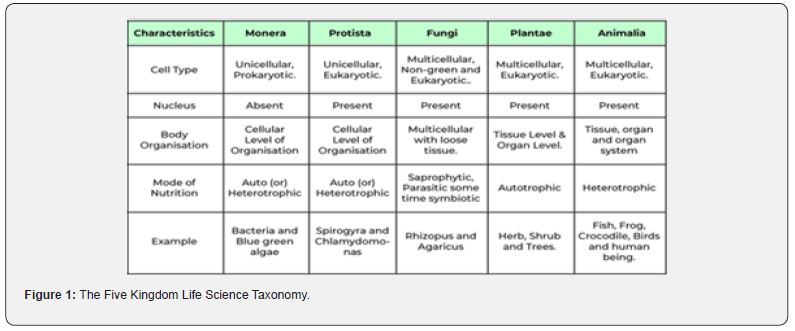
Life Science comprise the entities and events for ecology research. They are specified in standardized taxonomies for the combined fields of anthropology, ecology, entomology, botany, zoology, microbiology, physiology, biotechnology, evolutionary biology, genetics, human anatomy, marine biology, molecular and cell biology, neuroscience, paleontology, plant biology, and biochemistry. This standard rubric is shown below in (Figure 1). However, the eco-biophilia context posited here would complement objective empirical Life Science descriptors and findings with subjective emotional lived experience dependencies and feelings. This experiential aspect aligns Social Ecology living with Scientific Ecology life. Examples include:
i. holistic homeostasis for humans, bio-species, and microbes
ii. emotional value and biochemical valence scales
iii. subjective personification and anthropomorphic renderings of biochemical nomenclature.
Earth Science – Parallel Personalized Projections (‘What’)
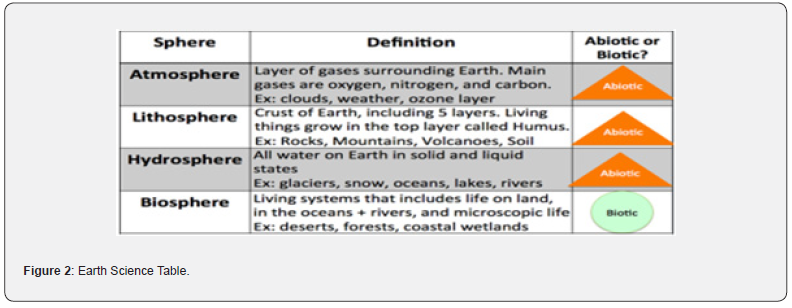
Earth science has been described above as the hardware structural forms and circuits that facilitate ecological life science platforms, and human lived experience applications. Although it is more remote in terms of lifespan, composition, and dynamism than either life science ecology or human socio-cultural experiences, the earth is a living planet with organic structures, substances, and flows. A body unto itself, analogous to the human body and holistic ecological anatomy. It has an amazing self-regulating and restoration system. Still, as readily observed for ecological climate change destruction, the hidden harm of Anthropocene era ills are eroding the earth as well. As a point of reference, Earth Science is described as follows, and shown in (Figure 2) “Earth science or geoscience includes all fields of natural science related to the planet Earth. This is a branch of science dealing with the physical, chemical, and biological complex constitutions and synergistic linkages of Earth’s four spheres: the biosphere, hydrosphere, atmosphere, and geosphere (or lithosphere). Earth science can be considered to be a branch of planetary science, but with a much older history.” Much like the relational eco-biophilia context for Life Science, a holistic and immersive eco-biophilia context for Earth Science is important for ecology researchers. Because the four spheres and their operant dynamics are more abstract and less familiar for many people – including ecology scholars, vivid meaningful mental metaphors are less consciously embodied as felt experiences, even though they dwell within primordial human memory. Consequently, ecology research approaches should be explored that make the Earth Science spheres more relevant to human experiences using holistic framing with human-centric circles of influence layers, human-contact webs of connection impact, and hierarchical human-rooted trees. Again, these are not objectively constructed diagrams, but subjectively felt eco-biophilia dialogues and dialectics. Similarly, immersive arrangements of study elements that create intimate familiarity through mental metaphors will infuse eco-biophilia sensibilities and feelings. The prevalence of mental metaphors in the actual Eco phenomenology embodiment of primordial human body in mind, as well as the fidelity of mental metaphors to fertilize present day dormant human minds, is addressed by Lakoff & Johnson’s [30] book, “Philosophy in the Flesh: The Embodied Mind and its Challenge to Western Thought.”
Conclusion – Growing Empirical Ecology Science into a Valid Experiential Art
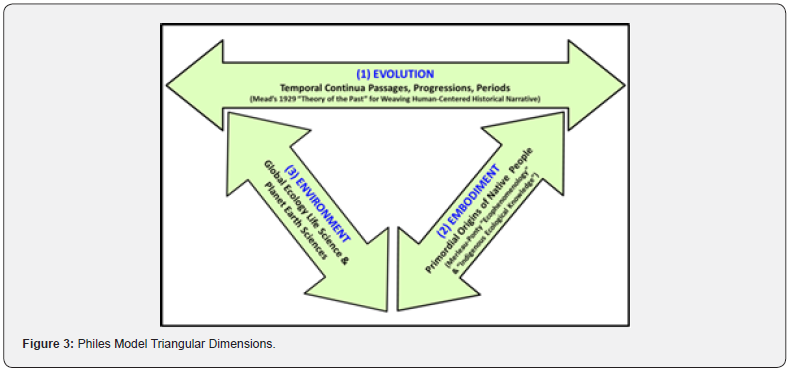
The ancient Chinese yin-yang philosophy captures the creative principle for human, ecological, and planet life. “Despite the differences in the interpretation, application, and appropriation of yinyang, three basic themes underlie nearly all deployments of the concept in Chinese philosophy: (1) yinyang as the coherent fabric of nature and mind, exhibited in all existence, (2) yinyang as jiao (interaction) between the waxing and waning of the cosmic and human realms, and (3) yinyang as a process of harmonization ensuring a constant, dynamic balance of all things.” (Internet Encyclopedia of Philosophy, Accessed 8/15/23) In the name of modern scientific progress, Cartesian Dualism “cogito” (1637) lost the body’s emotional intelligence contained in Hume’s Sentimentalism [31]. Logical positivism’s objective empirical proof of causality became ignorant of the subjectively embodied ecological wisdom guiding the mind’s intuition [32,33]. Worst of all, the creative genius of artistic representation became regarded as an impure pox on the pristine parsimony of numerical equations and scientific notation. Scientific progress has advanced its yang to improve humanity through ecology research. Along the way ecological science lost its yin and now yearns for the harmony of earth’s holistic primordial truth. The PHILES model is developed for this commentary to help open the primordial channels for eco-biophilia sensibility to be awakened in ecology research [34-39]. The background of eco-biophilia as an impetus for ecological research passion and purpose should be embraced by ecology scholars precisely because it asserts valid feelings with measurable merit. Science is not a sifting screen for weeding out experiential embodiment, bodily sensing, and human feeling. Rather, the complexity and conviviality of ecological phenomena is better served by wedding life science acuity with living sense accord. The PHILES model dimensions can be represented as a triangular balance, akin to the yin-yang principles. As shown in (Figure 3), evolution is the determining factor for the combined dimensions’ direction of progress and degrees of parity [40,41]. If 21st century humans neglect Indigenous Peoples’ primordial knowledge, the global ecology and planet earth will deteriorate and not support human survival. A similar evolution scenario can be envisioned for virtuous cycle direction and degrees. The two pillars of humanity and earth are positioned at opposite poles on the temporal continuum. Earth is anchored in the past with an astrological and geological lifespan beyond human comprehension. Humanity is affixed to the future with an innovative drive for discovery. However, the balance between humanity and earth is maintained by Eco phenomenology embodied biophilia and the earth’s ecological symbiosis with primordial human nature [42- 44]. Thus, as ecology scholars continue to be grounded in the earth, they should never forget that the earth is truly grounded in them.
References
- Stern PC, Dietz T, Guagnano GA (1995) The new ecological paradigm in social-psychological context. Environment and Behavior 27(6): 723-743.
- Schultz PW (2001) The structure of environmental concern: Concern for self, other people, and the biosphere. Journal of Environmental Psychology 21(4): 327-339.
- Schultz PW (2002) Inclusion with nature: The psychology of human-nature relations. In Schmuck P, Schultz WP, Psychology of Sustainable Development. Springer, Boston, MA (USA) p: 61-78.
- Mayer FS, Frantz CM (2004) The connectedness to nature scale: A measure of individuals’ feeling in community with nature. Journal of Environmental Psychology 24(4): 503-515.
- Nisbet EK, Zelenski JM, Murphy SA (2009) The nature relatedness scale: Linking individuals' connection with nature to environmental concern and behavior. Environment and Behavior 41(5): 715-740.
- Perkins HE (2010) Measuring love and care for nature. Journal of Environmental Psychology 30(4): 455-463.
- Merleau-Ponty M (1962) Phenomenology of Perception. Translated by Smith C. Humanities Press, New York (USA) and translated revised edition by Forrest Williams, Routledge & Kegan Paul, London (USA).
- Merleau-Ponty M (1968) The Visible and the Invisible, Followed by Working Notes. Translated by Alphonso Lingis A. Northwestern University Press, Evanston, IL (USA).
- Merleau-Ponty M (2003) Nature: Course Notes from the College de France. Northwestern University Press, Evanston, IL (USA).
- Merleau-Ponty, M (1970) The Concept of Nature, I, Themes from the Lectures at the Collège de France 1952-1960. Northwestern University Press, Evanston, IL (USA).
- Hegel JWF (1977) Phenomenology of Spirit, translated by Miller, AV. Oxford University Press, Oxford (UK).
- Husserl E (1970) The Crisis of European Sciences and Transcendental Phenomenology: An Introduction to Phenomenological Philosophy, translated by Carr D. Northwestern University Press, Evanston, IL (USA).
- Heidegger M (1962) Being and Time, translated by Macquarrie J and Robinson, E. Blackwell, Oxford (UK).
- Sartre JP (1956) Being and Nothingness, translated by Barnes HE. Routledge, London (UK).
- Brown CS, Toadvine T (2012) Eco-phenomenology: Back to the Earth Itself. State University of New York Press, Albany, NY (USA).
- Abram D (1996) The Spell of the Sensuous: Perception and Language in a More-than Human World. Pantheon Books, New York (USA).
- Carter EV (2019) Echo-sustainability: Digitally linking history to recall authentic green marketing lessons. Proceedings of 2019 Marketing Management Association Fall Educators’ Conference.
- Pierotti R (2010) Indigenous knowledge, ecology, and evolutionary biology. Routledge, New York (USA).
- Grim JA (2001) Indigenous Traditions and Ecology. Harvard University Press, Cambridge, MA (USA).
- Kanu IA (2022) African Indigenous Ecological Knowledge Systems: Religion, Philosophy and the Environment. Author House, Bloomington, IN (USA).
- Posey DA (2019) Indigenous ecological knowledge and development of the Amazon. The dilemma of Amazonian development. Routledge, London (USA) pp: 225-257.
- McCarter J, Gavin MC, Baereleo S, Love M (2014) The challenges of maintaining indigenous ecological knowledge. Ecology and Society 19(3): 1-14.
- Woodley E (1991) Indigenous ecological knowledge systems and development. Agriculture and Human Values 8: 173-178.
- Fellows A (2022) Gaia psyche and deep ecology. Journal of Analytical Psychology 67(5): 1232-1256.
- Fellows A (2019) Gaia Psyche and Deep Ecology: Navigating Climate Change in the Anthropocene. Routledge, London (UK).
- Jelinski DE (2010) On the notions of mother nature and the balance of nature and their implications for conservation. In Bates DG, Tucker J, eds. Human Ecology: Contemporary Research and Practice, Springer, New York (USA) p. 37-50.
- Desai FP (2009) Ecological ethics in Vedic metaphysics an effectual method to indoctrinate environmental awareness. Journal of Environmental Research and Development 4(2): 636-642.
- Rose D (2005) An indigenous philosophical ecology: Situating the human. The Australian Journal of Anthropology 16(3): 294-305.
- Salmon E (2000) Kin centric ecology: Indigenous perceptions of the human–nature relationship. Ecological Applications 10(5): 1327-1332.
- Lakoff G, Johnson M (1999) Philosophy in the flesh: The embodied mind and its challenge to Western thought. Basic Books, New York (USA).
- Hume D (1777) An Enquiry Concerning the Principles of Morals. A. Millar, London (UK).
- Abram D (1988) Merleau-Ponty and the voice of the earth. Environmental Ethics 10(2): 101-120.
- Blaser MJ (2006) Who are we? Indigenous microbes and the ecology of human diseases. EMBO reports 7(10): 956-960.
- Descartes R (1637) Discourse on the Method of Rightly Conducting Reason and Searching for Truth in the Sciences. Leiden (NL).
- Dizon’s Diggs, http://dizonsdiggs.weebly.com/topic-1-earths-spheres-atmosphere-and-water-cycle.html.
- Internet Encyclopedia of Philosophy, Yinyang.
- Meadows DH, Meadows DL, Randers J, Behrens WW (1972) The Limits to Growth: A Report for The Club of Rome’s Project on the Predicament of Mankind. Universe Books, New York (USA).
- Toadvine T (2009) Merleau-Ponty’s Philosophy of Nature. Northwestern University Press, Evanston, IL (USA).
- Toadvine T (2014) The elemental past. Research in Phenomenology 44: 262-279.
- United Nations (2021) State of the World’s Indigenous Peoples, Volume V, Rights to Lands, Territories and Resources. United Nations Department of Economic and Social Affairs, New York (USA) p: 10-11.
- Varela FJ, Thompson E, Rosch E (1991) The Embodied Mind: Cognitive Science and Human Experience. MIT Press, Cambridge, MA (USA).
- org, Earth Science.
- org Maurice Merleau-Ponty.
- Wood D (2001) What is Eco phenomenology? Research in phenomenology 31(1): 78-95.

























