




 CTOIJ Home



Abstract
Pleomorphic adenoma represents the most prevalent benign salivary gland neoplasm. The tumor most commonly involves the superficial lobe of the parotid gland, accounting for 84% of cases. Although technically benign, pleomorphic adenoma carries a strong propensity for local recurrence if inadequately or incompletely resected and harbours a small but meaningful risk of malignant transformation. The most reported risk is 1% per year for developing carcinoma ex pleomorphic adenoma, and this rate of malignant transformation increases significantly with advancing patient age. We report here a rare case of a benign parotid gland pleomorphic adenoma that recurred as a malignant tumor following an inappropriate initial surgery. The resulting malignancy responded only partially to standard chemoradiation, which ultimately had to be discontinued due to severe treatment-related morbidity. Following the failure of conventional options, the patient was successfully treated using an evidence-based alternative therapy.
Keywords: Pleomorphic Adenoma; Recurrence; Conventional Therapy; Alternative Therapy; Siddha Medical System
Abbreviations: PET-CT: Positron Emission Tomography and Computed Tomography; SCC: Squamous Cell Carcinoma; MRN: Modified Radical Neck Dissection; ALT: Anterolateral Thigh; PMMC: Pectoralis Major Myocutaneous; MRI: Magnetic Resonance Imaging; CXPA: Carcinoma ex Pleomorphic Adenoma; HNSCC: Head and Neck Squamous Cell Carcinoma; IC: Induction Chemotherapy; MEC: Mucoepidermoid Carcinoma; AJCC: American Joint Committee on Cancer
Introduction
Pleomorphic adenoma represents the most prevalent benign salivary gland neoplasm. It accounts for 45% to 75% of all salivary gland tumors and 80% to 90% of benign salivary masses [1]. The tumor most commonly involves the superficial lobe of the parotid gland, accounting for 84% of cases; the remainder occur in the submandibular gland (8%) and minor salivary glands (6.5%) [2]. Contemporary management approaches emphasize complete surgical excision while minimizing functional morbidity and recurrence risk [1]. Although technically benign, pleomorphic adenoma carries a strong propensity for local recurrence if inadequately or incompletely resected. Furthermore, these tumors harbour a small but meaningful risk of malignant transformation. The most reported risk is 1% per year for developing carcinoma ex pleomorphic adenoma, and this rate of malignant transformation increases significantly with advancing patient age [2,3].
This underscores the critical need for accurate initial diagnosis and strict evidence-based management [1]. Clinically, pleomorphic adenoma typically presents as a slowly enlarging, painless mass with an indolent growth rate averaging 1 to 2 cm over several years. This slow growth pattern often allows patients to accommodate the mass, delaying medical evaluation until the tumor reaches a significant size. Because of the benign nature of the primary tumor, pain, facial nerve dysfunction, or systemic symptoms are absent in most cases [1]. We report here a rare case of a benign parotid gland pleomorphic adenoma that recurred as a malignant tumor following an inappropriate initial surgery. The resulting malignancy responded only partially to standard chemoradiation, which ultimately had to be discontinued due to severe treatment-related morbidity. Following the failure of conventional options, the patient was successfully treated using an evidence-based alternative therapy.
Case Description
Initial Presentation and Recurrence (1992-2004)
A 33-year-old male initially presented in 1992 with a right-sided preauricular mass that underwent surgical excision at an external center. In 2004, twelve years postoperatively, the patient developed a multifocal recurrence at the primary surgical site, characterized by three discrete, nodular lesions. Rather than pursuing conventional surgical intervention, the patient elected for non-conventional, indigenous Siddha medicine. Following this alternative therapy, two of the nodules were reportedly resolved, while a single residual nodule remained untreated and asymptomatic.
Disease Progression and Diagnostic Evaluation (2021-2025)
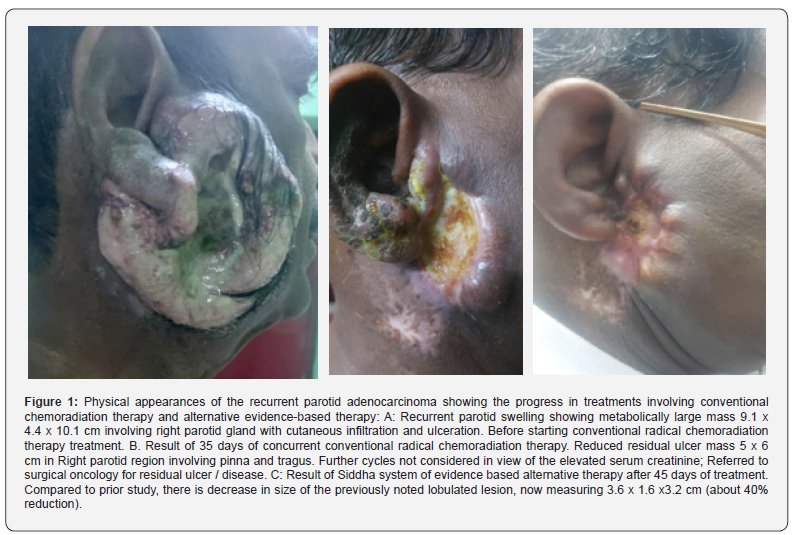
In 2021, approximately 17 years later, the residual mass exhibited renewed growth. The patient sought further alternative interventions for two years (2022-2024); however, the therapy was ineffective, and the mass underwent significant local expansion (Figure 1A). The patient transitioned to conventional oncological care in late 2024. In November 2025, a combined Positron Emission Tomography and Computed Tomography (PET-CT) scan was performed to evaluate the extent of the disease. On December 2, 2025, an incision biopsy of the right parotid mass was performed. Histopathological evaluation revealed skin involvement with underlying moderately differentiated squamous cell carcinoma (SCC).
First-Line Oncological Management (2025-2026)
Definitive management commenced in the third week of December 2025. The patient was prescribed a 35-day course of radical radiation therapy with concurrent chemotherapy. The systemic regimen consisted of weekly cisplatin; however, the patient received only two cycles (administered on December 17, 2025, and December 24, 2025). Further cycles of cisplatin were permanently discontinued due to the development of acute kidney injury, evidenced by elevated serum creatinine levels. By the second week of February 2026, the patient demonstrated a partial clinical response, characterized by tumor mass reduction and visible wound healing (Figure 1B).
Surgical Consultation and Multidisciplinary Assessment (March 2026)
Following the completion of chemoradiotherapy, further tumor regression plateaued. On March 16, 2026, the patient was referred to surgical oncology for evaluation of the residual disease. Clinical examination revealed a 5 × 6 cm residual ulcerated mass in the right parotid region, directly involving the pinna and the tragus. Notably, there was no clinical evidence of cervical lymphadenopathy, mandibular invasion, or facial nerve paralysis. A concurrent Magnetic Resonance Imaging (MRI) scan of the neck identified a 4 × 3.7 cm lesion involving the superficial lobe of the right parotid gland, overlying skin, and the pre- and infra-auricular regions.
The multidisciplinary tumor board proposed an aggressive salvage surgical plan consisting of:
• A right extended radical parotidectomy
• En bloc resection of the involved skin and external ear structures
• Optional modified radical neck dissection (MRND)
• Microvascular reconstruction via an anterolateral thigh (ALT) free flap or a pectoralis major myocutaneous (PMMC) flap
Patient Disposition and Alternative Intervention
The patient was thoroughly counselled regarding the surgical procedure, financial costs, potential complications-including permanent facial nerve paralysis-recurrence risks, morbidity, mortality, prolonged intensive care and hospital stay, and available alternatives. Due to the high risk of treatment-related morbidity and permanent complications, the patient declined surgical intervention. The patient subsequently elected to pursue a trial of alternative therapy and returned to Siddha medical management under the care of the first author's clinical team on March 26, 2026.
Integrative Alternative Therapeutic Protocol:
Following surgical refusal, the clinical team led by the first author initiated an evidence-based integrative treatment protocol on March 26, 2026. The primary therapeutic backbone consisted of formulations from the Siddha medical system-an indigenous system of medicine officially recognized and regulated by the Ministry of AYUSH, Government of India [4]. The prescribed primary herbal-mineral formulations included Parangipattai Rasayanam, Kandhaga Rasayanam, Maha Vallathi Legiyam, and Iraasagandhi Mezhugu [5,6]. To complement the traditional regimen, a holistic adjuvant framework was implemented, incorporating repurposed pharmaceuticals, nutraceuticals, and dietary interventions: Repurposed Oncological Agents: Off-label metabolic and anthelmintic agents with established anti-neoplastic pathways, specifically Flubendazole [7] and Metformin [8], were introduced. Nutraceutical Supplementation: High-dose Curcumin was administered due to its documented anti-inflammatory and pro-apoptotic properties in epithelial malignancies [9,10]. Dietary Modification: The patient was placed on the 'Budwig Diet' protocol, a polyunsaturated fatty acid-rich dietary regimen evaluated for its potential role in altering cellular membrane energetics and tumor microenvironments [11].
Mid-Treatment Response and Radiological Re-evaluation: The integrated protocol was well tolerated over a 45-day period, with the patient reporting excellent treatment compliance and an absence of therapy-induced toxicities or treatment-related morbidity. On May 13, 2026, a follow-up Magnetic Resonance Imaging (MRI) of the neck was performed to assess intermediate treatment efficacy and tumor kinetics. The objective radiological evaluation revealed a significant volumetric regression of the primary tumor bed. The formal imaging report noted: "Compared to the prior study dated March 16, 2026, there is an interval mild decrease in the size of the previously noted lobulated lesion, now measuring 3.6 × 1.6 × 3.2 cm (previously 4.0 × 2.1 × 3.7 cm). No significant interval increase in regional lymphadenopathy is observed. Imaging features suggest a partial treatment response / stable residual infiltrative lesion" (Figure 1C). The radiological dimensions represented an approximate 40% reduction in total cross-sectional tumor area compared to post-chemoradiotherapy baselines, indicating continuing regression without concurrent cytotoxic standard care.
Discussion
Parotid gland tumors confined to the superficial lobe and measuring less than 3 cm are optimally managed via superficial parotidectomy with meticulous preservation of the facial nerve. In experienced hands, this standard surgical approach achieves local control rates exceeding 95% while maintaining a facial nerve preservation rate of over 95% [1]. The clinical history of the current patient began to be aligned with these metrics; a small, nodular preauricular inflammation developed in 1992 when the patient was 33 years old and was subsequently exercised. Primary benign pleomorphic adenomas rarely undergo immediate malignant transformation, with literature citing a baseline transformation risk of approximately 1% per year [3]. However, complete surgical excision with adequate margins is necessary to achieve long-term cure rates exceeding 95%. Most treatment failures arise from local regional recurrence rather than primary malignant transformation [12].
Simple local excision or tumor enucleation frequently breaches the delicate, incomplete tumor pseudocapsule. This structural disruption causes microscopic tumor seeding within the surrounding surgical bed [13]. In our patient's case, a multifocal recurrence manifest as three distinct nodules occurred at the primary surgical site 12 years postoperatively (2004). It can be presumed that the initial 1992 procedure involved a simple local enucleation that resulted in structural breach and tumor seeding. Because the recurrent nodules were left untreated or improperly managed with unmonitored alternative means over a prolonged 17-year latency period, the chronic cellular proliferation culminated in a malignant transformation into Carcinoma ex Pleomorphic Adenoma (CXPA) by 2021. This trajectory mirrors established historical cohorts, which document that malignant transformation into CXPA represents the most serious long-term complication of pleomorphic adenoma, occurring in up to 25% of untreated cases after 20 years of disease latency [13].
By the time the patient sought conventional care, the recurrent tumor had advanced to an extensive, fungating state (Figure 1A). The standard of care for locally advanced head and neck squamous cell carcinoma (HNSCC) or advanced secondary parotid malignancies primarily centers on concurrent chemoradiation (CCR) utilizing a cisplatin backbone [14,15]. While induction chemotherapy (IC) via a docetaxel-cisplatin-fluorouracil (TPF) regimen followed by CCR remains a robust secondary option for aggressive presentations [16], no induction chemotherapy was performed in this case. The patient proceeded directly to definitive radiation with concurrent cisplatin. Although frontline chemoradiotherapy induced partial clinical remission, continuing the regimen became impossible due to acute nephrotoxicity. Among contemporary chemotherapeutic agents, cisplatin is the best-described substance with the greatest nephrotoxic potential [17].
As recently reaffirmed by Raza et al [18], standard multi-modal cancer regimens-encompassing chemotherapy, radiotherapy, and hormonal interventions-frequently precipitate varying degrees of renal impairment. Thus, the rapid elevation of this patient's serum creatinine levels represents a well-documented, expected morbidity of platinum-based cytotoxic protocols rather than an isolated anomaly. Faced with severe systemic nephrotoxicity, the conventional medical team discontinued chemoradiotherapy and proposed an aggressive surgical salvage plan centered on extended radical parotidectomy. However, proceeding with radical parotidectomy after chemoradiation in an advanced field presents severe prognostic and operative risks. Patient age and volume of tumors significantly influence long-term surgical outcomes. Notably, the risk of local regional recurrence after surgery increases up to three-fold in patients older than 60 years.
Furthermore, tumors larger than 4 cm carry a significantly higher recurrence probability than smaller lesions [19,20]. Given that our patient was over 60 years old and presented with a large residual tumor bed, his refusal of radical surgery can be interpreted as an optimistic, self-preservative decision aimed at avoiding high recurrence liabilities and permanent facial paralysis. To contextualize this therapeutic dilemma, it is pertinent to analyse a recent parallel case report by Acharya et al [21]. They evaluated an advanced parotid mucoepidermoid carcinoma (MEC) classified as Stage IVA (T4a N1 M0) according to the American Joint Committee on Cancer (AJCC) 8th edition staging criteria. Stage IVA denotes locally advanced disease with regional extension and skin involvement in the absence of distant metastasis-a clinical profile identical to our patient's presentation. In the cohort evaluated by Acharya et al [21], the combination of an advanced stage, extensive deep-tissue invasion, and the severe morbidity of radical surgery led the patient to decline definitive curative operations in favor of conservative palliative care.
Conversely, our patient, aware of regulated complementary modalities, confidently opted for an evidence-based alternative protocol within the Indian Siddha medical system. The Siddha system is an evidence-based medical system practiced for centuries across Southern India. It is officially recognized, regulated, and approved by the Ministry of Health and Family Welfare, AYUSH, Government of India [4]. Specialized therapeutics for malignancies and cancer-associated constitutional symptoms are well-documented and explained within classical Siddha literature [22]. Modern clinical oncology increasingly evaluates this system as a viable alternative or complementary medical framework capable of modulating tumor pathways [5,6,23]. In the current case, implementing the integrated Siddha protocol as a primary alternative therapy effectively bypassed the severe treatment-related morbidities, surgical defects, and permanent facial nerve palsy anticipated with standard conventional salvage therapies, while successfully achieving an objective 40% intermediate reduction in the residual tumor mass (Figure 1C).
Conclusion
Our Salvage of malignant parotid gland tumor recurrence proves that alternative therapy wasn't just a random choice; when conventional oncological therapies fail or must be permanently ceased due to prohibitive treatment-related morbidity, salvage options are severely limited. This case report highlights the successful intervention of an evidence-based alternative therapy protocol to achieve clinical remission when standard chemoradiation yielded only a partial response and threatened systemic organ failure. This clinical success underscores the imperative to explore valid, evidence-backed non-traditional pathways for salvaging aggressive head and neck malignancies when standard clinical guidelines hit a therapeutic ceiling.
Patient’s Consent
Consent of the patient was obtained to use his case study for publication. The authors appreciated the Patient’s cooperation in providing the history of his past treatments and connected records.
References
- Menon G, Winters R (2026) Pleomorphic Adenoma. In: StatPearls [Internet]. Treasure Island (FL): StatPearls Publishing.
- Zhan KY, Khaja SF, Flack AB, Day TA (2016) Benign Parotid Tumors. Otolaryngol Clin North Am 49(2): 327-342.
- Valstar MH, Mast H, Ten Hove I, Moonen LR, Balm AJ, et al. (2021) Malignant transformation of salivary gland pleomorphic adenoma: proof of principle. J Pathol Clin Res 7(5): 432-437.
- India Ministry of Health and Family Welfare (1992) The Siddha Formulary of India Part 1. (1st edn), New Delhi: Controller of Publications, pp. 68: 120-121.
- Anbuganapathi G, Paulraj S, Ramalingam K, Priyadharshini R (2026) Enhancing Quality of Life and Progression-Free Survival in Minor Salivary Gland Cancer Patients through Holistic Care: A Case Report. J Medical Case Repo 8(4): 1-5.
- Anbuganapathi G, Paulraj S, Selvagambeer A, Priyadharshini A, Ramalingam K (2026) Exceptional Clinical Response to Conventional Therapy When Combined with Evidence-based Complementary Therapy in a Young Patient with Advanced Lung Adenocarcinoma: A Case Report. Trends Gen Med 4(3): 1-4.
- Xing Xing, Zongning Zhou, Hongwei Peng, Shaoping Cheng (2024) Anticancer role of flubendazole: Effects and molecular mechanism review. Oncol Lett 28(6): 558.
- Lin Zhu, Kaiqing Yang, Zhe Ren, Detao Yin, Yubing Zhou (2024) Metformin as anticancer agent and adjuvant. Translational Oncology 44: 101945.
- Paulraj S (2015) Scopes for using curcumin as an effective therapeutic agent against cancer. J Sci Trans Environ Technov 8(4): 159-172.
- Paulraj S, Ramalingam K, Anbuganapathi G (2026) Harnessing Phytochemical Synergy in Functional Foods to Target Hypoxia Inducible Factor (HIF) for Effective Cancer Therapy. American J Pathol Res 5(3): 1045.
- Paulraj S, Ramalingam K (2025) Revisiting the Budwig Diet Protocol with Recent Research Findings Authenticate it as an Effective Evidence Based Anticancer Therapy. J Can Res Rep 1(1): 1-7.
- Kalwaniya DS, Meena R, Kumar D, Tolat A, Arya SV (2023) A Review of the Current Literature on Pleomorphic Adenoma. Cureus 15(7): e42311.
- Infante-Cossio P, Gonzalez-Cardero E, Garcia-Perla-Garcia A, Montes-Latorre E, Gutierrez-Perez JL, et al. (2018) Complications after superficial parotidectomy for pleomorphic adenoma. Med Oral Patol Oral Cir Bucal 23(4): e485-e492.
- Argiris A, Haraf DJ, Kies MS, Vokes EE (2003) Intensive concurrent chemoradiotherapy for head and neck cancer with 5-Fluorouracil- and hydroxyurea-based regimens: reversing a pattern of failure. Oncologist 8(4): 350-360.
- Iocca O, Farcomeni A, Di Rocco A, Di Maio P, Golusinski P, et al. (2018) Locally advanced squamous cell carcinoma of the head and neck: A systematic review and Bayesian network meta-analysis of the currently available treatment options. Oral Oncol 80: 40-51.
- Gau M, Karabajakian A, Reverdy T, Neidhardt EM, Fayette J (2019) Induction chemotherapy in head and neck cancers: Results and controversies. Oral Oncol 95: 164-169.
- Jagieła J, Bartnicki P, Rysz J (2021) Nephrotoxicity as a Complication of Chemotherapy and Immunotherapy in the Treatment of Colorectal Cancer, Melanoma and Non-Small Cell Lung Cancer. Int J Mol Sci 22(9): 4618.
- Raza U, Iftikhar A, Khanam A, Rizwan S (2025) Increased blood level of urea and creatinine after chemotherapy in breast cancer patients. International Journal of Research in Medical Sciences 13(10): 3968–3971.
- Hochwald E, Korkmaz H, Yoo GH, Adsay V, Shibuya TY, et al. (2001) Prognostic factors in major salivary gland cancer. Laryngoscope 111(8): 1434-1439.
- Fayette J, Fontaine-Delaruelle C, Ambrun A, Daveau C, Poupart M, et al. (2016) Neoadjuvant modified TPF (docetaxel, cisplatin, fluorouracil) for patients unfit to standard TPF in locally advanced head and neck squamous cell carcinoma: a study of 48 patients. Oncotarget 7(24): 37297-37304.
- Acharya A, Kunwar B, Ghimire A, Thapa S, Kafle A, et al. (2026) Parotid mucoepidermoid carcinoma presenting as a cutaneous mass. JAAD Case Reports 73: 99-102.
- Balasubramani A, Banu S, Jeevagan J, Suresh Ramasamy, Sathish Adithya Rajathinakaran, et al. (2026) Siddha formulations for cancer management: a review of preclinical and clinical data. Bioinformation 22(3): 1582-1592.
- Riyasdeen A, Periasamy VS, Paul P, Alshatwi AA, Akbarsha MA (2012) Chloroform extract of Rasagenthi Mezhugu, a Siddha formulation, as an evidence-based complementary and alternative medicine for HPV-positive cervical cancers. Evidence-Based Complementary and Alternative Medicine 2012: 136527.

























