




 CTOIJ Home



Abstract
Cancer is a deadly disease with high therapeutic failures and human deaths. Clinical drug treatment needs diagnosis, prognosis and therapeutic innovations and custom transition. To improve therapeutic outcomes, clinical diagnosis should be expanded in dimensionality and therapeutic guidance as a whole and gradual transition. This editorial discusses issues of diagnosis normality (digital profiling creations) and dataset enrichments in different fields totally.
Keywords:Cancer Diagnosis; Neoplasm Metastasis; Drug Treatment; Digital Profiling; Dilemma
Introduction
Cancer is the secondary leading mortality disease worldwide (12% of all human deaths) [1,2]. 70-90% of all cancer death is caused by neoplasm metastasis or recurrence [3-6]. To achieve this aim, cancer diagnosis needs to improve information and clearance for both tumor growth inhibition and therapeutic specificity against different types of cancer by increasing drug sensitivity and reducing toxicity to patients [7].
Dilemma and Obstacles
To reach such goals of different-stage cancer, cancer diagnosis should be more informative and usefulness for therapeutic guidance and drug selections. This editorial discusses the landscape of cancer diagnosis improvements and transition in the clinic.
Challenge
Cancer metastasis is a challenge for therapeutic improvements of patient’s survivals. To promote therapeutics against neoplasm metastases, recurrence, and drug resistance, clinical diagnosis should be expanded in dimensionality for therapeutic options and combination. This issue of diagnostic profiling creations and expansion is a decisive pathway for therapeutic promotion and systemization.
New Ideas and Technology
Nomenclature expansion
Clinical diagnostic systems have different layers and nomenclatures. However, current cancer diagnostic systems are not well categorized for all information and disease predictions. Biopsy, especially histopathology, is the common procedure for pathological and diagnostic evaluation. According to this stage of techniques, more informative data of diagnostic platforms and systems should be created, optioned and integration.
Expansion of TNM
Today, human cancer in the clinic is termed as TNM. It only contains information of morphology, especially the status of tumor metastasis. With the rapid expansion and updating of molecular biology technology [8-15], it should be categorized as TNMH (hallmark) G(genomic) M(molecular) T(target) or other systems to embrace new information of molecular biology for prognostic or therapeutic applications [16]. It means much assistance for targeted pharmacotherapy.
New Insights
Pathology Information Growing
Tumors are subtyped (>200). Proper division or addition of clinical diagnostic data or systems has great benefits for different treatments (surgery, radio, thermos, or pharmaceutical). Due to these new integrations of pathology (TNMH (hallmark) G(genomic) M(molecular) T(target) [16], further treatments will be based on suiting clinical therapeutic decisions, like personalized oncology [17-19] or many other kinds of drug development or industry [20,21]. It is very important for scientific breakthroughs and clinical applications.
Drug Combination Feasibility
Drug combination is one of popular strategies for cancer treatments. However, it is not well defined for standardization and guideline supports. Since drug combination can be as high as (>one million) to several thousands in real clinical settings, how to utilize the optimized drug combination is still a matter of medical frontiers [22-25]. After systematic progress in platforms and technology, new diagnostic systems can be of usefulness for these medical system references. To do this therapeutic upgrading, diagnostic progress will be very helpful.
Associations between Drug Targets, Mechanisms and Developments
Drug treatment outcomes (targets, responses and mechanisms) are not similar between different subtypes of cancer. How to define these differences and relationship waits diagnostic updating, like this one (expansion genetic or bioinformatics data) in tumor pathogenesis nomenclature and systemization.
Tumor Characters
Tumor malignancy in humans is progressed and changeable (genes and molecules). In the earliest, tumor cells have only one or two tumor mutants. After several passages, one tumor cell may have many gene mutants or onco-proteins [7]. Several pathways and mechanisms are proposed to reveal these mutant changes by technology and medical knowledge. Large volume of such research may be followed in upcoming decades. Many pharmaceutical progresses, clinical cancer treatment will be disciplinary changes to improve cancer therapeutics.
Conclusion
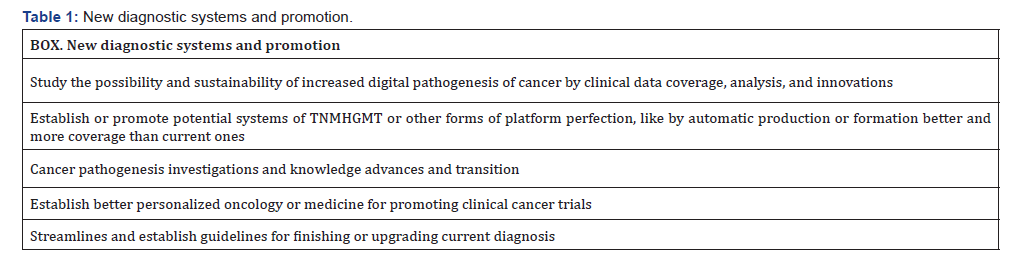
To fulfill pathological revelation, advanced diagnostic or molecular information should be upgraded in several pathways; (Table 1).
Conclusion
Cancer metastasis should be emphasized for patient’s survival benefiting. For performing this treatment upgrading, many new discoveries, methodology, and classifications could be pursuit. More efficacy in cancer treatments can be achieved by these new proposals.
References
- Lu DY (2025) Advances in cancer therapeutics and genomics for improved patient outcomes. Current Cell Science 1: 43-46.
- Siegel RL, Kratzer TB, Giaquinto AN, Sung H, Jemal A (2025) Cancer stastistics 2025. CA-Cancer J Clin 75(1): 10-45.
- Lu DY, Lu TR, Wu HY, Cao S (2013) Cancer metastasis treatments. Current Drug Therapy 8(1): 24-29.
- Lambert, AW, Pattabiraman DR, Weinberg RA (2017) Emerging biological principles of metastasis. Cell 168(4): 670-691.
- Lu DY, Lu TR (2025) Antimetastatic drugs, pharmacologic challenge and opportunity. Current Drug Therapy 20(2): 169-179.
- Gerstberger S, Jiang Q, Ganesh K (2023) Metastasis. Cell 186(8): 1564-1579.
- Lu DY, Qi RX, Lu TR, Wu HY (2017) Cancer bioinformatics for update anticancer drug developments and personalized therapeutics. Reviews on Recent Clinical Trials 12(2): 101-110.
- Birkbak NJ, McGranahan N (2020) Cancer genome evolutionary trajectories in metastasis. Cancer Cell 37(1): 8-19.
- Wang DF, Liu BL, Zhang ZM (2023) Accelerating the understanding of cancer biology through the lens of genomics. Cell 186: 1755-1771.
- Passaro A, Bakir MA, Hamilton EG, Diehn M, Andre F, et al. (2024) Cancer biomarkers: emerging trends and clinical implications for personalized treatment. Cell 187(7): 1617-1635.
- Gadade DD, Jha H, Kumar C, Khan F (2024) Unlocking the power of precision medicine: exploring the role of biomarkers in cancer management. Future J Pharmaceutical Science 10: 5.
- Lu DY, Lu TR, Xu B, Ding, J (2015) Pharmacogenetics of cancer therapy: breakthroughs from beyond? Future Science OA 1(4): FSO80.
- Hyman DH, Tayloe BS, Baselga J (2017) Implementing genome-driven oncology. Cell 168(4): 584-599.
- Pantel K, Alix-Panabieres C (2022) Crucial roles of circulating tumor cells in the metastatic cascade and tumor immune escape: biology and clinical translation. J Immuno Therapy of Cancer 10(12): e005615.
- Lu DY, Lu TR (2025) Personalized oncology: scientific and technical approaches. Current Cell Science 1(1): 57-66.
- Lu DY, Che JY (2026) Cancer diagnosis: digital profiling creations. Cancer Therapy and Oncology International Journal 31(5): 556325.
- Lu DY () Personalized cancer chemotherapy, an effective way for enhancing outcomes in clinics. 2014, Woodhead Publishing, Elsevier, UK.
- Lu DY, Lu TR, Che JY, Shen Y, Yarla NS (2018) Individualized cancer therapy, future approaches. Current Pharmacogenomics & Personalized Medicine 16(2): 156-163.
- Khalili M, Azizi M, Sadeghzadeh H (2022) Immune evader cancer stem cells direct the perspective approaches to cancer immunotherapy. Stem Cell Res Therapy 13(1): 150.
- Lu DY, Lu TR (2020) Anticancer drug development, challenge and dilemma. Nursing & Care Open Access 7(3): 72-75.
- Lu DY, Lu TR (2020) Drug sensitivity testing, a unique drug selection strategy. Advances in Biomarker Sciences and Technology 2: 59-66.
- Lu DY, Lu TR, Yarla NS, Wu HY, Xu B, et al. (2017) Drug combination in clinical cancer treatment. Reviews on Recent Clinical Trials 12(3): 202-211.
- Lu DY, Lu TR (2026) Anticancer drug combinations: Different strategies used in the clinic. Current Advances in Medicine 1: e29496632394562.
- Aarwai U, Paliwal S, Tonk RK. Kumar N, Gupta SK (2025) Combinational drug therapy; its adverse effects and mitigation strategies. Current Advance Medicine 1: e29496632404793.
- Lu DY, Lu TR (2024) Anticancer drug combination, from possibility to principles. Clinics in Oncology 9: 2077.

























