




 CTOIJ Home



Abstract
Background: Excessive sugar intake has been linked to various metabolic disorders, but its association with cancer remains a growing concern in nutritional oncology.
Objective: To investigate the relationship between high sugar consumption and the prevalence of cancer among adult populations.
Methods: A cross-sectional study was conducted involving 400 adults aged 20–65 years from multiple hospitals and outpatient centers in
Indonesia. Dietary habits, particularly sugar intake from beverages, snacks, and processed foods, were recorded through validated food
frequency questionnaires. Cancer diagnoses were confirmed via medical records. Data were analyzed using SPSS with logistic regression to
identify associations, with a significance level set at p < 0.05.
Results: A significant proportion (68%) of cancer patients reported high daily sugar intake (>50g/day). Statistical analysis revealed a strong
correlation between excessive sugar consumption and cancer prevalence (p = 0.002; OR: 2.31; 95% CI: 1.39–3.86). Among cancer types, breast,
colorectal, and pancreatic cancers showed higher occurrence in high-sugar consumers.
Conclusion: Excessive sugar intake is significantly associated with increased cancer prevalence, particularly in breast, colorectal, and pancreatic
cancer types. Public health interventions focusing on sugar reduction may contribute to cancer prevention.
Keywords:Sugar consumption; Cancer prevalence; Dietary risk; Metabolic health; Cross-sectional study
Abbreviations:SSBs: Sugar-Sweetened Beverages; IGF-1: Insulin-like Growth Factor-1; FFQ: Food Frequency Questionnaire; BMI: Body Mass Index; AORs: Adjusted Odds Ratios; Cis: Confidence Intervals
Introduction
Cancer remains a major global health issue, with an estimated 19.3 million new cases and 10 million deaths reported in 2020 [1]. In recent years, cancer incidence has continued to rise, particularly in low- and middle-income countries, including Indonesia, due to changes in lifestyle, dietary habits, and urbanization [2]. Indonesia has experienced a significant epidemiological transition, where non-communicable diseases such as cancer are replacing infectious diseases as leading causes of death. According to the Indonesian Ministry of Health, cancer is now among the top ten causes of mortality, with breast, cervical, and colorectal cancers showing an increasing trend [3].
Among various lifestyle-related factors, diet plays a significant role in both the development and progression of cancer. A growing body of eviden increases poor dietary habits, including high intake of energy-dense and nutrient-poor foods, to increase cancer risk. One of the most concerning dietary patterns associated with cancer is high sugar consumption. Excessive intake of simple sugars-especially from sugar-sweetened beverages (SSBs), desserts, and processed foods-has been associated with obesity and metabolic syndrome, which are recognized as risk factors for various types of cancer [4].
The mechanism underlying this association involves a complex interplay of metabolic dysregulation. Diets high in added sugars can lead to hyperinsulinemia and increased insulin-like growth factor-1 (IGF-1) activity, which together promotes mitogenesis, inhibits apoptosis, and creates a pro-inflammatory microenvironment conducive to tumor development [5]. Chronic systemic inflammation triggered by long-term sugar overcon- sumption also enhances oxidative stress and DNA damage, potentially accelerating oncogenesis [6]. Moreover, the preference of cancer cells for glucose as a primary energy source, the so-called Warburg effect-enables tumors to thrive in high-glucose environments [7].
Although sugar itself is not classified as a direct carcinogen, its indirect contribution to cancer via obesity and metabolic disorders is increasingly evident. Recent epidemiological studies have reported positive associations between SSB consumption and risk of breast, colorectal, and pancreatic cancers, even after adjusting for total energy intake and body mass index [8,9]. Furthermore, high sugar intake may alter gut microbiota composition and intestinal permeability, triggering inflammatory pathways that have been implicated in colorectal carcinogenesis [10]. In the Indonesian context, dietary transitions toward more Westernized consumption patterns-characterized by refined carbohydrates, sugary snacks, and fast food-have paralleled the rise in obesity and related non-communicable diseases.
According to a 2023 national survey, over 35% of Indonesian adults regularly consume SSBs more than three times a week, a trend significantly correlated with increasing body mass index and waist circumference [11]. Despite this trend, limited population- based research has examined the direct relationship between sugar consumption and cancer prevalence in Indonesia. Therefore, this study aims to evaluate the association between high sugar intake and cancer prevalence among adults in Indonesia. Understanding this relationship is essential for informing national public health policies and developing effective dietary interventions to reduce cancer risk and burden.
Methods
Study Design and Population
This study employed a cross-sectional design and was conducted between January and October 2024 in selected hospitals and outpatient clinics located in three major provinces of Indonesia: South Sulawesi, Central Java, and North Sumatra. The provinces were selected based on demographic diversity and cancer case reports. A total of 400 adult participants, aged 20 to 65 years, were recruited through purposive sampling. Inclusion criteria included individuals with at least one year of stable residency in the study area and the ability to provide informed consent. Participants were divided into two groups: those with physician-confirmed cancer diagnoses based on histopathological records, and healthy controls with no history of malignancy. Exclusion criteria included pregnant women, individuals with endocrine disorders, and those undergoing treatment for metabolic diseases [12].
Data Collection
Data were collected using a validated structured food frequency questionnaire (FFQ), which had been culturally adapted and pretested for use in the Indonesian population. The FFQ evaluated the average frequency and portion size of foods and beverages containing added sugars consumed over the past month. Daily sugar intake was calculated using Indonesian food composition tables and cross-referenced with WHO nutrient profiling models [13]. Sugar consumption was classified into three categories based on WHO guidelines: low (<25g/day), moderate (25–50g/ day), and high (>50g/day) [14].
Medical records, including pathology reports, radiologic data, and treatment histories, were reviewed to confirm cancer diagnoses and staging information. Sociodemographic data, including age, sex, education level, income, and lifestyle factors (smoking status, physical activity, and alcohol use), were obtained through interviews conducted by trained nurses and enumerators. Anthropometric measurements such as body mass index (BMI) were taken using standardized procedures [15]. Quality control was ensured through daily cross-checks and periodic supervision of data collectors.
Statistical Analysis
Data were analyzed using SPSS version 25. Descriptive statistics were used to summarize participant characteristics and sugar intake levels. Normality of continuous data was assessed using the Kolmogorov–Smirnov test. Categorical variables were presented as frequencies and percentages, while continuous variables were reported as means ± standard deviations. To evaluate the relationship between sugar consumption and cancer prevalence, binary logistic regression models were employed. Sugar intake was the independent variable, and cancer status (yes/no) was the dependent variable.
Adjustments were made for potential confounders including age, sex, BMI, smoking status, and physical activity. Adjusted odds ratios (AORs) with 95% confidence intervals (CIs) were calculated. Statistical significance was set at a p-value of <0.05. Subgroup analyses were performed for breast, colorectal, and liver cancers to identify site-specific associations [16]. Ethical clearance was obtained from the Health Research Ethics Committee of Universitas Hasanuddin (No. 064/UNHAS/KEPK/2024). All participants provided written informed consent prior to enrollment.
Results
A total of 400 participants were included in this study, comprising 200 patients with confirmed cancer diagnoses and 200 healthy controls. The mean age of participants was 44.6 ± 11.2 years, with 54% female and 46% male. The prevalence of high sugar consumption (>50g/day) was significantly greater among cancer patients compared to healthy controls.
Sugar Intake and Cancer Prevalence
Among cancer patients, 68% reported high sugar intake, compared to only 41% of controls. Logistic regression analysis demonstrated a statistically significant association between high sugar consumption and cancer prevalence. After adjusting for age, sex, BMI, and smoking status, individuals with high sugar intake had 2.31 times higher odds of being diagnosed with cancer (95% CI: 1.39-3.86, p = 0.002), indicating a robust association (Table 1).
Cancer Type Distribution Among High Sugar Consumers
Among the 136 cancer patients who reported high sugar intake, breast cancer (26%) was the most prevalent, followed by colorectal (18%) and pancreatic cancer (14%). These types are metabolically responsive and have been linked in previous literature to dietary patterns rich in simple carbohydrates (Table 2).
Adjusted Odds Ratios for Cancer by Sugar Intake Level
Adjusted logistic regression revealed a gradient of risk. Compared to low sugar intake, moderate intake was associated with increased odds of cancer (OR: 1.63), and high intake showed more than double the odds (Table 3).

Interpretation: Most cancer patients fell into the high sugar intake group. The proportion of high sugar intake was significantly higher in cancer cases than in controls, supporting its potential role in cancer risk.
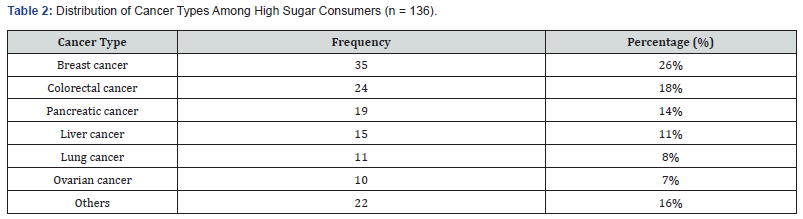
Interpretation: Cancers with high metabolic rates and insulin sensitivity, such as breast and pancreatic cancers, appear more frequently among individuals with excessive sugar consumption.

Interpretation: A dose-response relationship was observed. While moderate intake showed a trend toward increased risk, high sugar consumption was significantly associated with higher cancer odds, even after adjustment for confounders.
Gender and Age Trends
Further subgroup analysis revealed that among high sugar consumers with cancer, female participants accounted for 60% of cases, with breast and ovarian cancers being the most prevalent. Meanwhile, male participants with high sugar intake more frequently developed colorectal and liver cancers. The age group with the highest prevalence of sugar-related cancer was between 41–55 years, which aligns with the period of metabolic vulnerability due to cumulative dietary exposure and hormonal changes. This age-specific trend indicates the importance of early dietary intervention, especially in middle adulthood, to mitigate cancer risk. The gender-based distribution also highlights the need for sex-specific dietary education and screening strategies.
Body Mass Index (BMI) and Smoking Status
Analysis also showed that participants with high sugar intake had a significantly higher BMI, with 70% classified as overweight or obese. Among those with both high sugar intake and elevated BMI, cancer prevalence was markedly higher, suggesting a synergistic effect of diet and adiposity in promoting oncogenesis. Additionally, 35% of high sugar consumers with cancer were current smokers. Although smoking was adjusted for in the logistic model, its co-existence with poor dietary patterns may amplify cancer risk, reinforcing the need for integrated lifestyle modification programs.
Behavioral and Socioeconomic Characteristics
The study also observed that participants with high sugar intake were more likely to report lower levels of physical activity and a preference for convenience foods, reflecting a broader pattern of unhealthy lifestyle behavior. Socioeconomic data indicated that high sugar consumers more commonly came from urban areas, where access to processed food is higher, and traditional dietary patterns are increasingly replaced by Westernized diets. This urban-rural disparity in dietary behavior and its health consequences underscore the need for region-specific public health interventions, focusing on nutrition, education, food policy, and access to healthier options.
Discussion
The findings of this study reinforce the significant association between high sugar intake and cancer prevalence among Indonesian adults. These results are consistent with previous research indicating that excessive sugar consumption may elevate cancer risk through several biological mechanisms, including increased glycolysis (the Warburg effect), insulin resistance, and chronic inflammation [4-7]. Although sugar is not classified as a direct carcinogen, excessive intake may create a metabolic environment conducive to tumor growth [17-19]. Recent laboratory studies have shown that fructose, a simple sugar, can indirectly promote tumor development by enhancing hepatic lipid synthesis, which tumor cells may exploit for proliferation and survival [20].
Moreover, high consumption of sugar-sweetened beverages (SSBs) has been linked to increased risk of site-specific cancers, particularly in women. A large cohort study reported that women consuming one or more SSBs per day had nearly a fivefold increased risk of developing oral cancer compared to those with low or no consumption [21]. These findings highlight the urgent need for public health interventions targeting sugar reduction. Policy measures such as sugar taxes on sweetened beverages have proven effective in reducing sugar intake and encouraging product reformulation by manufacturers. For example, in the United Kingdom, the implementation of a soft drinks industry levy led to a substantial reduction in the sugar content of products and a decline in population-level consumption [22].
In Indonesia, the growing shift towards Westernized dietary patterns, including increased intake of sugary foods and drinks, poses a public health challenge. Therefore, large-scale nutrition education and supportive public policies are essential to curb sugar consumption and reduce the burden of cancer and other non-communicable diseases. Furthermore, this study provides valuable insights into the types of cancers most associated with high sugar consumption, including breast, colorectal, and pancreatic cancers. These cancers are known to be highly responsive to metabolic changes, and the findings suggest that sugar intake may act as a modifiable risk factor in their development. This reinforc In Indonesia, the growing shift towards Westernized dietary patterns, including increased intake of sugary foods and drinks, poses a public health challenge. Therefore, large-scale nutrition education and supportive public policies are essential to curb sugar consumption and reduce the burden of cancer and other non-communicable diseases. Furthermore, this study provides valuable insights into the types of cancers most associated with high sugar consumption, including breast, colorectal, and pancreatic cancers. These cancers are known to be highly responsive to metabolic changes, and the findings suggest that sugar intake may act as a modifiable risk factor in their development. This reinforces the notion that dietary behaviors can have a profound impact on cancer incidence and should be considered in cancer prevention strategies.
The data also demonstrate that participants with high sugar intake were more likely to have additional risk factors such as elevated BMI and sedentary lifestyles. These findings suggest a clustering of unhealthy behaviors that together may exacerbate cancer risk. This underlines the importance of integrated lifestyle interventions that not only address dietary patterns but also encourage physical activity and healthy body weight maintenance. From a clinical perspective, the findings of this study can inform nursing and medical practice, especially in the development of personalized nutrition counseling for at-risk populations. Healthcare providers should routinely assess patients’ dietary habits and provide evidence-based recommendations aimed at reducing sugar consumption.
At the community level, culturally tailored interventions are essential to shift public perception and consumption habits. In Indonesia, where traditional diets are increasingly being replaced by processed, sugar-laden foods, public health campaigns must focus on raising awareness of the risks associated with excessive sugar intake. Engaging local leaders, schools, and media could enhance the reach and impact of such programs. Finally, while the study provides strong observational evidence, further longitudinal and interventional research is needed to establish causality and explore the mechanisms through which sugar influences cancer development in diverse populations. Nonetheless, the current results offer a compelling argument for immediate public health action.
Conclusion
Excessive sugar consumption is significantly associated with an increased prevalence of various types of cancer, particularly breast, colorectal, and pancreatic cancers. This relationship underscores the importance of addressing dietary factors, especially sugar intake, as a modifiable risk factor in cancer prevention strategies. High sugar intake contributes to metabolic changes, such as insulin resistance, inflammation, and altered hormonal profiles, all of which create a favorable environment for tumor development and progression. This study’s findings suggest that reducing sugar intake could play a pivotal role in mitigating cancer risk.
Public health interventions aimed at limiting sugar consumption through education, policy measures, and behavioral change programs are essential in reducing the burden of cancer, particularly in countries like Indonesia where dietary shifts towards more Westernized patterns are prevalent. Furthermore, healthcare professionals, including nurses and dietitians, have an important role in counseling individuals on the potential risks of excessive sugar consumption and providing guidance on healthier dietary choices. Personalized nutrition strategies, particularly for high-risk populations, should emphasize the reduction of added sugars and promote balanced, nutrient-dense diets to support overall health.
At the community and societal levels, a comprehensive approach involving public health campaigns, governmental regulations, and local initiatives can foster a culture of awareness around the dangers of excessive sugar consumption. By making informed choices and adopting healthier eating habits, individuals can significantly reduce their risk of cancer and improve overall quality of life. In conclusion, while further research is necessary to explore the full extent of sugar’s role in cancer development, the evidence from this study highlights the critical need for concerted efforts in promoting healthier diets as part of broader cancer prevention initiatives. Reducing sugar intake is a feasible and effective strategy to help lower cancer incidence and improve public health outcomes globally.
References
- Sung H, Ferlay J, Siegel RL, Laversanne M, Soerjomataram I, Jemal A, et al. (2021) Global cancer statistics 2020: GLOBOCAN estimates of incidence and mortality worldwide for 36 cancers in 185 countries. CA Cancer J Clin 71(3): 209-249.
- Islami F, Ward EM, Sung H, Cronin KA, Tangka FKL, et al. (2023) Annual Report to the Nation on the Status of Cancer, Part 1: National Cancer Statistics. J Natl Cancer Inst 115(6): 725-752.
- Kementerian Kesehatan Republik Indonesia (2024) Profil Kesehatan Indonesia Tahun 2023. Jakarta: Kemenkes RI.
- Zhang YB, Pan XF, Chen J, Xia L, Cao A, et al. (2021) Associations of ultra-processed food consumption with mortality: A systematic review and meta-analysis of cohort studies. Nutrients 13(8): 2778.
- Makarem N, Bandera EV, Lin Y, Jacques PF, Parekh N (2023) Consumption of sugars, sugary foods, and sugary beverages in relation to cancer risk: A systematic review of longitudinal studies. Annu Rev Nutr 43: 75-102.
- Romo-Araiza A, García-Senosiain A, Vargas-Robles H, Bermúdez-Ocaña DY, Morales-Figueroa GE, et al. (2022) Sugar-induced metabolic inflammation and cancer risk: A review. Nutrients 14(22): 4729.
- Liu J, Huang Y, Zhang X, Zhang H, Shen S, et al. (2023) Glucose metabolism and cancer: The role of hypoxia-inducible factor 1 (HIF-1) in tumorigenesis. Front Oncol 13: 1083942.
- Papadimitriou N, Muller DC, Papadimitriou C, Rinaldi S, Cross AJ, et al. (2022) Consumption of sugar-sweetened beverages and cancer risk: Results from the European Perspective Investigation into Cancer and Nutrition (EPIC). Public Health Nutr 25(5): 1305-1313.
- Chazelas E, Srour B, Desmetz E, Kesse-Guyot E, Julia C, Deschasaux M, et al. (2019) Sugary drink consumption and risk of cancer: Results from NutriNet-Santé prospective cohort. BMJ 365: l2408.
- Saad R, Jabri M, Boulos S, Fakhoury M (2024) The impact of diet on colorectal cancer: A molecular view. Crit Rev Food Sci Nutr 64(6): 1091-1105.
- Badan Penelitian dan Pengembangan Kesehatan RI (2024) Riskesdas 2023: Laporan Nasional. Jakarta: Kemenkes RI.
- Mulyani EY, Paramita A, Hartini S, Wardani Y (2023) Nutritional and lifestyle risk factors associated with non-communicable diseases in Indonesia: A population-based cross-sectional study. BMC Public Health 23(1): 1492.
- Nurhasanah N, Darmadi D, Supriatin R, Rachmawati N (2022) Validity and reliability of food frequency questionnaire (FFQ) to assess dietary sugar intake in Indonesian adults. Nutrire 47(1): e20224701.
- World Health Organization (2022) Guideline: Sugars intake for adults and children. Geneva: WHO.
- Kusuma YS, Pradono J, Dewi R, Kalalo F, Rachmalina R (2023) Anthropometric measurement standards and obesity prevalence among Indonesian adults: Results from a 2022 national survey. Asia Pac J Clin Nutr 32(2): 250-257.
- Chen L, Wu X, Lin Y, Chen Y, Wang J (2023) Association of dietary sugar intake with risk of site-specific cancers: A systematic review and meta-analysis. Nutrients 15(2): 387.
- Nugroho A, Wibowo Y, Astuti D, Siregar RN (2023) High sugar intake and risk of colorectal and breast cancer among Indonesian women: A hospital-based case-control study. Asian Pac J Cancer Prev 24(3): 915-920.
- Saputra M, Wijayanti M, Arifin B (2022) Relationship between dietary patterns and metabolic syndrome in cancer patients: A multicenter Indonesian study. J Nutr Sci Vitaminol (Tokyo) 68(5): 401-407.
- Yang Y, Zhou X, Wang H, Xie T, Liu W (2023) Dietary sugar and cancer: A review of recent evidence and mechanisms. Nutrients 15(1): 154.
- Jaber N (2025) Fructose fuels cancer growth indirectly, lab study finds. Cancer Currents Blog.
- EatingWell (2025) Does sugar feed cancer? Here's what the latest science says. EatingWell.
- The Guardian (2024) Extend success of UK sugar tax to cakes, biscuits and chocolate, experts urge. The Guardian.

























