




 CTOIJ Home



Abstract
The potentized seven metals, silver, gold, copper, iron, mercury, lead and tin, are widely used clinically in both homeopathic and anthroposophical therapeutic practices. As metals- based remedies they are then called: Argentum metallicum, Aurum metallicum, Cuprum metallicum, Ferrum metallicum, Mercurius metallicum, Plumbum metallicum and Stannum metallicum. Despite their established therapeutic use, there are very few in vitro studies and of those none are specifically directed toward finding if they are active against cancer cell lines. We demonstrate here for the first time that these seven potentized metals, both in low dose and at high potencies (potencies above D24), can statistically significantly inhibit, but also stimulate, the proliferation of the liver cancer cell line Hep3B. These findings encourage further research into their mechanism of action and therapeutic applications.
Keywords:Hep3B; Potentized metal-based remedies; Homeopathy; Anthroposophy
Introduction
The Seven Metals
The seven metals in the study are: silver, gold, iron, lead, tin, copper and mercury. When appearing in potentized forms (in both low doses and high potencies) in homeopathic or anthroposophical therapies their Latin names are used: Argentum metallicum (silver), Aurum metallicum (gold), Cuprum metallicum (copper), Ferrum metallicum (iron), Mercurius metallicum (mercury), Plumbum metallicum (lead), Stannum metallicum (tin). In clinical use these metal-based remedies are well-established in both homeopathic and anthroposophical therapies [1,2]. In the homeopathic Materia Medica guidance for the use of remedies based on these seven metals is given according to the reactions elicited in the so-called “provings”. Specific “sensations” reported by the patient then guide the therapist to the choice of the appropriate metal-based remedy.
To list the complete number of symptoms given for each would go beyond the scope of this article so that, for illustrative purposes, only a few examples for their applications will be given here: Argentum metallicum (silver)-anxiety and nervousness, etc.; Aurum metallicum (gold)-depression, suicidal ideation, low self-esteem, etc.; Cuprum metallicum (copper)-spastic feelings in various body organs, etc.; Ferrum metallicum (iron)- fatigue of uncertain origin, poor resistance to disease, etc.; Mercurius metallicum (mercury)-restlessness, etc.; Plumbum metallicum (lead)-slow decline in physical strength, dementia, etc.; Stannum metallicum (tin)-weakness and exhaustion, etc [3].
Normally, in homeopathy, diseases as such are not addressed, but rather depending on the psychological or functional manifestations that the patient presents with, a diagnosis can be treated with different metal-based remedies. However, in clinical practice the metal-based remedies have proven themselves to be more appropriate for one pathological condition or another. Thus, for example, the remedy made from Mercurius metallicum is effective for overcoming infections involving the lymphatic system; the remedy made from Stannum metallicum for chronic cough and bronchitis, etc. Of note is that none of these metal– based remedies are specifically considered to be anti–cancer treatments as such or recommended in cancer treatments only as constitutionally strengthening additives [3].
In anthroposophical medicine these seven potentized metalbased remedies are given a heightened layer of importance based on the understanding that they have additional energetic/ spiritual properties [4-7]. Examples of their anthroposophical clinical applications would be Argentum metallicum -for the reproductive endocrine system; Aurum metallicum -for the cardiovascular system; Cuprum metallicum – for the urogenital system; Ferrum metallicum – for the digestive system; Mercurius metallicum-for all mucous membranes; Plumbum metallicum – recovery from sclerosing processes; Stannum metallicum – cartilage components of joints [2]. In distinction to homeopathic traditions, anthroposophical medicine uses these metals – based remedies frequently in the treatment of cancer either as additional supportive means to enhance other specific treatments, or, as an example, formulating them in combination with widely used anticancer mistletoe extracts [8].
In Vitro Studies
In vitro studies demonstrating that potentized metals have a statistically significant effect on substrates are notably few. Several researchers have used plant-based assays to demonstrate active potencies. In a study using garden cress as a bioassay method different concentrations of several heavy metal compounds (cadmium nitrate, copper sulphate, iron sulphate, lead nitrate, manganese chloride, zinc chloride and sodium chloride) were analyzed. It showed that these heavy metal compounds affect root length, total length, and root-to-shoot ratio of the cress in the following order of toxicity: copper > cadmium > iron > lead > zinc > manganese [9]. Baumgartner et al. [10] found that Stannum metallicum 30X treatment was statistically effective in a seedlingbiocrystallization system.
Repeated studies reported a significant statistical effect of Argentum nitricum in the range of 14x to 30x on the growth rate of duckweed (Lemna gibba L.) [11]. Similar results for effectiveness were found for Argentum nitricum 24x on the growth of coleoptiles of wheat seedlings [12,13]. Doesburg, reported that Stannum metallicum 30X potency was found to be stable when tested for stability against the physical treatments of exposure to cell phone radiation and autoclaving [14]. Nevertheless, in a review, Witt concluded that even when in vitro experiments had a high methodological standard, they could demonstrate an effect of high potencies, but that reproducibility seemed to be a challenge. He felt that a general adoption of succussed controls, randomization and blinding would strengthen the evidence of future experiments [15].
Mechanism of Action
The clinical use of homeopathic preparations will continue to be a topic of controversy as long as the mode of action remains unclear. Several ideas, both theoretical and based on empirical studies, have been presented [16]. In a biophysical study looking at membrane fluidity Ghosh [17] found an effect of different potencies of Cuprum metallicum (6C, 30C, and 200C) on fluidizing the cell membrane. Thus, he concluded that certain target effects of homeopathic medicine can be explained from a regular physicochemical point of view. Oskan et al. [18] analyzed the molecular mechanisms of action of Ferrum phosphoricum (FP) D12 on cell proliferation and mRNA expression of iron metabolism, antioxidant defense and inflammation-related genes in mouse J774A.1 macrophages. They found that the D12 dilution promotes iron retention, antioxidant and immunomodulation activities, possibly by modulating transcription levels of related genes in the non-stimulated mouse macrophages.
In another study, looking at metal-based homeopathic medicines, Argentum metallicum, Stannum metallicum, Zincum, Aurum metallicum and Plumbum metallicum in 6C, 30C and 200C potencies, the authors asked whether at such negligible metal concentrations a biological response is still elicited. They found that the potentized metals induced a proliferation-independent hormetic activation by increasing the intracellular protein synthesis [19]. Ullman [20] reviewed studies showing that ultrahigh diluted remedies, beyond Avogadro’s number, have an impact on gene expression that is different than controls. He postulates that these effects are due to nanoparticles still available in the high dilutions.
The same idea that the effect of highly diluted homeopathic remedies is due to the presence of nanoparticles is presented in an article researching Argentum nitricum by Bell [21]. In a separate study Nowbuth et al, [22] confirmed the presence of nanoparticles in the 2X, 4X and 6X potencies of Ferrum phosphoricum and attributed the presence of nano particles to the effectiveness of the potencies. Finally, Dos Santos [23] in a review of 14 in vitro, eight in vivo, one in vitro plus in vivo experimental model showed that most studies ascribed the mechanism of action of high potencies to cytotoxic effects involving apoptotic mechanisms. He drew the conclusion that fundamental research of homeopathy in cancer is still at an early stage and that these findings still need more independent reproduction.
Hepatocarcinoma
The incidence and mortality rates of hepatocarcinoma (HCC) increased significantly from 1975 to 2017, especially in males, non-Hispanic Blacks and older individuals [24,25]. Primary liver cancer, mostly hepatocellular carcinoma, remains a difficult-totreat cancer [26]. Present risk factors pose a major obstacle in attempts to tackle the rising incidence of liver cancer globally [27]. Despite novel treatments, transplantation options, etc., hepatocarcinoma still remains one of the most fatal cancers. Conventional therapies are accompanied by significant side effects which explain the need to find additional solutions that are better tolerated and help improve the ultimate outcome [28]. Homeopathic/anthroposophical potencies have been proven valuable as adjunct anticancer treatments [29].
Materials and Methods
Metal Potentization
The seven metals (Table 1) were potentized in a “homeopathic” style, by adding 1 g of silver, iron, mercury, copper or lead to 9 g lactose and mixed with a mortar and pestle for 30 minutes; this was designated D1. From D1, 5 g was added to 45 g lactose and mixed as before; this was designated D2. From D2, 5 g was added to 45 g lactose and mixed as before; this was designated D3. To make D4, 9 g of D3 was added to 91 ml sterile diH2O and mixed for 15 minutes and rested for 1 minute then sterilized using a 0.22 μm filter (SimPure, B09B9QNXRL). Potencies D5 and D6 were made using 9 ml of the previous potency to 91 ml sterile diH2O, mixed for 15 minutes and rested for 1 minute. D7-D30 were made using 9 ml of the previous potency to 91 ml sterile diH2O, mixed for 4 minutes and rested for 1 minute.
The gold potencies were made by adding 0.2 g of gold to 1.8 g lactose and mixed with a mortar and pestle for 30 minutes; this was designated D1. From D1, 2 g was added to 18 g lactose and mixed as before; this was designated D2. From D2, 5 g was added to 45 g lactose and mixed as before; this was designated D3. To make D4, 1 g of D3 was added to 9 ml sterile diH2O and mixed for 15 minutes and rested for 1 minute then sterilized using a 0.22 μm filter. Potency D5 and D6 were made using 9 ml of the previous potency to 81 ml sterile diH2O, mixed for 15 minutes and rested for 1 minute. D7-D30 were made using 9 ml of the previous potency to 81 ml sterile diH2O, mixed for 4 minutes and rested for 1 minute.
The tin potencies were made by adding 5 g of tin to 45 g lactose and mixed with a mortar and pestle for 1 hour; this was designated D1. From D1, 5 g was added to 45 g lactose and mixed as before; this was designated D2. From D2, 5 g was added to 45 g lactose and mixed as before; this was designated D3. To make D4, 1 g of D3 was added to 9 ml sterile diH2O and mixed for 30 minutes and rested for 5 minutes then sterilized using a 0.22 μm filter. Potencies D5 and D6 were made using 1 ml of the previous potency to 9 ml sterile diH2O, mixed for 30 minutes and rested for 5 minutes. D7-D30 were made using 9 ml of the previous potency to 81 ml sterile diH2O, mixed for 2 minutes and rested for 1 minute. To keep with homeopathic/anthroposophic convention the potentized metals were then named as in Table 1.
Cell Culture
Hep3B, a human liver cancer cell line (ATCC, HB-8064), was typically seeded at 20% confluence in 75cm2 flasks, and grown to approximately 80% confluency at 37˚ C, 5% CO2, which typically took four days. The medium used was Eagle’s Essential Medium (ATCC, 30-2003) supplemented with 10% Fetal Bovine Serum (FBS; ATCC, 30-2020) and 1% penicillin streptomycin (ATCC, 30- 2300). Once confluent, the medium was removed, and the cells rinsed with Dulbecco’s Phosphate Buffered Saline 1X (D-PBS) (ATCC, 30-2200). The cell monolayer was then harvested by adding 3 mL 0.25% Trypsin, 0.53 mM EDTA (TE; ATCC, 30-2101) to the flask and incubated at room temperature for 5 minutes, followed by 6 mL fresh medium. The suspension was transferred to a 15-ml centrifuge tube, and sedimented at 130 x g for 7 minutes. The supernatant was removed, and the pellet resuspended in fresh media. The countess 3 (Invitrogen, AMQAX2000) was used to count cell inoculum and to check viability.
Cell Viability Assay
Cells were plated in white, 96-well plates (Costar, CLS3917) at a density of 1 x 10⁴ cells per well and a volume of 90 μl per well. The controls contained 10 μl ddH2O (0% and 100% controls) and the experimental wells contained 10 μl of the appropriate potency (D7-D30), with four replicates per treatment or control. Plates were left for 1 hour at room temperature, before subsequent incubation at 37˚C and 5% CO2, to produce uniform cell distribution on the growth surface and reduce edge effect. Cell growth was assessed using the CellTiter-Glo luminescent cell growth assay (Promega, G9243), using 100 μl of reagent per well according to the manufacturer’s instructions. The luminescence was measured in a BioTek, Synergy LX plate reader. Cell growth was assessed for 0% control wells after an initial 18 hours of incubation, while sample and 100% control wells were assessed after an additional 48 hours of growth.
Statistical Calculations
Cell count analysis was performed on four measurements: 16
wells in total (two sets of quadruplicates on two different plates).
All samples were included in the analysis. Data are expressed as
mean ± standard deviation. Significance (p < 0.05) and STDEV
calculations were done with the Microsoft Excel software.
The percentage growth was measured according to the
following formula:
% Growth = 100 x (Sample – 0% Control)/ (100%
Control– 0% Control)
Results and Discussion
We demonstrate for the first time that anthroposophically potentized metals modulate both at a low dose level as well as in potencies that are above Avogadro’s number (D24) the proliferation of the cancer cell line, Hep3B). Of special interest is the fact that each potency cannot be assumed to be either inhibitory or stimulating but rather needs to be experimentally observed. The low potency D7 of Argentum metallicum, Aurum metallicum, Ferrum metallicum, Mercurius metallicum, and Stannum metallicum all have inhibitory activity although only Stannum metallicum D7 does so in a statistically significant manner. On the other hand, Cuprum metallicum and Plumbum metallicum D7 show stimulatory activity (Table 2, Graph 1). For the high potencies D24 to D30, the effects are mixed, being both stimulatory and inhibitory (Table 2, Graph 1).


The most interesting finding is the fact that Aurum metallicum was seen to have inhibitory effects across all potencies tested. In homeopathic as well as in anthroposophical medicine gold in high potencies is used largely for improvement of mental conditions. Here we can see that Aurum metallicum merits in the future a careful look as an anti-cancer treatment (Table 2, Graph 1). On the other hand, Cuprum metallicum, perhaps not surprisingly, has a stimulatory effect across all potencies tested. It remains for future investigations to show whether these initial findings are related or not to the known physiological effect that copper stimulates angiogenesis and its levels in cancer conditions are attempted to be kept low (Table 2, Graph 1). Ferrum metallicum is shown to be strongly inhibitory in many of the high potencies but not in the low dose (Table 2, Graph 1).
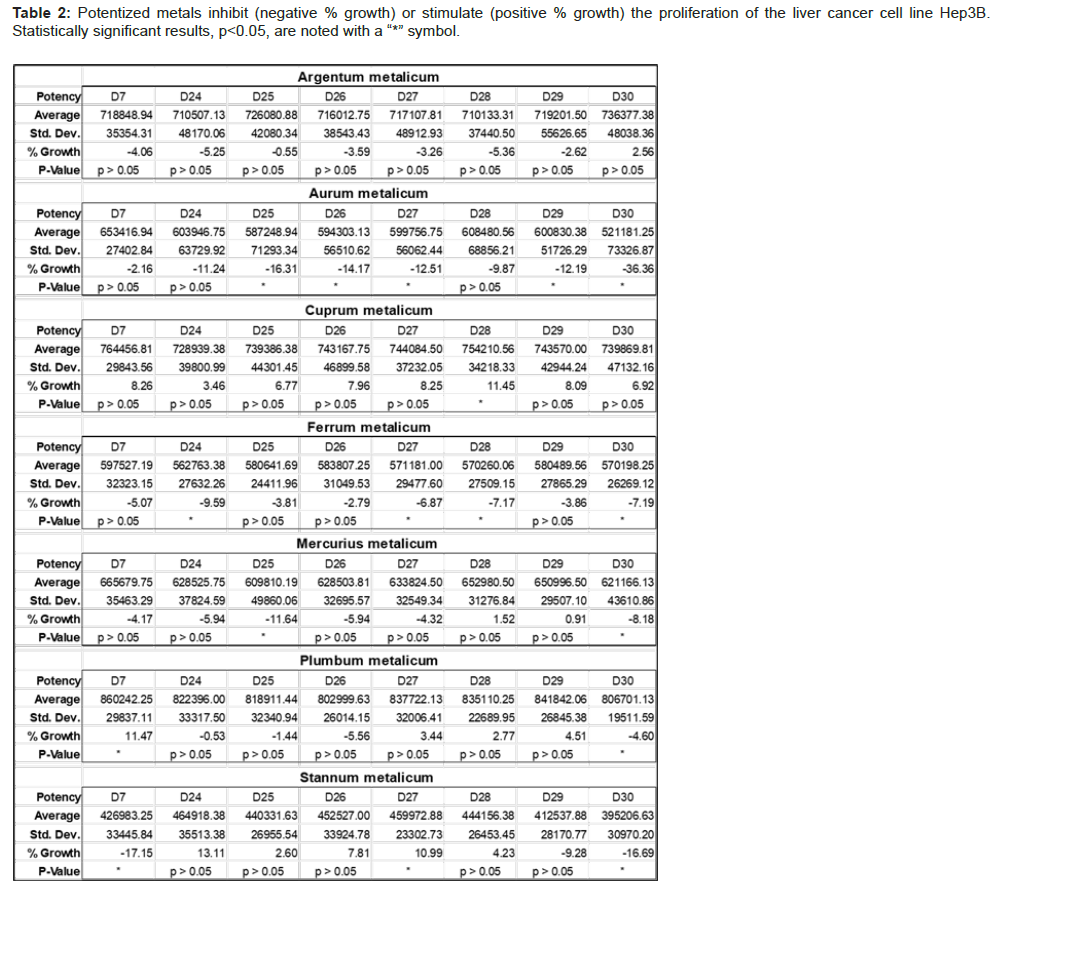
Contrary to the general homeopathic belief that low doses of a substance have the opposite effect of high potencies we can see here that in four of the metals (Aurum metallicum, Cuprum metallicum, Ferrum metallicum and Stannum metallicum) modulation is in the same direction in both the low and the high potencies. The phenomenon of each potency of a substance having an individual effect that needs to be found experimentally, versus a theoretical expectation, has been found previously, both historically by Kolisko [30] in the 1920s, as well as more recently by Husemann [31]. Kolisko had advocated forcefully that therapies substances should be guided by the results of in vitro studies. She was arguably the first who advocated that clinical practice should not simply assume that, for example, the D30 potencies of all substances would have the same effect. We can see that here we find that Aurum metallicum D30 is inhibitory while Cuprum metallicum D30 is stimulating. In one of our previous studies [32], we had similar findings.
In this study we have not analyzed all the potencies going from D7 to D 30 but tentatively one can observe a hormetic effect in Argentum metallicum (D7 versus D30) and Plumbum metallicum (D7 versus D30). The potential applicability of the inhibitory activity of the seven metals for the treatment of cancers in general, and of course, as shown here, in liver cancer, is considerable. Clinical use of metal-based remedies has been shown, as presented above, to be free of major side effects and as such would be of considerable interest to cancer patients who are often almost more burdened by the severe side effects of conventional therapies than they are by the actual illness itself. Our current experiment does not address the issue of the mechanism of action which will need to be studied in detail later. However, the current results encourage continuing work with these substances.
Conflict of Interest
The authors report no conflict of interest.
Authors Participation
1. Rentea R MD - designed the experimental project and wrote
the article.
2. Kamsler M MD - participated in the potentization of the
seven metals
3. Mueller M M. Sc – executed, calculated the experimental
data, and wrote the Materials & Methods section.
References
- Phatak SR (2013) Materia Medica of Homeopathic Medicine. Jain Publishers, Uttarpradesh, India.
- Roemer F (2014) Therapiekonzepte der Anthroposophischen Medizin . Karl Haug Verlag.
- Sisir PR (2024) CAHIERS MAGELLANES-NS [Internet]. magellanes.com.
- Kummer K (2017) Anthromedics - Der Merkurstab : Mineralische Komponenten in anthroposophischen Arzneimitteln. Anthromedics.org.
- M Karutz, Soldner G (2018) Einleitung / Argentum metallicum metallicum praeparatum. Der Merkurstab. 71(3): 221-224.
- Titze O (2007) Aurum metallicum und Aurum metallicumtherapie. Der Merkurstab 80(6).
- Karutz M (2023) Anthromedics - Der Merkurstab : Einleitung / Einleitung, Cuprum metallicum metallicum praeparatum, Cuprum metallicum (ext.) org.
- Steiner R (2010) Introducing Anthroposophical Medicine. Rudolf Steiner Press.
- Schulz VM, Scherr C, Baumgartner S, Tournier A (2025) A versatile Lepidium sativum bioassay for use in ecotoxicological studies. Scientific Reports 15(1).
- Baumgartner S, Doesburg P, Scherr C, Andersen JO (2012) Development of a Biocrystallisation Assay for Examining Effects of Homeopathic Preparations Using Cress Seedlings. Evidence-based Complementary and Alternative Medicine 2012: 125945.
- Scherr C, Schneider C, Arlt SP, Baumgartner S, Majewsky V (2017) Reproducibility of the effects of homeopathically potentised Argentum metallicum nitricum on the growth of Lemna gibba L. in a randomised and blinded bioassay. Homeopathy 106(03): 145-154.
- Scherer-Pongratz W, Endler PC, Harald Lothaller, Stephen S (2015) Wheat and ultra-high diluted silver nitrate – further experiments and re-analysis of data. Homeopathy 104(4): 246-249.
- Endler PC, Scherer-Pongratz W, Lothaller H, Stephen S (2015) Wheat and ultra-high diluted gibberellic acid – further experiments and re-analysis of data. Homeopathy 04(4): 257-262.
- Doesburg P (2025) Metabolomic fingerprinting: revealing the formative forces at play in homeopathic preparations. Allgemeine Homöopathische Zeitung 270(05): 16-20.
- Witt CM, Bluth M, Albrecht H, Weißhuhn TER, Baumgartner S, Willich SN (2007) The in vitro evidence for an effect of high homeopathic potencies—A systematic review of the literature. Complementary Therapies in Medicine 15(2): 128-138.
- Wassenhoven MV, Nysten B, Goyens M, Dorfman P, Devos P, Magnin D (2022) Ion Partition Detected in Homeopathically Manufactured Medicine Cuprum metallicum metallicum and Controls. International Journal of High Dilution Research 21(cf): 67-84.
- Ghosh S (2014) Effect of Different Potencies of Nanomedicine Cuprum metallicum metallicum on Membrane Fluidity-a Biophysical Study. American Journal of Homeopathic Medicine 107(4): 161.
- Oskan T, Kiselova-Kaneva Y, Ivanova D, Pasheva M (2022) Ferrum metallicum phosphoricum D12 Treatment Affects J774A.1 Cell Proliferation, Transcription Levels of Iron Metabolism, Antioxidant Defense, and Inflammation-related Genes. Homeopathy : the journal of the Faculty of Homeopathy 111(2): 113-120.
- Chikramane PS, Suresh AK, Kane SG, Bellare JR (2017) Metal nanoparticle induced hormetic activation: a novel mechanism of homeopathic medicines. Homeopathy: The Journal of the Faculty of Homeopathy 106(3): 135-144.
- Ullman D (2021) Exploring Possible Mechanisms of Hormesis and Homeopathy in the Light of Nanopharmacology and Ultra-High Dilutions. Dose-Response 19(2):155932582110229.
- Bell IR, Muralidharan S, Schwartz GE (2015) Nanoparticle Characterization of Traditional Homeopathically-Manufactured Silver (Argentum metallicum Metallicum) Medicines and Placebo Controls. Journal of Nanomedicine & Nanotechnology 5(3).
- Nowbuth A, Kaminsky M (2021) Characterization of Nanoparticles in 2X, 4X and 6X Potencies of Ferrum metallicum Phosphoricum. Altern Ther Health Med 27(1): 12-17.
- Dos Santos AP, Cardoso TN, Waisse S, Bonamin LV (2020) Homeopathy in Experimental Cancer Models: A Systematic Review. Homeopathy 110(02): 76-85.
- Yao Z, Dai C, Yang J, Xu M, Meng H, et al. (2023) Time-trends in liver cancer incidence and mortality rates in the U.S. from 1975 to 2017: a study based on the Surveillance, Epidemiology, and End Results database. Journal of Gastrointestinal Oncology 14(1).
- Altekruse SF, Henley JS, Cucinelli JE, McGlynn KA (2014) Changing Hepatocellular Carcinoma Incidence and Liver Cancer Mortality Rates in the United States. American Journal of Gastroenterology 109(4): 542-553.
- Liu CY, Chen KF, Chen PJ (2015) Treatment of Liver Cancer. Cold Spring Harbor Perspectives in Medicine 5(9).
- Petrick JL, McGlynn KA (2019) The Changing Epidemiology of Primary Liver Cancer. Current Epidemiology Reports 6(2): 104-111.
- Anwanwan D, Singh SK, Singh S, Saikam V, Singh R (2020) Challenges in liver cancer and possible treatment approaches. Biochimica et Biophysica Acta (BBA) - Reviews on Cancer 1873(1): 188314.
- Hema Priya Manivannan, Vishnu Priya Veeraraghavan, Manoharan R, Arul Prakash Francis (2023) Anticancer potential of homeopathic medicines: an updated review. Natural product research 38(11): 1982-1996.
- Kolisko LN, Kolisko L (1960) Physiologischer und physikalischer Nachweis der Wirksamkeit kleinster Entitäten. Arbeitsgemeinschaft anthroposophischer Aerzte.
- Husemann F (2010) Rhythmusphänomene beim Wirksam - keitsnachweis potenzierter Heilmittel – nachgewiesen von Kolisko (1923) bis Cristea (1991). Der Merkurstab 25(45).
- Rentea R, Kamsler M, Mueller M (2024) Rhythmical behavior of ultra-high potencies of substances in cell cultures: a pilot study. Der Merkurstab 77(4): 237-243.

























