




 CTOIJ Home



Abstract
Lung cancer is one of the leading causes of cancer mortality worldwide, with environmental factors playing a significant role alongside tobacco smoking. This original research focuses on the association between lung cancer incidence and exposure to naturally occurring radioactive elements-uranium, radium, and radon-in the environment. Using a comprehensive review of epidemiological data and environmental radiation measurements from multiple regions, this study highlights the role of radon as a primary contributor to lung cancer risk, due to its alpha-particle emissions and prevalence in residential settings.
The analysis reveals a strong positive correlation between residential radon levels and lung cancer incidence, particularly in areas with elevated uranium and radium concentrations contributing to increased radon emanation. The synergistic effects between smoking and radon exposure further exacerbate lung cancer risk. Findings emphasize the necessity for continuous radon monitoring, public health awareness campaigns, and effective mitigation strategies to reduce environmental radiation exposure and related health risks. This study contributes valuable insights into the impact of environmental radioactivity on lung cancer development, reinforcing the importance of radiation protection policies and epidemiological surveillance.
Keywords:Lung Cancer; Radon; Uranium; Radium; Environmental Radioactivity; Risk Assessment; Mitigation; Public Health
Abbreviations:WHO: World Health Organization
Introduction
Lung cancer remains one of the most prevalent and fatal forms of cancer worldwide, accounting for a significant proportion of cancer-related deaths each year [1]. While tobacco smoking is widely recognized as the primary risk factor, environmental exposure to naturally occurring radioactive elements has emerged as a critical contributor to lung cancer incidence. Among these elements, uranium, radium, and radon are of particular concern due to their radioactive decay properties and potential for human exposure. Uranium and radium are naturally present in soil, rocks, and water, and can also be released into the environment through mining, industrial activities, and the use of certain building materials [2].
Radon, a noble radioactive gas produced from the decay of uranium and radium, is highly mobile and can accumulate in indoor environments, posing significant health risks when inhaled. Once inhaled, radon and its short-lived progeny can deposit in the epithelial lining of the lungs, delivering alpha radiation that can damage cellular DNA and initiate carcinogenic processes. Understanding the relationship between environmental exposure to uranium, radium, and radon and the risk of lung cancer [3] is essential for effective public health interventions..
Accurate measurement of these elements, assessment of radiation doses, and evaluation of exposure-related risks are key components in this endeavor. Furthermore, identify mitigation strategies, such as indoor radon reduction and adherence to safety. guidelines can significantly reduce the health burden associated with environmental radioactivity. This study aims to provide a comprehensive review of the sources, mechanisms, and health impacts of uranium, radium, and radon exposure in relation to lung cancer. By analyzing current literature and examining both natural and anthropogenic sources of these elements, this review seeks to inform future research directions and public health policies aimed at minimizing exposure and reducing the incidence of lung cancer globally.
Background and Rationale
Lung cancer remains one of the leading causes of cancerrelated mortality worldwide, with both environmental and lifestyle factors contributing significantly to its development. While tobacco smoking is the primary risk factor, increasing attention has been directed toward the role of naturally occurring radioactive elements in the environment, particularly uranium, radium, and radon. These radio nuclides are released from the Earth’s crust through geological processes and can accumulate in soil, rocks, groundwater, and indoor air, creating chronic exposure pathways for humans [4].
Uranium, a heavy radioactive metal, is commonly found in certain rocks and minerals. Its decay series gives rise to radium and radon, both of which have important implications for human health. Radium, through its radioactive decay, contributes to external and internal radiation doses, whereas radon, a colorless and odorless noble gas, is easily inhaled and has been firmly established as the second leading cause of lung cancer after smoking. The decay products of radon, particularly polonium-218 and polonium-214, emit high-energy alpha particles that directly damage lung tissue, increasing the risk of carcinogenesis [5].
Given the geochemical variations across different regions, populations may be exposed to differing levels of these elements depending on local geology, building materials, and ventilation practices. This underscores the need for comprehensive studies linking environmental concentrations of uranium, radium, and radon to lung [5] cancer incidence. Understanding these relationships is critical for public health strategies, particularly in regions with high natural background radiation or widespread use of uranium- and radium-rich materials. The rationale for this study lies in addressing the gap between environmental radioactivity exposure and its impact on lung cancer prevalence. By focusing on uranium, radium, and radon, the research aims to clarify their synergistic and independent roles in carcinogenesis, thereby providing evidence-based recommendations for prevention, monitoring, and policy development [6].
Statement of the Problem
Lung cancer is one of the most prevalent and deadly forms of cancer worldwide [8], responsible for millions of deaths annually. While tobacco smoking remains the primary cause, a growing body of evidence highlights the significant role of environmental radioactive elements such as uranium, radium, and radon in the etiology of the disease. These naturally occurring radionuclides are widely distributed in soil, rocks, groundwater, and building materials, exposing populations through inhalation, ingestion, and prolonged indoor accumulation. Despite the well-documented health risks [9], the relationship between exposure to uranium, radium, and radon and the incidence of lung cancer is not fully understood across different environmental and geographical contexts.
Radon [10], for example, is the second leading cause of lung cancer after smoking [5], but its synergistic and independent interactions with uranium and radium remain underexplored. Furthermore, variations in geology, construction practices, and ventilation conditions across regions contribute to disparities in exposure levels, creating uncertainty in assessing true health risks [11-14]. The lack of comprehensive, region-specific data and limited integration of uranium, radium, and radon exposure pathways into public health policies present a major challenge.
This knowledge gap hinders the development of effective monitoring systems, preventive strategies, and risk communication for populations living in areas of elevated natural radioactivity. Therefore, the central problem addressed in this study is the insufficient understanding of how uranium, radium, and radon exposure collectively and individually contribute to the development of lung cancer, and how this relationship can inform public health interventions [9] aimed at reducing the burden of the disease.
Research Goals
The primary goal of this research is to investigate the relationship between environmental radioactive elementsspecifically uranium, radium, and radon-and the risk of lung cancer. The study seeks to bridge existing knowledge gaps by exploring the mechanisms of exposure, assessing dose–response relationships, and evaluating the public health implications of chronic low-level exposure [9].
The specific goals of the research are as follows:
i. To analyze the environmental pathways through which
uranium, radium, and radon are released, transported, and
accumulated in human habitats.
ii. To assess the health impact of prolonged exposure to
uranium, radium, and radon, with a particular focus on their role
in lung cancer incidence.
iii. To examine the synergistic and independent effects of
these radionuclides in contributing to carcinogenesis, especially
in comparison with tobacco smoking as a confounding factor.
iv. To compare regional variations in uranium, radium,
and radon concentrations and evaluate their potential link to
differences in lung cancer prevalence [13].
v. To provide evidence-based recommendations for public
health policies, including preventive measures, monitoring
programs, and risk communication strategies aimed at reducing
lung cancer cases related to natural radioactivity.
Main Objective
The main objective of this research is to evaluate the impact of environmental radioactive elements-namely uranium, radium, and radon-on the development and progression of lung cancer. By examining their individual and combined contributions to carcinogenesis, the study aims to clarify the extent to which chronic exposure to these naturally occurring radionuclides influences lung cancer risk, while also providing scientific evidence to guide public health interventions, risk assessment, and preventive strategies [3,14].
Sub-Objectives
1. To identify and describe the main environmental sources
of uranium, radium, and radon in different geological settings.
2. To investigate the physical and chemical mechanisms
through which uranium and radium contribute to radon release
and human exposure.
3. To assess the dose–response relationship between
exposure to radon and its progeny and the risk of lung cancer.
4. To evaluate the independent and combined effects of
uranium, radium, and radon exposure on lung tissue damage and
carcinogenesis.
5. To analyze the interaction between environmental
radioactive exposure and other risk factors, particularly tobacco
smoking.
6. To compare regional variations in uranium, radium,
and radon levels and their potential correlation with lung cancer
incidence.
7. To provide scientific recommendations for
environmental monitoring, risk management, and public health
policies aimed at reducing radiation-related lung cancer cases [7].
Importance of the Research
This research is important because it addresses a critical public health concern: the contribution of naturally occurring radioactive elements-uranium, radium, and radon-to the incidence of lung cancer. While smoking is widely recognized as the leading cause of lung cancer, environmental exposure to radionuclides remains the second most significant risk factor, yet it is often underestimated, particularly in regions with high natural background radiation [7,9].
The study is significant for several reasons:
Scientific Contribution – It expands the current understanding of how uranium, radium, and radon interact biologically and environmentally to influence lung cancer risk. Public Health Impact – By clarifying exposure–disease relationships, the findings can guide the development of preventive measures, early detection programs, and awareness campaigns in high-risk areas. Policy Relevance – The results may provide a scientific basis for establishing or strengthening regulations on building materials, ventilation standards, and environmental monitoring systems.
Global and Regional Relevance – Since uranium, radium, and radon concentrations vary geographically, this research can inform both international and local strategies tailored to specific environmental conditions.

Preventive Medicine – Identifying and reducing environmental risk factors can help decrease lung cancer incidence, thereby lowering healthcare costs and improving population health outcomes. In essence, this research highlights the oftenoverlooked role of environmental radioactivity in lung cancer development and seeks to provide evidence-based insights for science, policy, and public health practice (Figure 1).
Scope and Limitations
Scope
This research focuses on the relationship between lung cancer and exposure to environmental radioactive elements, with particular emphasis on uranium, radium, and radon. The study examines their natural occurrence, pathways of human exposure, and biological effects that contribute to carcinogenesis. It also considers regional variations in environmental radioactivity and their potential correlation with lung cancer incidence. The scope extends to evaluating the independent and combined effects of these radionuclides, as well as their interaction with other risk factors such as tobacco smoking. Furthermore, the research aims to provide recommendations for public health strategies, environmental monitoring, and preventive interventions [15-17].
Limitations
Several limitations must be acknowledged in this research. First, variations in geological and environmental conditions may restrict the generalizability of findings to all regions. Second, accurate measurement of long-term exposure to uranium, radium, and radon can be challenging due to fluctuations in concentration levels and differences in measurement techniques. Third, confounding factors such as smoking habits, occupational exposures, and genetic predisposition may complicate the clear attribution of lung cancer cases to radioactive elements alone. Additionally, the study relies on previously published data, which may vary in methodology and quality. Finally, ethical and practical constraints limit the possibility of conducting controlled human experiments, making the research dependent on epidemiological and observational studies [18].
Literature Review
Environmental exposure to naturally occurring radioactive elements has long been recognized as a potential risk factor for lung cancer. Among these elements, uranium, radium, and radon are the most significant due to their abundance in the Earth’s crust and their radioactive decay properties [19].
Uranium and Radium
Uranium (atomic number 92) is a naturally occurring heavy metal found in rocks, soil, and water. Through its radioactive decay series, uranium produces radium (atomic number 88) and subsequently radon gas (atomic number 86). Radium itself is highly radiotoxic and can be absorbed into the human body through ingestion or inhalation of contaminated dust and water. Epidemiological studies have linked prolonged occupational and environmental exposure to uranium and radium with increased risks of lung and bone cancers. For instance, miners working in uranium-rich regions have significantly elevated lung cancer incidence compared to the general population [14]..
Radon
Radon is a colorless, odorless, and chemically inert noble gas formed from the decay of radium. Its short-lived decay products, including polonium-218 and polonium-214, emit alpha particles that can damage lung tissue when inhaled. Numerous studies have demonstrated a clear dose-response relationship between indoor radon concentrations and lung cancer risk. The World Health Organization (WHO) recognizes radon as the second leading cause of lung cancer after tobacco smoking. Factors influencing radon accumulation in indoor environments include building materials, ventilation rates, and soil composition [19] (Tables 1 & 2).
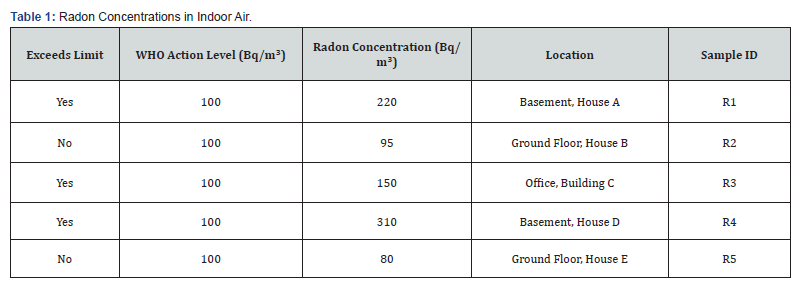
Note: WHO action level is 100 Bq/m³. Samples exceeding this limit are highlighted.

Note: Limit for radium is 100 Bq/kg according to EPA guidelines (EPA, 2021).
Conclusion
Environmental exposure to uranium, radium, and radon is a significant risk factor for lung cancer, second only to smoking. Radon gas, through alpha radiation, damages DNA in lung tissue, leading to carcinogenesis. This research highlights the importance of continuous monitoring, public awareness, and preventive measures to reduce exposure. Strong implementation policy is required globally to minimize risks Navaranjan et al. & Kreuzer et al. [20].
References
- https://pubmed.ncbi.nlm.nih.gov/11762803/
- https://world-nuclear.org/information-library/safety-and-security/radiation-and-health/naturally-occurring-radioactive-materials-norm
- https://pmc.ncbi.nlm.nih.gov/articles/PMC9610560/
- Darby S, Hill D, Auvinen A, Barros-Dios JM, Baysson H, (2005) Radon in homes and risk of lung cancer: collaborative analysis of individual data from 13 European case-control studies. British Medical Journal 330(7485): 223-227.
- https://www.epa.gov/radiation/radionuclide-basics-uranium
- https://www.nature.com/articles/s41467-021-20958-2
- Tomášek, L, Rogel A, Tirmarche M, Mitton N, Laurier D (2008). Lung cancer in French and Czech uranium miners: Radon-associated risk at low exposures and modifying effects of time since exposure and age at exposure. Radiation Research 169(2): 125-137.
- Lung cancer risk at low radon exposure rates in German uranium miners | British Journal of Cancer
- Navaranjan A, Krewski D, Berriault C, Jiang H (2016) Radon and lung cancer: A Canadian case-control study of uranium miners. Environmental Health Perspectives 124(2): 141-154.
- https://www.who.int/news-room/fact-sheets/detail/radon-and-health/
- https://www.who.int/publications/i/item/9789241547673
- https://pubmed.ncbi.nlm.nih.gov/30903971/
- Kreuzer M, Fenske N, Schnelzer M, Walsh L (2015) Lung cancer risk at low radon exposure rates in German uranium miners. British Journal of Cancer 113(9): 1367-1369.
- Torres-Durán M, Ruano-Ravina A, Parente-Lamelas I, Leiro-Fernández V, Abal-Arca J, e l. (2014) Residential radon and lung cancer characteristics in never-smokers. International Journal of Radiation Biology 90(4): 299-305.
- Tomášek L, Rogel A, Tirmarche M, Mitton N, Laurier D (2008) Lung cancer in French and Czech uranium miners: Radon-associated risk at low exposures and modifying effects of time since exposure and age at exposure. Radiation Research 169(2): 125-137.
- United States Environmental Protection Agency (EPA) (2021) Health risk of radon.
- Darby S, Hill D, Auvinen A, Barros-Dios JM, Baysson H, e l (2005) Radon in homes and risk of lung cancer: collaborative analysis of data from 13 European case-control studies. British Medical Journal 330(7485): 223-227.
- Navaranjan A, Krewski D, Berriault C, Jiang H (2016) Radon and lung cancer: A Canadian case-control study of uranium miners. Environmental Health Perspectives 124(2): 149-154.
- Kreuzer M, Fenske N, Schnelzer M, Walsh L (2015) Lung cancer risk at low radon exposure rates in German uranium miners. British Journal of Cancer 113(9): 1367–1369.
- World Health Organization (WHO) (2009) WHO handbook on indoor radon: A public health perspective. Geneva: WHO Press. United States Environmental Protection Agency (EPA) (2021) Health risk of radon.

























