




 CTOIJ Home



Abstract
Background: Granulosa cell tumor are uncommon tumors of ovary accounting for 70% of all sex cord-stromal tumors. They carry very good prognosis with 10-year survival rate of 75-90% with prolong relapses. The most common sides of relapse are the upper abdomen and retroperitoneum followed by distant metastasis to liver and relapses metastasis to bone is rare. Management principally includes a combination of chemotherapy, radiotherapy and surgery.
Case presentation: This case report describes the case of middle-aged female who relapse after 20 years of initial diagnosis with bony metastasis to Right iliac bone and lung metastasis. She was successfully treated with combination of chemotherapy followed by palliative radiation to Rt iliac lesion after systemic control of disease. Her disease remained stable for last 1 and ½ year till last follow up.
Conclusion: This case report dictates although bony metastases are exceedingly rare and present unique diagnostic and therapeutic challenge, multidisciplinary management can provide good local control and improve survival.
Keywords:Granulosa cells; Bony metastasis; Adult; Ovary; Relapse
Abbreviations: GCT: Granulosa Cell Tumors;
Introduction
Granulosa cell tumors (GCT) originate from granulosa cells. They account for 5% of all ovarian tumors and represent over 70% of sex cord-stromal tumors. They are typically found in women who are perimenopausal or postmenopausal, with the highest incidence between the ages of 50 and 55. In general, these tumors have a more favorable prognosis compared to epithelial ovarian tumors and tend to progress slowly. In contrast to epithelial tumors, granulosa cell tumors (GCT) are diagnosed at an early stage in 81% of cases (with 71% at stage I and 10% at stage II), while 19% present at a late stage (11% at stage III and 8% at stage IV). They are known for a prolonged natural history, with about 25% of cases potentially recurring several years after an apparent clinical cure of the primary tumor [1]. The stage of the tumor seems to be the most significant prognostic factor.
Other prognostic indicators, which have been reported with varying consistency, include the presence of intraperitoneal dis ease, tumor size, patient’s age, degree of differentiation, mitotic activity, and nuclear atypia [2]. The overall 10-year survival rate is favorable, ranging between 75% and 90%. The pelvis is the most frequent site of recurrence for granulosa cell tumors, although the upper abdomen and retroperitoneal area can also be affected [3]. Distant metastases are uncommon but have been reported, especially in the liver and lungs. Metastasis to the bones is extremely rare [4]. This case would reflect the natural course of granulosa cell tumor with prolonged remission and relapsing course, presenting with bony metastasis as a rare presentation. It also emphasizes the need of multimodality approach for treating metastatic disease..
Case Description
We present the case of 51 yrs old female k/c HTN presented in Jan 2023 with pain in Rt leg with a palpable lesion near Rt gluteal region. She had significant past history of Left sided ooAbstract phorectomy in 2001, histopathology of which consistent with granulosa cell tumor of ovary after which she was kept on surveillance. On examination she was a lady of average built, walking with support and unable to bear weight on Rt side of leg with tender lesion over Right buttock area. She got a CT scan done on 5th Jan,23 that showed soft tissue density mass in Right hemipelvis mea 11.1*11.9*9.9cm, there were also soft tissue density nodules in bilateral lung fields likely metastatic deposits Figure 1. PET/CT scan was also done on 15th feb, 23 showed neoplastic lesion in Rt iliac bone with infiltration into adjacent muscles and metastatic deposits in lungs with suspicious solitary Rt external iliac vessel lymph node Figures 1-3.
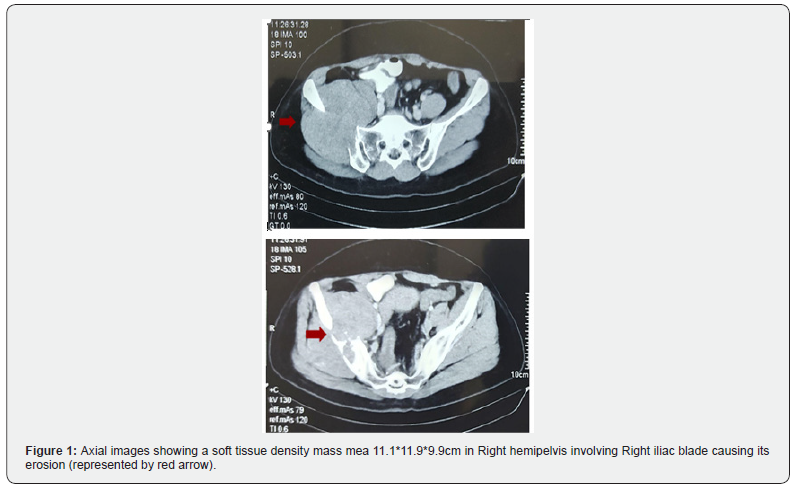
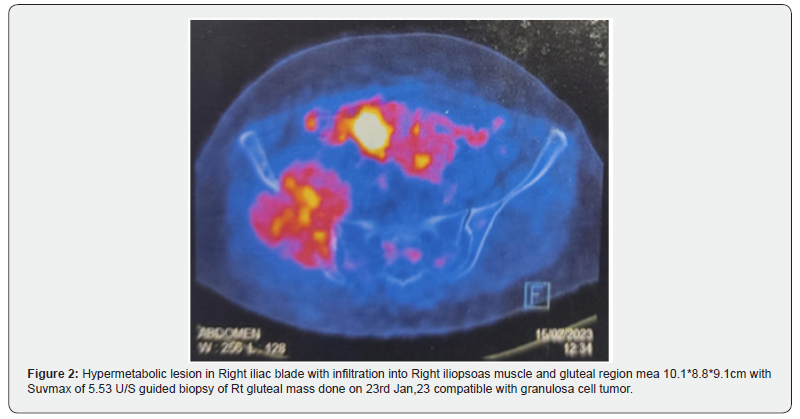
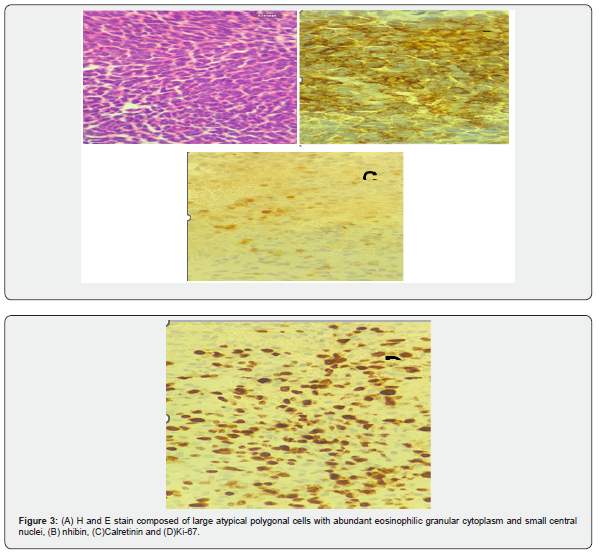
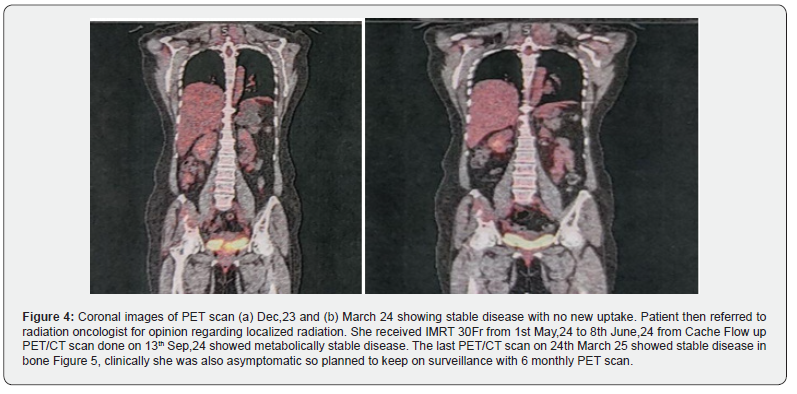
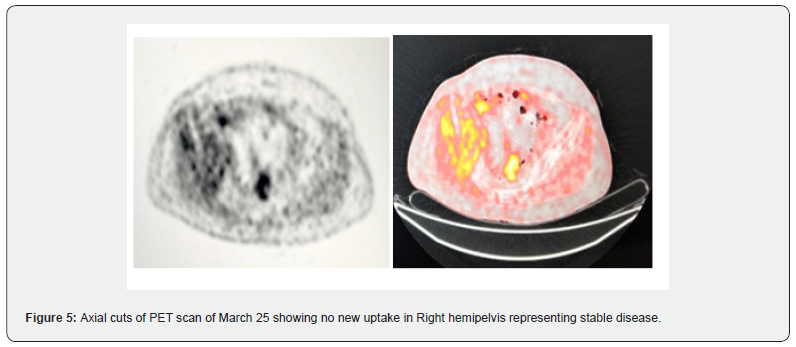
She started chemotherapy with weekly paclitaxel and carboplatin on 21st Feb,23. CT scan repeated after 4 cycles on 15th May,23 showed significant disease regression. She continued with the same regimen and PET/CT scan was performed after 8 cycles on 28th Aug, 23 it showed partial metabolic response. As there was still residual disease in the lung it was decided to continue with 4 more cycles. PET/CT scan was repeated after 12 cycles on 14th Dec,23 showed metabolically stable disease. After cycle 13 patients had an infusion reaction with carboplatin. She was rechallenged with the same regimen according to de-sensitization protocol for paclitaxel. Despite desensitization protocol she experienced the same allergic reaction, so further chemotherapy discontinued. HRCT performed on 16th Feb, 24 showed stable fibrotic lung nodules followed by PET/CT scan on 22nd March, 24 which showed stable Rt iliac bone deposit and non-avid sub centimeter bilateral lung nodules Figures 4 & 5.
Discussion
Granulosa cell tumors arise from granulosa cells and characteristically produce estrogen, frequently manifesting as large ovarian masses. Classified under sex-cord stromal tumors, they differ from epithelial neoplasms. Notably, these tumors can develop in both the ovaries and testes, despite granulosa cells being native to the ovaries. Granulosa cell tumors are categorized into juvenile and adult types based on clinical and histological characteristics. Several key factors may increase the risk of developing granulosa cell tumors, these include nulliparity, elevated body mass index (BMI), use of oral contraceptives, and a family history of cancer [5]. Granulosa cell tumors often manifest as asymptomatic, slow-growing abdominal masses. Hypoestrogenism-related symptoms, such as breast tenderness, postmenopausal bleeding, and menstrual irregularities, are common presentations [6].
Given the propensity for late recurrences and metastasis granulosa cell tumors can relapse even after 20 years, like our case where our patient with a history of granulosa cell tumor in 2001 presented with relapse in 2023 with bony and lung metastases [5]. The clinicopathological features of adult granulosa cell tumors can overlap with those of other neoplasms, particularly in metastatic sites. A diagnosis of metastatic tumor can be suspected based on characteristic cytological features, such as Call-Exner bodies and nuclear grooves. Notably, FOXL2 immunohistochemistry has been shown to be more sensitive than inhibin and calretinin in identifying these tumors [7]. While recurrences typically involve the abdominopelvic region, distant metastases, especially to bone, are exceedingly rare but clinically significant when they occur [20].
Given the propensity for late recurrences and metastasis granulosa cell tumors can relapse even after 20 years, like our case where our patient with a history of granulosa cell tumor in 2001 presented with relapse in 2023 with bony and lung metastases [5]. The clinicopathological features of adult granulosa cell tumors can overlap with those of other neoplasms, particularly in metastatic sites. A diagnosis of metastatic tumor can be suspected based on characteristic cytological features, such as Call-Exner bodies and nuclear grooves. Notably, FOXL2 immunohistochemistry has been shown to be more sensitive than inhibin and calretinin in identifying these tumors [7]. While recurrences typically involve the abdominopelvic region, distant metastases, especially to bone, are exceedingly rare but clinically significant when they occur [20].
Bone metastasis from ovarian GCT represents an unusual pattern of spread, likely reflecting hematogenous dissemination rather than the more common local or lymphatic routes. Reported cases include metastases to vertebrae, clavicle, humerus, and other skeletal sites, often presenting as isolated lytic lesions causing pain or pathological fractures [4,5,8]. In our case patients presented with a soft tissue density mass in the right hemipelvis and bilateral lung fields, suggestive of metastatic deposits causing her local pain and limping gait because of local destruction of pelvic bone and uptill now as per literature search is reported to be the second case of granulosa cell tumor involving the pelvis [9].
While standard guidelines for treating recurrent granulosa cell tumors are lacking, various treatment modalities, including surgery, chemotherapy, radiotherapy, and hormonal therapy, have been described in the literature. Effective management of widespread disease often involves radiotherapy and chemotherapy, with outcomes influenced by the extent of cytoreduction and disease confinement to the pelvis or abdomen. Systemic therapies including chemotherapy regimens such as BEP (bleomycin, etoposide, cisplatin), hormonal treatments, and targeted agents like bisphosphonates for bone disease have been employed with variable success [5]. In this case patient underwent chemotherapy with weekly paclitaxel and carboplatin, which demonstrated disease regression after the fourth cycle, prompting continuation of the regimen.
A subsequent PET scan revealed stable disease in the right iliac bone and non-FDG-avid lung nodules, so she underwent SBRT of the Right hemipelvis as local treatment and disease remained stable till last follow up 2024. Similarly, there is a case report of 35 years old female presented with multiple bony metastasis treated with 6 cycles of paclitaxel and carboplatin followed by imaging which showed stable disease so underwent palliative radiation to bony metastasis at site of pain [9,10-15]. Despite aggressive multimodal treatment, outcomes may be poor in cases with extensive metastatic disease, highlighting the need for individualized treatment planning and supportive care [5,16-20].
Conclusion
Granulosa cell tumors (GCT) of the ovary are typically characterized by a favorable prognosis and indolent clinical course; however, the occurrence of bone metastases represents a rare and atypical pattern of disease spread. This case report highlights the unusual presentation of ovarian GCT with bony metastasis, given the rarity of skeletal involvement, diagnosis can be challenging and often requires a combination of imaging, histopathology and markers. Aggressive treatment with multidisciplinary approaches, including surgery, chemotherapy, and radiotherapy may be warranted to address metastatic lesions and improve patient outcomes.
Availability of Data and Material
Not applicable.
Competing interests
There is no competing interest by the authors
Funding
None.
Authors’ contribution
FS main idea of case report, literature search, retrieving images from radiology and majority of manuscript writing; HW contributed to manuscript writing; SB contributed to retrieval of histopathological slides.
Acknowledgement
None.
References
- Kottarathil VD, Antony MA, Nair IR, Pavithran K (2013) Recent advances in granulosa cell tumor ovary: a review. Indian journal of surgical oncology 4(1): 37-47.
- Sehouli J, Drescher FS, Mustea A, Elling D, Friedmann W, et al. (2004) Granulosa cell tumor of the ovary: 10 years follow-up data of 65 patients. Anticancer research 24(2C): 1223-1230.
- Mangili G, Sigismondi C, Frigerio L, Candiani M, Savarese A, et al. (2013) Recurrent granulosa cell tumors (GCTs) of the ovary: a MITO-9 retrospective study. Gynecologic Oncology 130(1): 38-42.
- Thirumala SD, Putti TC, Medalie NS, Wasserman PG (1988) Skeletal metastases from a granulosa‐cell tumor of the ovary: Report of a case diagnosed by fine‐needle aspiration cytology. Diagnostic cytopathology 19(5): 375-377.
- Asher N, Chan M, Leonard S, Rountree C, Aziz M (2020) Metastatic Ovarian Granulosa Cell Tumor to the Clavicle Bone Twenty Years After Primary Diagnosis: A Case Report and Literature Review. JSM Clin Cytol Pathol 2(3): 4.
- Al Khalil M, Otero JJ, Mujeeb I, Riyas M (2016) Neck metastasis of a juvenile granulosa cell tumour. A case report and literature review. Egyptian Journal of Ear, Nose, Throat and Allied Sciences 17(1): 39-41.
- Nikas IP, Sepsa A, Kleidaradaki E, Salla C (2022) EUS-FNA diagnosis of a metastatic adult granulosa cell tumor in the stomach. Laboratory Medicine 53(5): 533-536.
- Dubuc-Lissoir J, Berthiaume MJ, Boubez G, Van Nguyen T, Allaire G (2001) Bone metastasis from a granulosa cell tumor of the ovary. Gynecologic oncology 83(2): 400-404.
- Laios A, Tan YS, Pathak D, Weston M, Anderson J, et al. (2021) Granulosa cell ovarian cancer with synchronous multiple bone metastases: case report of extreme rarity. Tumori Journal 107(6): NP54-NP58.
- Pectasides D, Pectasides E, Psyrri A (2008) Granulosa cell tumor of the ovary. Cancer treatment reviews 34(1): 1-2.
- Tanha AS, Hosseini S, Soltani E, Oryani MA, Askari E (2025) Incidental Ovarian Uptake in Bone Scintigraphy. Clinical Nuclear Medicine 50(2): e115-e117.
- Ege G, Öncü HN, Öztürk N, Korkmaz V (2025) Bone Metastases in Late Recurrence of Adult Granulosa Cell Tumor of The Ovary. International Journal of Gynecological Cancer 35(2).
- Moretti-Marques R, De Cillo P, Cerqueira J, Salim R, Queiroz P, et al. (2024) Early bone progression in apparent early-stage ovarian cell tumor: a unprecedented case report and literature review. International Journal of Gynecological Cancer 34: A238.
- Dridi M, Chraiet N, Batti R, Ayadi M, Mokrani A, et al. (2018) Granulosa cell tumor of the ovary: a retrospective study of 31 cases and a review of the literature. International Journal of Surgical Oncology 2018(1): 4547892.
- Auranen A, Sundström J, Ijäs J, Grénman S (2007) Prognostic factors of ovarian granulosa cell tumor: a study of 35 patients and review of the literature. International Journal of Gynecological Cancer 17(5): 1011-1018.
- Yang AD, Curtin J, Muggia F (2018) Ovarian adult-type granulosa cell tumor: focusing on endocrine-based therapies. International journal of Endocrine Oncology 5(2): IJE08.
- Suzuki K, Kitami A, Okada M, Takamiya S, Ohashi S, et al. (2023) A case of adult granulosa cell tumor presenting as thoracic lesions. General Thoracic and Cardiovascular Surgery Cases 2(1): 14.
- Yaacoub S, Hajj L, Khairallah A (2024) A clinicopathological study about the epidemiology of granulosa cell tumors in Lebanon. BMC cancer 24(1): 309.
- Kimura T, Shiono H, Takemoto T, Ohta Y (2013) Lung metastasis from an ovarian granulosa cell tumor 36 years after the initial diagnosis: report of a case. Surgery today 43(2): 199-202.
- Khosla D, Dimri K, Pandey AK, Mahajan R, Trehan R (2014) Ovarian granulosa cell tumor: clinical features, treatment, outcome, and prognostic factors. North American journal of medical sciences 6(3): 133-138.

























