




 CTOIJ Home



Abstract
Introduction: Globally, the number of Larynx cancer deaths increased significantly from 1990 to 2022, rising from 85,790 deaths in 1990 to 103,216 deaths in 2022, a rise of 36%. In 2022 India had an estimated 188,960 Laryngeal cancer cases and 103,216 LC deaths. In India Laryngeal Cancer ranks seventh most common cause of cancer in males, and leading causes of cancer-related male deaths. It contributes 3-6% of all cancers in men & 0.2-1% in women. Smoking, Tobacco chewing and alcohol abuse are major synergistic risk factors, with poor diet, especially spicy and non-vegetarian food, indoor air pollution, GERD, & HPV infection add to the risk. Current treatment options are transoral laser microsurgery, laryngectomy, radiotherapy, & concurrent chemoradiotherapy. The 5-year survival rate in India is approximately 30%. There is an overall decreasing trend in incidence, especially for males in Metropolitan and other cities due to better diagnostic & managing facilities, and an increasing trend in Rural & female populations and younger subjects in the last decade due to expanding accessibility of services. Decreased trend in incidence in men is attributed to reduced tobacco & alcohol consumption, whereas decrease in mortality is due to improved diagnostics, accessibility to treatment, & quality of management with latest technologies. Yet disparity in trend and management remains in Rural and Urban India and developed countries versus developing countries globally because of differences in the level of access to surgical care.
Materials & Methods: This article was prompted by a recent case in May2025 in our close circle which reminded me of the first LC ever I followed and learned a lot in 1991. The recent case in stage 3 also raises the doubt of identifying the primary source of the tumor. The third case of rare Laryngeal Spindle Cell Carcinoma also survived and did well for nearly 3 years.
Outcomes: While the first and third case survived over 5 years after Laryngectomy followed by a combo of radio and chemotherapy, the recent case is put on chemotherapy to know the response before identifying the primary source for planning surgical intervention. The challenge of retaining voice is mind boggling!
Keywords:Head & neck cancers; Laryngeal Cancer; International Agency for Research on Cancer, Smoking, Tobacco chewing; Alcohol abuse; Fine Needle Aspiration Cytology; Biopsy; Histopathological features; Squamous cell carcinoma; Adenocarcinoma; Spindle Cell Carcinomas; Computerized tomography Scanning
Abbreviations: HNC: Head & neck cancers; LC: Laryngeal Cancer; IARC: International Agency for Research on Cancer; FNAC: Fine Needle Aspiration Cytology; SpCCs: Spindle Cell Carcinomas, CTS= Computerized tomography Scanning, MRI: Magnetic resonance imaging; CCRT: Concurrent chemoradiotherapy
Introduction
Cancer is a major societal, public health, and economic problem in the 21st century, responsible for almost one in six deaths (16.8%) and one in four deaths (22.8%) from noncommunicable diseases (NCDs) worldwide. International Agency for Research on Cancer (IARC), estimated that there were close to 20 million new cases of cancer in the year 2022 and 9.7 million deaths from cancer. The estimates suggest that approximately one in five men or women develop cancer in a lifetime, whereas around one in nine men and one in 12 women die from it. Lung cancer (12.4%) was the most frequently diagnosed cancer in 2022, worldwide, followed by cancers of the female breast (11.6%), colorectum (9.6%), prostate (7.3%), and stomach (4.9%). Laryngeal Cancer (LC) contributes to 0.9% of the total cases of all cancers & 1.1% of LC specific deaths [1]. Globally, the number of Larynx cancer deaths increased significantly from 1990 to 2022, rising from 85,790 deaths in 1990 to 103,216 deaths in 2022, a rise of 36% with annual rise of 1% per year [1]. In 2022 India had an estimated 188,960 Laryngeal cancer cases and 103,216 LC deaths in 2022. The age-standardized rate (ASR) of laryngeal cancer incidence and mortality were 2.0 and 1.0 per 100 000 worldwide [2]. In India it ranks seventh most common cause of cancer in Indian males and is among the leading causes of cancer-related male deaths in India. It contributes 3-6% of all cancers in men and 0.2-1% in women in India, with incidence rates varying by region, with the highest rates reported in the northeastern region, particularly in districts like Aizawl & Kamrup. The age-adjusted incidence rate of cancer larynx in males was highest at 8.18 per 100,000 in Kamprup Urban District and the lowest is 1.26 per 100,000 in Nagaland in 2022. Classified as a type of head and neck cancer, squamous cell carcinoma is the common type. It originates from the cells lining the larynx, more prevalent in men, leads to hoarseness of voice, difficulty breathing, & swallowing, significantly impacting overall quality of life [3].
Smoking, Tobacco chewing and alcohol abuse are major synergistic risk factors, with poor diet, especially spicy and non-vegetarian food, indoor air pollution, GERD, and HPV infection contributing to some extent. Current treatment options are transoral laser microsurgery, radiotherapy, concurrent chemoradiotherapy, and laryngectomy. The 5-year survival rate for laryngeal cancer in India is approximately 30% [3]. There is an overall decreasing trend in incidence, especially for males, and an increasing trend in female populations and younger subjects in the last decade. Decreased trend in incidence is attributed to reduced tobacco use & alcohol consumption, whereas decrease in mortality is due to improved diagnostics, accessibility to treatment, & quality of management with latest technologies. Yet disparity in trend and management remains in rural and Urban Idia and developed countries versus developing countries globally because of differences in the level of access to surgical care. This article as an outcome of the author witnessing and following up the first case in 1990 and the most recent in April 2025 with appropriate literature search.
Case Reports
Case 1: Most Recent Case: Mr. Laxman, a 57-year-old male, presented to a private General Surgeon in Gadag, Karnataka, on May 25, 2025, with a three-month history of swelling under the left side of his jaw. He also reported experiencing hoarseness, stridor (a high-pitched breathing sound), and mild dysphagia when consuming Sorghum Roti (bread) over the past three weeks. Physical examination noted a submandibular swelling, mostly lymph node, with no active signs of infection or a stridor. On inquiry he reported having lost 2 kg in the last 3 months and in the habit of chewing tobacco for the last 20 years. A Fine Needle Aspiration Cytology (FNAC) done on 30 May 2025 indicated “Histological features are suggestive of Metastatic deposits of squamous cell Carcinoma- Left submandibular regional lymph node”. Investigation of Primary Tumor in the upper aero-digestive tract recommended. A CT scan of the neck from Temporomandibular (TM) joint up to Clavicle done on 31 May 2025 showed Left level 2 lymph node measuring 2.1x2.0 cm had necrotic center and left IJV was compressed by the node. The left lateral pharyngeal wall was mildly bulky. All other soft tissues, blood vessels and spaces were normal. Serum creatinine was 1.0mg/dl within normal range (0.6-1.4 mg dl). A Provisional diagnosis was made of Laryngeal cancer was made and was advised Chemotherapy of Cisplatin a platinum-based agent combined with Paclitaxel 5-fluorouracil (5-FU), initial treatment to address stridor as primary lesion was not detected.
Case 2: First ever LC case followed by the Author in 1991: Mr. Raghvendra Rao, brother-in-law of the author referred by a local ENT surgeon suspecting Laryngeal Cancer. He had been chewing Tobacco well over 25 years. We consulted HOD ENT in AIIMS New Delhi, in May 1991. Scanning, & FNAC diagnosed it as squamous cell Carcinoma in stage III. A laryngectomy and removal of Vocal cords was done followed by Chemo & Radiotherapy for 3 months. He lost his voice, refused to try artificial voice training but survived for the next 12 years.
Case 3: Laryngeal Spindle Cell Carcinoma (SpCC): A 62-yearold male with a history of tuberculosis and extensive smoking presented with respiratory distress and a white vocal cord mass in April 2022. Laryngoscopic and imaging evaluations revealed an ill-defined mass originating from the right supraglottic larynx. Histopathological examination confirmed the diagnosis. The management included immediate tracheostomy, surgical resection, adjuvant radiation therapy, and chemotherapy. Regular follow- ups and a multidisciplinary approach contributed to a successful three-year outcome without recurrence.
Discussion
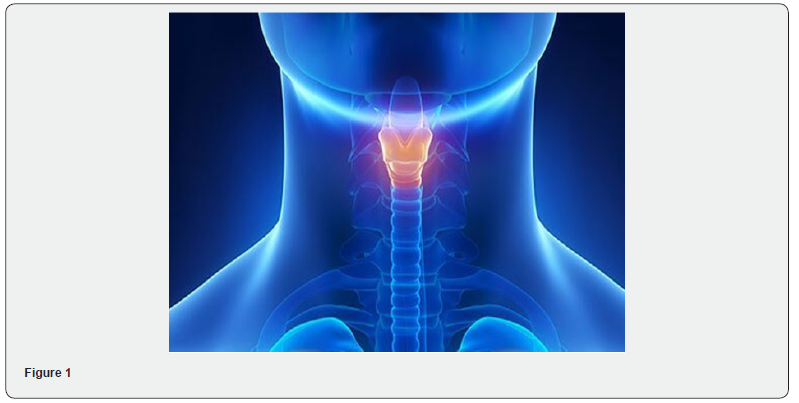
Throat cancer a relatively uncommon compared to other forms of cancer, is characterized by uncontrollable growth of abnormal cells in the region of the throat, voice box, epiglottis, tonsils or oropharynx. The throat consists of a tube-like structure made up of muscles, which starts from behind the nose and ends at the base of neck. It houses structures that enable us to speak through voice box (larynx) & vocal cords, swallow through oropharynx and breath, through Larynx, epiglottis, and tonsils. Voice box, which consists of cartilage and the vocal cords for creating sound by vibrations. Epiglottis, made of cartilage, functions as a windpipe lid. Tonsils, which are soft structures located towards the back of throat (Figure 1).
Types of throat cancer: Based on the location, the most
common types of throat cancer are pharyngeal cancer and laryngeal
cancer. Based on the type of cells affected, throat cancer is
classified as
i) Squamous cell carcinoma – When the cells lining the throat
are affected,
ii) Adenocarcinoma – When the glandular cells become cancerous.
The adenocarcinoma of the throat is very rare
iii) Spindle Cell Carcinomas (SpCCs) of the larynx, are rare and
predominantly affect middle-aged to elderly males. These biphasic
tumors arise from both epithelial and spindle cell elements
and present symptoms like hoarseness and dysphagia. Accurate
diagnosis relies on histological and immunohistochemical analysis.
Early detection facilitates favorable outcomes, with five-year
survival rates ranging from 65 to 95%.
Early warning signs and symptoms of throat cancer:
i) Abrupt changes like hoarseness of voice,
ii) Long-standing cough
iii) Poor healing of lump or sores in the throat
iv) Pain in the ear
v) Soreness of throat
vi) Difficulty in swallowing and
vii) Unexplained weight loss
Diagnosis of throat cancer:
i) A thorough medical history
ii) Examining the throat by laryngoscopy or endoscopy
Conducting laboratory tests:
i)Tissue sample (biopsy or fine-needle aspiration Cytology
(FNAC),
ii) X-ray,
iii) Computerized tomography (CT) Scanning,
iv)Magnetic resonance imaging (MRI) and
v)Positron emission tomography (PET)
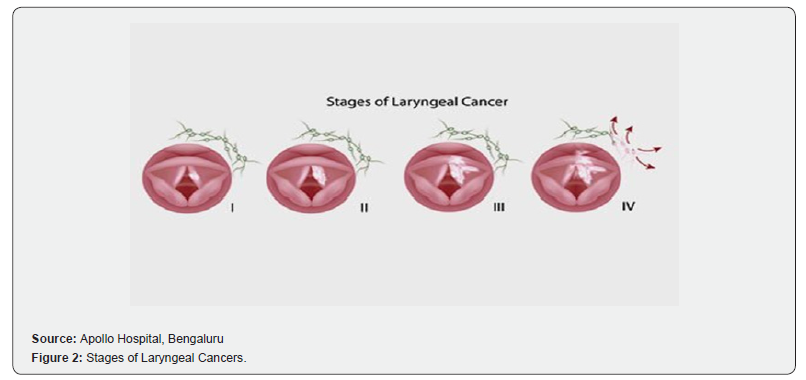
Stages of Laryngeal Cancers
Laryngeal cancer staging is a crucial factor in determining
treatment options and prognosis. The stages, ranging from 0 to IV,
indicate how much cancer has spread, with lower numbers representing
less spread.
Stage 0 (Carcinoma in Situ): This is the earliest stage, where
abnormal cells are present in the lining of the larynx but haven’t
invaded deeper tissues.
Stage I: The cancer is limited to the larynx, and the vocal cords
can move normally (Figure 2)
Stage II: The cancer spread to a different part of the larynx, &
the vocal cords do not move normally.
Stage III: The cancer has spread throughout the larynx, and
the vocal cords are likely fixed.
Stage IV: The cancer has spread beyond the larynx, potentially
to lymph nodes, surrounding tissues, or other parts of the body.
Stage IV is further divided into IVa, IVb, and IVc based on the
extent of spread.
Throat cancer treatment
Treatment options for throat cancer are based on the location and stage of the throat cancer, the type of cells affected and health status of the patient.
i. Radiation therapy: Use of high-energy beams that kill
target cancer cells,
ii. Surgery: Depending on the location and stage of the
your cancer: a) Endoscopic surgery for early-stage throat cancer
b) Surgery to remove all or part of the affected area or the whole
voice box – laryngectomy as was done in our case of Raghvendra
Rao, c) Surgery to remove part of the throat – Pharyngectomy d)
Surgery to remove the involved cancerous lymph nodes - dissection.
iii. Chemotherapy: Use of medicines to kill cancer cells.
iv. Targeted drug therapy: Use of anti-cancer medicines
that target specific defects in cancer cells to inhibit abnormal cell
growth.
v. Rehabilitation after treatment for eating, swallowing
and speech difficulties
vi. The updated guidelines for laryngeal cancer treatment
in India emphasize non-surgical modalities due to the morbidities
associated with surgery. The diagnosis workflow is streamlined
to focus on essential evaluations, like imaging and biopsies, for
timely and accurate staging. New induction chemotherapy options,
particularly docetaxel, cisplatin, and 5-fluorouracil (TPF),
are described as alternative regimens for cisplatin-ineligible patients.
The importance of organ preservation is underscored, with
recommendations for concurrent chemoradiotherapy (CCRT) and
specific chemotherapy combinations for eligible patients. Enhanced
protocols for post-treatment follow-up highlight regular
examinations and monitoring for recurrence [4,5].
Epidemiology of Laryngeal Cancers in India
According to GLOBOCAN 2022, there were close to 20 million new cases of cancer in the year 2022 and 9.7 million deaths from cancer. India will have 3 million new cancer cases by 2050 an increase of 57.5% from the year 2022, [1]. Moreover, one in nine Indians has a lifetime risk of developing cancer. Head and neck cancer (HNC), accounts for 30% of the all-cancer cases and Laryngeal cancer contributes 40% of HNC. A significant rise in the incidence of HNC was noted in the Indian population-based cancer registries (PBCRs) of Aurangabad, Delhi, Chennai, and Bhopal for males, and Nagpur for females [3]. HNC includes the cancers of the oral cavity, pharynx, and larynx – primarily originating from the mucosal epithelium, but also from less common sites like salivary glands, and nose, sinuses, muscles and nerves. Squamous cell carcinoma makes up most cases of HNC [6]. Head and neck cancers in India accounted for 30% of all cancers. 60 to 80% of patients present with advanced diseases as compared to 40% in developed countries. The all-site cancer incidence rate is about 103 and 102 / 100,000 population for males & females, respectively. The ASIR for HNC was 26 & 8 per 100,000 pops. of males & females, respectively. In India, more than 65% of patients with HNC attend the hospital with locally advanced disease. Late-stage presentations, lack of access to cancer care and failure to complete treatment led to poor survival in HNC patients. In India, PBCRs cover less than 15% of the total population. HNC accounted for about 26% of all cancer cases in males and 8% in females. The risk of developing HNC is 1 in 33 for males and 1 in 107 for females. All regions reported mouth as a leading cancer site followed by tongue, larynx, hypopharynx and tonsil.
The HNC burden was the lowest in the age group 0–19 years (0.1–0.3 in males and 0.1–0.2 in females) for the age group 20–39 years, males in the central region the highest burden of 15.0). For the age group 40–59 years, the northeastern registries reported the highest burden of the disease among males with ASIR 62.6 and among females, it was high in the central region with ASIR 20.8. The incidence rate of age group 40–59 was in the range of 36.3–62.6 and 12.4–20.8 in males and females, respectively. Compared to all other age groups, age 60 & above reported the overall ASIR for males (114.9) & females (36.9) respectively. The highest incidence was in the northeastern region for both males (155.3) & females (46.2) per 100,000 population [3]. Laryngeal cancer incidence and trends in India show a wide variation across regions. While Delhi and Mumbai registries have shown a decreasing trend in recent decades, other registries, like Bhopal, have reported a statistically significant increasing trend, with higher incidence in males than females, male: female ratio being approximately 93:7. The most common risk factors are synergistic alcohol and smoking & non-smoking tobacco use. It is most common in the 51-60 age group, followed by the 41-50 and 61-70 age groups. The supra-glottis is the most common site of laryngeal cancer, followed by the glottis. Delhi and Mumbai registries have shown a decreasing trend in laryngeal cancer incidence over the past 25 years, mirroring global trends. In contrast, registries like Bhopal have reported a statistically significant increasing trend of laryngeal cancer mainly due to the expansion of diagnostic facilities. However, majority of patients are diagnosed at a later stage, which impacts treatment outcomes.
Prevention and Control
Promoting smoking cessation programs and providing support for individuals seeking to quit is crucial. Individuals need to Quit smoking, limit alcohol consumption, and avoiding chewing tobacco products are also crucial for reducing risk. Promoting diets rich in fruits and vegetables will also help to reduce the risk of laryngeal cancer.
Early Detection
Early diagnosis is crucial for better outcomes and survival rates. Education campaigns highlighting the importance of regular screening and early detection will help identify precancerous lesions or early-stage tumors.
Conclusion
There is wide regional variation in the incidence of laryngeal cancer in India. Survival rates of laryngeal carcinoma are much lower as compared to other Asian & Western countries. Promoting smoking cessation programs and providing support for individuals seeking to quit is crucial. Etiology, especially diet and indoor air pollution, needs more research. Development of scientifically sound laryngeal cancer prevention programs are the need of the time. Demographics-based predictions indicate that the number of new cases of all cancers will reach 35 million and Laryngeal cancers 320,00 by 2050. Investments in prevention, targeting the key risk factors like Tobacco chewing, smoking, overweight and obesity, and infection, could avert millions of future cancer diagnoses & save many lives worldwide, bringing huge economic as well as societal dividends to countries over the forthcoming decades.
References
- Freddie Bray, Mathieu Laversanne, Hyuna Sung, Jacques Ferlay, Rebecca L Siegel, et al. (2024) Global Cancer Statistics (2022) GLOBOCAN estimates of incidence & mortality worldwide for 36 cancers in 185 countries. CA Cancer J Clin 74(3): 229-263.
- Junjie Huang, Sze Chai Chan, Samantha Ko, Veeleah Lok, Lin Zhang, et.al (2023) Updated disease distributions, risk factors, and trends of laryngeal cancer, a global analysis of cancer registries. Int J Surg 110(2): 810-819.
- Saurabh Bobdey, Aanchal Jain, Ganesh Balasubramanium (2015) Epidemiological review of laryngeal cancer, Indian J Med Pediatric Oncol 36(3): 154-160.
- Syed Anwar Ahmad, Asma Iqbal, Syed Faqeer Hussain Bokhari, Fatima Sial (2024) Spindle cell carcinoma of larynx: A case report, Syed Anwar Ahmad et.al, International Journal of Surgery Case Reports 122: 110015.
- Manish Singhal, Kumar Prabhash, Govind Babu, Pankaj Chaturvedi, Moni Kuriakose, et al. (2020) Indian clinical practice consensus guidelines for the management of laryngeal Cancer. Indian J Cancer 57(Supplement): S19-S21.
- Sonali Bagal, Atul Budukh, Jarnail Singh Thakur, Tapas Dora, Burhanuddin Qayyumi, et al. (2023) Head and neck cancer burden in India: an analysis from published data of 37 population-based cancer registries. Ecancermedicalscience 17: 1603.

























