




 CTOIJ Home



Multiple Osteocartilaginious Exostosis in a Developing community
Wilson Onuigbo*
Department of Pathology, Medical Foundation & Clinic, Nigeria
Submission: December 08, 2017; Published: January 03, 2018
*Correspondence Address: Wilson Onuigbo, Department of Pathology, Medical Foundation & Clinic, 8 Nsukka Lane, Enugu 400001, Nigeria, Email: wilson.onuigbo@gmail.com
How to cite this article: Wilson O. Multiple Osteocartilaginious Exostosis in a Developing community. Canc Therapy & Oncol Int J. 2018; 8(4): 555744. DOI: 10.19080/CTOIJ.2018.08.555744
Abstract
Jaffe's standard work on bone tumors did define multiple osteocartilaginious exostosis as the hereditary form of the solitary type. However, in a developing community, the family tree may not be traceable. The relatively few cases encountered among the Ibo/Igbo ethnic group in the South Eastern Region of Nigeria are worthy of documentation.
Keywords: Bone; Tumor; Exostosis; Multiple, Osteocartilaginous; Age
Introduction
In his standard work on bone tumors, interest was shown not only on solitary but also on familial multiple osteocartilaginious exostosis by Jaffe [1]. As for the latter, the element of familiar disposition is difficult to trace in a developing community. Accordingly, this paper beams on the few cases provided that multiplicity occurred. This has been aided by the injunction that the establishment of a histopathology data pool facilitates epidemiological analysis [2]. The pool long established at Enugu, in South Eastern Nigeria, offers itself for such analysis [3]. The analysis is in Tabular form.
Results
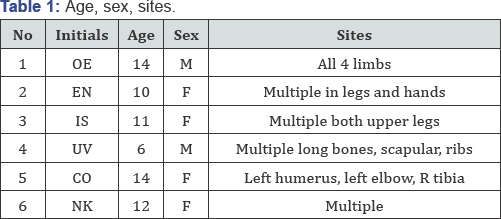
Table 1 on the whole, the patients were aged from 6 to 14 years (mean 11 years). The female/male ratio was 2:1. Multiplicity of sites was striking. The specimens measured 1 cm to3 cm. Incidentally, only two patients were X-Rayed
Discussion
A Norfolk, USA, group stated that these exostoses are uncommon in the hand [4]. There were 2 examples here. In a French book [5], these exostoses were commonest in males. This is contrary to my experience. From the Netherlands [6], these tumors are mostly formed along the long bones of the extremities. The present series is of this distribution. Unlike the local childhood cases, a USA 54-year-old male was presented twice curiously [7].
References
- Jaffe HL (1958) Tumors and timorous conditions of the bones and joints. Lea & Febiger, Philadelphia, USA, pp. 150.
- Macartney JC, Rollaston TP, Codling BW (1980) Use of a histopathology data pool for epidemiological analysis. J Clin Pathol 33(4): 351-353.
- Basden GT (1966) Niger Ibos. Cass, London, UK.
- Karr MA, Aulicino PL, Dupuy TE, Gwathmey FW (1984) Osteochondromas of the hand in hereditary multiple exostosis: Report of a case presenting as a blocked proximal interphalangeal joint. J Hand Surg 9(2): 264-268.
- Mazabraud A (2008) Osteogenic Exostosis (Osteochondroma), Multiple Exotoses, Subungual Exostosis, Metachondromatosis. Pathology of Bone Tumours, Heidelberg: Springer-Verlag Berlin H p. 63-75.
- Bovee JV (2008) Multiple osteochondromas. Orphan J Rare Dis 3:3.
- Shtomakher G, Kaufman MA, Bhoola PH, Patel AA, Rice SM, et al. (2015) Multiple osteocartilaginious exostoses of the lower extremity: A case report. Foot 25(1): 62-65.

























