




 CTBEB Home



Abstract
Immobilization of enzymes, particularly, the soluble enzymes is key for the purpose of efficiency and robust commercial utilization. The high demand in the utilization of immobilized enzymes in numerous industrial processes arise due to the huge advantages immobilized enzyme provides. A number of these advantages includes, good enzyme recovery, enhanced enzymatic stability in extreme conditions of pH, temperature and in organic solvents as well as improved enzyme reutilization and reuse. Numerous immobilization techniques have been developed as a vehicle for enzyme recovery. These immobilization techniques includes, adsorption onto an insoluble carrier, entrapment in a polymeric matrix, cross linking with a bifunctional reagent and covalent linking to an insoluble solid material. Enzyme recovery by immobilization is the new route for the production of many useful industrial products.
Keywords: Enzyme recovery, adsorption, entrapment, crosslinking, covalent linking, immobilization.
Introduction
The major challenge in the utilization of soluble enzymes relates to their cost of production, recovery and possible reutilization. These challenges can be circumvented by immobilization of soluble enzymes onto an inert insoluble support medium. Enzyme immobilization is the process of confining or attaching enzyme molecules to a support carrier or medium. Enzyme recovery by immobilization is a unique technique for increasing the availability of the enzyme to the substrate, which results in a greater turnover of products over a considerable period of time [1,2]. Enzymes are naturally robust and efficient as they can be utilized for the production of many different molecules that have a wide range of applications [3]. Enzyme recovery by immobilization has become the new route for the production of many useful industrial products [4].The recovery of soluble enzymes bythe process of enzyme immobilization onto an inert insoluble material is currently reported to be an active area of research because immobilized enzymes have shown to be recoverable, reusable and more stable than soluble ones. These characteristics are often desired features of enzymes for commercial utilization [5,6]. Enzyme recovery by immobilization also improves the duration of usage of soluble enzymes [7]. The main advantage of enzyme recovery by immobilization lies in the reusability of the enzyme for several times and the easy separation of the immobilized enzyme from the reaction mixture [8]. Enzyme immobilization is thus a reliable technique to enhance enzyme recovery, stability and reuse [9].
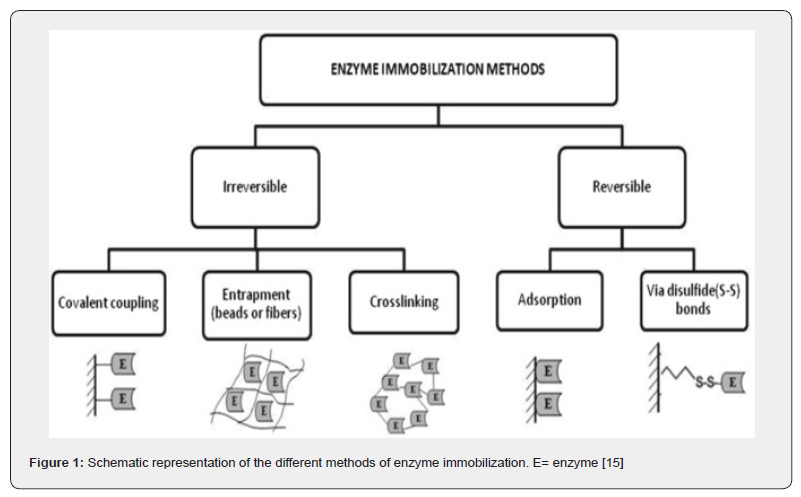
An immobilized enzyme is described as an enzyme physically confined at or localized in a certain region of space with retention of its catalytic activity and which can be utilized repeatedly and continuously over a period of time [10,11].The immobilization of enzyme has helped to prevent and reduce the contamination of the substrate with the enzyme or other compounds. Enzyme recovery by immobilization has made immobilized enzymes highly applicable to a range of evolving biotechnologies.There are many different methods reported through which soluble enzymes can be immobilized. However, for industrial utilization, simple and cost-effective methods are most preferred. The most used methods are based on physical immobilization (adsorption or physical entrapment) and chemical immobilization (covalent binding and cross linking) [2,4]. The enzyme immobilization techniques include; adsorption onto an insoluble carrier [5], entrapment in a polymeric matrix, cross linking with a bifunctional reagent and covalent linking to an insoluble solid material [12]. Enzyme immobilization methods are mainly grouped into; Physical or reversible method and Chemical or irreversible methods (Figure 1). Physical methods have weak interactions between the immobilization support and the enzyme, while the chemical methods involve the formation of covalent bond between the immobilization support and the enzyme [13]. The choice of immobilization technique is very important as it prevents the loss of enzyme activity by not interfering with the reactive groups in the enzyme active site.
Enzyme immobilization by adsorption
Enzyme immobilization by adsorption is based on weak forces (e.g., ionic bonds, hydrogen bonds, van der Waals forces, hydrophobic bonding or salt linkages) of interaction between the enzyme and the immobilization support but still achieving an efficient binding process [14].
In this method of immobilization, the support material is often dipped or immersed into the enzyme solution for enough time to let it physically adsorbed [1]. The major advantage of enzyme immobilization by adsorption is the reversibility of the reaction process, and the little or no damage to the enzyme or cell [15]. Similarly, the most significant disadvantage of enzyme immobilization by adsorption is the existence of desorption, which could occur under changes in pH, temperature and also ionic strength. Desorption could also result from a number of physical factors, such as, flow rate, agitation and particle-particle collisions [16]. Immobilization by adsorption is the cheapest and simplest forms of enzyme immobilization [17].
Enzyme Immobilization by entrapment
Enzyme Immobilization by entrapment involves the restriction or detention of enzymes within polymeric gels, beads or fibers by covalent or non-covalent interactions [1]. It is based on incorporating enzymes into the lattices of a semi permeable gel or enclosing enzymes in a semi permeable polymer membrane [18]. A typical type of enzyme immobilization by entrapment is encapsulation (Figure 1), in encapsulation; the enzymes are restricted within the membrane walls, usually in a form of a capsule [19]. A major disadvantage of enzyme immobilization by the entrapment and encapsulation methods is the challenge of diffusion limitations. Entrapment has been reported to be broadly utilized for the immobilization of cells more than for enzymes because the enzyme activity could be lost during repeated or continuous use due to the small molecular size of enzyme compared to the cells [6].
Enzyme immobilization by covalent binding
Enzyme immobilization by covalent binding consists of the formation of covalent bonds between the enzyme and the immobilization support (Figure 1). It involves covalent bond formation between the functional groups present on the surface of the immobilization support and the surface functional groups of the enzyme.
Covalent immobilization consists of two steps: first is the activation of functional groups found on the surface of the immobilization support by a specific reagent, and the second is the addition of the enzyme to form covalent bond with the activated surface of the immobilization support. The attachment between the enzyme and the support material can be achieved either through direct linkage or through the spacer arm. The utilization of the spacer arm is preferably, because it provides greater degree of mobility to the enzymes hence the enzymes show higher enzyme activity when compared to the direct attachment. Furthermore, enzyme immobilization by covalent binding is based on the utilization of different amino acid side chain residues of the enzyme in the formation of covalent bond with the immobilization support [1]. Immobilization by covalent method also depends largely on the stability of the bonds formed between the enzyme and the immobilization support, which prevents enzyme release into the environment. A type of covalent immobilization is Cross Linking. This method is widely used for enzyme recovery by immobilization and it is based on intermolecular interactions of enzymes using bi-functional or multi-functional reagents [20]. Immobilization by cross linking does not require a support and this is the major advantage of this method.
Conclusion
Enzyme recovery by immobilization is a useful technique for the enhancement of the properties of enzymes particularly their reusability, reutilization and stability.
References
- Sikander A, Wajeeha Z, Sammia S, Mehvish M (2017) Enzymes immobilization: An overview of techniques, support materials and its applications. International Journal of Scientific and Technology Research 6: 64-72.
- Bernal C, Rodríguez K, Martinez R (2018) Integrating enzyme immobilization and protein engineering: an alternative path for the development of novel and improved industrial biocatalysts. Biotechnological Advances 36(5): 1470-1480.
- Rodrigues RC, Virgen OJJ, Santos JC, Berenguer MA, Alcantara AR, et al. (2019) Immobilization of lipases on hydrophobic supports: immobilization mechanism, advantages, problems, and solutions. Biotechnological Advances 37(5): 746-770.
- Alessandra B, Simona S (2019) Industrial applications of immobilized enzymes - A review. Molecular Catalysis 479: 1-20.
- Zheng MM, Lu Y, Huang FH, Wang L, Guo PM, et al. (2013) Lipase immobilization on hyper cross linked polymer coated silica for biocatalytic synthesis of phytosterol esters with controllable fatty acid composition. Journal of Agriculture and Food Chemistry 61(1): 231-237.
- Kuoa C, Liub Y, Changb C, Chenc J, Changa C, et al. (2012) Optimum conditions for lipase immobilization on chitosan-coated Fe3O4 nanoparticles. Carbohydrate Polymers 87(4): 2538-2545.
- Gorecka E, Jastrzebska M (2011) Immobilization techniques and biopolymer carriers. Biotechnology and Food Science 75: 65-86.
- Sanaa TE, Nagwa IO, El Sayed ME, Wafaa GS (2017) Immobilization of pepper chitosanase on different natural carriers for improving enzyme stability. Saudi Journal of Medical and Pharmaceutical Sciences 3(11): 1222-1229.
- Zdarta J, Meyer AS, Jesionowski T, Pinelo M (2018) A general overview of support materials for enzyme immobilization: Characteristics, properties, practical utility. Catalysts 8: 1-27.
- Doaa ARM, Wafaa AH (2009) Potential application of immobilization technology in enzyme and biomass production. Journal of Applied Sciences Research 5: 2466-2476.
- Thirumavalavan A, Lee H (2015) A short review on chitosan membrane for biomolecules immobilization. Journal of Molecular and Genetic Medicine 9: 1-5.
- Koszelewski D, Muller N, Schrittwieser JH, Faber K, Kroutil W, et al. (2010) Immobilization of transaminases by encapsulation in a sol gel / celite matrix. Journal of Molecular Catalysis and Enzyme 63(1-2): 39-44.
- Sulek F, Fernandez DP, Knez Z, Habulin M, Sheldon RA (2011) Immobilization of horseradish peroxidase as cross-linked enzymes aggregates (CLEAs). Process Biochemistry 46(3): 765-769.
- Elnashar MM, Danial EN, Awad GE (2009) Novel carrier of grafted alginate for covalent immobilization of inulinase. Industrial and Engineering Chemistry Research 48 (22): 9781-9785.
- Ahmad R, Sardar M (2015) Enzyme immobilization: an overview on nanoparticles as immobilization matrix. Analytical Biochemistry 4(2): 1-8.
- Hoda JM, Mohammad AJ, Aydin B (2012) Potential applications of chitosan nanoparticles as novel support in enzyme immobilization. American Journal of Biochemistry and Biotechnology 8(4): 203-219.
- Hassan ME, Tamer TM, Omer AM (2016) Methods of enzyme immobilization. International Journal of Current Pharmaceutical Review and Research 7: 385-392.
- Lei CX, Hu SQ, Shen GL, Yu RQ (2003) Immobilization of horseradish peroxidase to a nano-Au monolayer modified chitosan-entrapped carbon paste electrode for the detection of hydrogen peroxide. Talanta 59(5): 981-988.
- Briones AV, Sato T (2010) Encapsulation of glucose oxidase (GOD) in polyelectrolyte complexes of chitosan-carrageenan. Reactive Functional Polymers 70: 19-27.
- Seo DJ, Janga YH, Park RD, Junga WJ (2012) Immobilization of chitinases from Streptomyces griseus and Paenibacillus illinoisensis on chitosan beads. Carbohydrate Polymers 88(1): 391-394.

























