




 CTBEB Home



Abstract
High-throughput genomic sequencing generates vast amounts of data, yet the interpretation of individual-genetic variants remains hindered by the dispersion of relevant evidence across various databases. We present a modular, web-based framework (GenomeVAP) designed for deterministic evidence integration in genomic research. Unlike machine learning models that often introduce noise into genomic annotations or rely on opaque predictive thresholds, GenomeVAP utilizes a weighted, rule-based scoring methodology to synthesize evidence from primary repositories, including ClinVar,[1] dbSNP,[2] Ensembl,[3] and the GWAS Catalog.[4] We evaluate the framework's efficacy through representative batch entries of clinically significant variants, demonstrating that centralized, automated retrieval reduces manual querying time while maintaining high transparency and reproducibility. GenomeVAP is intended exclusively as a bioinformatics software framework to aid interpretation in healthcare and academic research fields17.
Keywords: Genome, Variant Interpretation; Bioinformatics; Deterministic Scoring; Evidence Integration; Genomic Research; API / Application Programming Interface; Automated Report Generation
Introduction
The rapid advancement of high-throughput genomic sequencing technologies has outpaced the development of standard interpretation pipelines.[5] For genomic researchers, the identification of a variant is only the initial step in a complex workflow.[5] The subsequent characterization of these variants requires the synthesis of heterogeneous data from siloed biological repositories, such as ClinVar for clinical significance,[1] dbSNP for nomenclature and identifiers,[2] and the GWAS Catalog for trait associations.[4] This fragmentation creates a substantial "manual search bottleneck," where researchers must query multiple interfaces to compile a single comprehensive profile for a variant of interest.
This process is inherently time-consuming and prone to human error, particularly when managing large datasets. Current computational approaches for variant interpretation frequently rely on machine learning or black-box predictive models [6-8] (A black-box predictive model is an AI or machine learning system whose internal decision-making process is hidden from users, who can only see inputs and outputs). While these methods offer speed, they often obscure the underlying evidence, making it difficult for researchers to audit the provenance of the final annotation. Furthermore, these probabilistic models can introduce latent noise, complicating the distinction between variants of interest.
To address these challenges, we propose GenomeVAP, a deterministic ‘evidence integration’ framework. By utilizing a weighted, rule-based approach rather than probabilistic inference, the framework provides a transparent, reproducible pipeline for retrieving and consolidating genomic data.
Materials and Methods
GenomeVAP, our deterministic ‘evidence integration’ framework, is designed to streamline genome data from varied definite databases into a single portal and ensure that all research annotations are directly traceable to their source data. This paper outlines GenomeVAP’s system architecture, detailing the integration of its major analysis modules, and demonstrating the framework's utility through representative entries.
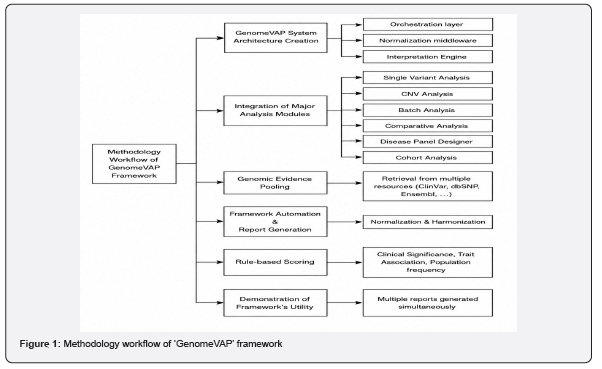
The following figure (Figure 1 depicts the methodology workflow of ‘GenomeVAP’ framework.
Architecture Creation
The GenomeVAP framework is structured as a modular, web-based application utilizing a Python Flask backend,[9] chosen for its scalability and ease of integration with diverse APIs (Application Programming Interface). The system architecture is organized into three distinct layers to ensure robust data handling:
a) Orchestration Layer: Manages asynchronous requests to NCBI E-utilities [10] and EBI Ensembl endpoints.[3]
b) Normalization Middleware: Maps heterogeneous API responses to a standardized internal schema.
c) Interpretation Engine: Applies rule-based scoring (non-probabilistic).
Integration of Major Software Analysis Modules
GenomeVAP integrates several specific modules to support diverse research requirements intended for automated report generation. Such modules considered for this framework include,
a) Single Variant Analysis: The primary module accepts a unique variant identifier (e.g., rsID or chromosomal coordinate) and retrieves all associated data from registered sources.
b) CNV Analysis: Dedicated module for assessing Copy Number Variants (CNVs), enables the retrieval of overlapping gene annotations [11] and phenotypic associations of structural variations.
c) Batch Analysis: Facilitates high-throughput processing by allowing users to upload CSV or VCF files containing multiple variants, which are then queued for sequential retrieval and normalization.
d) Comparative Analysis: Provides a side-by-side interface for contrasting two or more variants, allowing researchers to visualize differences in trait associations or clinical significance scores.
e) Disease Panel Designer: Allows users to filter evidence through customizable panels (e.g., cardiovascular disease, metabolic syndrome), focusing retrieval on specific gene sets or phenotypic associations [12,13].
f) Cohort Analysis: Aggregates findings across a set of processed samples, enabling the identification of common variant profiles within specific user-defined groups.
Genomic Evidence Pooling
Retrieval from multiple resources
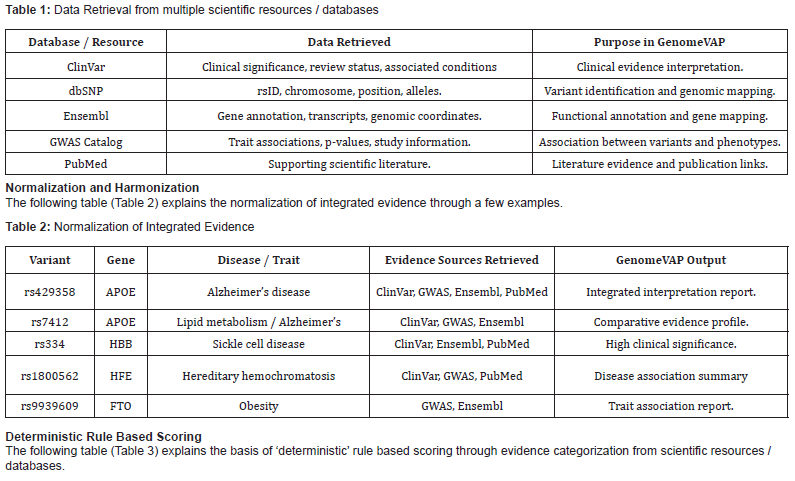
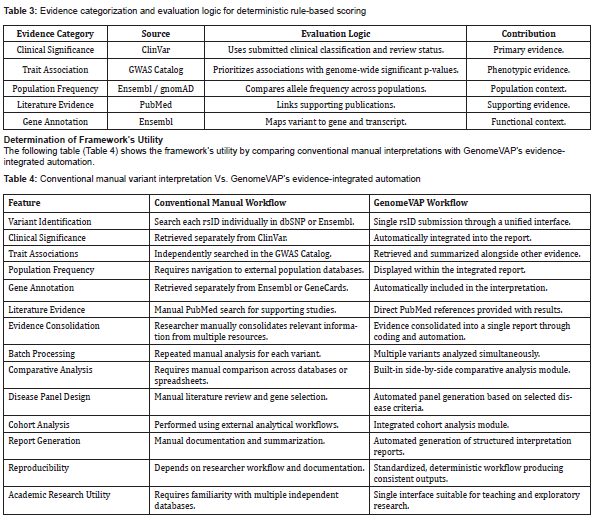
The following table (Table 1) elaborates the nature of data retrieved from databases / scientific resources and their purpose in GenomeVAP’s framework.
Findings and Discussion
GenomeVAP effectively mitigates the manual search bottleneck inherent in genomic variant analysis. By integrating evidence from disparate databases into a unified, deterministic framework, it provides a reproducible alternative to opaque, probabilistic models. Its deterministic nature of the scoring system ensures that researchers can trace every calculation back to the original source data, a credible feature for scientific transparency in academic and healthcare research settings.
Comparing this automated approach to manual interpretation reveals clear advantages. Manual interpretation often requires a researcher to synthesize information across browser tabs and multiple database interfaces, a process susceptible to fatigue and inconsistent data evaluation. GenomeVAP standardizes this process, ensuring that every variant is subjected to the same rule-based scoring criteria. GenomeVAP provides a reproducible, transparent, and efficient research environment for the deterministic integration of genomic variant data. By centralizing evidence retrieval and standardizing output, the framework empowers researchers to focus on analysis rather than data acquisition.
Limitations and scope for further research
The GenomeVAP framework, however, remains subject to the inherent limitations of external API availability. Reliance on NCBI [10] and EBI [3] endpoints means that service outages or API updates may impact functionality. Most importantly, this framework is exclusively meant for improving time economy and limiting the cumbersomeness of manual effort in genome variant analysis. Hence, it does not claim clinical decision support. Future research should focus on tackling service outages, improving API resilience and expanding the supported evidence sources. The GenomeVAP framework was evaluated using representative genomic variants with well-characterized biological and clinical associations to demonstrate its functionality and utility. Upon submission of a variant through either an rsID [2] or chromosomal coordinate, the framework retrieves evidence in parallel from multiple genomic resources, including ClinVar,[1] dbSNP, [2] Ensembl,[3] GWAS Catalog,[4] and PubMed.[14] The retrieved information is normalized into a unified internal schema, integrated through a deterministic rule-based evidence synthesis pipeline, and presented as a comprehensive interpretation report. The modular architecture, comprising the presentation layer, Flask-based orchestration layer,[9] evidence integration engine, and report generation module, enables seamless retrieval and consolidation of genomic annotations, clinical significance, population frequencies, trait associations, gene context16, biological pathways [15], pharmacogenomic information, and supporting literature. In addition to single-variant interpretation, GenomeVAP supports simultaneous comparison of multiple variants through an integrated comparative analysis module, facilitating side-by-side evaluation of gene annotations, evidence confidence, clinical relevance [16,17], and prioritization metrics. The framework further extends its functionality through a Disease Panel Designer, which automatically prioritizes candidate genes by integrating genomic evidence, literature support, and deterministic scoring, thereby generating evidence-based panels suitable for research and educational applications. Together, these integrated modules demonstrate the framework's ability to centralize fragmented genomic evidence into a unified, interactive, and human-readable platform that supports efficient exploratory genomic analysis while reducing the need for repetitive manual database searches. [18-21]
References
- Landrum MJ, Lee JM, Benson M, Garth RB, Chen C, et al. (2018) ClinVar: improving access to variant interpretations and supporting evidence. Nucleic Acids Research 46(D1): D1062-D1067.
- Sherry ST, Ward MH, Kholodov M, J Baker, L Phan, et al. (2001) dbSNP: the NCBI database of genetic variation. Nucleic Acids Research 29(1): 308-311.
- Howe KL, Achuthan P, Allen J, Jorge AJ, Irina MA, et al. (2021) Ensembl 2021. Nucleic Acids Research 49(D1): D884-D891.
- Buniello A, MacArthur JAL, Cerezo M, Laura WH, James H, et al. (2019) The NHGRI-EBI GWAS Catalog of published genome-wide association studies. Nucleic Acids Research 47(D1): D1005-D1012.
- Richards S, Aziz N, Bale S, David B, Soma D, et al. (2015) Standards and guidelines for the interpretation of sequence variants: a joint consensus recommendation of the American College of Medical Genetics and Genomics and the Association for Molecular Pathology. Genetics in Medicine 17(5): 405-424.
- Rentzsch P, Witten D, Cooper GM, Shendure J, Kircher M, et al. (2019) CADD: predicting the deleteriousness of variants throughout the human genome. Nucleic Acids Research 47(D1): D886-D894.
- Adzhubei IA, Schmidt S, Peshkin L, Vasily ER, Anna G, et al. (2010) A method and server for predicting damaging missense mutations. Nature Methods 7(4): 248-249.
- Pauline CNg, Henikoff S (2003) SIFT: predicting amino acid changes that affect protein function. Nucleic Acids Research 31(13): 3812-3814.
- Grinberg M (2018) Flask Web Development. 2nd ed. O'Reilly Media.
- Sayers EW, Beck J, Brister JR, Devon B, James RB, et al. (2024) Database resources of the National Center for Biotechnology Information. Nucleic Acids Research 49(D1): D10-D17.
- McLaren W, Gil L, Hunt SE, Harpreet SR, Graham RSR, et al. (2016) The Ensembl Variant Effect Predictor. Genome Biology 17(1): 122.
- Köhler S, Gargano M, Matentzoglu N, Leigh CC, David LS, et al. (2021) The Human Phenotype Ontology in 2021. Nucleic Acids Research 49(D1): D1207-D1217.
- Musen MA, Bean CA, Cheung KH, Patricia LW, Christopher GC, et al. (2012) The National Center for Biomedical Ontology. Journal of the American Medical Informatics Association 19(2): 190-195.
- Canese K, Weis S (2013) PubMed: the bibliographic database. In: The NCBI Handbook. National Center for Biotechnology Information.
- The Gene Ontology Consortium (2021) The Gene Ontology Resource: enriching a gold mine. Nucleic Acids Research 49(D1): D325-D334.
- Li MM, Datto M, Duncavage EJ, Shashikant K, Neal IL, et al. (2017) Standards and guidelines for the interpretation and reporting of sequence variants in cancer: A Joint Consensus Recommendation of the Association for Molecular Pathology, American Society of Clinical Oncology, and College of American Pathologists. Journal of Molecular Diagnostics 19(1): 4-23.
- Good BM, Ainscough BJ, McMichael JF, Joshua FMM, Adam CC, et al. (2020) The CIViC knowledgebase for expert crowdsourcing the clinical interpretation of variants in cancer. Nature Genetics 49(2): 170-174.
- Karczewski KJ, Francioli LC, Tiao G, Beryl BC, Jessica A, et al. (2020) The mutational constraint spectrum quantified from variation in 141,456 humans. Nature 581: 434-443.
- Cock PJA, Antao T, Chang JT, Brad AC, Cymon JC, et al. (2009) Biopython: freely available Python tools for computational molecular biology and bioinformatics. Bioinformatics 25(11): 1422-1423.
- Uni Prot Consortium (2023) Uni Prot: the Universal Protein Knowledgebase in 2023. Nucleic Acids Research 51(D1): D523-D531.
- Rehm HL (2017) Evolving health care through personal genomics. Nature Reviews Genetics 18(4): 259-267.

























