




 CERJ Home



Abstract
The nonpoint-source pollution (from stormwater runoff) is a persistent, ubiquitous environmental challenge, rarely linked to the formerly industrial and currently blighted sites impacting the watershed as a whole-river, creek, stream, and lake. This shortcoming is particularly prevalent in the legacy, post-industrial city, characterized by abandoned industrial sites slated for cleanup. We develop a GIS-aided procedure to (a) map the whereabouts of industrial sites, and (b) identify site-specific pollutants also found in waterbodies in proximity. For our case study, we map industrial sites in various stages of cleanup per U.S. Environmental Protection Agency classification-brownfield, superfund, and national priority list (NPL).
It turns out, the 3/4-mile buffer zones centered on industrial sites with water permit also contain water quality monitoring stations, thereby meeting the spatial search criteria of proximity of the industrial site to the waterbody (river, creek, and lake) as well as to the station that gauge’s water quality. Interactive spreadsheets identify industrial site pollutant quantity and type in common with waterbodies. Thereby, the watershed environmental quality holistically linked to industrial activity is monitored, with implications for site-specific physical design interventions that mitigate pollutants and toxin runoff in waterbodies and promote public health.
Keywords:Industrial Activity; Nonpoint Source Pollution; Watershed Toxicity; Environmental Impact; GIS
Abbreviations: NPS: Nonpoint Sources; CWA: Clean Water Act; PCBs: Polychlorinated Biphenyls; EPA: Environmental Protection Agency
Highlightsa) The nonpoint source pollution (NPS) is a persistent, ubiquitous environmental challenge.
b) NPS is rarely linked to toxic industrial sites, impacting the watershed quality holistically.
c) A GIS-aided procedure maps the whereabouts of toxic industrial sites in proximity to waterways and water quality monitoring stations.
d) We find industrial site pollutants also present in waterways in proximity, identified by type and quantity with interactive spreadsheets.
e) Findings indicate monitoring industrial activity and waterbodies holistically, with site-specific physical, landscape interventions that mitigate
pollutant and toxin runoff, promoting public health.
Introduction
Nationwide more than 85% of the U.S. rivers and streams, and 80% of reservoirs and lakes are polluted by Nonpoint Sources (NPS). (Lei et al. 2021, USEPA [1] & US Geological Survey [2]); Xie et al. [3] for a global survey of the NPS). Nonpoint source pollution results from rainfall or snowmelt moving over and through the ground, picking up and carrying pollutants like sediment, oil, and nutrients, which are then deposited into water bodies. This type of pollution is significant as it harms aquatic ecosystems, affects water quality, and contributes to harmful algal blooms and ocean acidification Zhao et al. [4], USGAO 2022 & USEPA [5]. The Clean Water Act (CWA), notably amended in 1987, addresses NPS pollution through the Section 319 Nonpoint Source (NPS) Program. This program assists states, territories, and tribes in implementing measures to prevent and manage NPS pollution, although managing these diffuse sources remains a challenging task USEPA [6] & USEPA [7]. Daniels & Daniels [8] note, notwithstanding the Clean Water Act, “in 2000, about 40 percent of America’s waterbodies were still not fit for drinking or swimming; and about four out of every five U.S. residents were living within ten miles of a polluted lake, river, stream or coastal area.” Xie et al. [3] global bibliometric analytical survey.) Memphis and Shelby County is home to many abandoned industrial properties that impact the watershed CRA, 2023; Lewis [9]. Recent research on the impact of industrial blight Banai & Ploderer [10]; Banai & Momeni [11] provided the impetus to explore the environmental impact of industrial activity in proximity to waterbodies in Memphis, Shelby County Tennessee.
The historic location of industry in proximity to waterbodies and floodplains is a generally known urban form, albeit rarely conceptually considered as a determinant of the analytic methods’ spatial criteria in mapping the nonpoint source pollution in the watershed. Furthermore, the nonpoint-source pollution targeted particularly to the formerly industrial and currently blighted sites slated for clean up or remediation in a legacy city impacting the watershed is rarely recorded in the literature. What specific type and quantity of the industrial site contaminants with various EPA remediation classification is linked to the waterbodies in proximity, and what are the environmental consequences?. In the section that follows we develop a mapping procedure to identify the type and quantity of pollutants that are in abandoned or active industrial sites and the nearby waterbodies-river, creak, and lake. Our GIS-aided mapping of industrial sites is enabled by data available in the public domain from the U.S. later below. We organize data on pollutants in waterbodies and indusial sites interactively by spreadsheets linking pollution data from industrial sites by current EPA-designated status and the water bodies. We start with a brief review of observational methods of analysis and mapping of NPS pollution in the watershed.
Methods and Materials
Our case study focus is like those that aim to examine the impact of NPS pollution in the watershed like a bay or river Saba & Su [12]; Hoogestraat 2015; Celen et al. 2022; Lin et al. [13]. By pointing to upland activities as sources of pollutants the relevance of spatial mapping tools like GIS which we also use is realized Saba & Su [14]. Spatial mapping tools like GIS augment multicriteria analysis methods that streamline or structure the multiple drivers of NPS pollution Corwin et al. [15]; Loague et al. [16]; Siverturn &Prause, 2003; Guo et al. [17]; Liu et al. [18]; Eisakhani et al., 2009). However, spatial analytical methods of tracking NPS pollution rarely pay attention to where industry is historically legally permitted to locate in the region in relation to the waterbodies in proximity. Thereby, industrial sites (source pollution) particularly the former industrial and currently blighted, designated for cleanup as “brownfield” or Superfund sites are plausibly considered as a driver of NPS pollution in the waterbodies and floodplains in proximity. Our approach is a GIS-aided mapping that locates industrial sites in proximity to the waterbodies. GIS is a spatial analysis and visualization tool applied in a wide variety of fields.
It is used as a watershed assessment tool (Naranjo [19]; Miller et al., 2007; Loague et al. [16]; Liu et al. [18]; Kim et al. [20]; Liu et al. [18]. GIS assisted interactive mapping tools for NPS on the web adopted by local (state) environmental protection agencies serve a variety of general purposes including local community capacity building, funding, showcasing exemplary, “inspirational,” restoration and proactive action plans that prevent, monitor, and/or mitigate NPS pollution in the watershed (MassDEP, NJDEP, TCEQ). However, what industrial pollutants are also found in waterbodies requires site-specific mapping that generic, web-based NPS tools do not provide. Furthermore, the watershed impact of NPS pollution is rarely inclusive of the watershed’s connected waterbodies holistically. Our GIS-aided, interactive spreadsheet fills this void in the literature, identifying the industrial site pollutants also found in the waterbodies--river, creek, stream, lake--as a connected ecosystem. The GIS spatial buffer tool described below is particularly useful in a Boolean search with multiple criteria and site attributes. It turns out, 3/4-mile buffer zone centered on EPA-designated industrial sites also contains the location of the sites with water permit as well as water quality monitoring stations.
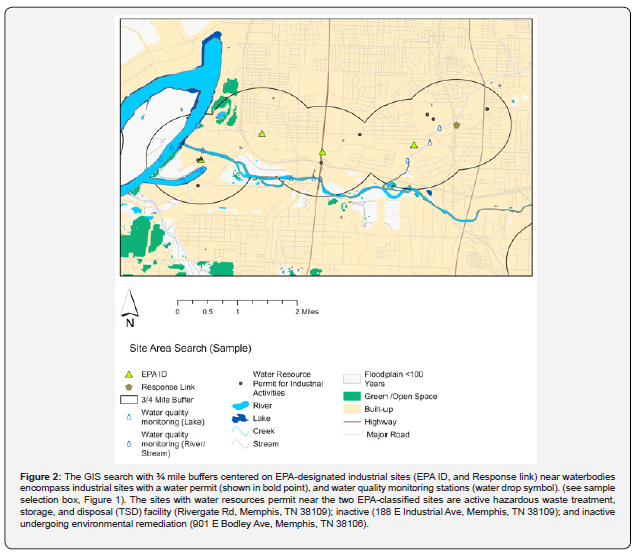
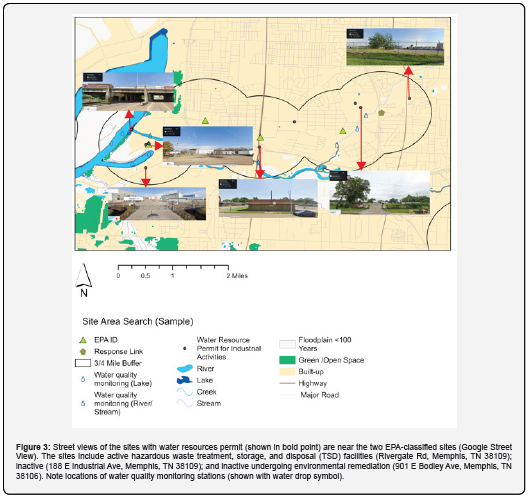
Thereby, the spatial search criteria of the proximity of the industrial site to the waterbody (river, creek, and lake) as well as to the station that gauge’s water quality are met. Industrial sites that impact water resources require a permit from TDEC (Figure 2, and Figure 3). The significance of the ¾ mile distance search for targeted, EPA-industrial sites among the sites that impact water resources (watershed) is indicated. The extent of spatial search is determined by the type of pollutant that is mapped. For example, Ma & Tong [21] use a 1-km distance in mapping air pollution impact (for similar GIS and Web-integrated applications, see also Giglione et al. [22]; Hochstein & Szczur [23]; Vieux & Needham [24]. The ¾ mile buffer centered on industrial sites encompass water quality monitoring gauges that likely register the impact of industrial site activity with NPS pollution in proximity. Pollutants in industrial sites that are also found in the waterbodies in proximity are highlighted by type and proportion within interactive spreadsheets by each body of waterway analyzed with available data-river, creek, and lake. Our GIS-aided procedure is a simple tool to aid environmental monitoring and public decision making that aims to improve the quality of the watershed in conjunction with the state of industrial site remediation in the city and the region. We conclude with a discussion of the environmental and public health consequences of pollutants.
Data and Mapping Methodology
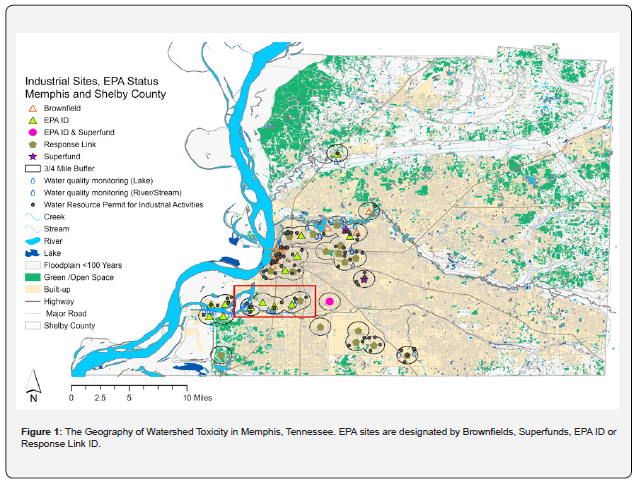
The methods applied to the problem of NPS pollution in the watershed are a wide variety of deterministic, probabilistic, sce nario-based, simulated, and GIS-aided techniques (e.g. USEPA [25], Clement et al. [26]; Lee & Jones‐Lee [27], Kaushal et al. [28], Hoogestraat 2015, Altenburger et al., Celen et al. 2022). Primary data collection is a common feature. Our method of mapping NPS pollution in the watershed linked to industrial activity is developed with environmental data available in the public domain, outlined below, illustrated with a case study of Memphis and Shelby County Tennessee (Figure 1). A GIS aids in mapping the whereabouts of industrial sites based on U.S. EPA classification. The historical location of industry in proximity to waterbodies is a clue in the selection of the geographical extent. A second clue is a legal (permit) one- “water resources permit for industrial sites” data from Tennessee Department of Environment and Conservation (TDEC). Thus, we include waterbodies, floodplains, and (site) permits as map features. We give an outline of steps taken in retrieving, preparing data and mapping watershed toxicity with industrial activity.
Data Acquisition and Preparation
I. Obtained water resources permit data (2024) and water
monitoring stations data (2024) from the Tennessee department
of Environment and Conservation (TDEC). Industries that impact
water resources with storm water discharge require a permit
from the Tennessee Department of Environment and Conservation
(TDEC). Surficial hydrology (surface waters, streams, rivers,
lakes, reservoirs, and wetlands) is gauged in water quality monitoring
stations (TDEC).
II. Retrieved industrial location address data from TDEC
information resource page (2020).
III. Performed geocoding with latitude and longitude from
the addresses of the location of the industries with EPA status and
water resources permit.
GIS Operation
a. Displayed the geocoded data for water resource permits
by importing XY data into the GIS software and exported these as
point features.
b. Created a ¾-mile buffer zone around each industry location
to assess the proximity of water monitoring stations and
water resources permits. The spatial search with ¾ mile buffers
encompasses industrial sites near waterbodies, permitted location
of industry, and water quality monitoring station. (Figure 1).
Analysis and Mapping
a) Utilized the ArcGIS Pro’s Selection by Location tool to
identify and review all water monitoring stations and water resource
permits within the ¾-mile buffer zones (Figure 2).
b) Compiled and arranged the findings to prepare the final
map, clearly marking the buffer zones and relevant features.
Brownfields are locations that have industrial or commercial sites where any future use is affected by environmental contamination. EPA IDs are the ID numbers of sites designated for cleanup that are in process or complete. Response Link IDs are numbers for sites that the EPA has designated for the removal of waste. Superfunds are sites that have a fund set up to establish financing cleanup of environmental contamination.
Results
Pollutants Identified in Industrial Sites in common with Waterbodies
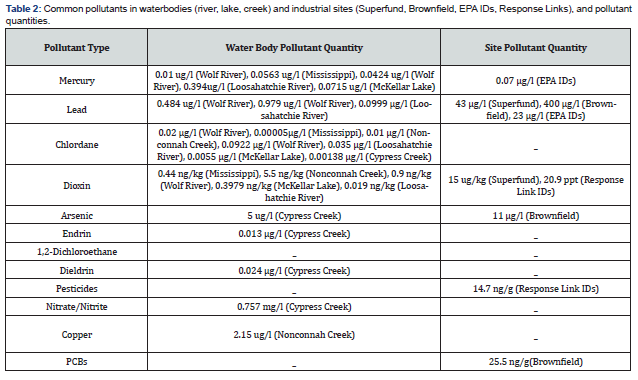
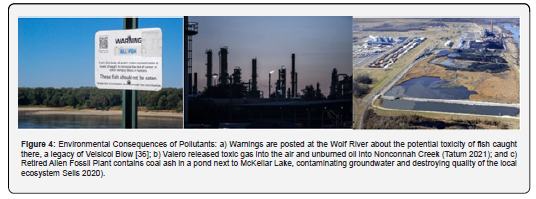
What pollutants in industrial sites (e.g., Superfund, National Priority List) are also found in waterbodies-River, Creek, Lake? We developed spreadsheets that display pollutants data identified by industrial sites by EPA classification interactively in common with the water bodies (Figure1) EPA site classification). For brevity, we highlight results from Cypress Creek, excluding other waterbodies, which we also observed. Polychlorinated Biphenyls (red color) is linked to a Brownfield, in parentheses. Cyprus Creek is highlighted since it is a source of flooding in the abutting city neighborhood (Table1). For perspective on toxicity, compare Superfund and brownfield site contaminant type and quantity. These are the former industrial sites that are abandoned (blight ed), designated for the clean-up of the toxic waste before the site is redeveloped. In brownfield, we find PCB: 25.5 mg/kg (25,500 ug/kg) (5.71%); Lead: 400 mg/kg (400,000 ug/kg) (89.57%); Arsenic: 11 mg/kg (25,500 ug/kg) (5.71%); Metals: 10 mg/kg (10,000 ug/kg) (2.24%), (EPA 2024). In Superfund, Lead: 43 mg/ kg 43,000 ug/kg (81.09%); Asbestos: 0.0400000 ppb (0.04 ug/ kg) (~0%); Soil Bioavailability: 10000 ug/kg (18.86%); Dioxin: 15 ug/kg (0.0283%); Radiation: 2.4 pCi/g (EPA 2013) (Table2). The pollutants identified in our industrial sites and waterbodies are linked to a wide-ranging impact, including environmental/economic/ public health/marine life, groundwater, crops or farming also observed in the literature (Harrington et al. [29]; Clement et al. [26]; Luo et al. [30]; Allan et al. [31]; Hoogestraat 2015; Merrit, 2017; Spearing-Bowen & Schneider, 2017; Ghosh et al., 2022; Feng et al., 2023; Li et al., 2010; Lin et al., 2023) (Figure 4).
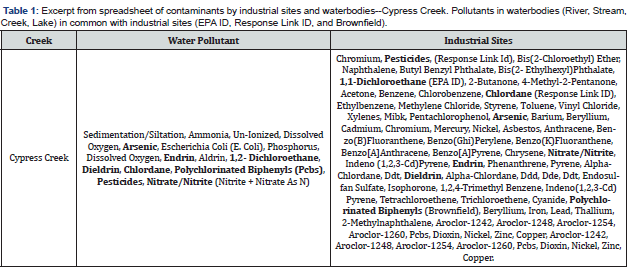
Pollutant data for industrial sites in common with the rest of major water bodies in Memphis are available upon request. They include Nonconnah Creek, McKellar Lake, and Mississippi River.
Potential Toxic Elements
We highlight toxicity of NPS pollutants observed in our data
by associated impacts recorded in literature.
a) Heavy metals like, cadmium (Cd), chromium (Cr), copper
(Cu), iron (Fe), manganese (Mn), nickel (Ni), potassium (K),
phosphorus (P), sodium (Na), sulfur (S) and zinc (Zn)
a. Aquatic and terrestrial environments (water and soil)
(Abbas et al, 2023)
b) Polycyclic aromatic hydrocarbons (PAHs)
a. Public health (high cancer risk) (Allan et al. [31])
c) Metal pollution
a. Environmental, public health, and economic consequences
(Byrne et al.,2020);
d) Chlorinated ethene and ethane
a. Environmental, public health, and economic consequences
(Clement et al. [26])
e) Dense nonaqueous phase liquid (DNPL)
a. Environmental (biodegradation) (Feng et al., 2023)
f) Biochemical
a. Freshwater flora (Ghosh et al., 2022)
g) Chlordane
a. Public health (Harrington et al. [29])
h) Lead (Pb) and copper (Cu)
a. Local ecosystems(fishery) Hoogestraat (2015)
i) Nitrate
a. Public health, risk of preterm birth (Lin et al., 2023); forest,
agricultural, and urbanized watersheds (Kaushal et al. [28])
j) Polycyclic aromatic hydrocarbons
a. Environnent (soil, plant, air) (Li et al.,2010)
k) Mercury (Hg), lead (Pb), arsenic (As), cadmium (Cd),
chromium (Cr), Copper (Cu), nickel (Ni) and zinc (Zn), Brown
Field
a. Environmental (Liu et al., 2011); bioaccumulation in fish
(Lee and Jones‐Lee [27])
l) Cadmium, copper, and lead in soil, industrial site
a. Environmental and public health (Luo et al. [30])
m) Polychlorinated Biphenyls (PCBs)
a. Fish (Merrit, 2017)
n) Arsenicus, cadmium, lead, copper, and mercury
a. Air pollution, dust storms, human health, agriculture,
and ecosystems (Just how dangerous is Great Salt Lake dust? (Retrieved
December 5, 2024)
o) Lead, zinc & chromium
a. Groundwater toxicity, drinking water pollution (Spearing-
Bowen & Schneider, 2017)
Further research plausibly identifies the contaminant thresholds type and quantity in waterbodies and industrial sites for safekeeping of the ecosystem.
Discussion
Critical Pollutant Levels and their Environmental Impacts, Comparison with Standards
We identify contaminants in Superfund, Brownfield, and EPA
ID sites that are also found in rivers, lakes, and creeks, including
mercury, lead, arsenic, chlordane, dioxin, and polychlorinated biphenyls
(PCBs).
a) Mercury Levels: River, creeks, and lake have mercury
concentrations ranging from 0.01 to 0.0715 μg/l. The maximum
mercury contamination limit (MCL) for drinking water is 2 μg/l,
according to EPA recommendations Environmental Protection
Agency [32]. Despite being below the drinking water guideline,
these values pose as ecologically dangerous in delicate settings,
such as aquatic food webs Zhao et al. [4]. According to research by
Lei et al. (2021), mercury is bio-accumulative, meaning that even
tiny amounts can cause major disturbances in aquatic environments.
High-risk sites: Mercury values of 0.07 μg/l are reported at
EPA ID sites, suggesting a possible environmental risk of bioaccumulation
in nearby ecosystems.
b) Lead Concentration: With concentrations in waterbodies
ranging from 0.484 to 0.979 μg/l, lead is another significant
contaminant. Lead concentrations at Superfund sites can surpass
the EPA’s action standard of 15 μg/l for drinking water, with levels
as high as 43 μg/l United States Environmental Protection Agency
[33]. Remedial actions are necessary to stop ecological harm and
human exposure to such high quantities. Even low levels of lead
exposure can have serious negative effects on health, especially
in children, where they can impair brain development Geological
Survey [34]. Cleaning up lead-contaminated places frequently
involves intricate socioeconomic factors, which emphasizes the
importance of community engagement (Maxwell, Kiessling, &
Buckley, 2020).
c) Arsenic Levels: Cypress Creek’s arsenic values are 5
μg/l. While present levels of arsenic in drinking water are within
acceptable bounds, continuous monitoring is necessary to make
sure they do not exceed the EPA’s MCL of 10 μg/l Tennessee Department
of Environment & Conservation [35]. Even at low levels,
continued exposure to arsenic can raise the risk of cancer and other
chronic illnesses Zhao et al. [4].
d) Chlordane and Dioxin: The range of chlordane values
in different waterbodies is 0.01 to 0.0922 μg/l. Because chlordane
is a persistent organic pollutant that persists in the environment
for a long time and can bioaccumulate in fish and other aquatic
species, its presence is especially alarming (Environmental Protection
Agency, 2013). The U.S. Government Accountability Office’s
report from 2022 also emphasizes how legacy chemicals like
chlordane still present hazards decades after they were initially
used. Dioxin levels at Superfund sites can reach up to 15 μg/kg.
According to the Environmental Protection Agency [34], dioxins
are extremely hazardous and can harm the immune system, interact
with hormones, and create issues with reproduction and development.
In aquatic ecosystems, even minimal levels of dioxin
can cause significant changes to the food web [36-78].
Industrial sites and waterbodies exhibit various levels of toxicity with environmental consequences. Findings on the NPS by contaminant type and quantity suggest site-specific monitoring and physical design interventions that mitigate the problem of the pollutant and toxin runoff from industrial sites that are historically located in or near floodplains in proximity to waterbodies [79-115]. The waterbodies studied-river, creek, and lake-are aquatic ecosystems with different strengths and vulnerabilities that should be further investigated when impacted by NPS pollution. Climate change with intense rain events exacerbates the NPS pollution problem linked to the industrial sites even further.
Having determined an association, further research plausibly investigates the structural causes of NPS pollutants targeted to the industrial and other land use types inclusively in various proximity to the waterbodies, combining GIS with methods briefly reviewed above. Land cover and topography, floodplains boundary, given industrial sites’ historical location near water bodies, are fundamental layers determining the disposition of pollutants in the watershed. Furthermore, GIS-aided mapping tools facilitate socio-economic and demographic analysis at a high resolution, neighborhood level with readily available U.S. Census block data. If added as additional layers, then the combined socio-economic- demographic-ecological mapping reveals the vulnerability of the residential population at risk in various proximities to the waterways and industrial sites [116-120].
Conclusion
Our GIS-aided spreadsheets facilitate the monitoring of environmental quality in the watershed holistically linked to the industrial site activity. Thereby, we fill a void created with GIS-aided tools used by local (state) environmental protection agencies that serve a variety of general purposes including environmental monitoring and NPS pollution mitigation, however, do not specifically target industrial sites in various stages of remediation in the watershed’s connected waterbodies. We identified contaminants in Superfund, Brownfield, and EPA ID sites that are also found in rivers, lakes, and creeks, including mercury, lead, arsenic, chlordane, dioxin, and polychlorinated biphenyls (PCBs). We determined the type and quantity of the industrial site contaminants with various EPA remediation classification in waterbodies in proximity. Furthermore, the observation of the industrial sites’ toxicity in common with river, creek, and lake holistically highlights the property of the watershed as a connected ecosystem, and thereby the ubiquitous NPS pollution in that ecosystem. Hence also highlighted is the rationale for monitoring the environmental quality of that ecosystem holistically.
strial sites [116-120].
Acknowledgement
Joyanta Basak and Progga Ghosh assisted with data curation and mapping.
References
- USEPA (2019) National rivers and streams assessment report 2018-2019.
- US Geological Survey (2019) Drinking water and source water research.
- Xie Z, Ye C, Li, Shi X, Shao Y, Qi W (2022) The global progress on the non-point source pollution research from 2012 to 2021: A bibliometric analysis. Environmental Sciences Europe 34(121).
- Zhao CS, Pan X, Yang ST, Xiang H, Zhao J, et al. (2020) Effects and predictions of nonpoint source pollution on the structure of aquatic food webs. Ecology and Evolution 10(20).
- USEPA (2024) Persistent organic pollutants: A global issue, a global response.
- USEPA (2021) Toxics in the food web.
- USEPA (2024) Report on the environment.
- Daniels TL, Daniels K (2009) Environmental planning. In E. L. Birch (Ed.), The Urban and Regional Planning Reader. Routledge, New York, USA.
- Lewis R (2020) Chicago's industrial decline: The failure of redevelopment, 1920-1975. Cornell University Press.
- Banai R, Ploderer L (2018) The geography of industrial blight: Neglected options for sustainable urban revitalization. Paper presented at the 65th Annual North American Meetings of the Regional Science Council International, November 7-10, San Antonio, Texas, USA.
- Banai R, Momeni E (2022) The neighborhood impact of industrial blight: A path analysis. GeoScape 16(2): 132-147.
- Saba T, Su S (2013) Tracking polychlorinated biphenyls (PCBs) congener patterns in Newark Bay surface sediment using principal component analysis (PCA) and positive matrix factorization (PMF). Journal of Hazardous Materials 262: 1004-1012.
- Bingquan Lin, Fei Qi, Xinqi An, Chen Zhao, Yahong Gao, et al. (2024) Review: The application of source analysis methods in tracing urban non-point source pollution: Categorization, hotspots, and prospects. Environmental Science and Pollution Research International 31(16): 23482-23504.
- Saba T, Su S (2013) Tracking polychlorinated biphenyls (PCBs) congener patterns in Newark Bay surface sediment using principal component analysis (PCA) and positive matrix factorization (PMF). Journal of Hazardous Materials 260: 634-643
- Corwin DL, et al. (1997) Modeling non-point source pollutants within a spatial and temporal context. United States Department of Agriculture, Agricultural Research Service.
- Loague K, Corwin DL, Ellsworth TR (1999) Are advanced information technologies the solution to non-point source pollution problems? In D. L. Corwin, K. Loague, & T. R. Ellsworth (Eds.), Assessment of non-point source pollution in the vadose zone American Geophysical Union pp. 363-369.
- Guo HY, Wang XR, Zhu JG (2004) Quantification and index of non-point source pollution in Taihu Lake region with GIS. Environmental Geochemistry and Health 26(2-3): 147-156.
- Liu Z, Li Y, Li Z (2009) Surface water quality and land use in Wisconsin, USA – a GIS approach. Journal of Environmental Science and Health, Part A 44(2): 69-89.
- Naranjo E (1997) A GIS based nonpoint pollution simulation model.
- Kim K, Ventura SJ, Harris PM, Thum PG, Prey J (1993) Urban non-point-source pollution assessment using a geographical information system. Journal of Environmental Management 39(3): 157-170.
- Ma S, Tong DQ (2022) Neighborhood Emission Mapping Operation (NEMO): A 1-km anthropogenic emission dataset in the United States. Sci Data 9(1): 680.
- Giglione G, Annibaldi A, Iaccarino A, Capancioni R, Borghini G, et al. (2022) An Integrated Web-Based GIS Platform for the Environmental Monitoring of Industrial Emissions: Preliminary Results of the Project. Applied Sciences 12(7): 3369.
- Hochstein C, Szczur M (2006) TOXMAP: A GIS-Based Gateway to Environmental Health Resources. Medical Reference Services Quarterly 25(3): 13-31.
- Vieux BE, Needham S (1993) Nonpoint-pollution model sensitivity to grid-cell size. Journal of Water Resources Planning and Management 119(2): 141-157.
- USEPA (1991) Handbook: Remediation of Contaminated Sediments (EPA/625/6-91/028). Office of Research and Development, Washington, DC: Center for Environmental Research Information.
- Clement TP, Truex MJ, Lee PB, Davis GB (2002) A case study for demonstrating the application of U.S. EPA's monitored natural attenuation screening protocol at a hazardous waste site. Journal of Contaminant Hydrology 59(1-2): 133-162.
- Lee G, Jones‐Lee A (2009) Lehr superfund stormwater runoff and putah creek mercury issues. Remediation Journal 19(2): 123-134.
- Kaushal S, Groffman P, Band L, Elliott E, Shields C, et al. (2011) Tracking nonpoint source nitrogen pollution in human-impacted watersheds. Environmental Science & Technology 45(19): 8225-8232.
- Harrington JM, Baker EL, Folland DS, Saucier JW, Sandifer SH (1978) Chlordane contamination of a municipal water system. Environmental Research 15(1): 155-159.
- Luo W, Lu Y, Tong X, Wang B, Guang W, et al. (2008) Distribution of copper, cadmium, and lead in soils from former industrialized urban areas of Beijing, China. Bulletin of Environmental Contamination and Toxicology 82(3): 378-383.
- Allan S, Sower G, Anderson K (2011) Estimating risk at a Superfund site using passive sampling devices as biological surrogates in human health risk models. Chemosphere 85(6): 920-927.
- Environmental Protection Agency (2024) Brownfields near you.
- S. Environmental Protection Agency (2023) Superfund overview.
- Geological Survey (2019) Drinking water and source water research.
- TDEC (2021) Quantity of pollutants data.
- Blow A, Motycka E (2022) Velsicol closed its chemical plant 10 years ago. Memphis still endures its toxic legacy. Tennessee Lookout
- Corwin DL, Wagenet RJ (1996) Applications of GIS to the modeling of nonpoint source pollutants in the vadose zone: A conference overview. Journal of Environmental Quality 25(3): 403-411.
- DWR Monitoring Stations (2024) Data Viewer - Division of Water Resources.
- DWR Permits (2024) Data Viewer - Division of Water Resources.
- Esri (2024) ArcGIS Pro.
- Greene A (2018) Toxic Battles: The Fight for Environmental Justice in Memphis, Memphis Flyer.
- MassDEP (n.d.) (2025) INSPIRE Tool for Nonpoint Source Capacity Building,
- NJDEP (2025) Watershed Restoration Projects in New Jersey J Dept. of Environmental Protection Bureau of GIS.
- TCEQ (n.d.) (2025) Nonpoint Source Project Viewer.
- TCEQ (n.d.) (2025) Nonpoint Source Project Viewer.
- TDEC, Division of Water (2024) DWS water quality data.
- TDEC, Division of Water (2023) Fiscal year 2023-2024 surface water monitoring and assessment program plan .
- (n.d.) (2024) DWS water quality assessments and permits water quality monitoring data. TDEC/USEPA regulated sites mapped in Shelby County, Center for Applied Earth Science and Engineering Research.
- Tennessee Division of Water Resources (2023) Water quality monitoring data from 2002 to 2022 [Graph]. TDEC.
- Tennessee Division of Water Resources (2023) Fiscal year 2023-2024 surface water monitoring and assessment program plan.
- TDEC (2024) Brownfields program overview.
- Tennessee Valley Authority (2024) Allen Fossil Plant.
- Tennessee Department of Environment & Conservation (2024) Quantity of pollutants data.
- USEPA (2021) EPA takes action to address risks to public health by proposing to add the National Fireworks site in Cordova, Tennessee to the National Priorities List.
- USEPA (2023) Polybrominated diphenyl ethers (PBDEs).
- USEPA (2024) Common types of brownfields and their contaminants.
- USEPA (2013) List of 10 contaminants at CERCLIS sites.
- USEPA (2016) Types of contaminated sites.
- USEPA (2024) Superfund site: Former Custom Cleaners, Memphis, TN.
- USEPA (2024) Cleanup activities at Memphis Defense Depot (DLA), Memphis, TN. Retrieved October 31, 2024, from EPA's Cumulative Environmental Management System.
- USEPA (2023) U.S.E.P.A. site location.
- USEPA (2023) Brownfield overview.
- USEPA (2023) Final NPL/Superfund.
- USEPA (2023) National Priorities List (NPL).
- USEPA (2023) Stationary sources of air pollution.
- USEPA (2024) Current NPL updates: New proposed NPL sites and new NPL sites.
- USEPA (2024) SCAP-12 FOIA NPL/NON-NPL site summary, version 24.01.
- USEPA (2016) Stationary sources of air pollution.
- USEPA (2024) Brownfields near you.
- US Environmental Protection Agency (2024) Superfund glossary.
- USEPA (2025) Final NPL/Superfund. Retrieved February 24, 2023; October 24, 2024U.S. E.P.A. (n.d.). Overview of EPA's Brownfields Program.
- USEPA (2024) Common types of brownfields and their contaminants.
- USEPA (2013) List of 10 contaminants at CERCLIS sites. Retrieved (September,12,2025)
- USEPA (2019) National rivers and streams assessment report 2018–2019.
- US Government Accountability Office (2022) 50 years after the Clean Water Act—Gauging progress.
- USEPA (2024) Nonpoint Source Program.
- USEPA (2021) History of the Clean Water Act.
- Valero Energy Corporation (2022) Valero Memphis Refinery.
- Water Supply Program, TDEC. (n.d.). (2024) Water quality reports and publications.
- TDEC, Division of Water (2024) DWS water quality data.
- TDEC, Division of Water (2023) Fiscal year 2023-2024 surface water monitoring and assessment program plan.
- (n.d.) (2024) DWS water quality assessments and permits water quality monitoring data. TDEC/USEPA regulated sites mapped in Shelby County, Center for Applied Earth Science and Engineering Research.
- Tennessee Division of Water Resources (2023) Water quality monitoring data from 2002 to 2022 [Graph]. TDEC.
- Tennessee Division of Water Resources. (2023) Fiscal year 2023-2024 surface water monitoring and assessment program plan.
- TDEC (2021) Quantity of pollutants data.
- TDEC (2024) Brownfields program overview.
- Tennessee Valley Authority (2024) Allen Fossil Plant.
- Tennessee Department of Environment & Conservation (2024) Quantity of pollutants data.
- USEPA (2021) EPA takes action to address risks to public health by proposing to add the National Fireworks site in Cordova, Tennessee to the National Priorities List.
- S. E.P.A (2024). Persistent organic pollutants: A global issue, a global response. Retrieved October 24, 2024.
- USEPA (2024) Report on the environment.
- USEPA (2023) Polybrominated diphenyl ethers (PBDEs).
- USEPA (2021) Toxics in the food web.
- USEPA (2024) Common types of brownfields and their contaminants.
- USEPA (2013) List of 10 contaminants at CERCLIS sites.
- USEPA (2016) Types of contaminated sites.
- USEPA (2024) Superfund site: Former Custom Cleaners, Memphis, TN.
- USEPA (2024) Cleanup activities at Memphis Defense Depot (DLA), Memphis, TN.
- USEPA (2023) U.S.E.P.A. site location.
- USEPA (1991) Handbook: Remediation of Contaminated Sediments (EPA/625/6-91/028). Office of Research and Development, Washington, DC: Center for Environmental Research Information.
- USEPA (2023) Brownfield overview.
- USEPA (2023) Final NPL/Superfund.
- USEPA (2023) National Priorities List (NPL).
- USEPA (2023) Stationary sources of air pollution.
- USEPA (2024) Current NPL updates: New proposed NPL sites and new NPL sites.
- USEPA (2024) SCAP-12 FOIA NPL/NON-NPL site summary, version 24.01.
- USEPA (2016) Stationary sources of air pollution.
- USEPA (2024) Brownfields near you.
- US Environmental Protection Agency (2024) Superfund glossary.
- USEPA (2023) Final NPL/Superfund .
- USEPA (n.d.). Overview of EPA's Brownfields Program.
- USEPA (2024) Common types of brownfields and their contaminants.
- USEPA (2013) List of 10 contaminants at CERCLIS sites.
- US Government Accountability Office (2022) 50 years after the Clean Water Act-Gauging progress.
- USEPA (2024) Nonpoint Source Program.
- USEPA (2021) History of the Clean Water Act.
- US Environmental Protection Agency (2023) Superfund overview.
- Valero Energy Corporation (2022) Valero Memphis Refinery.
- Vieux BE, Needham S (1993) Nonpoint-pollution model sensitivity to grid-cell size. Journal of Water Resources Planning and Management 119(2): 141-157.
- Water Supply Program, TDEC. (n.d.) (2024) Water quality reports and publications.

























