




 APBIJ Home



Abstract
This research aimed to assess the impact of Plantago major extract on the oxidative/antioxidative balance in heart tissues and certain biochemical markers in the serum of rabbits with atherosclerosis induced by a high-cholesterol diet.
The study included a total of 26 male New Zealand albino rabbits, which were divided into five groups. The first group served as the control group, while the second group was subjected to cholesterol treatment. The remaining groups were administered Plantago Major Extract (PME) at different doses. The control group was given physiological saline, while the cholesterol group was treated with 1 g/kg/day of cholesterol. The PME groups were administered the same cholesterol dose combined with PME at levels of 0.1 g/kg/day (low), 0.5 g/kg/day (moderate), and 1.0 g/kg/day (high). All treatments were delivered orally for a 12-week duration.
Heart tissue samples were examined to evaluate the activity of enzymes such as nitric- oxide synthase [NOS], glutathione-peroxidase [GSPx], catalase [CAT], superoxide- dismutase [SOD], and xanthine-oxidase [XO], alongside-measurements of nitric oxide [NO] and malondialdehyde (MDA] levels. In addition, serum samples were analyzed to determine-triglyceride [TG], [LDL] cholesterol, [HDL] cholesterol, total cholesterol [TC], blood urea nitrogen [BUN], and creatinine levels, as well as the activities of alanine aminotransferase [ALT] and aspartate aminotransferase [AST] enzymes. Moreover, histopathological evaluation of heart tissues was performed during the study.
The results showed no statistically significant differences among groups regarding NOS, GSPx, CAT, SOD, XO, ALT, AST activities, or BUN, creatinine, NO, and MDA levels. Excluding the control group, the lowest serum TG levels were observed in the group receiving the highest PME dose, while the highest TG levels were found in the group receiving the lowest PME dose. A dose-dependent decrease in TG levels was noted, with the highest PME dose group exhibiting TG levels lower than those of the cholesterol group. Similarly, TC levels followed a comparable pattern, with the lowest TC levels detected in the highest PME dose group, and the highest levels in the lowest dose group.
Regarding LDL cholesterol, the lowest levels were observed in the high PME dose group, which were even lower than those in the cholesterol group. Conversely, HDL levels were highest in the low PME dose group, while the lowest HDL levels were recorded in the high PME dose group. The HDL/TC ratio differed only between the control and cholesterol groups, with the cholesterol group showing a higher ratio.
Histopathological evaluations revealed increased connective tissue between muscle fibers, hemorrhage, and lipid vacuoles in groups other than the control group. However, these findings did not significantly differ between the cholesterol and PME groups.
In conclusion, neither the hypercholesterolemic diet nor the PME supplementation exhibited statistically significant effects on the oxidant/antioxidant system in cardiac tissues based on the studied parameters. It was inferred that the hypercholesterolemic diet caused tissue damage through mechanisms independent of oxidative stress, and PME supplementation did not demonstrate a protective effect against these changes.
Key words: Hypercholesterolemia; Cardiac tissue; Oxidant/antioxidant status; Plantago major; Rabbit
Introduction
Atherosclerosis, which is still the leading cause of death worldwide, is a progressive systemic disease with high morbidity and mortality, characterised by hypertrophy of the vascular media, intimal thickening and formation of lipid plaques [1,2].
Elevated levels of lipids and cholesterol in the blood are a very important factor in the development of atherosclerosis and coronary heart disease. Hypercholesterolaemia, which is defined as the presence of high concentrations of cholesterol in the blood and leads to the formation of atherosclerotic plaques that cause complete blockage of the vessels in advanced periods, causes heart attack, stroke, circulatory disorders and death [3,4].
During various metabolic activities in the organism, it is known that a number of compounds in the structure of free radicals causing oxidation are formed [5-9]. Free radicals are highly unstable structures that can rapidly attack any organic structure around them and expose them to oxidation [10-12]. In order for the organism to maintain its healthy life, it must protect itself against such effects [13-14]. It does this through the antioxidant defence system [15].
Since ancient times, herbal products have been traditionally used in the world with the idea that they contribute to human health in various disease states [16-19]. In addition, many plants or some products obtained from plants have been used in many scientific researches and remarkable findings have been obtained in a significant part of these researches indicating that plants may have positive effects on human health [20-25].
For this reason, plantago major plant used in this study has high antioxidant activity and rich phenolic component content [26]. Thus, this study aimed to evaluate the impact of Plantago major leaf extract on the oxidant/antioxidant balance and specific serum biochemical markers in the heart tissue of rabbits fed a high-cholesterol diet.
Materıal and Method
This study was approved by the Gazi University Rectorate Animal Experiments Local Ethics Committee under the code number G.Ü.ET-12.091. The research began with 30 New Zealand breed albino male rabbits, obtained from the Experimental Animals Laboratory of the Turkish Ministry of Health, Public Health Institution of Turkey, with an average initial weight of 1,970.33 ± 159.84 g. The study was conducted at the Gazi University Laboratory Animal Breeding and Experimental Research Centre (GÜDAM) and completed with 26 animals, which had an average final weight of 2,148.46 ± 259.24 g. The rabbits were housed in standard polycarbonate cages under a 12-hour light/12-hour dark cycle, with a constant room temperature of 21-24 °C and 30-40% humidity. The animals were supplied with standard feed and water without any restrictions throughout the study period.
The rabbits were assigned to five distinct groups. The first group served as the control group, while the remaining four groups were classified as experimental groups. Initially, each group consisted of six rabbits. By the end of the study, one rabbit in each of the experimental groups died, leaving five animals in each of these groups, while the control group retained all six animals. The study duration was 12 weeks. The first group (control group) was fed a standard diet. Rabbits in the second group were given cholesterol at a dose of 1 g/kg/day orally (p.o.) along with the standard diet. In the third group, rabbits were given the same dose of oral cholesterol (1 g/kg/day) with the standard diet, along with a daily dose of 0.1 g/kg of the prepared dry crude extract for 12 weeks. The fourth group received 0.5 g/kg/day of the dry crude extract, prepared differently from the third group. The fifth group was given 1 g/kg/day of the dry crude extract, also prepared differently from the third group [8,9].
Blood samples were taken from femoral vein packets and serum was separated from all animals in the groups at the beginning, at day 15, in the middle of the experimental period and before euthanasia. At the end of the experiment, all animals were euthanised under general anaesthesia (Xylazine 5 mg/kg i.m., Ketamine 45 mg/kg i.m.) by intracardiac blood sampling, and the heart and other organs were removed and stored under appropriate conditions. Some of the heart tissues were placed in 10% phosphate buffered formalin solution for histopathological examination. The remaining tissues were stored at -80 Co until biochemical studies were performed.
Triglyceride, LDL cholesterol, HDL cholesterol, total cholesterol, serum urea and creatinine values, alanine and aspartate aminotransferase enzyme activities were measured in the serum of the blood taken from the animals. In addition to protein determination, Glutathione Peroxidase (GSPx), Catalase (CAT), Superoxide Dismutase (SOD), Xanthine Oxidase (KO), Nitric Oxide Synthase (NOS) Enzyme Activities, Malondialdehyde (MDA) and Nitric Oxide (NO) levels were determined in heart tissues.
Preparation of Tissues for Light Microscopy (IM) Examinations
Heart tissues taken from each animal in each group were fixed in 10% phosphate buffered formalin solution for 24-72 hours for fixation. The fixed tissues were subjected to histological follow-up. The tissues were washed with tap water for 1 hour to remove the fixative from the tissue and dehydrated by passing through 75%, 80%, 90% and 100% alcohol series with gradually increasing concentrations, respectively. After dehydration, the tissues were cleared with xylene and incubated with liquid paraffin in an oven at 60 °C for 3 hours. Following liquid paraffin infiltration, tissue samples were embedded in hard paraffin blocks. Paraffin blocks were sectioned at a thickness of 4 µm with a Leica RM 2125 RT model sliding microtome. The sections were removed from the hot water bath onto a slide and kept in an oven at 60 °C for 1 hour for deparaffinisation. Hematoxylin-Eosin stain was applied to the tissue sections prepared for histological staining. The stained preparations were examined and photographed by Zeiss Axio Scope A1 light microscope.
Statistical_Analysis
Data analysis was conducted using the "SPSS 22.0 for Windows" software. For variables not following a normal distribution, descriptive statistics were presented as median (min-max). Group differences in medians were assessed using the Kruskal-Wallis test, a non-parametric method for analyzing variance. If significant differences were identified by the Kruskal-Wallis test, a non-parametric "post-hoc" multiple comparison test was applied to determine which groups exhibited differences. Statistical significance was defined as p<0.05.
For variables meeting the assumptions of parametric tests, descriptive statistics were reported as mean ± standard deviation. The one-way ANOVA test was used to evaluate differences in means among groups. When ANOVA revealed significant differences, the Bonferroni method, a "post-hoc" multiple comparison technique, was applied to identify the specific groups contributing to these differences. A p-value of less than 0.05 was considered statistically significant.
Findings
Experimental Animals
Table 1 First group (control group); standard normal diet, second group (cholesterol group); 1 g/kg/day dose of cholesterol with standard diet, the third group (low dose extract group); 1 g/kg/day cholesterol and 0.1 g/kg/day dose of plantago major crude extract with standard normal diet, the fourth group (medium dose extract group); The fifth group (high dose extract group) was fed with plantago major crude extract at a dose of 0.5 g/kg/day different from the third group, and the fifth group (high dose extract group) was fed with plantago major crude extract at a dose of 1 g/kg/day different from the third group.
No significant differences were observed among the groups regarding GSPx and SOD levels. For KAT levels, the control group exhibited the highest values, while the second and third groups showed statistically significantly lower levels. However, no overall statistically significant differences in KAT levels were detected between the groups (p > 0.05).
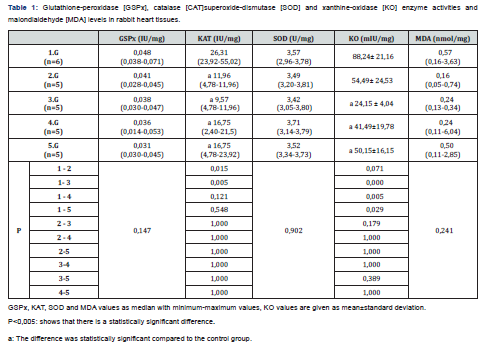
Similarly, no differences were noted in MDA levels across the groups. In terms of KO levels, the control group displayed the highest value, but comparisons among the remaining groups, excluding the control group, revealed no statistically significant differences (p > 0.05) (Table 2).
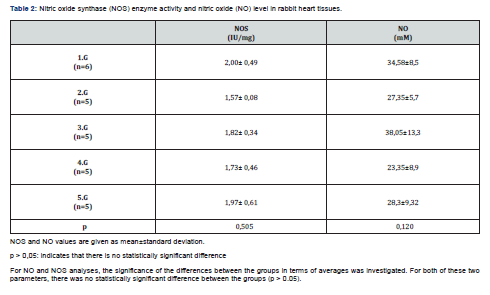
Table 3 The Kruskal-Wallis Analysis of Variance test was used to evaluate differences in median BUN and ALT levels among the groups. Similarly, the ANOVA test was applied to analyze differences in serum creatinine and AST levels. The results of the study revealed no statistically significant differences among the groups for BUN, creatinine, serum AST, or ALT levels.
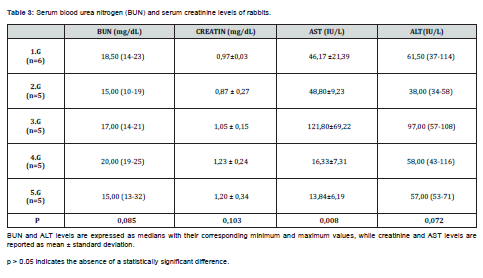
Table 4 At the end of the study, apart from the control group, the group administered the highest dose of the extract had the lowest serum Triglyceride (TG) levels, whereas the group receiving the lowest dose exhibited the highest TG levels. A progressive reduction in TG levels was noted from the group given the lowest extract dose to the group with the highest extract dose, with the TG level in the highest extract group falling below that of the cholesterol group.
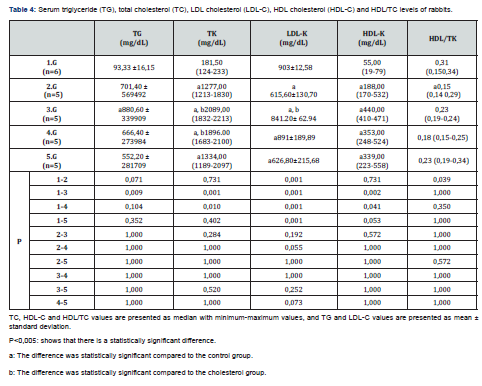
For Total Cholesterol (TC), excluding the control and cholesterol groups, the group receiving the highest extract dose had the lowest serum TC level, whereas the group receiving the lowest dose had the highest TC level. A gradual decline in TC levels was observed from the group with the lowest dose to the group with the highest dose, with TC levels in the highest dose group nearly matching those of the cholesterol group.
In terms of LDL cholesterol levels, apart from the control group, the group receiving the highest dose of the extract had the lowest serum LDL level, which was also lower than that of the cholesterol group. Regarding HDL cholesterol, excluding the control group, the group receiving the lowest extract dose exhibited the highest HDL level, while the group with the highest extract dose showed the lowest HDL level among all extract groups. The HDL/TC ratio differed significantly solely between the control group and the cholesterol group, with the latter showing a higher ratio.
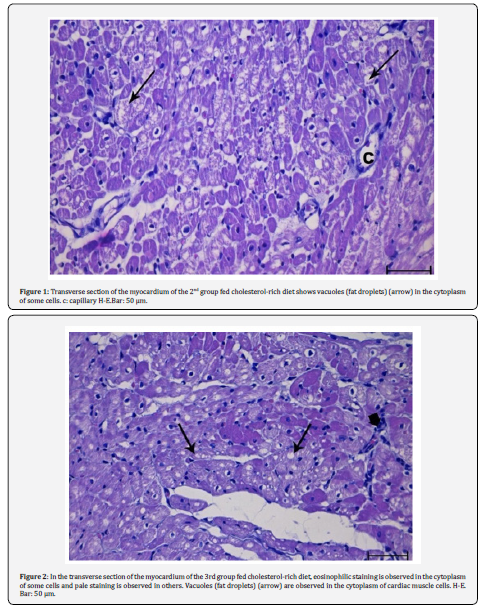
Increased connective tissue, haemorrhage and mononuclear cell infiltration between muscle fibres were observed in heart muscle samples of the 2nd group fed cholesterol-rich diet. As a result, it was observed that muscle fibres were separated from each other. Increased eosinophilic staining and hyperchromatic nuclei were observed in the cytoplasm of some cells. Vacuoles (oil droplets) were observed in the cytoplasm of some cells (Figure 1).
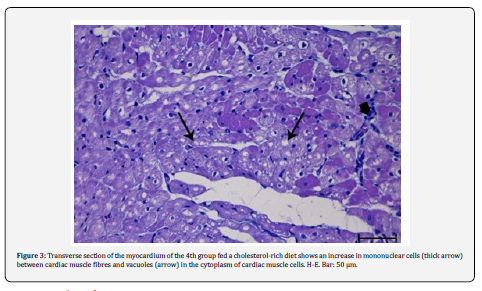
In the light microscopy examination of the 3rd, 4th and 5th groups fed cholesterol-rich diet and given extracts, haemorrhage in the myocardium, fibroblast proliferation between muscle fibres, mononuclear cell infiltration, eosinophilic staining in the cytoplasm of some cells, accompanied by hyperchromatic nuclei, and pale staining in the cytoplasm of others were observed. Vacuoles (fat droplets) were observed in the cytoplasm of cardiac muscle cells (Figures 2 & 3).
Discussıon and Conclusıon
This study evaluated the role of the NO-NOS system, essential for maintaining cardiovascular health, modulating vascular tone, preventing platelet aggregation, and inhibiting vascular smooth muscle cell proliferation. Furthermore, the effects of the oxidant and antioxidant systems on heart tissue were analyzed, as these systems are closely linked to LDL oxidation, which poses significant risks to the cardiovascular system. To achieve this, levels of NO and NOS, as well as enzyme activities of GSPx, KAT, SOD, and KO, along with MDA levels, were measured in rabbit heart tissues.
In a previous in vitro study, P. major leaf extracts were shown to enhance NO release from macrophages in a dose-dependent manner [27]. In the current study, however, NO and NOS levels did not differ significantly among the groups. Findings from a recent TÜBİTAK project demonstrated that antioxidant activity of P. major leaf extracts prepared with water, 80% ethanol, and 80% methanol reached 90.3%, 93.3%, and 93.2%, respectively, highlighting the plant's potent ROS-scavenging properties [26]. Similarly, an in vitro rat study reported that ethanol-prepared P. major extracts exhibited strong O2•- radical scavenging activity in the liver and significantly reduced MDA levels [28]. Another study, involving rats treated with DMBA (7,12-dimethylbenz(a)anthracene) to induce oxidative stress, showed that oral administration of aqueous P. major extract resulted in significant reductions in MDA levels (p<0.01) and marked increases in KAT (p<0.05), KA (carbonic anhydrase) (p<0.01), and GSH levels (p<0.01) [29]. These findings suggest that P. major provides protection against oxidative stress and lipid peroxidation in biological tissues.
In the current study, no significant differences were observed in MDA levels in the heart tissues across the groups. Regarding xanthine oxidase levels, the highest values were detected in the control group, while no statistically significant differences were noted among the other groups. This indicates that P. major did not adversely affect these key oxidant parameters in heart tissue. Similarly, for antioxidant enzymes, no differences were found in GSPx or SOD levels between the groups. KAT levels were highest in the control group, but no significant differences were observed among the other groups. These results suggestthat P. major does not negatively influence the antioxidant defense system in heart tissue.
In this study, the effects of P. major on serum lipids were also investigated. In 1962, in a study with rabbits in which atherosclerosis was induced by a hypercholesterolemic diet, three groups were formed and comparisons were made between a group receiving only a hypercholesterolemic diet, a group fed 50 g/day of dried P. major leaves and a group given 1 ml/day orally of P. major leaf extract, the preparation of which was not explained. major leaf extract, the preparation of which was not explained, it was found that during the three-month period, the TC values in the cholesterol group gradually increased, a slight increase in TC occurred in the first month in both leaf and extract groups, and then both returned to the initial TC levels at the end of the three- month period [30]. Contrary to the findings of Angarskaya and Sokolova, it was determined that higher serum TK levels were observed in the extract groups compared to the cholesterol group, but serum TK levels gradually decreased from the group in which the amount of extract was the lowest to the group in which the amount of extract was the highest and almost equalised with the cholesterol group in the highest extract group. In the study, when P. major extract was added into the cholesterol suspensions prepared in 10 cc syringes, it was observed that the extract groups solubilised cholesterol in direct proportion to the amount of extract. Due to the small stomach volume of rabbits, the volume of suspension given orally had to be divided into two parts, 10 cc in the morning and 10 cc in the evening. When P. major extract and cholesterol were administered to rabbits in the same syringe, it is thought that P. major extract may have increased cholesterol absorption or increased cholesterol levels due to the lipophilic molecules in its structure.
When serum TG and LDL cholesterol levels were analysed, it was found that the lowest serum TG levels were in the highest extract group and the highest TG levels were in the lowest extract group, except for the control group. Among the extract groups, it was observed that TG levels gradually decreased from the lowest extract group to the highest extract group and decreased below the cholesterol group in the highest extract group. Except for the control group, the lowest serum LDL cholesterol level was observed in the highest extract group and was also lower than the cholesterol group. All these findings were found to be compatible with the cholesterol lowering activity of P. major shown by Angarskaya and Sokolova.
In addition, at the end of the study, it was determined that there was no statistical difference in terms of serum AST, ALT, BUN and creatinine levels among the liver and kidney function tests performed in all groups and that the P. major extract we used had no toxic effect on the liver and kidney. There are studies showing that oral and intraperitoneal administration of P. major has very low toxicity in rats [31]. In addition, in acute toxicity studies with mice, it was determined that the in vivo LD50 dose was 182.54 mg/kg as a result of oral administration of P. major leaf extract, but it was found to be toxic at high amounts [32]. In another study, it was determined that P. major protected rats against CCl4 -induced hepatotoxicity and also showed strong anti-inflammatory properties [33]. In addition, in a study conducted to investigate the effects of P. major on hypertension in humans, it was observed that systolic and diastolic blood pressure values decreased from 150 ± 2.58 / 98 ± 1.33 mmHg to 129 ± 2.77 / 86 ± 1.63 mmHg (p<0.001). During this study, it was determined that oral administration of P. major in this amount and for this time period did not have any toxic effect on liver and kidney function tests [34].
The findings were consistent with those of normal heart tissue [35]. Cardiac tissue observations in the other groups exhibited similar features, revealing that high cholesterol levels led to conditions such as increased connective tissue between muscle fibers, hemorrhage, mononuclear cell infiltration, fibroblast proliferation among muscle fibers, separation of muscle fibers, heightened eosinophilic staining in some cells' cytoplasm, hyperchromatic nuclei, and vacuoles (fat droplets) in the cytoplasm of certain cells.
Since each group in the study included a maximum of six animals, and the number was further reduced due to unexpected mortalities inherent to such research, obtaining adequate and reliable statistical results proved challenging. Moreover, due to budget constraints, it was not feasible to sustain an eight-month study using a 0.25% cholesterol diet, one of the most suitable rabbit models for atherosclerosis. Consequently, a shorter duration with very high cholesterol levels was adopted. While administering cholesterol with specially prepared hypercholesterolemic diets would have been more appropriate, this study used oral suspension due to the unavailability of such diets locally, the high costs of imported diets, and importation difficulties.
As no comparable study has been identified in the literature, this research is considered pioneering in investigating the effects of P. major extract on heart tissue. It is expected that these findings will provide valuable contributions to the scientific literature and serve as a foundation for future studies.
In conclusion, this study found that a hypercholesterolemic diet, combined with the administration of Plantago major extract, did not lead to statistically significant alterations in the oxidant/antioxidant system within the cardiac tissues of rabbits, based on the analyzed parameters. However, the diet appeared to cause tissue damage through mechanisms unrelated to oxidative stress, and the addition of P. major extract did not demonstrate any protective effects against this damage.
Total cholesterol levels in the groups treated with the extract were higher than those in the cholesterol-only group. However, an incremental decrease in cholesterol levels was observed as the extract dosage increased. The elevated cholesterol levels in the extract groups compared to the cholesterol-only group were attributed to possible adverse interactions between the extract and the administered cholesterol. These results suggest that P. major leaf extract and cholesterol should be administered separately.
Additionally, liver and kidney function tests revealed no significant differences among the groups. These findings indicated that the prepared dry crude extract did not exhibit toxic effects on the liver or kidneys.
Acknowledgement
Tuğçe OKTAY GÜNEŞ, General Manager of TOG ENGINEERING and Electrical-Electronics Engineer, for her financial support and contributions.
References
- Mackness B, Durrington PN, Mackness MI (1980) Polymorphisms of paraoxonase genes and low-density lipoprotein lipid peroxidation. Lancet 353(6): 468-469.
- James RW, Leviev I, Righetti A (2000) Smoking is associated with reduced serum paraoxonase activity and concentration in patients with coronary artery diseases. Circulation 10: 2252-2257.
- Murray RK, Granner DK, Mayes PA (1993) Harper's Biochemistry. In: (23rd), Prentice Hall International Inc.
- Ustünes L (1997) Turkish pharmacology association educational symposiums programme VI. Endothelium-derived vasoactive substances. Editor: Bökesoy TA.
- Cadenas E (1989) Biochemistry of Oxygen Toxicity. Annual Review Biochemistry 58: 79-110.
- Droge W (2002) Free Radicals in the Physiological Control of Cell Function. Physiological Review 82: 47-95.
- Li CY, Jackson RM (2002) Reactive Species Mechanisms of Cellular Hypoxia-reoxygenation Injury. American Journal of Physioogyl-Cell Physiology 282: 227-241.
- Inoue T, Jackson EK (1999) Strong antiproliferative effects of baicalein in cultured rat hepatic stellate cells. European Journal of Pharmacology 378: 129-135.
- Valko M, Izakovic M, Mazur M, Rhodes CJ, Telser J (2004) Role of Oxygen Radicals in DNA Damage and Cancer Incidence. Molecular and Cellular Biochemistry 266: 37-56.
- Halliwell B, Gutteridge JM (1984) Oxygen Toxicity, Oxygen Radicals, Transition Metals and Disease. Biochemistry 219: 1-14.
- Halliwell B, Gutteridge JM (1992) Biologically Relevant Metal Ion-Dependent Hydroxyl Radical Generation. An update, FEBS Lett 307: 108-112.
- Valko M, Rhodes CJ, Moncol J, Izakovic M, Mazur M (2006) Free Radicals, Metals and Antioxidants in Oxidative Stress-Induced Cancer. Chemico-Biology Interact 160: 1-40.
- Sies H (1993) Strategies of Antioxidant Defence. European Journal of Biochemistry 215: 213-219.
- Cao G, Prior RL (1999) In vivo Antioxidant Capacity: Comparison of Different Analytical Methods, Free Radialc Biology Medicine 27: 1173-1181.
- Cadenas E (1997) Basic Mechanisms of Antioxidant Activity Biofactors 6: 391-397.
- Dubick MA (1986) Historical Perspectives on the Use of Herbal Preparations to Promote Health. Journal of Nutrition 116 (7): 1348-1354.
- Ernst E (2002) Herbal Medicinal Products. British Journal of General Practice 52(478): 410.
- Bent S, Ko R (2004) Commonly Used Herbal Medicines in the United Chemistry of Tea Flavonoids. Crit Rev Food Science Nutrition 3: 693-704
- Halberstein RA (2005) Medicinal Plants: Historical and Cross-Cultural Usage Patterns. Annals of Epidemiology 15(9): 686-699.
- Chiou GC, Li BH, Wang MS (1994) Facilitation of Retinal Function Recovery by Natural Products After Temporary Ischemic Occlusion of Central Retinal Artery. Journal of Ocular Pharmacology 10(2): 493-498.
- Gori M, Campbell RK (1998) Natural Products and Diabetes Treatment. The Diabetes Educator 24(2): 201: 205-208.
- Hildsen RJ, Scott CM, Verhoef MJ (1998) Complementary Medicine Use by Patients with Inflammatory Bowel Disease. The American Journal of Gastroenterology 93(5): 697-701.
- Ernst E (2000) The Role of Complementary and Alternative Medicine in Cancer. The Lancet of Oncology 1: 176- 180.
- Hamblin L, Laird A, Parkes E, Walker AF (2008) Improved Arthritic Knee Health in a Pilot RCT of Phytotherapy. Journal of the Royal society for the Promotion Health 128(5): 255-262.
- Tachjian A, Maria V, Jahangir A (2010) Use of Herbal Products and Potential Interactions in Patients with Cardiovascular Diseases. Journal of the American College of Cardiology 55(6): 515-525.
- Oztürk HS, Simşek E (2011) Determination of Phenolic Component Content and Antioxidant Power of Extracts from Various Plants with Different Extraction Methods. TUBITAK. 109S236 Ankara.
- Flores GR, Calderon CL, Scheibel LW, Guerra PT, Padilla CR, et al. (2000) Immunoenhancing properties of Plantago major leaf extract. Phytotherapy research: PTR 14(8): 617-622.
- Coban T, Saltan CG, Sever B, Iscan M (2003) Antioxidant Activities of Plants Used in Traditional Medicine in Turkey. Pharmaceutical Biology 41: 608-613.
- Oto G, Ekin S, Ozdemir H, Demir H, Yasar S, et al. (2011) Plantago major Protective Effect on Antioxidant Status after Administration of 7- 12 Dimethylbenz(a)anthracene in Rats. Asian Pacific Journal of Cancer Prevention 12: 531-535.
- Angarskaya MA, Sokolova E (1962) The effect of plantain (plantago major) on the course of experimental atherosclerosis in rabbits. Translated from Bull Exp Biol Med 53(4): 50-53.
- Angelov A, Lambev I, Markov M (1980) Study of acute and chronical toxicity of dispergue of Plantago major. Medical Archives 18: 47-52.
- Parra LA, Yhebra SR, Sardinas GI, Buela LI (2001) Comparative study of the assay of Artemia salina L. and the estimate of the medium lethal dose (LD50 value) in mice, to determine oral acute toxicity of plant extracts. Phytomedicine 8(5): 395-400.
- Türel I, Ozbek H, Erten R, Oner AC, Cengiz N, et al. (2009) Hepatoprotective and anti-inflammatory activities of plantago major L. Indian Journal of Pharmacology 41(3): 120-124.
- Nyunt TM, Lwin KK, Aye TT (2007) Antihypertensive effect of Plantago major Linn. whole plant (Ahkyawpaungtahtaung) on mild to moderate hypertensive patients. The Myanmar Health Sciences Research Journal 19 (2): 97-102.
- Welsch U (1999) Sobotta Histology, Colour Cytology, Histology and Microscopic Atlas of Human Anatomy, 5th Edition, Trans. Editor: Tekelioglu M. Istanbul: Beta.

























