




 APBIJ Home



Abstract
Background: Free-floating, respiratory-competent mitochondria circulating in human blood plasma represent a novel systemic target for laser-mediated bioenergetic modulation. The carotid sheath region of the neck - containing the common carotid artery, internal jugular vein, and vagus nerve - provides direct optical access to these circulating mitochondria within a high-flow vascular compartment. This study investigated whether coherent LLLT applied to this site could acutely enhance systemic mitochondrial function and antioxidant defense in healthy adults.
Methods: Ten healthy adults were randomized to receive either coherent 640 nm red laser therapy or non-coherent red LED light applied to the carotid sheath region for 20 minutes. Oxidative stress (plasma TBARS) and antioxidant defense markers (SOD, CAT, GSH) were measured in plasma and erythrocyte fractions before and 10 minutes after intervention. The lactate-to-pyruvate (L/P) ratio was assessed as a functional indicator of mitochondrial oxidative phosphorylation efficiency.
Results: The laser group exhibited marked improvements across all parameters. Plasma TBARS decreased by 650 nM and the L/P ratio by 6.68, indicating reduced lipid peroxidation and improved mitochondrial coupling efficiency. Plasma catalase increased by 189 U/L, erythrocyte GSH by 134.3 µg/g Hb, and SOD by 4.96 U/g Hb, reflecting rapid systemic antioxidant mobilization. No meaningful changes were observed in the LED group.
Conclusion: A single session of coherent LLLT applied to the carotid sheath region produced rapid and substantial improvements in systemic mitochondrial function and redox balance in healthy adults, suggesting this anatomic site may serve as an effective access point for systemic mitochondrial modulation.
Keywords: Low-level laser therapy; LLLT; Carotid sheath; Mitochondria; Oxidative stress; Antioxidant response; Lactate/Pyruvate ratio; Circulating mitochondria; Redox balance; Cytochrome c oxidase
Abbreviations
ATP: Adenosine Triphosphate; CAT: Catalase; eNOS: Endothelial Nitric Oxide Synthase; GSH: Reduced Glutathione; L/P ratio: Lactate-To-Pyruvate Ratio; LED: Light-Emitting Diode; LLLT: Low-Level Laser Therapy; NAD⁺: Nicotinamide Adenine Dinucleotide (oxidized); NADH: Nicotinamide Adenine Dinucleotide (reduced); NO: Nitric Oxide; ROS: Reactive Oxygen Species; SOD: Superoxide Dismutase; TCA: Tricarboxylic Acid; TBARS: Thiobarbituric Acid Reactive Substances.
Introduction
Low-level laser therapy (LLLT) has gained substantial scientific attention for its capacity to modulate cellular metabolism through photochemical - rather than photothermal - mechanisms. The primary intracellular target of LLLT is the mitochondrial electron transport chain, which contains photoabsorbing molecules that, upon absorbing photons of specific wavelengths, undergo conformational changes that accelerate electron transfer, increase mitochondrial membrane potential, and upregulate ATP synthesis [1,2]. These photochemical events initiate downstream effects including modulation of reactive oxygen species (ROS), activation of redox-sensitive transcription factors, and enhancement of Nitric Oxide (NO) bioavailability through Endothelial Nitric Oxide Synthase (eNOS) activation [3,4].
Traditionally, mitochondria have been regarded exclusively as intracellular organelles. However, converging evidence from independent research groups has established that intact, metabolically active mitochondria circulate freely in human blood plasma under physiologically normal conditions [5,6]. These extracellular mitochondria retain respiratory competence, maintain transmembrane potential, and are capable of horizontal transfer to metabolically compromised cells, where they restore bioenergetic function. Their capacity to interact with all major organ systems through the systemic circulation positions them as uniquely tractable targets for non-invasive, laser-mediated systemic intervention.
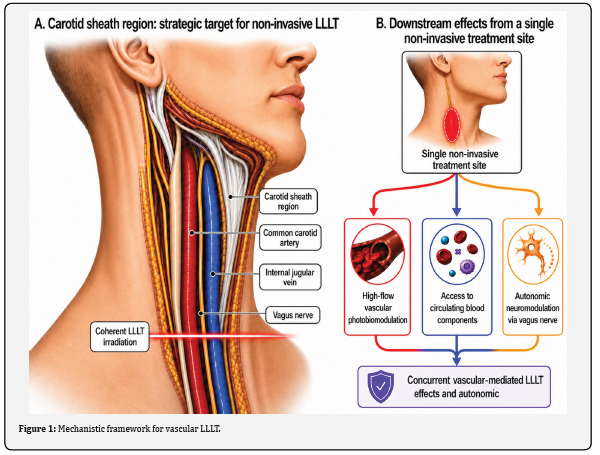
The carotid sheath region of the neck represents a strategically positioned treatment site for producing systemic, vascular-mediated LLLT effects. Within a single, superficially accessible anatomic corridor, three physiologically distinct structures lie in close proximity: the common carotid artery, which carries oxygenated blood toward the brain and systemic circulation; the internal jugular vein, which returns deoxygenated blood, circulating mitochondria, and metabolic byproducts from the cranial cavity; and the vagus nerve, the principal efferent and afferent limb of the parasympathetic nervous system [7,8]. Irradiation of this compact region simultaneously engages each of these structures, providing concurrent access to high-flow vascular LLLT effects and autonomic neuromodulation through a single non-invasive treatment site.
We hypothesized that coherent LLLT applied to the carotid sheath region would activate circulating extracellular mitochondria within the high-flow vascular compartment, producing measurable acute improvements in systemic oxidative stress markers, antioxidant enzyme activities, and the L/P ratio, with no comparable response observed following non-coherent LED exposure.
Materials and Methods
Study Design and Participants
This open-label, parallel-group, controlled pilot study enrolled ten healthy adult volunteers (5 males, 5 females; mean age 28 ± 5 years). Participants were randomized in equal numbers to either the active laser treatment group (n = 5) or the non-coherent LED control group (n = 5).
Intervention
Active treatment consisted of pulsed coherent red laser therapy delivered at 640 nm wavelength with a power output of 7.5 mW (Erchonia Corp). The laser was applied bilaterally to the carotid sheath region of the neck, overlying the common carotid artery, internal jugular vein, and vagus nerve for a total session duration of 20 minutes. The control intervention was delivered using a non-coherent red LED device emitting light at a similar wavelength and power output, with identical placement and duration.
Blood Sampling and Biomarker Analysis
Venous blood samples were collected from the antecubital vein immediately before the intervention and again 10 minutes after its completion. Biomarker analyses were performed at the Neurobiology Laboratory of the Rafael Estrada González Institute. All assays were conducted in triplicate using validated commercial kits and spectrophotometric methods. Assessed biomarkers included TBARS (an index of lipid peroxidation), SOD activity (superoxide scavenging), CAT activity (hydrogen peroxide decomposition), and reduced GSH concentration in both plasma and erythrocyte fractions. Plasma lactate and pyruvate concentrations were measured enzymatically and expressed as the lactate/pyruvate (L/P) ratio, a functional indicator of mitochondrial redox status and coupling efficiency [9].
Statistical Analysis
Delta (Δ) values were computed as the arithmetic difference between post-intervention and pre-intervention measurements for each biomarker. Group means and mean delta values are reported descriptively for the laser and LED control groups. Exploratory between-group comparisons were conducted using independent samples t-tests and within-group pre-to-post changes were evaluated using paired t-tests; however, given the small sample size (n = 5 per group) and the pilot nature of this investigation, these analyses were performed to characterize the direction and relative magnitude of observed differences rather than to draw inferential conclusions. All findings should be regarded as hypothesis-generating and interpreted with appropriate caution pending replication in adequately powered studies.
Results
Plasma Oxidative Stress and Antioxidant Biomarkers
Table 1 presents mean delta values for plasma parameters. The laser group demonstrated a substantial reduction in plasma TBARS (Δ = −650.2 nM), indicating a marked decrease in lipid peroxidation and systemic oxidative burden. Plasma catalase activity increased by 188.6 U/L, representing pronounced upregulation of hydrogen peroxide decomposition. Plasma SOD activity showed a modest increase (+0.7 U/mL), while plasma GSH decreased slightly (−18.4 µg/mL), consistent with increased GSH utilization in active antioxidant cycling rather than net depletion. The non-coherent LED group showed negligible changes across all plasma parameters.

Erythrocyte Antioxidant Biomarkers
Table 2 summarizes mean delta values for erythrocyte antioxidant markers. The laser group demonstrated a marked increase in erythrocyte GSH (+134.3 µg/g Hb) and a nearly fivefold increase in SOD activity (+4.96 U/g Hb), indicating robust systemic antioxidant mobilization. Erythrocyte catalase decreased modestly (−7.1 U/g Hb), likely reflecting redistribution of catalytic resources. A modest increase in erythrocyte TBARS (+47.1 nM/g Hb) is consistent with a transient intracellular redox reorganization rather than net oxidative injury. The LED group showed no meaningful changes.

Lactate-to-Pyruvate Ratio
Table 3 presents L/P ratio values for both groups. The laser group demonstrated a reduction from 15.42 at baseline to 8.74 post-intervention (Δ = −6.68; 43.3% decrease), indicating marked improvement in mitochondrial oxidative phosphorylation efficiency. The LED group showed no meaningful change (pre: 14.06; post: 14.24; Δ = +0.18), confirming the coherence-dependence of the response.

Discussion
This controlled pilot study demonstrates that a single 20-minute session of coherent LLLT applied to the carotid sheath region of the neck produces rapid and substantial improvements in systemic mitochondrial metabolic function and antioxidant defense in healthy adults.
The carotid sheath area offers an especially strategic treatment site for producing systemic effects with LLLT because several biologically important structures are concentrated within a small, superficial region of the neck. One of these is the internal jugular vein, which provides access to the circulating blood as it exits the cranial cavity. As blood passes through this vessel, multiple circulating components - including erythrocytes, leukocytes, platelets, plasma mediators, and extracellular mitochondrial elements such as mitochondria-derived vesicles and free mitochondria - may be exposed to the optical field [5,6]. Because extracellular mitochondria can remain functionally active in the circulation and move throughout the vascular system, they may represent an important target for blood-mediated photobiomodulatory effects.
Positioned alongside the jugular vein, the common carotid artery serves as a major distribution route by which oxygenated blood, endothelial signals, and other photo-modulated vascular mediators can be carried to the brain and peripheral tissues. LLLT delivered in this region has been associated with increased nitric oxide bioavailability, reduced vascular constriction, and improved cerebral perfusion dynamics, findings consistent with established laser-related nitric oxide mechanisms [3,4]. The vagus nerve, also contained within this region, introduces an additional neural component by potentially influencing parasympathetic output and broader autonomic regulation [7,8].
Together, these vascular and neural features make the carotid sheath region a highly advantageous noninvasive target for LLLT. Figure 1 By acting simultaneously on venous blood components, arterial signaling pathways, and vagal autonomic mechanisms, treatment at this single site may support broad multisystem effects. In addition, mitochondria emit ultra-weak biophoton signals that have been implicated in intercellular communication; coherent laser light may help entrain or amplify these endogenous emissions, thereby strengthening mitochondrial signaling cascades [10]. Importantly, prior studies have shown that laser coherence can be at least partially maintained as light passes through biological tissues, including blood, allowing direct photonic interaction with targets within the vascular lumen [11]. The discovery of circulating free-floating mitochondria as viable, respiration-competent organelles has expanded the mechanistic framework for vascular LLLT. These extracellular mitochondria participate in intercellular energy redistribution, redox signaling, and immune modulation, and are capable of horizontal transfer to metabolically compromised cells to restore bioenergetic function [6,12].
Significance of the Lactate-to-Pyruvate Ratio Reduction and Systemic Implications for Cellular Repair
The reduction in the L/P ratio observed in the laser group warrants detailed interpretation, as this metric reflects fundamental biochemistry at the cellular level with broad systemic implications. The L/P ratio is a direct biochemical expression of the cytoplasmic NADH/NAD⁺ redox couple. When mitochondrial oxidative phosphorylation is functioning efficiently, NAD⁺ is continuously regenerated within the mitochondrial matrix, maintaining the cytoplasmic NADH/NAD⁺ equilibrium at levels that allow pyruvate - the terminal product of glycolysis - to enter the Tricarboxylic Acid (TCA) cycle and proceed through full aerobic oxidation. When mitochondrial function is impaired, electron transport slows, NADH accumulates in the cytoplasm, and the cell is forced to reduce pyruvate to lactate as an emergency mechanism to regenerate sufficient NAD⁺ to sustain glycolytic flux. The result is an elevated L/P ratio - a metabolic signature of cells operating in an anaerobic or pseudo-anaerobic state despite adequate oxygen availability [9].
For metabolically compromised or damaged cells, this shift carries particular therapeutic significance. Cells operating under conditions of mitochondrial dysfunction - whether due to disease, aging, ischemia, or oxidative injury - are often locked in a high-lactate, low-efficiency metabolic state that limits their capacity for energy-dependent repair processes. Protein synthesis, DNA repair, membrane maintenance, ion gradient restoration, and immune effector functions all impose substantial ATP demands that cannot be adequately met through glycolysis alone. By restoring oxidative phosphorylation efficiency, LLLT-activated circulating mitochondria effectively expand the available energy budget of recipient cells, enabling them to execute repair programs that were previously energy-limited. Concurrently, the reduction in lactate accumulation relieves local tissue acidosis, which independently impairs enzyme kinetics, ion channel function, and cellular signaling cascades required for recovery [9].
L/P Ratio as a Marker of General Wellness and Healthy Aging
Beyond its relevance in disease states, the L/P ratio has emerged as a meaningful indicator of mitochondrial vitality in the context of general wellness. Even in otherwise healthy individuals, suboptimal mitochondrial efficiency - reflected in a chronically elevated or high-normal L/P ratio - is associated with a range of functional complaints that are bioenergetic in origin: persistent fatigue, reduced physical endurance, impaired cognitive clarity, poor stress resilience, and delayed recovery from exertion. These symptoms reflect a sustained mismatch between cellular energy demand and mitochondrial supply capacity, for which improved L/P ratio normalization may serve as both a mechanistic target and an objective biomarker of response.
Restoring an optimal L/P ratio through LLLT-mediated mitochondrial activation translates directly into the biochemical conditions required for sustained wellness. Greater NAD⁺ availability accelerates the TCA cycle and supports biosynthetic pathways that depend on TCA-derived intermediates, including amino acid production, fatty acid oxidation, and one-carbon metabolism required for epigenetic regulation and immune function. Improved oxidative phosphorylation efficiency stabilizes mitochondrial membrane potential, which governs not only ATP production but also calcium buffering, apoptotic threshold regulation, and the controlled generation of mitochondrial ROS that serve as redox second messengers in health-maintaining signaling cascades. Reduced lactate accumulation lowers the metabolic acid load on tissues, supporting the pH-sensitive processes that underpin immune competence, hormonal signaling, and neurotransmitter synthesis.
The relationship between the L/P ratio, mitochondrial function, and healthy aging is particularly compelling. Mitochondrial dysfunction is one of the most consistently observed and mechanistically well-supported hallmarks of biological aging [13,14]. As organisms age, mitochondrial DNA accumulates mutations, electron transport chain efficiency declines, oxidative phosphorylation capacity diminishes, and the intracellular redox balance shifts progressively toward a more oxidized state - a process amplified by the self-reinforcing cycle of ROS-induced mitochondrial DNA damage first articulated by Harman and extensively elaborated since [15]. These changes are reflected in a gradual upward drift in the L/P ratio across the lifespan, as cells increasingly rely on anaerobic glycolytic flux to compensate for impaired mitochondrial oxidative capacity. This bioenergetic shift underlies many of the phenotypic features of aging - including declining muscle mass and strength, reduced aerobic capacity, impaired immune surveillance, cognitive slowing, and diminished tissue repair capacity - all of which are fundamentally ATP-limited processes that depend on efficient oxidative phosphorylation.
Interventions capable of restoring electron transport efficiency, normalizing the NADH/NAD⁺ redox couple, and reducing oxidative burden simultaneously address multiple nodes of the mitochondrial aging cascade. The biomarker profile observed in the present study - reduced L/P ratio, decreased plasma TBARS, elevated SOD, catalase, and GSH - maps directly onto each of these nodes. Carotid sheath LLLT therefore does not merely improve an isolated metabolic parameter; it recapitulates, in a single acute intervention, the multifactorial bioenergetic and redox improvements that characterize favorable aging trajectories.
Importantly, the systemic distribution of LLLT-activated circulating mitochondria through the bloodstream means that these pro-longevity bioenergetic effects are not confined to any single tissue but reach all vascularized organs concurrently. Tissues particularly vulnerable to age-related mitochondrial decline - including the brain, heart, skeletal muscle, liver, and kidneys - receive photo-energized circulating mitochondria capable of augmenting local bioenergetics and suppressing oxidative stress simultaneously. In the context of healthy aging, this systemic reach is especially valuable, as the mitochondrial decline of aging is a body-wide phenomenon requiring body-wide intervention [13-15]. Repeated carotid sheath LLLT sessions may therefore represent a promising non-pharmacologic strategy for attenuating age-related mitochondrial dysfunction, preserving functional capacity, and supporting the metabolic resilience that distinguishes healthy from accelerated aging trajectories.
Antioxidant Response Pattern
The pattern of antioxidant response observed across plasma and erythrocyte compartments merits specific discussion. Plasma catalase activity increased markedly (+188.6 U/L), representing the most pronounced directional change among plasma antioxidant markers. Concurrently, erythrocyte GSH increased substantially (+134.3 µg/g Hb) and erythrocyte SOD increased nearly fivefold (+4.96 U/g Hb), indicating coordinated upregulation of the multi-tier antioxidant defense system spanning both enzymatic (SOD, CAT) and non-enzymatic (GSH) arms across two distinct blood compartments simultaneously [16]. The modest decrease in plasma GSH (−18.4 µg/mL) alongside the substantial increase in erythrocyte GSH reflects compartmental redistribution and active utilization rather than net depletion, consistent with erythrocytes functioning as principal GSH reservoirs that export to plasma in response to increased oxidative demands. The modest increase in erythrocyte TBARS (+47.1 nM/g Hb) is consistent with the known biphasic redox signaling pattern of LLLT, in which an initial controlled oxidative signal precedes and drives downstream antioxidant upregulation.
Limitations and Future Directions
The primary limitations of this study include the small sample size (n = 5 per group), single post-treatment measurement timepoint (10 minutes), and restriction to healthy volunteers. All findings should be regarded as hypothesis-generating. Future studies should evaluate repeated LLLT sessions to assess cumulative and durable effects and incorporate patient populations with established mitochondrial dysfunction (including metabolic syndrome, neurodegenerative disease, and chronic kidney disease).
Conclusion
A single 20-minute session of coherent LLLT applied to the carotid sheath region of the neck produced rapid and substantial improvements in systemic mitochondrial function and antioxidant defense in healthy adults, including a 43.3% reduction in the lactate-to-pyruvate ratio, a marked decrease in plasma lipid peroxidation, and significant increases in plasma catalase, erythrocyte SOD, and erythrocyte GSH. These effects were not observed following non-coherent LED exposure, confirming the coherence-dependence of the response. The 43.3% reduction in the L/P ratio represents a fundamental restoration of oxidative phosphorylation efficiency, shifting cells from energy-limited anaerobic metabolism toward full aerobic function and expanding the ATP budget available for cellular repair throughout the body. Because LLLT-activated circulating mitochondria are distributed systemically through the bloodstream, this metabolic restoration is not confined to the irradiated site but extends to all vascularized tissues - including those most vulnerable to age-related mitochondrial decline. The carotid sheath region represents a promising and anatomically strategic access point for achieving non-invasive systemic mitochondrial modulation, with potential clinical implications for conditions characterized by mitochondrial dysfunction, oxidative stress, and accelerated biological aging.
Acknowledgement
The authors thank the clinical and laboratory staff at the Neurobiology Laboratory of the Rafael Estrada González Institute for conducting all biomarker assays.
Conflict of Interest
Travis Sammons and Steve Shanks are employees of Erchonia Corporation, the manufacturer of the laser device used in this study. Robert Silverman DC and Cesar Lara MD declare no conflicts of interest.
References
- Hamblin MR (2017) Mechanisms and applications of the anti-inflammatory effects of low-level laser therapy. AIMS Biophys 4(3): 337-361.
- Karu TI (2008) Mitochondrial signaling in mammalian cells activated by red and near-infrared radiation. Photochem Photobiol 84(5): 1091-1099.
- Freitas DLF, Hamblin MR (2016) Proposed mechanisms of low-level laser therapy and low-level light therapy. IEEE J Sel Top Quantum Electron 22(3): 7000417.
- Lohr NL, Keszler A, Pratt P, Bienengraber M, Warltier DC, et al. (2009) Enhancement of nitric oxide release from nitrosyl hemoglobin and nitrosyl myoglobin by red/near infrared radiation: potential role in cardioprotection. J Mol Cell Cardiol 47(2): 256-263.
- Stephens OR, Grant D, Frimel M, Wanner M, Yin M, et al. (2020) Characterization and origins of cell-free mitochondria in healthy murine and human blood. Mitochondrion 54: 102-112.
- Dache AAZ, Otandault A, Tanos R, Pastor B, Meddeb R, et al. (2020) Blood contains circulating cell-free respiratory competent mitochondria. FASEB J 34(3): 3616-3630.
- Machado C, Machado Y, Estevez M, Sibat HF, Chinchilla M (2020) Vagal nerve stimulation with low-level lasers of two different frequencies assessed by QEEG. Photobiomodul Photomed Laser Surg 38(8): 486-494.
- Machado C, Machado Y, Estevez M, Sibat HF, Chinchilla M (2020) Assessing the autonomic effect of vagal nerve stimulation with LLLT by heart rate variability. Photobiomodul Photomed Laser Surg 38(10): 621-629.
- Li X, Yang Y, Zhang B, Lin X, Fu X, et al. (2022) Lactate metabolism in human health and disease. Signal Transduct Target Ther 7(1): 305.
- Cifra M, Fields JZ, Farhadi A (2011) Electromagnetic cellular interactions. Prog Biophys Mol Biol 105(3): 223-246.
- Hode L (2005) The importance of the coherency. Photomed Laser Surg 23(4): 431-434.
- Torralba D, Baixauli F, Madrid SF (2016) Mitochondria know no boundaries: mechanisms and functions of intercellular mitochondrial transfer. Front Cell Dev Biol 4: 107.
- Otín LC, Blasco MA, Partridge L, Serrano M, Kroemer G (2013) The hallmarks of aging. Cell 153(6): 1194-1217.
- Otín LC, Blasco MA, Partridge L, Serrano M, Kroemer G (2023) Hallmarks of aging: an expanding universe. Cell 186(2): 243-278.
- Harman D (1972) The biologic clock: the mitochondria? J Am Geriatr Soc 20(4): 145-147.
- Jomova K, Alomar SY, Alwasel SH, Nepovimova E, Kuca K, et al. (2024) Several lines of antioxidant defense against oxidative stress: antioxidant enzymes, nanomaterials with multiple enzyme-mimicking activities, and low-molecular-weight antioxidants. Arch Toxicol 98(5): 1323-1367.

























