




 APBIJ Home



Abstract
Objective: Nigeria continues to share a significant proportion in the global malaria burden despite the significant malaria control efforts from stakeholders. The study was designed to evaluate the self-reported malaria prevalence in Iyamho inhabitants, knowledge and utilization of malaria control strategies and their interconnection. Material and Methods: A descriptive research design was employed. Data were collected from 356 households using structured questionnaires. Socio-demographic information was gathered, and knowledge of malaria, self-reported malaria prevalence, and control strategy utilization were assessed.
Results: 22.47% of respondents were between 21-26 years. 50.56% of the respondents were male and 47.75% were female. While 39.33%
were single, 44.94% were married. 53.65% of respondents had tertiary education. Of the respondents, 69.9% exhibited good knowledge of
malaria, its symptoms, transmission and medication. 57.3% of respondents showed low annual malaria occurrence feedback. The study revealed
that households were actively engaged in control strategies such as the use of insecticide-treated bed nets, indoor residual spraying, seeking
prompt medical treatment for suspected malaria cases, awareness of local government resources and belief in community’s ability to implement
control measures. There was a significant association between self-reported malaria prevalence and knowledge of malaria, its symptoms and
transmission (chi square =6.825, P<0.05). Also, self-reported malaria prevalence was significantly associated with indoor residual spraying (chi
square=10, P<0.05) and respondents’ awareness of local government resources for malaria control (chi square=10, P<0.05).
Conclusion: The study indicates that the low malaria prevalence perceived by households in the study area was attributed specifically to
utilization of control strategies such as the use of indoor residual spraying and awareness of local government resources for malaria control.
Key words:Malaria; Self-reported malaria prevalence; Household; Knowledge; Control strategies
Introduction
Malaria is one of the major public health concerns [1-2], with high morbidity and mortality rates in many tropical and subtropical regions, particularly in sub-Saharan Africa. Malaria affects an estimated 250 million people each year and is the most wide-spread parasitic disease encountered [1-4]. Over the last fifteen years renewed efforts at control have reduced the prevalence of malaria by over half, raising the prospect that elimination and perhaps eradication may be a long-term possibility [5]. After viral diseases, malaria is the second leading cause of death in Africa [5-7]. It is believed that nearly 1 in every 5 deaths among kids in Africa is as a result of malaria [8]. Many of the children who survive an episode of severe malaria suffer from brain damage and cognitive disability, consequently crippling these families with its debilitating aftermath [8].
According to the World Health Organization (WHO), in 2020, there were an estimated 229 million cases of malaria globally, with Africa accounting for 94% of these cases [9]. Nigeria, the most populous country in Africa, bears a substantial burden of malaria. In my country Nigeria, malaria is a major public health problem where it accounts for more cases and deaths than any country world over [6-8]. About 97% of the country’s population is at risk for malaria because of their location. It is only 3% of Nigeria’s population live in the malaria free zones [10]. Malaria alone accounts for more than 300,000 deaths each year in Nigeria [6]. This estimate is well above the 215,000 deaths each year from HIV/AIDS. If the above accounts for Nigeria alone how about other 29 Sub-Saharan African countries which together accounts for 90% of the world-wide malaria deaths [10].
Iyamho is a community located within the Uzairue local government area of Edo State, Nigeria. Like other diseases, it is known to be highly endemic for malaria [11]. The lack of accurate information on the knowledge, subjective prevalence, and control strategies of malaria in Iyamho, Uzairue, Edo State hinders the development and implementation of effective malaria control programs. Understanding the level of knowledge among households regarding malaria, assessing the subjective prevalence of the disease, and identifying existing control strategies are important for enabling policy makers and healthcare providers to design targeted interventions and improve malaria control efforts in the region. The enormous cost required for epidemiological evaluation of malaria prevalence through conduct of laboratory tests is a significant barrier in the fight against malaria in Africa [11]. Therefore, the study hypothesized that self-reported malaria prevalence in Iyamho inhabitants, Uzairue, Edo State has no nexus with knowledge of malaria and utilization of malaria control strategies.
Material and Methods
Research Setting
This study was conducted in the town of Iyamho, located within the Uzairue local government area of Edo State, Nigeria. The study was focused on households within Iyamho. The population of interest encompasses age groups, socioeconomic backgrounds residing in Iyamho. The environmental conditions in this region, including temperature, rainfall, vegetation, water bodies and relative humidity have the potential to significantly impact malaria prevalence.
Population of the study
The population of this study encompassed all households residing within the geographical boundaries of Iyamho, Uzairue, Edo State. This included all individuals or families living in the town of Iyamho and the surrounding areas falling under the jurisdiction of Uzairue, Edo State. The estimated total number of households in Iyamho was about three thousand, two hundred and twenty-five (3225) and it is from the target population that a sample size was determined.
Sample Size Estimation and Sampling Technique
The sample size was determined using a formula for estimating proportions in a single population. A convenience sampling technique was employed to select the study participants. Taro Yamane’s formula was used to determine the sample size from the population.
Taro Yamane’s Formula [12] is given as;
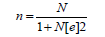
Where N = Population of study (3225), n = Sample size, e = Level of significance at 5% (0.05), 1 = Constant
Instrument for Data Collection
The data collection instrument utilized in this study was a self-designed questionnaire developed by the researcher. The questionnaire items were derived from comprehensive review of relevant literature and were aligned with the study’s objectives to gather pertinent information from the participants regarding the study. The questionnaire consisted of four distinct sections, labeled as Sections A (Demographic profile of respondents), B (Prevalence of malaria among households), C (Knowledge of malaria among households), and D (Control measures of malaria among households), with each section addressing specific aspects of the research objectives, and questions.
Method of Data Analysis
The collected data was analyzed using appropriate statistical software. Descriptive statistics such as frequencies and percentages were used to summarize the data. A p-value of less than 0.05 was considered statistically significant.
Ethical Consideration
Ethical approval was obtained from the institutional review board and Permission was obtained from the head of the community to ensure the protection of participant’s rights. Informed consent was sought from all participants, and efforts were made to respect cultural norms and sensitivities. The questionnaires presented to the respondents were clear and devoid of ambiguity.
Results
Socio-demographic Characteristics of Respondents
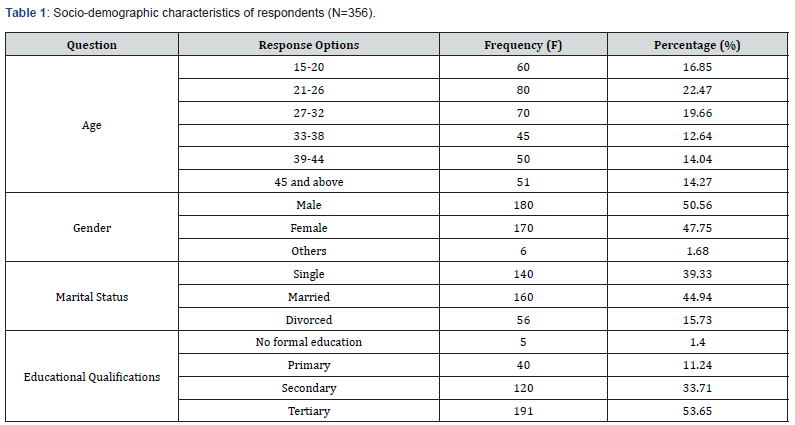
Table 1 shows the socio-demographic data of respondents. Age group 21-26 accounted for 22.47% of the total. The age group 27-32 follows closely, with 19.66% of respondents. The age groups 15-20, 39-44 and 45 and above represented approximately 14% each of the total respondents. The age group 33-38 had the lowest representation of 12.64%. 50.56% of respondents identified as male and 47.75% as female. A small percentage (1.68%) identified as “Others.” The majority are either single (39.33%) or married (44.94%). 15.73% is divorced. 53.65%, 33.71% and 11.24% of respondents have tertiary, secondary and primary educations respectively. 1.40% have no formal education.
Self-Reported Malaria Prevalence from Respondents
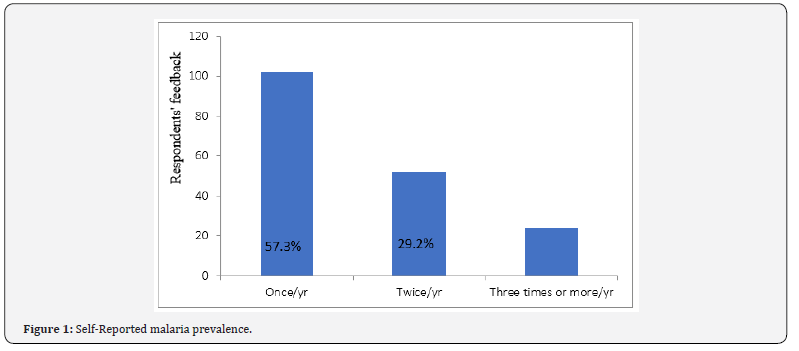
The majority of respondents, specifically 102 out of 178 respondents (57.3%) reported 1 malaria diagnosis per year (Figure 1). 52 out of 178 respondents (29.21%) reported 2 malaria diagnosis per year. 24 out of 178 respondents (13.5%) reported 3 malaria diagnosis or more per year.


*P <0.05

*P <0.05
Knowledge of Malaria
Awareness of malaria, its symptoms, transmission and medication
100% of the respondents have heard of malaria (Table 2), indicating widespread awareness. The primary sources of information about malaria were Home/Neighbors (34.55%) and Radio/TV/Newspaper (27.53%). Hospitals/Dispensaries (21.07%) and Schools (16.85%) were also significant sources. This suggested that various channels were used to disseminate information about malaria. The most recognized symptom of malaria was Fever (68.54%), followed by Headache (49.72%). Fewer respondents were aware of Loss of appetite (25.70%). A substantial portion (43.54%) recognized all the above symptoms. The majority of respondents correctly identified Mosquito bites (80.34%) as the mode of malaria transmission. Dirty/Stagnant Water (31.46%) was also recognized as a transmission source, but to a lesser extent. Fewer respondents mentioned Germs (12.64%) and Plasmodium Organisms (9.27%). A significant majority (74.72%) have a good understanding of the types of malaria medications and their appropriate use.
Level of knowledge of malaria
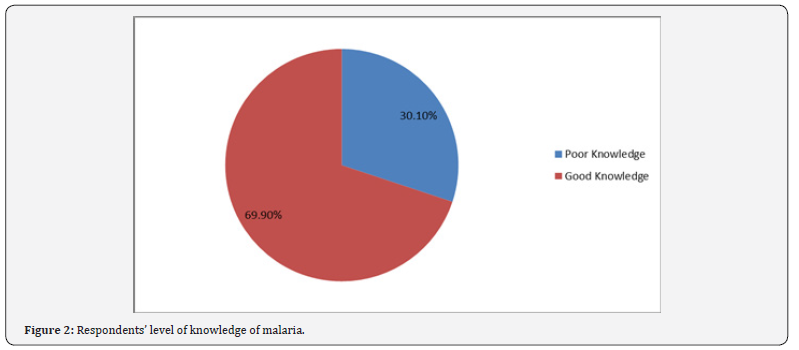
Majority of the respondents, comprising 249 individuals (69.9%), demonstrated good knowledge of malaria (Figure 2). A smaller portion of the respondents, accounting for 107 individuals (30.1%), exhibited poor knowledge of malaria.
Utilization of Control Strategies
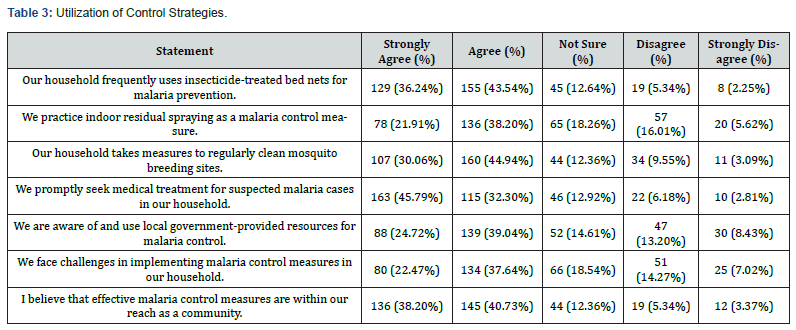
79.78% of respondents indicated that their households frequently utilized insecticide-treated bed nets for malaria prevention (Table 3). 20.22%) reported less frequent use or non-use of bed nets. 60.11% of respondents reported practicing indoor residual spraying as a malaria control measure. 39.89% either did not practice this method or did so less frequently. While 74% of respondents stated that their households took measures to regularly clean mosquito breeding sites, 26% did not clean the breeding sites regularly. 78.09% of respondents reported promptly seeking medical treatment for suspected malaria cases in their households while 21.91% may delay or not promptly seek medical treatment. 63.76% of respondents were aware of and use local government-provided resources for malaria control while 36.24% were not be aware of or utilized these resources. 60.11% of respondents face challenges in implementing malaria control measures in their households while 39.89% reported fewer challenges or none at all. 78.93% of respondents believed that effective malaria control measures were within their reach as a community while 21.07% are indifferent.
Association between self-reported malaria prevalence and knowledge of malaria, its symptoms, transmission and medication
There was an association between annual self-reported malaria prevalence and knowledge of malaria, its symptoms and transmission (Table 4).
Association between self-reported malaria prevalence and utilization of control strategies
There was a significant association between self-reported malaria prevalence and the use of indoor residual spraying. There was also a significant association between self-reported malaria prevalence and respondents’ awareness of local government resources for malaria control (Table 5).
Discussion
Over the years, a barrage of malaria prevention and control interventions has been canvassed especially in tropical region where malaria is most prevalent. Among the barriers towards effective prevention and control of malaria include malaria prevalence awareness among the local population and level of implementation of malaria control strategies. The study was designed to evaluate self-reported malaria prevalence and implementation of critical malaria control strategies and their relationship.
Majority of the respondents (22.47%) were between the ages of 21-26 years. A similar study conducted by Oladokun et al. [11] reported a mean age of 29.67 years (±5.21) in pregnant women. 50.56% of the respondents were male and 47.75% were female. This was consistent with the study of Diro et al. [13]. Just like the studies by Nwaneli et al. [14] and Tesfaye et al. [15], the present study also considered marital status and educational level. Majority of the respondents (44.94%) were married while 39.33% were single and. Majority of respondent (53.65%) had tertiary education.
Majority of the respondents (69.9%) exhibited good knowledge of malaria, its symptoms, transmission and medications. This might be due to the high educational status of majority (53.65%) of the respondents. Similarly, an Ethiopian study indicated that 63.1% of participants exhibited good knowledge and 62.1% had positive attitude scores towards malaria. A study by Lopez and Brown [16] in Ghana recorded a higher knowledge score (85.4%) of malaria. Even though in Lopez and Brown’s study, 49.4% exhibited good attitude towards malaria, a significant association was found between knowledge of malaria and educational status.
Conventional estimation of malaria prevalence involves determining the number of confirmed malaria cases in a population within a specific period [14]. This technique is slightly cost intensive. In the study, a questionnaire was developed to evaluate the number of cases perceived by the respondents in Iyamho Community in the past one year. 57.3% of respondents reported an annual malaria occurrence of 1 case per year, 29.2% and 13.5% reported 2 cases per year and 3/more cases per year respectively. Evident from the study, knowledge of malaria, its symptoms, transmission and medications could positively influence the annual malaria occurrence feedback due to the significant association between knowledge of malaria, its symptoms, transmission and medications and annual malaria occurrence feedback.
Malaria prevention and control revolve around human willingness to adopt and utilize malaria control strategies. Oladokun et al. [11] in their study indicated that despite the high educational status in a selected population of pregnant women in Ibadan, there was poor use of malaria control measures such as insecticide spray, window nets and insecticide treated nets. In the present study, respondents were actively engaged in control strategies such as the use of insecticide-treated bed nets, indoor residual spraying, seeking prompt medical treatment for suspected malaria cases, awareness of local government resources and belief in community’s ability to implement control measures.
Moreover, among the malaria control strategies utilized by the Iyamho Community, only indoor residual spraying and respondents’ awareness of local government resources for malaria control were found to have significant associations with selfreported malaria prevalence. This thus implies that the practice of indoor residual spraying and respondents’ awareness of local government resources for malaria control was responsible for the low annual malaria occurrence reported by largest percentage of respondents. More pragmatic efforts are required by governments at all levels and local authorities to improve the awareness of the local population on other effective methods of malaria control to achieve sustainable development goals.
Conclusion
The study indicates that the low malaria prevalence perceived by households in the study area was attributed specifically to utilization of control strategies such as the use of indoor residual spraying and awareness of local government resources for malaria control. Efforts should be devised in ensuring that effective malaria control strategies should be implemented. Extensive orientation on the relative significance of malaria control strategies will be necessary to enhance wellness and health and prevent malariarelated morbidity and mortality among healthy individuals and typically susceptible people such as pregnant women and people suffering from ailments.
Acknowledgement
The authors wish to appreciate the study participants.
Conflict of Interest
None declared.
References
- Mutebi JP, et al. (2018) Malaria: progress, perils, and prospects for eradication. The Journal of Clinical Investigation. 128(4): 1266-1268.
- Charles OA, Olugbemi TO, Olorunsola A, Ayobami D, Mayowa JA, et al. (2022) Internet of Health Things (IoHT) for COVID-19. In: Pani SK Dash S dos Santos WP Chan Bukhari SA Flammini, F (eds) Assessing COVID-19 and Other Pandemics and Epidemics using Computational Modelling and Data Analysis. Springer Cham.
- Grimberg BT, Mehlotra RK (2015) Malaria's Missing Number: Calculating the Human Component of R0 by a Within-Host Mechanistic Model of Plasmodium falciparum Infection and Transmission. PLOS ONE 10(5): e0129848.
- Charles OA, Olugbemi TO, Olorunsola A, Ayobami D, Mayowa JA, et al. (2022) Internet of Health Things (IoHT) for COVID-19. In: Pani SK Dash S dos Santos WP Chan Bukhari SA Flammini, F (eds) Assessing COVID-19 and Other Pandemics and Epidemics using Computational Modelling and Data Analysis. Springer Cham.
- Alan MB et al. (2016) A long way to go: Mapping the expansion of malaria vector mosquito breeding sites by 2030. Malaria Journal 15: 164.
- Flatie BT, Munshea A (2021) Knowledge, Attitude, and Practice towards Malaria among People Attending Mekaneeyesus Primary Hospital, South Gondar, Northwestern Ethiopia: A Cross-Sectional Study. J Parasitol Res 2021: 5580715.
- Charles OA, Olugbemi TO, Olorunsola A, Ayobami D, Mayowa JA, et al. (2022) Diverse Techniques Applied for Effective Diagnosis of COVID-19. In: Pani, S.K., Dash, S., dos Santos, W.P., Chan Bukhari, S.A., Flammini, F. (eds) Assessing COVID-19 and Other Pandemics and Epidemics using Computational Modelling and Data Analysis. Springer Cham.
- Chishti SA (2017) Severe malaria. Journal of the College of Physicians and Surgeons Pakistan. 27(8): 501-503.
- World Health Organization (WHO) (2021) World Malaria Report WHO.
- Emmanuel U (2013) Okeke. Exposing Malaria: How African Mosquitoes Are Moving to Our Side of the Globe. PLoS Biology 11(6): e1001618.
- Oladokun A, Oladokun RE, Adesina OA (2011) Knowledge and utilization of malaria control measures by pregnant and newly delivered mothers in Ibadan, Nigeria. Afr Health Sci 11(4): 573-577.
- Yamane T (1967) Statistics: An Introductory Analysis, 2nd Edition. New York: Harper and Row.
- Gracious MD, Hippolyte DA, Beatrice WM, Sarah KW, Charles M, et al. (2016) The role of gender on malaria preventive behaviour among rural households in Kenya. Malaria Journal 15: 14.
- Nwaneli EI, Eguonu I, Ebenebe JC, Osuorah CDI, Ofiaeli OC, et al. (2020) Malaria prevalence and its sociodemographic determinants in febrile children - a hospital-based study in a developing community in South-East Nigeria. J Prev Med Hyg 61(2): E173-E180.
- Tesfaye A, Teshome T (2022) Prevalence and Associated Factors of Malaria Infection among Outpatients Visiting Shewa Robit Health Center, Northcentral Ethiopia. J Trop Med 2022: 1784012.
- Lopez AR, Brown CA (2023) Knowledge, attitudes and practices regarding malaria prevention and control in communities in the Eastern Region, Ghana, 2020. PLoS One 18(8): e0290822.

























