




 APBIJ Home



Perpetual Smoking Can Compromise the Osmotic Fragility of RBC Because of Increased Level of Hydrogen Peroxide in the Serum
Mazhar Mushtaq1*, Uzma Jabbar2, Mumtaz Begum3 and Naim Ahmad Nazami4
1Associate professor, Basic Medical Sciences, Sulaiman Al Rejhi College, KSA
3Professor and HOD of Biochemistry Department, Pakistan
2,32,4Assistant professor at Biochemistry Department, Shalamar Medical and Dental College affiliated with University of Health Sciences, Pakistan
Submission: October 03, 2016; Published: December 30, 2016
*Corresponding author: Mazhar Mushtaq, Associate professor, Basic Medical Sciences, Sulaiman Al Rejhi College, KSA, Email:dr.hcg@yahoo.com
How to cite this article: Mazhar M, Uzma J, Mumtaz B, Naim A N. Perpetual Smoking Can Compromise the Osmotic Fragility of RBC Because of Increased Level of Hydrogen Peroxide in the Serum. Anatomy Physiol Biochem Int J. 2016; 1(3): 555564. DOI: 10.19080/APBIJ.2016.01.555564
Abstract
Objective: Hydrogen Peroxide (HP) is one of the Reactive Oxygen Species (ROS) causing cellular injury. The present study was aimed to assess the level of HP, catalase, total glutathione (T-GSH) in chronic smokers and compare these with acute smoker, passive smokers and non-smokers.
Study Design: Cross sectional comparative study
Methodology: In the peripheral blood of chronic smoker, acute smoker, passive smokers and control subjects, oxidative stress was measured in terms of HP present in the serum; antioxidant status was measured by blood T-GSH and catalase activity. Adverse affects of HP was measured in term of osmotic fragility of RBC.
Results: Increase amount of HP in serum of smoker was observed, where as two fold increase of the HP was detected in the serum of acute smoker and moderate amount was detected in passive smoker as compare to non-smoker. Variability in the measurement of catalase and T-GSH were also significantly evident in the groups.
Conclusion: Increase concentration of HP in acute smoker suggested that ROS produced in smoking not only have their adverse affects in the lungs but they can cross the alveolar epithelium. Osmotic fragility test indicated the increase in fragility of RBC membrane of smoker when they are subjected to high concentration of HP.
Keywords: Hydrogen peroxide, Reactive oxygen species, Oxidative stress, Catalase, Glutathione, Smoker, Blood, Serum, Osmotic fragility.
Introduction
HP pale-blue covalent liquid, freely miscible with water and apparently able to cross cell membranes readily; makes it ubiquitous molecule and is widely regarded as a serious oxidative stressful agent. Numbers of stressful oxidative conditions do contribute to etiology of different diseases. For healthy aerobic organisms, production of ROS is balanced by the antioxidant defense systems. The balance is not always perfect. Damages molecules have to be repaired e.g. DNA; or replaced e.g. most oxidized proteins. Damage molecule impairs the normal functions of cells and eventually damages the tissue.
Ample data is available in the literature describing HP as being cytotoxic to a wide range of cells. We exhale it, excrete it and take it in from diet. However, levels of HP at or below 20-50 M seem to have limited cytotoxicity to many cell types. There is a growing literature showing that HP is used as inter and intra-cellular signaling molecule [1]. Hence these may be a good reason not to eliminate the entire HP generated in vivo as it is used in physiological signaling mechanisms. At sites of inflammation, HP generated by activated phagocytes appears to modulate the inflammatory process. Controlling cell proliferation or apoptosis and modulating platelet aggregation [2].
ROS play an important role in the modulation of airway inflammation. There is an evidence of oxidant-antioxidant imbalance in asthma. Amounts of exhaled HP appear greater in subjects with inflammatory lung diseases [3,4] and in cigarette smokers [5,6]. Cigarette smoke has been calculated to contain 10 [17] oxidant molecules/puff, of which 10 [14] are ROS. The gas phase of cigarette smoke mainly contains short lived ROS, such as superoxide radical and nitrogen oxide, both of which immediately react to form highly reactive peroxynitrite. In contrast, the tar phase contains the long lived hydroquinones that undergo redox-cycle to form superoxide radical and hydrogen peroxide via semiquinones, thereby resulting in persistent oxidative stress [7]. Hydroquinones and hydrogen peroxide can enter cells and may even reach the nucleus, where they may cause oxidative DNA damage [1] [8].
The evidence for the significant role of ROS and free radicals in cigarette smoke toxicology has been overwhelming in the last decades. Substantial amount of free radicals are introduced exogenously and produced endogenously [5,6]. Hydroxyl radical generated by aqueous cigarette tar can cause oxidative damage. Cigarette smoke, respirable fibres and dusts act synergistically in the increasing production of damaging hydroxyl radicals. Cell death induced by cigarette smoke exposure can largely be accounted for an enhancement in oxidative stress [9].
It is well documented fact that cigarette smoke is a potent source of oxidative stress that depletes oxidant in vitro, it is unclear whether it has a similar effect in vivo, particularly in humans. However smokers do have increased dietary requirements of oxidants to manage oxidative stress [10]. RBCs are highly susceptible to oxidative damage due to the high cell concentration of oxygen and hemoglobin, a powerful promoter of the oxidative process [11]. Hence in vitro, RBCs are a reliable model for the study of oxidative stress [12]. The present study also focuses on RBC to demonstrate the stressful effects of HP which can be measures in term of osmotic fragility.
Methodology
Cross sectional comparative study. It was conducted at the Biochemistry Department of Shalamar Medical and Dental College, between November 2014 and March 2015. Quantified data obtained from the measurements were compared among the groups. Studied individual were inducted and grouped on the following bases;
Exclusion criteria
Smoker if having diseases like HTN, DM or Lung Pathology was excluded from study.
Individual on chronic use of, Phenobarbital, Tranquilizers, Alcohol, Opium or other addictive drugs was excluded from this study.
Inclusion criteria
Group 1 -Smoker is defined as person smoking at-least 20- 25 cigarettes a day - Chronic Smoker Group 2- Smoker giving the blood sample 5 minutes after smoking one cigarette - Acute Smoker Group 3- Passive smoker is defined as person inhabiting with smokers for 5-6 hours.
Group 4- Control group is defined as person who does not have any chronic illness, does not smoke and neither he inhabit with smokers. Blood sample was collected, after consent from all individual, Irrespective of the socioeconomic status, marital status and the brand they use. Each of the individual filled the Performa and its contents were explained to them in native language.
Phlebotomy method was employed to take blood sample from smoker. Collected samples were labeled and split in to two parts;
- tube containing EDTA for osmotic fragility test
- Tube containing clotting agent - serum was separated from this tube and stored for further use. The entire stored sample was thawed in one go and used for the measurement of HP, catalase activity and measurements of glutathione. Essentially the same procedure was followed for collection of the blood sample from other groups in the study.
For the quantification catalase activity and HP; measuring kit - Cellbiolab - Cat # STA-341. Oxiselect was used. Necessarily protocol suggested on the leaflet by the kit manufacturer was followed. All the samples were tested in one batch using appropriate standard provided by the kit manufacturer. Briefly measurements of catalase take place in the following two steps; (Reaction 2).

Left over H2O2 from the reaction 1 conjunct the chromogenic reagent A and B in the presence of HRP catalyst, thus producing measurable product at 520nm (Reaction 2).

HRP Quinoneimine Dye (measured at 520)
For the measurement of HP, immediately after the separation of serum 50 L of catalase quencher was added to 100 L of serum and the reaction 2 was repeated.
For the quantification total glutathione, measuring kit - Cellbiolab - Cat # STA-312. Oxiselect was used. Necessarily protocol suggested on the leaflet by the kit manufacturer was followed. All the samples were tested in one batch using appropriate standard provided by the kit manufacturer.
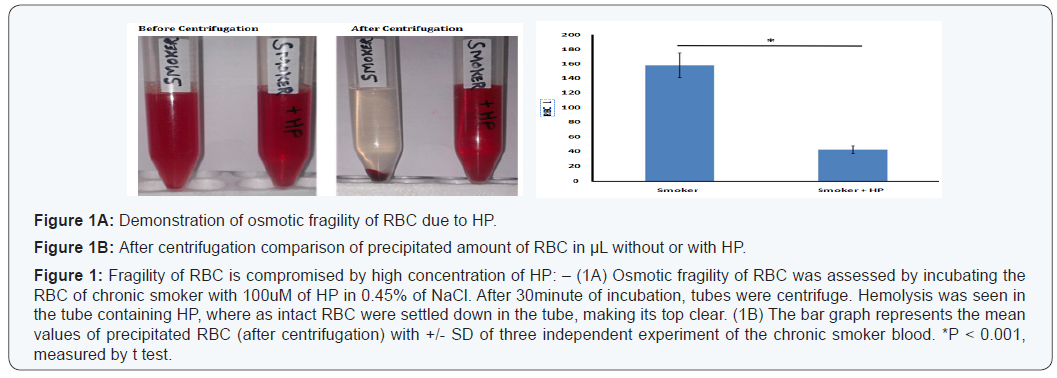
RBC osmotic fragility was determined according to the method previously described. However slight modifications were made to suite the need of experiment. A total of 0.2ml of fresh blood was added to falcon tube containing, 0.45% of 5ml sodium chloride solution. This concentration of sodium chloride has been well documented in research literature at which hemolysis is initiated. After adding the fresh blood, appropriate amount of HP was also added, so that final concentration of HP in the tube was 100μM. It was gently mixed and incubated at room temperature for 30 minutes. Images were taken after gentle inversion of the tubes. After 30 minutes the mixtures were then centrifuged for 2,000 RPM for 5 minutes.
Images were taken after the centrifugation. Supernatant was discarded and the amount of precipitated RBC were measured with micropipette and plotted on graph. The results were expressed as amount of left over RBC after the hemolysis. The data was entered and processed using SPSS 16.0. It was expressed as mean ± SD. For comparison of means of variables of acute and chronic smoker independent t. test is used. For comparison of means of variables of chronic, passive and non smoker ANOVA is applied. P values < 0.05 were regarded as statistically significant.
Results
Total of 190 individual were inducted and grouped in four grouped depending upon the inclusion criteria as discussed in the methodology. In the serum of inducted individual increase concentration of HP is observed in the serum of chronic smoker, when compare with non-smoker and passive smoker (Tables 1 & 2). Two fold increase of HP was present in the sample of acute smoker when compared with chronic smoker (Table 1). No increase of HP was observed in passive smokers when compared with non-smoker.
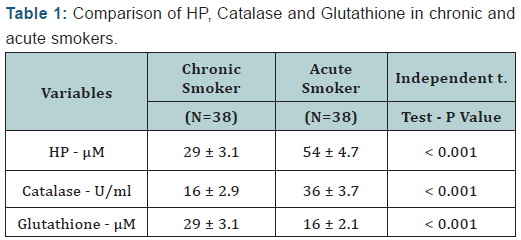
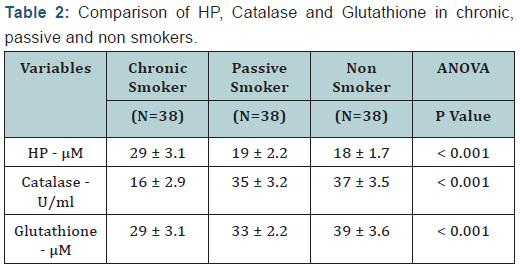
Catalase is antioxidant metalloenzymes, ubiquitous among aerobic organisms, which promote the conversion of HP to water and molecular oxygen. Remarkably decrease concentrations were detected in the chronic smoker individuals of our study, indicating their increase consumption in managing the oxidative stress. No changes in the concentration were noticed in the passive individual and in the samples of acute smoker; indicating that catalase may not be the first line of defense against the rise in HP (Tables 1 & 2).
Due to the rapid nature of the reduction of GSSH relative to its synthesis or secretion, the ratio of GSH to GSSH is a good indicator of oxidative stress within cells. T-GSH or GSSH levels can be determined by HPLC or biochemically in micro plates. Using spectrophotometric assay kit, it was found that there is decrease in level of T-GSH in the serum of acute smoker as compared to chronic smoker (Table 1). Remarkably no changes in the concentration T-GSH level were observed in the chronic and passive smokers when compared with non-smoker (Table 2).
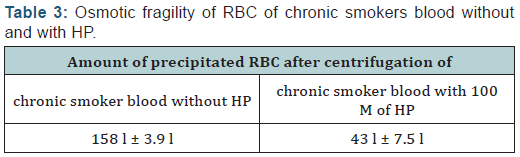
To demonstrate the adverse effect of HP on living human cell; RBCs were selected. RBCs are susceptible to attacks by ROS because of their high polyunsaturated fatty acid content and their abundance of iron-rich hemoglobin. We performed the osmotic fragility test in the presence or absence of HP of chronic smoker’s blood (Figure 1A). Blood of chronic smokers, when incubated with 100 M of HP resulted in hemolysis and very few micro liters of RBC were precipitated after centrifugation in the tube having HP (Figure 1B; Table 3).
Discussion
Numerous pathological conditions have an oxidative stress component. Overproduction of ROS has been implicated in more than sixty different health conditions and to the etiology of degenerative diseases some of which are summarized in (Figure 2). However, reactive oxygen species can be beneficial, as they are used by the immune system as a way to attack and kill pathogens. However, the type of ROS that actually kill bacteria is still debated [13].
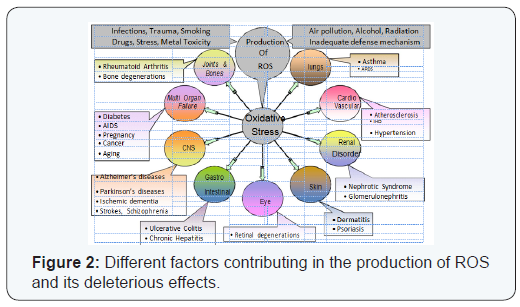
Airway epithelia are able to generate ROS upon their exposure to smoke tar. Following cigarette smoking, alterations in alveolar epithelial cells induce an increase in epithelial permeability, a decrease in surfactant production and inappropriate production of inflammatory cytokines [14]. However, the most deleterious effect of cigarette smoke on alveolar epithelial cells is cell death, i.e., either apoptosis or necrosis depending on the magnitude of cigarette smoke exposure. Hence the exposure to smoke tar result in epithelial damage and alter its permeability, thus allowing the movements of HP from alveoli to the blood stream. Increase concentration of HP has been demonstrated in other conditions such as; in the serum of hypertensive patients of different gender and of different ethnicity, in the freshly voided human urine, expired breath of cigarette smokers and increased exhalation of hydrogen peroxide in healthy subjects following cigarette smoke [4-6].
Similarly an amount is greater in patients with inflammatory lung diseases, patient with asthma [3]. Furthermore perpetual exposure of cigarette smoke would elevate the HP level which can create critical imbalance in oxidative and anti-oxidative status of the body. Hence decreases catalase level in the serum of chronic smoker was observed. Similarly bronchiolar epithelial catalase is diminished in smokers [15]. Significantly lower levels of catalase were reported in plasma of diabetic patients. Furthermore low level of catalase may also promote the likelihood of developing type 2 Diabetes [16]. Hence the capacity of antioxidant defense systems to catch ROS is highly important in protecting the tissues from oxidative damage caused by endogenous or exogenous ROS.
In addition to enzymatic defenses, there are non-enzymatic defenses against oxidative stress in the form of several metabolites which are important scavengers of ROS. GSH is one such reductant, which serves many biological functions including maintenance of membrane integrity and protection against free radicals. Reduced glutathione (GSH) is regenerated from its oxidized form (GSSH) by the action of an NADPH dependent reductase (Reaction 3).
Reaction 3: GSSH + NADPH + H+2 GSH + NADP+
Acutely, initial decrease of T-GSH had earlier been reported in the smoker [17]. However perpetual smoking may deplete the level of T-GSH thus over-riding of the oxidative stress which can prevails to the chronic inflammation in the lower respiratorytract epithelium and contribute to the pathogenesis of obstructive lung diseases [14,17]. Hence continuously decreased serum antioxidant status or continuously increase oxidative status can catastrophically damage to the epithelial lining of lungs and allowing the movements of HP in the blood which can jeopardize the well being of erythrocyte. In other study it was well demonstrated that RBC membrane of rats can’t sustain the oxidative stress of streptozotocin-induced diabetes, however in the same study it was demonstrated that protective agent (oxidant) when administer in adequate dose enables the RBC to sustain the oxidative stress of diabetes [18-20].
Conclusion
Our finding suggest that glutathione and catalase provide overlapping defenses for the detoxification mechanism of HP. Uneven distribution of oxidant enzymes and highly variable metabolic load of various parts of the mitochondrial network varies from cell to cell. It is conceivable that the same mitochondrion (or any part of it) may act alternatively as either a sink or a source of ROS. Various studies have been conducted on vitamin E and large number of positive data is suggestive that this compound has much potential in the managements of oxidative stress.
Hence its availability, accessibility and its consumption should be brought into consideration of all individual. Health practicing individuals should be encouraged of its routine recommendation to their patients and smokers should be encouraged of it routine usage. In summary this study demonstrates the effects of smoking in term of raised HP which can eventually results in oxidative stress. Catalase and glutathione plays essential role in the detoxification mechanism of HP. However their individual roles at the molecular level are yet to be illustrated.
References
- Veal E, Day A (2011) Hydrogen peroxide as a signaling molecule. Antioxid Redox Signal 15(1): 147-151.
- Alvin Eng Kiat Loo, Yee Ting Wong, Rongjian Ho, Martin Wasser, Tiehua Du, et al. (2012) Effects of Hydrogen Peroxide on Wound Healing in Mice in Relation to Oxidative Damage. PLoS ONE 11: e49215.
- Umit M Sahiner, Esra Birben, Serpil Erzurum, Cansin Sackesen, Omer Kalayci (2011) Oxidative Stress in Asthma. World Allergy Organ J 4(10): 151-158.
- Holguin F (2013) Oxidative Stress in Airway Diseases. Ann Am Thorac Soc 10: S150-S157.
- Talhout R, Schulz T, Florek E, van Benthem J, Wester P (2011) Hazardous Compounds in Tobacco Smoke. Int J Environ Res Public Health 8(2): 613-628.
- Rockville (2010) How Tobacco Smoke Causes Disease: The Biology and Behavioral Basis for Smoking-Attributable Disease. U.S. Department Of Health And Human Services.
- The Chemicals in Cigarette Smoke & Their Effects.
- Aydogan U, Durmaz E, Ercan CM, Eken A, Ulutas OK, et al. (2013) Smoking during pregnancy, DNA damage and ROS level. Arh Hig Rada Toksikol 64(1): 35-46.
- Jiayuan Z, Philip KH (2012) Concentration of Reactive Oxygen Species (ROS) in Mainstream and Sidestream Cigarette Smoke. Aerosol Science and Technology 46(2): 191-197.
- Chen ZL, Tao J, Yang J, Yuan ZL, Liu XH, et al. (2011) Vitamin E Modulates Cigarette Smoke Extract-induced Cell Apoptosis in Mouse Embryonic Cells. Int J Biol Sci 7(7): 927-936.
- Widmer CC, Pereira CP, Gehrig P, Vallelian F, Schoedon G, et al. (2010) Hemoglobin can attenuate hydrogen peroxide-Induced oxidative stress by acting as an antioxidative peroxidase. Antioxid Redox Signal 12(2): 185-198.
- Pandey KB, Rizvi SI (2011) Biomarkers of oxidative stress in red blood cells. Biomed Pap Med Fac Univ Palacky Olomouc Czech Repub 155(2): 131-136.
- Mahapatra SK, Das S, Dey SK, Roy S (2008) Smoking induced oxidative stress in serum and neutrophil of the university students. Al Ameen J Med Sci 1: 20-31.
- Kosmider B, Messier EM, Chu HW, Mason RJ (2011) Human Alveolar Epithelial Cell Injury Induced by Cigarette Smoke. PLoS ONE 6(12): e26059
- Betsuyaku T, Fuke S, Inomata T, Kaga K, Morikawa T, et al. (2013) Bronchiolar epithelial catalase is diminished in smokers with mild COPD. Eur Respir J 42(1): 42-53.
- Thomas B, Ramesh A, Suresh S, Prasad BR (2013) A comparative evaluation of antioxidant enzymes and selenium in the serum of periodontitis patients with DM type 2. Contemp clin dent 4(2): 176- 180.
- Gould NS, Min E, Gauthier S, Martin RJ, Day BJ (2011) Lung glutathione adaptive responses to cigarette smoke exposure. Respir Res 12: 133- 142.
- Yousif Y. Bilto, Sanaa Suboh, Talal Aburjai, Shtywy Abdalla (2012) Structure activity relationships regarding the antioxidant effects of the flavonoids on human erythrocytes. Natural Science 4(9): 740-747.
- Jamaludin Mohamed, Saw Wuan Shing, Muhd Hanis Md Idris, Siti Balkis Budin, Satirah Zainalabidin (2013) The protective effect of aqueous extracts of roselle against red blood cell membrane oxidative stress in rats with streptozotocin-induced diabetes. Clinics 68(10): 1358-1363.
- Abbas Meamarbashi, Ali Rajabi, Shor T Communica Tion (2013) Erythrocyte osmotic fragility test revealed protective effects of supplementation with saffron and cinnamon on the Red Blood Cell membrane. Asian J exp biol sci 2: 322-326.

























