




 AJPN Home




Summary
Cantú syndrome, or hypertrichotic osteochondrodysplasic, is a rare genetic disorder characterized by generalized hypertrichosis, macrosomia, cardiomegaly, and distinctive coarse facial features. We report the case of an 8-year-old girl with Cantú syndrome presenting for growth assessment and evaluation of early body hair development. This case highlights the clinical challenges of distinguishing syndromic hypertrichosis from premature pubarche and emphasizes the necessity for multidisciplinary and targeted endocrine monitoring. Introduction and Clinical Features Cantú syndrome is a rare genetic disorder characterized by congenital hypertrichosis, neonatal macrosomia, a distinct osteochondrodysplasic, and cardiomegaly [1-2]. Certain features, such as macrocephaly, coarse facial features, and a broad nasal bridge, can initially suggest a metabolic storage disorder. While approximately half of affected individuals are macrosomic and edematous at birth, they typically develop a fit, muscular appearance with minimal subcutaneous fat during childhood.
Skeletal anomalies frequently include a narrow thorax, broad ribs, coxa valga, osteopenia, and metaphyseal widening of the long bones [3-4]. Cardiac involvement is reported in about 80% of cases and may include patent ductus arteriosus, ventricular hypertrophy, pulmonary hypertension, and pericardial effusions. Over time, the facial phenotype naturally evolves; the face lengthens, the forehead becomes taller, and the supraorbital ridges become more prominent [5,6]. The Clinical Challenge of Hypertrichosis (Hirsutism) A defining and cosmetically challenging hallmark of Cantú syndrome is generalized congenital hypertrichosis. This manifests as thick scalp hair extending onto the forehead, accompanied by a profound, generalized increase in body hair. In clinical practice, this excessive hair growth often mimics severe hirsutism and can be particularly striking in early childhood.
Managing this hypertrichosis presents a significant problem because it is a genetically driven structural anomaly rather than a simple, easily reversible endocrine imbalance. Consequently, standard dermatological or hormonal treatments for hirsutism are generally ineffective. However, long-term follow-up indicates that as the patient ages and their facial structure lengthens, the facial pattern becomes much less striking and naturally less noticeable over time [7,8]. Inheritance Although early reports suggested an autosomal recessive inheritance pattern due to sibling recurrence, subsequent segregation analyses and documented cases of male-to-male and mother-to-daughter transmission firmly established that Cantú syndrome follows an autosomal dominant inheritance pattern [2,4,7].
Keywords: Chronic Kidney Disease; Atrial Septal Defect; Adrenocorticotropic hormone; Sex Hormone; Follicle-Stimulating Hormone; Thyrotropin
Abbreviations: CKD: Chronic Kidney Disease; VSD: Ventricular Septal Defect; PDA: Patent Ductus Arteriosus; ASD: Atrial Septal Defect; SGA: Small for Gestational Age; ACTH: Adrenocorticotropic hormone; SHBG: Sex Hormone-Binding Globulin; DHEA-S: Dehydroepiandrosterone Sulfate; FSH: Follicle-Stimulating Hormone; TSH: Thyrotropin
Molecular Genetics
At the molecular level, Cantú syndrome is primarily caused by heterozygous missense mutations in the ABCC9 gene. Most of these pathogenic variants are shown to arise de novo [1-3].
Case Presentation
A 6-year and 2-month-old girl was initially referred from primary care to the Pediatric Endocrinology department for growth evaluation following a diagnosis of Cantú syndrome.
Family History
· Mother: 38 years old, height 155cm, menarche at 9 years. Diagnosed with Type 2 Diabetes Mellitus, currently managed with Synjardy (empagliflozin and metformin). No history of hypercholesterolemia or hypertension.
· Father: 45 years old, 168cm, normal pubertal development. Medical history includes obesity and a myocardial infarction at 38 years of age.
· Siblings: Five sisters. Four are healthy (ages 23, 20, 13, and 9), with menarche occurring at age 10 for the older three. The 9-year-old sister experienced premature thelarche at age 7, managed with triptorelin (Decapeptyl). Another 18-year-old sister was diagnosed with Immune Thrombocytopenia (ITP) and reached menarche at age 9.
· Target Height: 155 cm (+/- 6 cm).
Birth and Developmental History
The pregnancy was closely monitored. The mother developed gestational diabetes, which was successfully managed with diet. Delivery was a spontaneous, uncomplicated vaginal birth at 36 weeks of gestation.
· Birth weight: 3040 g (+ 0.2 SDS)
· Birth length: 46.5 cm (- 1.5 SDS)
· Head circumference: 34 cm
· Apgar scores: 8/9
The patient was not small for gestational age (SGA). Abundant lanugo was noted at birth, leading to an initial clinical suspicion of Cornelia de Lange syndrome. She was breastfed for four months, achieved normal psychomotor milestones, and is up to date with the official vaccination schedule. She has no known allergies. Medical History A genetic study for Cornelia de Lange syndrome was negative. She was subsequently diagnosed with Cantú syndrome, presenting with the classic phenotype: generalized hypertrichosis, osteochondrodysplasic, cardiomegaly, and facial dysmorphism (macrocephaly, coarse facial features, thick eyebrows, prominent supraciliary arches, broad nasal bridge, anteverted nares, wide mouth with thick lips, long philtrum, and macroglossia).
The patient has a complex cardiovascular history requiring surgical intervention for a patent ductus arteriosus (PDA) and an atrial septal defect (ASD). She also underwent surgery for an iatrogenic aortic arch obstruction and has a small muscular ventricular septal defect (VSD). Secondary to cardiac surgery complications, she developed renal failure and is currently classified with chronic kidney disease (CKD) stage G2 A1. Additional findings include microcytic hypochromic anemia. Prior dermatological evaluation for generalized hypertrichosis concluded that no targeted therapies could be offered at the center to resolve the hair growth.
Current Presentation
Following a loss to follow-up in April 2024, the patient returned to the clinic in June 2026 at the chronological age of 8 years and 4 months. Current medications include Ibuprofen (40 mg/ml, 4.5 ml every 8 hours) and Salbutamol (100 mcg, 4 inhalations every 6 hours).
Physical Examination Revealed
· Weight: 24.1 kg (- 1.2 SDS), Height: 120 cm (- 1.8 SDS)
· Bone Age (Greulich-Pyle): 8 years and 10 months
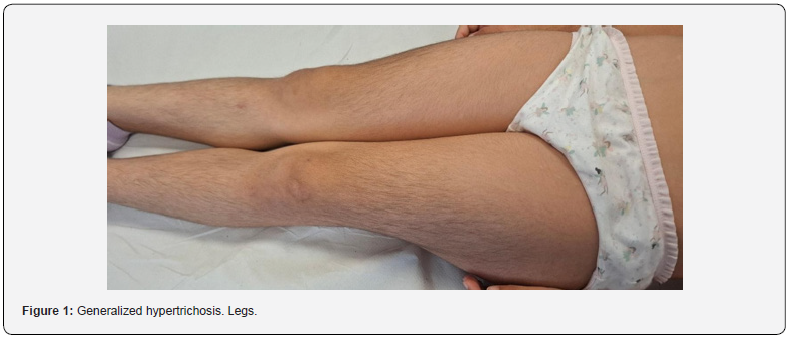
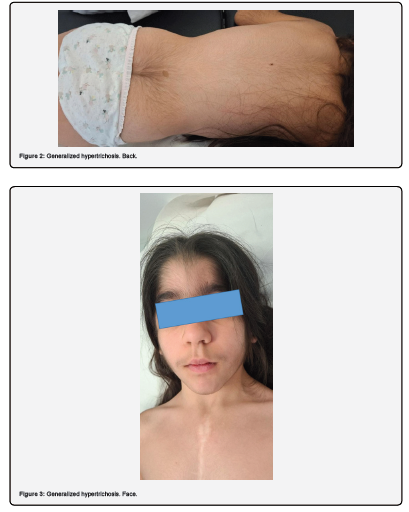
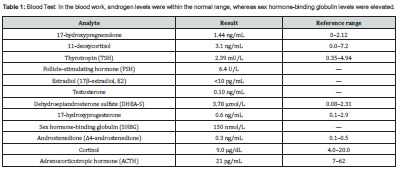
The patient was in good general condition with no exanthems, petechiae, skin lesions, or palpable goiter. Abdominal examination was unremarkable. Pubertal assessment showed tanner stage I for breast development (Thelarche I) and axillary hair (Axillarche I). Pubic hair was staged as Pubarche II-III; however, it was noted that while the hair was slightly darker and thicker than typical pediatric body hair, it closely resembled the generalized hypertrichosis present on the rest of her body. No perianal hair was observed. Clitoral length was measured at 20 mm (Figures 1-3). The patient shows short stature, but not below pathology range yet. Informed consent was requested to obtain medical photography of the patient. To evaluate the clitoromegaly and differentiate isolated syndromic hypertrichosis from potential premature adrenarche or pubarche, baseline androgens have been ordered. The patient will remain under close endocrinological surveillance to monitor growth velocity and pubertal progression (Table 1).
Discussion
Cantú syndrome is an exceptionally rare autosomal dominant genetic disorder, with only a limited number of cases documented in the literature to date. Consequently, clinical experience remains scarce, and evidence-based guidelines for long-term management are largely absent. This lack of extensive epidemiological data poses a significant challenge for clinicians when anticipating the phenotypic evolution and potential complications in affected patients [1-3]. While the cardinal features of Cantú syndrome are traditionally recognized as congenital hypertrichosis, cardiomegaly, and osteochondrodysplasic, emerging evidence suggests that the syndrome can also encompass complex endocrine abnormalities. Recent reports have identified multiple anterior pituitary hormone deficiencies in patients with Cantú syndrome, including compromised linear growth, partial growth hormone deficiency, and adrenal insufficiency.
The pathogenic variants in the ABCC9 and KCNJ8 genes, which cause a gain-of-function in ATP-sensitive potassium ($K_{ATP}$) channels, may directly impact the glucose-sensing neurons within the hypothalamus that regulate hormone secretion. This highlights that growth failure and other endocrine axes can be significantly affected, underscoring the necessity for rigorous and routine endocrinological surveillance in these pediatric patients [2-5]. Despite the critical nature of the cardiovascular and potential pituitary complications, the profound generalized hypertrichosis-often presenting clinically as severe hirsutism-frequently remains the most distressing and psychologically impactful feature for the patients and their families.
As observed in our patients, differentiating this syndromic hypertrichosis from early signs of premature pubarche or hyperandrogenism requires careful clinical evaluation and baseline androgen screening [7]. Managing this excessive hair growth presents a formidable clinical challenge. Because the hypertrichosis in Cantú syndrome is driven by a primary genetic channelopathy affecting the structural phase of hair follicles rather than an underlying androgen excess, standard pharmacological treatments for hirsutism (such as antiandrogens or oral contraceptives) are entirely ineffective. Furthermore, as noted in the dermatological evaluation of our patient, aesthetic and physical therapies are highly limited in their efficacy and availability for young children.
Although there is anecdotal evidence suggesting that the facial hair pattern may become less prominent as the facial structure naturally lengthens with age, the lack of targeted medical therapies for the hypertrichosis leaves a significant gap in improving the daily quality of life for these individuals [6-8]. It is therapeutically challenging to offer an alternative treatment for this patient’s hirsutism, since although the clinical is compatible, these medications are off label in pediatrics and, in this case, there is an associated nephrological condition. In conclusion, Cantú syndrome requires a highly individualized, multidisciplinary approach. Clinicians must remain vigilant for evolving endocrine dysfunctions, particularly regarding growth and pubertal development, while also acknowledging and supporting the profound psychosocial burden caused by the currently untreatable hypertrichosis.
References
- Cantu JM, Garcia-Cruz D, Sanchez-Corona J, Hernandez A, Nazara Z (1982) A distinct osteochondrodysplasia with hypertrichosis-individualization of a probable autosomal recessive entity. Hum Genet 60(1): 36-41.
- Garcia-Cruz D, Sanchez-Corona J, Nazara Z, Garcia-Cruz MO, Figuera LE, et al. (1997) Congenital hypertrichosis, osteochondrodysplasia, and cardiomegaly: further delineation of a new genetic syndrome. Am J Med Genet 69: 138-151.
- Robertson SP, Kirk E, Bernier F, Brereton J, Turner A, et al. (1999) Congenital hypertrichosis, osteochondrodysplasia, and cardiomegaly: Cantu syndrome. Am J Med Genet 85(4): 395-402.
- Scurr I, Wilson L, Lees M, Robertson S, Kirk E, et al. (2011) Cantu syndrome: report of nine new cases and expansion of the phenotype. Am J Med Genet 155A (3): 508-518.
- Lazalde B, Sanchez-Urbina R, Nuno-Arana I, Bitar WE, Ramirez-Duenas ML (2000) Autosomal dominant inheritance in Cantu syndrome (congenital hypertrichosis, osteochondrodysplasia, and cardiomegaly). Am J Med Genet 94(5): 421-427.
- Grange DK, Lorch SM, Cole PL, Singh GK (2006) Cantu syndrome in a woman and her two daughters: further confirmation of autosomal dominant inheritance and review of the cardiac manifestation. Am J Med Genet 140(15): 1673-1680.
- Van Bon BWM, Gilissen C, Grange DK, Hennekam RCM, Kayserili H, et al. (2012) Cantu syndrome is caused by mutations in ABCC9. Am J Hum Genet 90(6): 1094-1101.
- Harakalova M, van Harssel JJT, Terhal PA, van Lieshout S, Duran K, et al. (2012) Dominant missense mutations in ABCC9 cause Cantu syndrome. Nature Genet 44: 793-796.