




 AJPN Home



Abstract
Objective: Medical language interpreters (MLI) are crucial for patients with limited English proficiency in navigating palliative care concepts, yet there is limited data on how to ensure clear interpretation of these concepts. Our aim was to assess Spanish interpreters’ knowledge of pediatric palliative care (PCC) concepts, comfort interpreting difficult conversations and insight on improving multidisciplinary collaboration.
Participants and Methods: An anonymized survey was electronically disseminated to Spanish MLIs employed at a tertiary pediatric hospital located in the Southwest United States. Likert scale questions were analyzed using descriptive statistics, and open responses were coded using inductive content analysis.
Results: 17 participants completed the survey yielding a 61% response rate. 88% felt prepared to interpret end-of-life conversations despite 41% denying specific training, and most (94%) felt pediatric palliative care training would be beneficial. 70% felt Spanish possessed sufficient vocabulary for end-of-life discussions, though 24% expressed shorter phrases would ensure more accurate interpretation. Many (88%) viewed their role was to act as both a conduit and cultural broker. Almost all (94%) indicated they would benefit from a pre-brief session, while 76% agreed that a debrief would be helpful, especially as 64% reported emotional distress after interpreting a difficult conversation.
Conclusion: This study highlights the need for increased education, collaboration and support for MLIs helping to deliver pediatric palliative care to patients and their families. Further research to explore the patient/family experience with medical language interpreters during difficult conversations would be vital to improving PPC delivery.
Keywords: Medical Language Interpreters; Pediatric Palliative Care; Competent Care; Communication; Statistics
Abbreviations: MLI: Medical Language Interpreters; PCC: Pediatric Palliative Care
Introduction
Pediatric palliative care (PPC) teams support patients and families throughout the course of a serious illness, which can pose high levels of uncertainty and decisions that are often difficult and complex. Clear, compassionate communication is essential and enables families to understand care plans and expectations, participate in informed decision making, and express their questions, concerns, and values [1]. When families and medical providers speak different languages, medical language interpreters (MLI) become an important part of the medical care team. MLIs are trained professionals who facilitate communication between patients, their families and medical personnel by providing real-time interpretation of spoken conversations – in person, by phone or through video, conveying not only the words but also bridging cultural differences, navigating sensitive topics, and ensuring culturally competent care [2].
Studies have shown that when interpreters were not used with patients and families with limited English proficiency there was increased confusion about diagnosis and prognosis, unclear goals of care, and worse symptom management at the end of life, including pain and anxiety [3]. Many studies emphasize the importance of language interpreters in medical settings, but fewer studies have been conducted in the pediatric care setting and specifically, from the perspective of the MLI. Our study aims to explore how language interpreters can better understand and interpret PPC concepts and how to improve collaboration to provide more culturally competent care.
Methods
This study was completed at a tertiary care children’s hospital in Southwest USA. Approval was granted by the hospital’s Institutional Review Board.
Participants and Data Collection
An informational email was disseminated to the Languages Services Department listserv requesting voluntary participation in this study. Surveys were administered anonymously through Microsoft Forms and contained embedded consent language. Surveys were distributed in March 2024 and were active for approximately 1 month. A reminder email was sent approximately 2 weeks prior to closure of the survey.
Survey Development
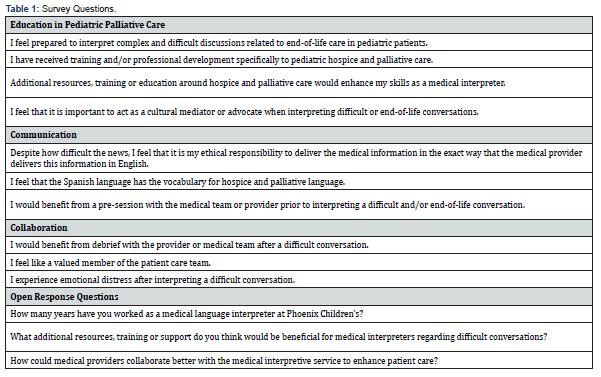
Survey items were developed in collaboration with the language service leadership after reviewing the literature to explore understanding of pediatric palliative care concepts, comfort in interpreting difficult conversations and gain insight into MLIs’ experience and needs for improving multidisciplinary team collaboration. The survey included 5-item Likert scale questions and optional open response questions (Table 1).
Data Analysis
Only fully completed surveys were included in the analysis. Likert scale questions were condensed into three categories (positive = “strongly agree/agree”, “neutral” and negative = “disagree/strongly disagree”) and were analyzed using descriptive statistics based on the themes: “Education in Pediatric Palliative Care,” “Communication,” and “Collaboration”. The open response questions were coded using inductive content analysis methodology.
Results
Participant Characteristics
There was a 61% response rate (n = 17). Median experience as a Spanish MLI was 5 years (range: 8 months - 20 years).
Education in Pediatric Palliative Care
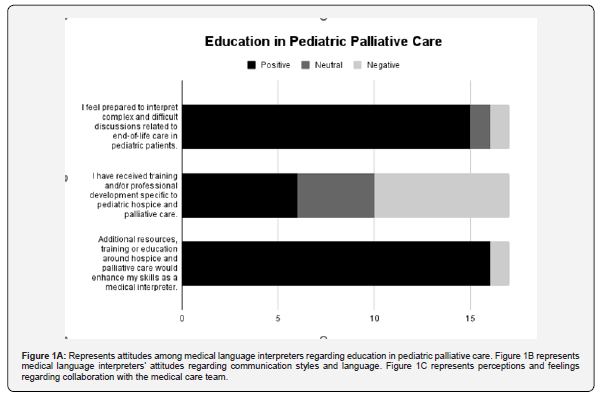
Almost 90% (n= 15) of respondents felt prepared to interpret end-of-life conversations despite 65% (n = 11) indicating they had not received or were neutral about having received specific training and most (94%, n = 16) felt that additional training would be beneficial [insert Figure 1A]. When exploring additional resources or support for interpreting difficult conversations, all survey participants provided free-text responses (n=17). 57% indicated additional educational sessions on hospice and palliative care and access to resources would be beneficial and 42% responded that a pre-session would be valuable. One participant felt they would benefit from, “Breathing techniques for during the encounter, coping skills for post-difficult encounters, proper palliative care, hospice and end-of life terminology, understanding of the hospice system, services and resources it offers.”- Participant 8 and another noting, “A social work or case management class, to better understand the nature of [hospice and palliative care].”- Participant 16.
Communication
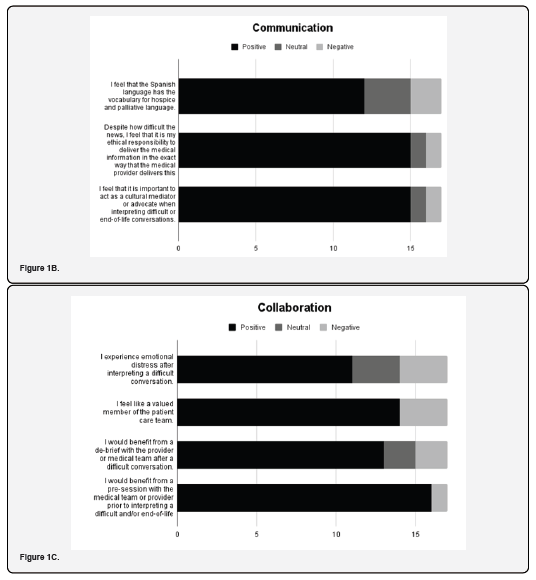
Most respondents (70%, n= 12) felt the Spanish language contained vocabulary necessary for end-of-life conversations, and 88% (n= 15) felt that it was their responsibility to act both as a conduit and cultural broker between provider and patient/family [insert Figure 1B].
Collaboration
Almost all respondents indicated they would benefit from a pre-session (94%, n= 16), while 76% (n = 13) agreed that a debrief would be helpful, especially as nearly two-thirds (64%, n = 11) reported emotional distress after interpreting a difficult conversation. A minority of participants noted feeling undervalued as a member of the team (18%, n=3) [insert Figure 1C]. When asked about how to improve collaboration, 82% (n=14) offered free text responses with most (58%, n=8/14) reinforcing that a session prior to an encounter would be useful and 24% (n=6/14) noting the use of shorter phrases would allow for more accurate interpretation. As expressed by one participant “It is ideal when the provider offers information to the interpreter prior to the encounter. If I, as the interpreter, have prior knowledge, I can better prepare myself for what is to come.” - Participant 2.
Discussion
This Southwestern metropolitan city boasts a diverse population and based on 2019 US census data, of the 8.6% of people who speak a language other than English, 76.8% indicate Spanish as their first language and indicate speaking English less than “very well” . It is imperative that patients and families who do not identify English as their first language have access to trained interpreters to receive equitable care. MLIs are critical in delivering culturally competent care, particularly within adult [4-8] and pediatric [9-11] palliative settings. This study provides needed insight into the role of medical language interpreters at a busy, tertiary pediatric care center in a diverse metropolis. While most surveyed Spanish-language interpreters felt comfortable with difficult conversations despite limited specialized training in hospice and palliative care, they also acknowledged the benefit of further education in these areas noting that communication workshops, informational sessions or online resources could be useful adjuncts to their professional development.
This finding aligns with existing literature identifying language interpreters’ need for palliative care and difficult conversation training [1,7]. Future quality improvement work could determine effective interventions for specialized training for interpreters in palliative care concepts. Almost all participants indicated that they would benefit from pre-session encounters with medical providers, echoing recommendations from other publications [6,12]. However, in practice, and as seen in our study, this presents itself as an area for improvement. We hypothesize that barriers to pre-session encounters include time constraints, limited access to in-person interpreters, or lack of medical provider awareness. Further research should investigate ways to improve systematic barriers to pre-sessions and debriefing, especially given that 18% of respondents felt undervalued. Notably, an equal percentage of respondents felt responsible for acting as both cultural brokers and direct conduits of information. This fluid navigation of the role of clarifier and patient advocate has been described in the literature [12].
Pre-sessions could allow interpreters to share valuable cultural insights with medical providers, although it would be prudent to avoid broad generalizations. The potentially underutilized bidirectional relationship between medical language interpreters and medical providers warrants further exploration. The highly diverse study location translates to the frequent utilization of medical interpreters at this large children’s hospital, making it a prime setting for this study. Another strength of this study was the addition of qualitative exploration of actionable feedback from participants on effective ways to increase collaboration and improved care for patients and families with limited English proficiency. There are limitations to this study including a small sample size with a low survey response rate and was completed only by Spanish language interpreters which may limit the study’s generalizability. In addition, the survey was not conducted due to the known small participant sample size.
Conclusion
This study further emphasizes the critical role of interpreters in facilitating difficult discussions for patients and families who do not speak English as their first language and demonstrates the need for increased PPC education and collaborative efforts between MLIs and medical providers. In this study, we found that while Spanish medical interpreters largely felt prepared for end-of-life conversations, they desired more training in PPC communication. Participants emphasized the importance of both conduct and cultural broker roles, strongly supported pre-session encounters, and suggested providers use shorter phrases for improved translational accuracy. Future research should examine the experiences of patients and families who utilize medical interpreters in English-speaking hospital systems, as well as exploring how different languages and cultures translate and understand PPC and end-of-life concepts.
References
- Brown J, Hu-Collins P (2025) Communication training for effective Goals of Patient Care conversations in acute care: An integrative review of the literature. Palliat Support Care 23: e81.
- AIA Translations (2024) The vital role of medical interpreters in enhancing healthcare services. AIA Translations Blog.
- Silva MD, Genoff M, Zaballa A, Sarah Jewell, Stacy Stabler, et al. (2016) Interpreting at the end of life: a systematic review of the impact of interpreters on the delivery of palliative care services to cancer patients with limited English proficiency. J Pain Symptom Manage 51(3): 569-580.
- Latif Z, Kontrimas J, Goldhirsch J, J Abrahm, HJ Warraich (2022) Top ten tips palliative care clinicians should know about working with medical interpreters. J Palliat Med 25(9): 1426-1430.
- Latif Z, Makuvire T, Feder SL, J Abrahm, PQ Pinzon, et al. (2023) Experiences of medical interpreters during palliative care encounters with limited English proficiency patients: a qualitative study. J Palliat Med 26(6): 784-789.
- Norris WM, Wenrich MD, Nielsen EL, PD Treece, JC Jackson, et al. (2005) Communication about end-of-life care between language-discordant patients and clinicians: insights from medical interpreters. J Palliat Med 8(5): 1016-1024.
- Schenker Y, Pérez-Stable EJ, Nickleach D, LS Karliner (2011) Patterns of interpreter use for hospitalized patients with limited English proficiency. J Gen Intern Med 26(7): 712-717.
- Thornton JD, Pham K, Engelberg RA, JC Jackson, JR Curtis (2009) Families with limited English proficiency receive less information and support in interpreted intensive care unit family conferences. Crit Care Med 37(1): 89-95.
- Olen A, Lim PS, Escandell S, KA Balistreri, JB Tager, WH Davies, et al. (2024) Distressing discussions in pediatric interpreted medical encounters: a qualitative study of medical interpreter perspectives on clinician communication practices. J Pediatr Health Care 38(2): 127-139.
- Weaver MS, Roeth A, Navaneethan H, Valerie K Shostrom, MC-Nourse (2022) Translating pediatric hospital interpreters' feedback from difficult conversations into improved communication. J Palliat Care 37(2): 159-163.
- S. Census Bureau (2025) Selected Social Characteristics in the United States. American Community Survey, ACS 5-Year Estimates Data Profiles, Table DP02. US Census Bureau website.
- Hordyk SR, Macdonald ME, Brassard P (2017) Inuit interpreters engaged in end-of-life care in Nunavik, Northern Quebec. Int J Circumpolar Health 76(1): 1291868.

























