




 AJPN Home



Abstract
Introduction: Cerebral cavernous malformations are low-flow vascular lesions that usually present with characteristic imaging findings. In certain situations, however, atypical radiological features may be observed, leading to diagnostic challenges, particularly in emergency settings.
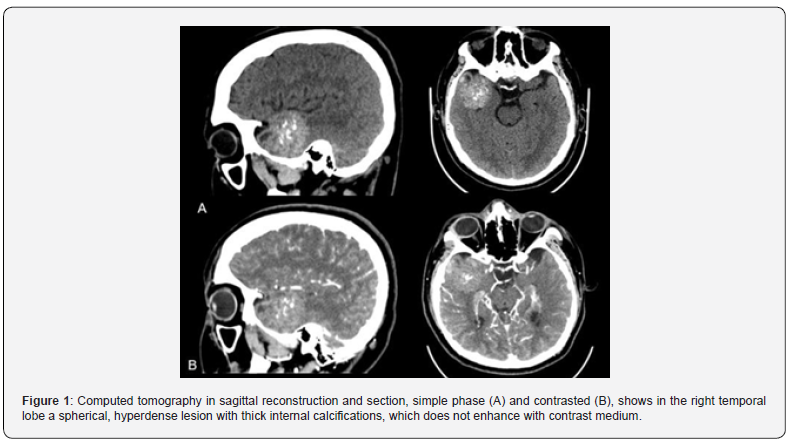
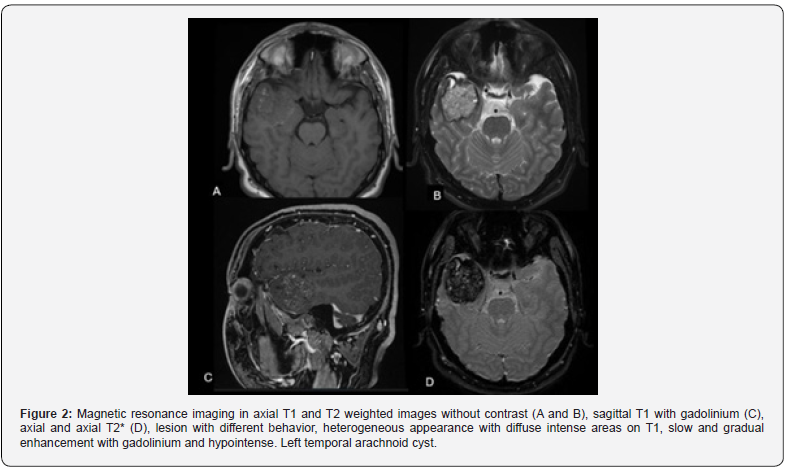
Case presentation: An 18-year-old male patient with a history of traumatic brain injury, in whom an intra- axial lesion located in the right temporal lobe was incidentally identified during the initial imaging evaluation. Computed tomography demonstrated a heterogeneous, predominantly hyperdense lesion with coarse calcifications, marked perilesional edema, and mass effect, resulting in initial diagnostic confusion. Subsequent magnetic resonance imaging allowed definitive characterization, demonstrating blood products at different stages and a peripheral hemosiderin rim, consistent with a cerebral cavernous malformation with atypical radiological behavior.
Conclusion: Cerebral cavernous malformations may exhibit atypical imaging features that broaden the differential diagnosis, particularly on computed tomography in emergency scenarios. Awareness of these presentations and appropriate use of magnetic resonance imaging are essential to avoid misdiagnosis and inappropriate management.
Keywords:Cavernous Malformations; Brain Hemorrhage; Magnetic Resonance Imaging; Diagnostic Imaging; Temporal Lobe
Introduction
Cerebral cavernous malformations, also known as cerebral cavernomas, constitute a group of low-flow vascular malformations characterized by clusters of dilated vascular channels lined by endothelium, lacking smooth muscle and without interposed neural tissue between their walls. Salzman & Jhaveri [1], in the fifth edition of Diagnostic Imaging: Brain, describe these lesions as dynamic entities, susceptible to structural changes secondary to repeated hemorrhagic episodes, which explains their morphological heterogeneity and their wide spectrum of imaging presentations [1]. From an epidemiological perspective, several authors have indicated that cerebral cavernous malformations represent one of the most frequent intracranial vascular malformations, with an estimated prevalence between 0.4 and 0.8% in the general population. Flemming et al. [2], in a contemporary cohort, report that a considerable number of these lesions are identified incidentally between the fifth and sixth decades of life; Particularly with the increasing use of brain magnetic resonance imaging, which has significantly altered our understanding of their natural history [2]. Similarly, Akers et al. [3] note that most cavernomas have a benign clinical course, although a subgroup may be associated with relevant neurological events, such as onset with epileptic seizures or intracerebral hemorrhage [3]. Regarding their anatomical distribution, the literature agrees that the supratentorial location is the most frequent, followed by the infratentorial region and, to a lesser extent, the brainstem and spinal cord. Sandmann et al. [4] describe that the lesion’s location directly influences the clinical presentation, the risk of bleeding, and the functional prognosis, which underscores the importance of accurate radiological characterization [4].
From a genetic standpoint, cerebral cavernous malformations can occur sporadically or in families. Akers et al. [3] and Rodemerk et al [5] describe those hereditary forms are mainly associated with mutations in the CCM1 (KRIT1), CCM2, and CCM3 (PDCD10) genes, which are transmitted in an autosomal dominant pattern and are characterized by a greater tendency toward multiple lesions and a more complex clinical course [3,5]. These findings have allowed for a better understanding of the pathophysiological mechanisms involved, including inflammatory processes and alterations in the stability of the blood-brain barrier. The clinical presentation of cerebral cavernomas is heterogeneous. Morrison et al. [6] note that the most frequent manifestations include epileptic seizures, focal neurological deficits, and headache, while intracerebral hemorrhage represents a less common but potentially serious complication [6]. In contrast, a significant proportion of patients remain asymptomatic for long periods, reinforcing the role of imaging as a fundamental tool for their detection and monitoring.
In the field of radiology, magnetic resonance imaging (MRI) is considered the method of choice for the diagnosis of cerebral cavernous malformations. Arkoudis et al. [7] describe that susceptibility- sensitive MRI techniques, such as GRE and SWI, allow for the highly sensitive identification of the blood degradation products characteristic of these lesions, in addition to facilitating the detection of associated developmental venous anomalies, providing a significant diagnostic advantage over other imaging modalities [7]. Similarly, Cogswell et al. [8] highlight the value of advanced techniques, including high-field magnetic resonance imaging, for detecting small lesions and providing detailed characterization of the surrounding parenchyma [8,9].
However, recent literature has shown that not all cerebral cavernous malformations present with classic radiological features. Demir et al. [10] and Xiao et al. [11] describe that certain variants, such as giant cavernomas, lesions with a cystic pattern, deep locations, or those associated with acute hemorrhage, can mimic other intracranial entities, including intra-axial tumors, arteriovenous malformations, or spontaneous hematomas [10,11]. These atypical presentations pose a significant diagnostic challenge, particularly in the context of daily radiological practice. In this context, Arkoudis et al. [12] emphasize the importance of identifying the association between cerebral cavernomas and developmental venous anomalies, given that their accurate recognition has diagnostic, therapeutic, and prognostic implications [12]. Similarly, Rauschenbach et al. [13] point out that the correct selection of magnetic resonance imaging sequences can optimize the detection of these associations without the need for routine intravenous contrast [13]. Finally, recent studies have explored the use of emerging tools, such as quantitative image analysis and artificial intelligence-based algorithms, to improve the differentiation between cerebral cavernomas and other causes of intracerebral hemorrhage. Chen et al. [14] and Kim et al. [15] describe promising results in this area, particularly in cases with atypical radiological presentations, reinforcing the need for a comprehensive and contextualized radiological interpretation [14,15]. The current evidence shows that, while cerebral cavernous malformations often present with characteristic radiological findings, there are variants that can lead to diagnostic confusion. In this context, the correct interpretation of imaging studies is essential, and case reports continue to play a relevant role in expanding the known spectrum of presentation and strengthening the radiologist’s diagnostic judgment [16-22].
Clinical case presentation
An 18-year-old male with mild traumatic brain injury, neurologically intact upon arrival and with no significant medical history, presented an incidental finding during initial imaging studies of an intra-axial lesion located in the right temporal lobe, with atypical radiological characteristics, including heterogeneity, coarse calcifications, and perilesional edema (Figure 1). In the initial clinical context, these findings generated diagnostic confusion, raising the need to establish a precise differential diagnosis from other intra-axial entities, such as vascular or tumorous lesions, so brain magnetic resonance imaging was performed (Figure 2).
Discussion
The atypical radiological presentation of the cerebral cavernoma in this case poses a diagnostic challenge, particularly in emergency settings, where incorrect interpretation can lead to inappropriate therapeutic decisions. Therefore, the need arises to describe and analyze the imaging characteristics that allowed differentiation of this lesion from other intracranial pathologies, contributing to a more accurate diagnostic approach. Cerebral cavernous malformations have been widely described as low-flow vascular lesions with relatively well-defined radiological characteristics, particularly in magnetic resonance imaging studies. However, contemporary literature recognizes that their spectrum of presentation is considerably broader, and that certain variants can lose their classic appearance, generating significant diagnostic challenges in daily clinical practice, especially in emergency settings [10,11]. Several authors have indicated that factors such as lesion size, internal heterogeneity, and the presence of acute or subacute hemorrhagic changes can significantly modify the radiological appearance of cerebral cavernomas, particularly on computed tomography. In this context, large cavernomas, including so-called giant cavernomas, can mimic intra-axial neoplastic lesions or primary intraparenchymal hemorrhages, due to their hyperdensity, mass effect and associated perilesional edema [18,19].
In the case presented, the atypical radiological features are explained by the simultaneous convergence of multiple factors previously described in the literature: supratentorial location in the temporal lobe, large size, intralesional heterogeneity, presence of coarse calcifications, significant perilesional edema, and incidental finding in the context of head trauma. This combination led to initial diagnostic confusion with intraparenchymal hemorrhage, a situation previously described by Demir et al. [10] and Xiao et al. [11] who emphasize that simple computed tomography may be insufficient to differentiate these entities in acute phases [10,11]. Magnetic resonance imaging played a determining role in the definitive characterization of the lesion. Magnetic susceptibility sequences allowed the identification of blood degradation products and the characteristic peripheral hemosiderin rim, findings considered fundamental for the diagnosis of cerebral cavernomas, even in atypical presentations [7,12,13].
These elements are consistent with those described by Arkoudis et al. [12] Rauschenbach et al. [13] emphasize that the appropriate selection of sequences can prevent diagnostic errors and inappropriate therapeutic approaches [12,13]. Likewise, recent studies have explored persistent diagnostic limitations even with the use of advanced image analysis tools and artificial intelligence- based algorithms, particularly in differentiating between primary intraparenchymal hemorrhage and cavernomas with recent bleeding. Chen et al. [14] and Kim et al. [15] point out that, despite technological advances, comprehensive and contextualized radiological interpretation remains essential for achieving a correct diagnosis [14,15].
The relevance of this case lies not in an isolated finding, but in the simultaneous coexistence of multiple atypical radiological features that, together, led to a clinically plausible diagnostic confusion. This scenario reinforces the value of case reports as a tool to broaden the known spectrum of presentation of cerebral cavernous malformations and strengthen the radiologist’s diagnostic judgment, particularly in young patients and in complex clinical contexts [16-22]. Based on the above, we present the case of a young, previously healthy patient in whom the finding of an intra-axial lesion with atypical characteristics in initial imaging studies represented a significant diagnostic challenge from a radiological point of view, prompting the performance of complementary studies for its proper characterization.
Conclusion
Recognizing the atypical radiological features of cerebral cavernomas is essential to avoid misdiagnoses and inappropriate therapeutic decisions, particularly when their presentation deviates from the classic pattern and mimics other intracranial entities. This case highlights the importance of careful and contextualized interpretation of imaging studies, as well as the appropriate use of magnetic resonance imaging, to achieve an accurate diagnostic approach in complex and urgent clinical scenarios.
Acknowledgments
The authors thank the Radiology and Imaging Service of the ISSSTE Susulá Clinic Hospital, as well as the Faculty of Medicine of the Autonomous University of Yucatán (UADY), for the academic and institutional support provided for this study.
References
- Salzman KL, Jhaveri MD (2025) Cerebral cavernous malformations. In: Osborn AG, Salzman KL, Jhaveri MD, editors. Diagnostic Imaging: Brain 5th Philadelphia: Elsevier pp. 1150-1164.
- Flemming KD, Brown RD, Lanzino G (2024) Clinical course of cerebral cavernous malformations: a contemporary population-based study. Lancet Neurol 23(2): 145-154.
- Akers A, Al-Shahi Salman R, Awad IA (2026) Cerebral cavernous malformations: current concepts and future directions. Lancet Neurol 25(1): 65-78.
- Sandmann M, Boström A, Förster MT (2025) Location-dependent clinical behavior of cerebral cavernous malformations. Neurosurg Rev 48(1): 102.
- Rodemerk U, Rath M, Haffner C (2025) Genetic mechanisms and clinical implications of familial cerebral cavernous malformations. Brain Pathol 35(2): e13112.
- Morrison L, Flemming KD, Jeon JP (2024) Symptomatic presentation and hemorrhage risk in cerebral cavernous malformations. Stroke 55(3): 812-820.
- Arkoudis NA, Witiw CD, terBrugge KG (2024) Imaging strategies for cerebral cavernous malformations: focus on susceptibility-weighted imaging. Clin Neuroradiol 34(4): 765-775.
- Cogswell PM, Van Gompel JJ, Lanzino G (2023) High-field MRI in the detection of cerebral cavernous malformations. AJNR Am J Neuroradiol 44(9): 1032-1039.
- Cogswell PM, Flemming KD, Lanzino G (2024) Advances in MRI techniques for cavernous malformations. Neuroimaging Clin N Am 34(1): 67-82.
- Demir MK, Yilmaz A, Aydin K (2024) Atypical imaging features of hemorrhagic cerebral cavernous malformations. Clin Radiol 79(6): e401-e408.
- Xiao Z, Li Y, Wang Y (2024) Diagnostic pitfalls of acute hemorrhagic cavernous malformations on computed tomography. Neuroradiology 66(5): 531-540.
- Arkoudis NA, Pereira VM, Terbrugge KG (2025) Developmental venous anomalies associated with cavernous malformations: imaging and clinical relevance. Radiology 304(2): 389-399.
- Rauschenbach L, Reith W, Yilmaz U (2025) MRI protocols for cavernous malformations and associated venous anomalies. Clin Neuroradiol 35(1): 15-25.
- Chen Y, Zhang J, Liu X (2024) Artificial intelligence-assisted differentiation of intracerebral hemorrhage and cavernous malformations. Eur Radiol 34(7): 4581-4590.
- Kim HJ, Park JE, Kim HS (2024) Imaging-based machine learning for differential diagnosis of hemorrhagic brain lesions. Neuroradiology 66(8): 813-823.
- Suyasha R, Saujanya R, Pranaya S (2021) Cavernoma presenting with atypical clinico-radiological features: a case report. Interdiscip Neurosurg 27: 101451.
- Ramírez CJS, Ramírez ZES, Toro MAA (2022) Case series of giant cavernomas: clinical presentation and management recommendations. Interdiscip Neurosurg 29: 101548.
- Ali H, Zaki S, Bari E, Khowaja S (2024) Cavernoma in a young adult: a case report. Egypt J Neurosurg 39(1): 1-6.
- Santoro JD, Lee S, Griffiths PD (2023) Intracerebral hemorrhage due to cavernous malformations: outcomes and predictors. Stroke 54(9): 2710-2718.
- Velásquez-Palacios C, Treto-Velázquez E, Chávez-Luevanos BE (2023) Malformación cavernomatosa cerebral múltiple en paciente pediátrico con epilepsia. Zenodo [Internet].
- Izi Z, El Haddad S, Allali N, Chat L (2023) Spinal cord cavernous malformation: a case report. Glob Pediatr Health 10: 2333794-231184317.
- Akers A, Flemming KD, Al-Shahi Salman R (2025) Role of case reports in expanding the phenotypic spectrum of cerebral cavernous malformations. Neurosurg Focus 58(4): E12.

























